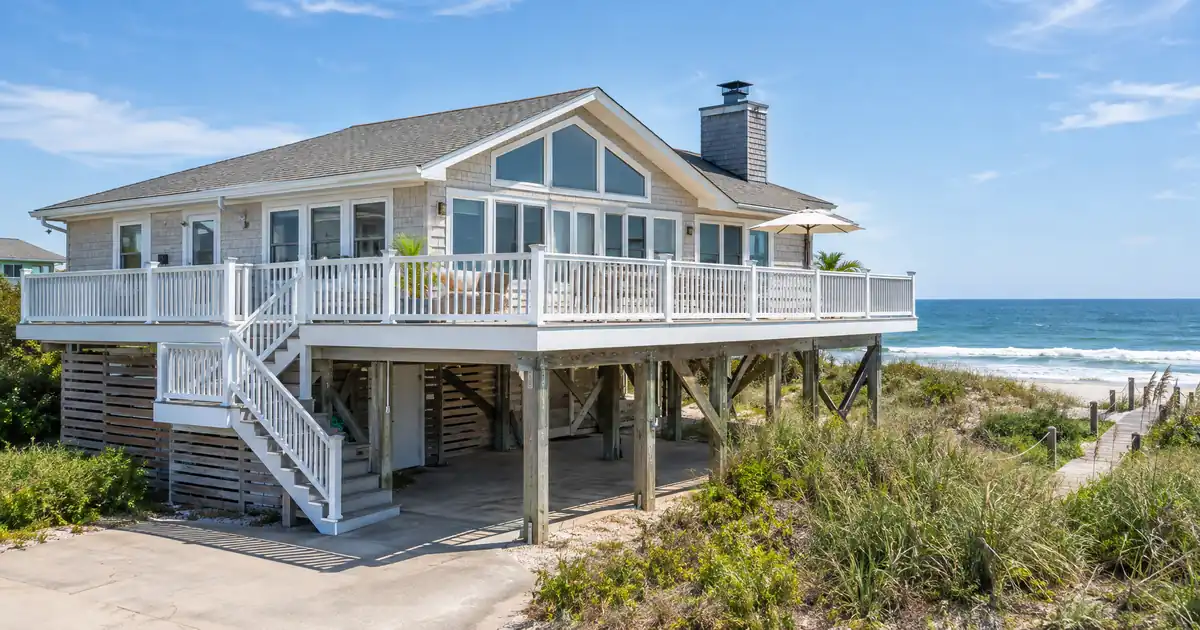
Business-purpose Loan On A Vacation Rental Property — The Quick Read: A business-purpose loan on a vacation rental property is financing tied to the property’s rental income, not the borrower’s paycheck. Federal rules automatically treat a loan on a non-owner-occupied rental as business purpose, which is why lenders can qualify it on projected rent instead of traditional personal-income documentation. It’s the legal foundation behind most DSCR financing on short-term rentals. If you never plan to live in the place, this classification almost certainly already applies to your deal.
Investors looking into vacation rental financing usually hit a wall fast. Their personal income documents don’t reflect what the property actually earns. And a regular mortgage officer often doesn’t know what to do with an Airbnb listing. Business-purpose lending exists to solve exactly that problem.
Short-Term Rental Calculator
Run the STR numbers in your market
Rate source: Freddie Mac 30-yr average via FRED® — Federal Reserve Bank of St. Louis · effective Sep 17, 2026
Prefilled with local estimates — enter your nightly rate, occupancy, taxes, and insurance for a more accurate picture.
Short-term rental income is documented with a 12-month history or a market data report. Program parameters update from Lendmire’s centralized guideline source.
As of Sep 17, 2026 · General Freddie Mac market benchmark, not a Lendmire loan offer. Nightly rate, occupancy, taxes, and insurance are editable estimates. Qualifying income for short-term rentals varies by program — some use appraisal market rent, others use documented STR history or projections — and is confirmed in underwriting. Not a Loan Estimate, approval, or commitment to lend. Program availability and eligibility are subject to lender guidelines, credit approval, property review, and underwriting.
What Does “Business Purpose” Actually Mean?
A loan counts as business purpose when the money is used for a business, commercial, or investment reason — not for personal, family, or household use. According to the federal consumer-finance regulator’s truth-in-lending rulebook, a loan to buy, improve, or maintain a rental property is treated as business purpose. This is a classification test, not just a marketing label.
The key trigger is occupancy. A vacation rental the owner never personally occupies clears that test without any gray area, according to legal trade press covering the federal truth-in-lending rulebook’s business-purpose rule. The commonly cited line is personal use of 14 days or fewer per year — cross that threshold with regular personal stays, and the loan may fall into a gray zone that needs a closer look.
This classification is why DSCR lending works the way it does. Because the loan is business purpose, the property’s rental income — not the borrower’s personal income — carries the qualification. Investors who want the full mechanics of how that income gets measured against the payment can check Lendmire’s complete DSCR loans guide.
Key Terms Defined
Business-purpose loan: financing extended for an investment or commercial reason, such as buying a rental, rather than for personal use — the classification that removes certain consumer-mortgage rules.
DSCR (debt-service coverage ratio): the property’s monthly rental income divided by its full monthly payment — taxes, insurance, and any HOA dues included. A DSCR of 1.00 means the rent exactly covers the payment.
Non-owner-occupied: a property where the borrower does not live, personally, for more than a small slice of the year — the trigger that makes a rental automatically business purpose.
Interest-only period: a stretch of the loan term where the payment covers interest only, no principal — lowers the monthly obligation and can help a marginal DSCR clear the bar.
No-ratio loan: a program where the lender doesn’t lean on a minimum DSCR at all, evaluated instead on the deal’s other strengths — available through select programs, not a universal option. Terms vary by lender guidelines, property type, leverage, credit profile, and full file review.
Why Traditional Lenders Struggle With Vacation Rentals
Regular mortgage underwriting is built around steady, documented personal income — pay stubs, W-2s, two years of traditional personal-income documentation. Vacation rental income doesn’t look like that. It’s seasonal, it swings with occupancy, and a lot of it shows up on a booking platform’s dashboard rather than a tax form.
Big banks and large retail lenders generally aren’t set up to evaluate that kind of income stream, and many won’t try. That’s less a policy failure and more a structural mismatch — their systems are built for W-2 borrowers buying a primary home, not investors buying a rental that earns nightly.
Business-purpose DSCR lending sidesteps the mismatch entirely by qualifying the loan on the property, not the person.
How Lenders Actually Verify Rental Income
Appraisers use two standard forms to establish market rent on an investment property: the Fannie Mae Form 1007 single-family comparable rent schedule, and its 2-4 unit counterpart, Form 1025. Both forms establish long-term rental value — not short-term rental income.
That gap matters. Form 1007 values the real estate, not the business running inside it. Appraisers aren’t scoping out nightly booking revenue on that form — they’re comparing the property to similar long-term rentals nearby. For a vacation rental, that means the appraisal alone rarely tells the whole income story.
That’s why short-term rental underwriting layers in additional documentation. Across the wholesale programs Lendmire places files with, short-term rental income on a purchase typically comes from the appraisal’s short-term-rent analysis, discounted to roughly 80% of projected gross. On a refinance, most programs want twelve months of actual operating history from the property itself — real booking data, not a projection. Either way, that income has to be run by an experienced investor: most programs in the network want to see twelve months of owning income property somewhere in the last thirty-six months before they’ll lean on short-term rent as the coverage figure.
Third-party platforms like AirDNA also feed into these projections. AirDNA states its data covers roughly 10 million Airbnb and Vrbo listings across 120,000 markets. Its Rentalizer tool builds a revenue estimate from comparable listings within about a 10-mile radius, weighted by bedroom count, bathroom count, and guest capacity, according to AirDNA’s own methodology. AirDNA claims its projections track Airbnb’s reported figures at roughly 94.9% to 98.7% accuracy. Treat that as the vendor’s own benchmark, not an independent audit — and never a guarantee for any single address.
What Leverage and Coverage Actually Look Like
Leverage on a business-purpose vacation rental loan steps down as the loan size climbs, and it runs lower for short-term rental collateral than for a standard long-term rental. Across the wholesale programs Lendmire arranges, purchase leverage typically runs up to 80% on loans up to $1,000,000 with credit around 660 or better, stepping to roughly 75% through the $1,500,000 to $3,000,000 range with stronger credit tiers, and down to about 65% and then 60% as loan size climbs past $3,000,000 into the $4,000,000-to-$10,000,000 range — reviewed case by case before submission at that size, never a flat “up to” figure.
Cash-out works on its own scale and is always narrower than purchase leverage. On standard rental collateral, cash-out typically tops out around 75% at lower loan sizes; on short-term rental collateral specifically, that ceiling runs closer to 70%, stepping down further as proceeds and loan size grow, with no cash-out available above roughly $3,000,000 on most programs.
A DSCR of 1.00 or better typically earns full leverage on the ladder above. Coverage between roughly 0.75 and 0.99 is a real path through select programs in the network up to about $2,000,000, though LTV and terms adjust to compensate, subject to underwriting. No-ratio options — where the lender skips a minimum coverage number altogether — exist through select wholesale programs up to about $2,000,000, generally requiring a clean seven-year housing history and strong payment record, subject to underwriting; no minimum ratio is published for that path because there isn’t one to publish.
Most programs also want six months of reserves — covering principal, interest, taxes, insurance, and any dues, or just interest, taxes, insurance, and dues if the loan is interest-only — sitting in the borrower’s accounts on closing day. First-time investors typically see that reserve requirement double to twelve months. Loans above $2,000,000 generally require two separate appraisals rather than one.
Purchase, Refinance, and Cash-Out: How Each One Plays Out
Purchase. An investor targeting a beach house or mountain cabin runs the DSCR math off projected rent — either long-term comparable rent from the appraisal, or a short-term-rent analysis discounted to about 80% of gross if the plan is nightly rental. If the deal clears somewhere around 1.00x or better, it typically earns the full leverage available at that loan size.
Rate-and-term refinance. An owner already holding a vacation rental can refinance to adjust structure — swap a shorter amortization for interest-only, for instance — without pulling cash out. Coverage here often benefits from twelve months of actual booking history rather than a projection, which tends to produce a cleaner number than a purchase file.
Cash-out refinance. An investor who’s built equity in a vacation property can pull cash for a second unit’s down payment or renovations, at the narrower cash-out leverage described above — capped lower on short-term rental collateral than on a standard rental, and unavailable above roughly $3,000,000 on most programs. Investors weighing this route can look at how Lendmire structures cash-out refinancing on rental property more broadly.
Picture an investor who owns a coastal property with no mortgage on it and strong seasonal bookings. Refinancing to pull out equity for a second property is a common move. Before any leverage gets locked in, the lender separately evaluates the coverage ratio on the existing property and the projected rent on the new one.
Entity Vesting and Ownership Structure
Business-purpose loans generally allow you to close in an LLC or other entity name — something a standard consumer mortgage typically won’t allow. Across the programs Lendmire places files with, entity vesting is standard practice. That said, layered entity structures (an LLC owned by another LLC) usually aren’t accepted. This matters for investors building a portfolio who want cleaner separation between personal assets and rental holdings. But the tax and liability side of that decision belongs with a qualified attorney or accountant, not a loan file.
Common Mistakes Investors Make
The biggest one: assuming the appraisal alone proves short-term rental income. It doesn’t — Form 1007 values real estate, not the booking business running through it, which is exactly why lenders lean on operating history or a separate short-term-rent analysis instead.
The second: treating a booking-platform projection as guaranteed. A tool like AirDNA is a strong directional estimate at the market level, not a promise for one specific address.
The third: assuming “business purpose” means the loan is unregulated. It isn’t — state licensing, fair-lending rules, and anti-fraud statutes all still apply regardless of the federal disclosure exemption; “business purpose” changes documentation, not oversight.
The fourth mistake: mixing up a second home the owner personally uses with a pure investment rental. If the owner occupies the property for a meaningful chunk of the year, it won’t automatically clear the same bright-line business-purpose test that a never-occupied rental clears. That’s a different conversation entirely, and usually a different loan product.
What Investors Should Do Before Applying
Pull twelve months of actual booking history if the property already operates as a short-term rental — that history typically produces a stronger file than a fresh projection. Confirm local short-term rental rules apply to the specific property, since those rules can vary by city, county, HOA, and property type, and should be confirmed locally before relying on projected rental income to review a loan. Line up reserve funds early, since most programs want six to twelve months sitting ready at closing. And get a realistic read on the DSCR math before shopping — a marginal number under 1.00 isn’t a dead end, but it changes the leverage and program available.
DSCR loans are business-purpose loans for investors. Lenders review them differently from a standard owner-occupied mortgage. That’s because you qualify based on the property’s income, not your personal paperwork, subject to lender guidelines. Want to see how this compares to a conventional mortgage? Check out Lendmire’s DSCR vs. conventional comparison.
Frequently Asked Questions
Does every vacation rental automatically qualify as business purpose?
Not automatically if the owner plans to use it personally. A property the owner never occupies clears the test cleanly. One the owner personally uses for a meaningful part of the year may fall into a gray area that needs a closer factual look before a lender treats it as business purpose.
Can I use projected Airbnb income if I haven’t operated the property yet?
On a purchase, most programs in the network will use the appraisal’s short-term-rent analysis, typically discounted to around 80% of projected gross, rather than a raw platform estimate. Refinances usually lean on actual operating history instead, which tends to produce a stronger number.
Do I need experience as a landlord to use short-term rental income?
Most programs want to see roughly twelve months of owning income property within the last three years before they’ll review a loan on short-term rental income specifically. Newer investors without that history typically start with long-term rent comparables instead.
What happens if my DSCR comes in below 1.00?
It isn’t automatically a dead end. Select programs in the network will review coverage in the 0.75-to-0.99 range up to roughly $2,000,000, though leverage and terms adjust to compensate, subject to underwriting. No-ratio options exist too, generally requiring stronger credit history in exchange for skipping the coverage test altogether.
Can I close a vacation rental loan in an LLC?
Generally yes — entity vesting is standard on business-purpose loans across most programs Lendmire arranges, subject to program eligibility. Layered entity ownership structures typically aren’t accepted, so a single LLC holding the property directly is the usual setup.
Tax treatment can depend on how loan proceeds are used and how the property is titled; investors should keep clear records and talk to a qualified tax professional before relying on any deduction.
Are you buying or refinancing a vacation rental? Want to see how the numbers actually work? Lendmire can help you compare DSCR loan options based on the property’s income, your credit profile, available leverage, and your investment goals. Reach the team at 828-256-2183 or request a quote directly.
For current guidelines and terms, see Lendmire’s super jumbo DSCR loan programs page.
Self-employed borrowers can compare both super jumbo programs on Lendmire’s self-employed mortgages page.
About Lendmire
A DSCR-focused mortgage broker, Lendmire (NMLS# 2371349) places investor financing across 40 markets — 39 states plus Washington, D.C. — with DSCR eligibility generally reviewed by the lender on property cash flow instead of tax returns, subject to lender guidelines. Scotsman Guide named Lendmire a Top Mortgage Workplace in 2025 and 2026.
Investors focused on short-term rentals can review DSCR loans for Airbnb and short-term rentals.
Lendmire’s Top Mortgage Workplace recognition is documented by Scotsman Guide 2025 Top Mortgage Workplace and Scotsman Guide 2026 Top Mortgage Workplace.
Get Started
Ready to find the right loan for you?
In about 30 seconds you can review financing options available for your home or investment property. No commitment required.
Informational only. Not a Loan Estimate, approval, or commitment to lend. Program availability and eligibility are subject to lender guidelines, credit approval, property review, and underwriting.
References
1. CFPB Regulation Z Official Interpretations
2. Lexology — Business-Purpose Loan Classification Under Regulation Z
3. Fannie Mae Form 1007 — Single-Family Comparable Rent Schedule
5. AirDNA Rentalizer Help Center
Brandon Miller
Founder & CEO, Mortgage Loan Originator, Lendmire LLC
- Mortgage Loan Originator · NMLS# 1129696 · Verify on NMLS Consumer Access
- North Carolina Real Estate Broker · License# 343312 · Verify on NCREC
- North Carolina Insurance Producer · License# 19053198 · Property, Casualty, Life, Health · Verify on NAIC SBS
- Lendmire LLC · Firm NMLS# 2371349 · Verify firm licensure
Disclosure information. Lendmire is a state-licensed mortgage brokerage under NMLS# 2371349. Lendmire is not a depository institution, direct lender, or financial advisor — all loans referenced are placed through wholesale lender partners and are subject to each lender's underwriting standards. This article is provided for general informational purposes and is not a commitment to lend, nor does it constitute financial, legal, or tax advice. Loan programs, terms, rates, and qualification standards change without notice and depend on borrower profile, property type, and the state in which the subject property is located. Equal Housing Opportunity provider. NMLS Consumer Access: nmlsconsumeraccess.org.