
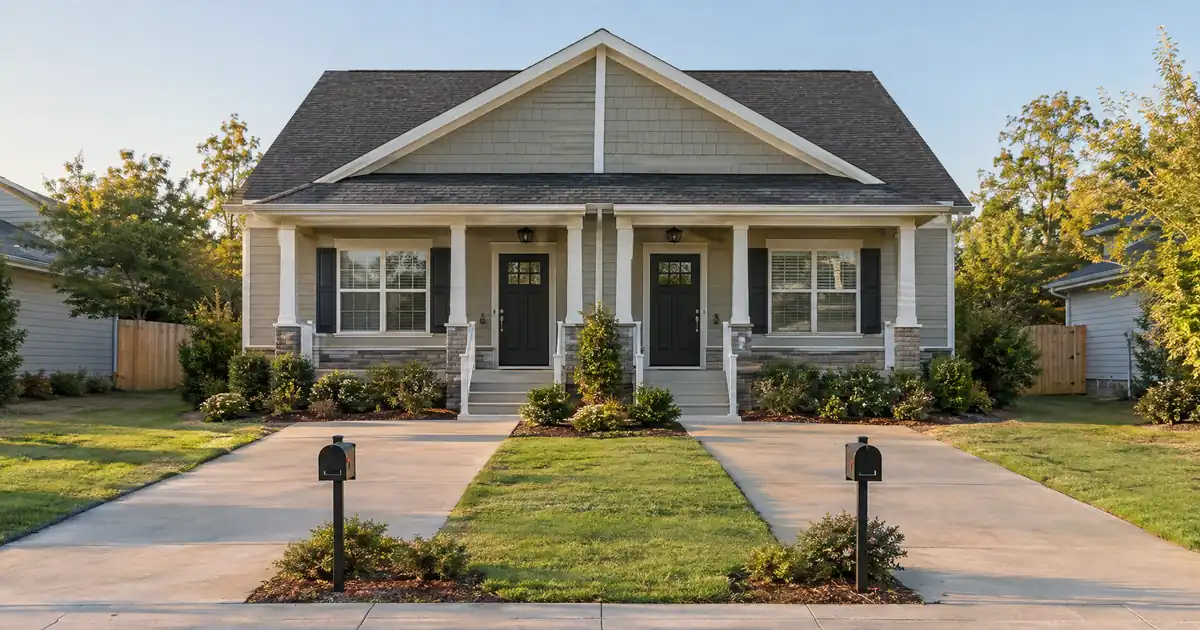
The Quick Read: A DSCR loan lets an investor finance a two-unit rental in Westerly by qualifying primarily on the combined rent of both units covering the full monthly obligation, subject to lender guidelines, as long as the buyer will not live in either unit.
- Both units’ rent is measured against principal, interest, taxes, insurance and any HOA dues (PITIA), and 1.00 is where select programs start.
- Most purchases land at 75%-80% LTV on an investment property, which means 20%-25% down.
- Credit floors begin at 620 in parts of the network, most programs want around 660, and 700+ opens the strongest leverage.
- Reserves are commonly around 6 months of PITIA.
- Coastal taxes and flood insurance can pull a coastal duplex’s ratio down faster than the price alone suggests.
What Makes a Duplex Different on a DSCR File?
A duplex gives the file two rent streams against one mortgage payment. If one unit sits empty, the other still pays part of the bill. That is the real benefit, and it is why a two-unit building often shows better coverage than a single-family house at the same price.
DSCR Calculator
Run the numbers in your market
Rate source: Freddie Mac 30-yr average via FRED® — Federal Reserve Bank of St. Louis · effective Oct 29, 2026
Prefilled with starting assumptions — enter your own rent or nightly figures, taxes, insurance, and HOA for a more accurate picture.
Program parameters update from Lendmire’s centralized guideline source. Taxes and insurance are editable estimates.
As of Oct 29, 2026 · General Freddie Mac market benchmark, not a Lendmire loan offer. Rent, nightly rate, occupancy, taxes, and insurance are editable estimates. Short-term rental figures are estimates only and vary significantly by season, property type, management approach, and local short-term-rental rules — confirm local regulations before relying on them. Qualifying income for short-term rentals varies by program — some use appraisal market rent, others use documented STR history or projections — and is confirmed in underwriting. Not a Loan Estimate, approval, or commitment to lend. Program availability and eligibility are subject to lender guidelines, credit approval, property review, and underwriting.
The lender treats a duplex as residential, not commercial. The appraiser reports it on a form built for two-to-four-unit income properties, Form 1025, which includes a rent analysis of comparable rentals. A single-family rental uses the one-unit rent schedule instead. DSCR loans are not agency loans, so the appraisal form is the only agency detail that matters here.
The property has to be a legal two-unit building. Manufactured homes (single- and double-wide), log homes and barndominiums are not offered in the network’s DSCR programs. A standard two-family in Westerly is fine on property type. The file questions are about legal status, rent evidence and cost.
Key Terms Defined
DSCR (debt service coverage ratio): The property’s qualifying monthly rent divided by its monthly PITIA.
PITIA: Principal, interest, taxes, insurance and association dues, which together make up the full monthly obligation on the property.
LTV (loan-to-value): The loan amount as a percentage of the purchase price or appraised value, depending on which is lower.
Reserves: Liquid funds the borrower keeps after closing, counted in months of PITIA.
Form 1025: The appraisal form for two-to-four-unit properties, which includes the rent comparison.
Non-owner-occupied: A property where the borrower does not live in any unit.
How Does Underwriting Treat the Rent?
Underwriting measures the rent against PITIA. Nothing else enters the ratio. The strongest files also clear a second test, which is enough equity and enough rental coverage together.
The ratio works like this: add the rent used for lender review for both units, then divide by PITIA. Rent used for lender review comes from the lease, the appraiser’s market rent estimate, or both, depending on the program. A ratio of 1.00 means rent equals the payment. Select programs begin there. Stronger ratios open better pricing and more leverage.
Coverage below 1.00 is available through select lenders in the network, with leverage and terms adjusted. That is a separate path from the 1.00 programs, not a lower floor on the same one. No-ratio structures exist only through select lenders, generally for borrowers who already own a primary residence.
Clearing 1.00 does not mean the duplex cash flows. Repairs, vacancy, management, utilities and capital costs sit outside the calculation. A duplex can pass the ratio and still leave the owner with thin monthly profit. Treat the ratio as the lender’s test and your own operating budget as a separate one.
What Does a Modeled Westerly Duplex Look Like?
These figures are modeled assumptions, not market data. Picture a duplex priced in the mid-six figures, bought at 75% LTV with both units leased to year-round tenants. Combined rent comes out near 1.15x PITIA. That file clears a 1.00 program with room. The exact numbers vary by lender and program and follow a full review of property, leverage, and credit.
Now add a flood policy. If the building sits in a mapped flood zone, flood coverage is required, and homeowner’s policies generally exclude flood damage. The new premium goes straight into the PITIA denominator. The same rent now covers roughly 1.02x. Add a tax reassessment after the sale and the file sits below 1.00.
At that point the investor has options a lender would review. A larger down payment lowers the payment and can lift the ratio. A longer or interest-only structure available through select lenders can lower the monthly obligation. A sub-1.00 program through select lenders is another path, with leverage and terms adjusted. Each is subject to lender guidelines, credit review and the property itself.
Run the stress test before the offer, not after the appraisal. Use the real insurance quote, a tax estimate based on the purchase price, and rent at the low end of the comparables.
What Do Westerly Prices Mean for the Ratio?
Westerly is a high-price coastal market, so rent has to carry a heavy load. Zillow reports an average Westerly home value of $634,210, up 8.8% over the past year. Use that as direction only, because it blends all home types and a duplex will price differently.
Price is the pinch point. A higher price raises the payment, taxes and insurance together, and rent does not rise in step. Run the file both ways.
How Do You Buy a Westerly RI Duplex Step by Step?
The sequence below is the order that keeps DSCR files clean.
1. Confirm the plan is a pure rental. DSCR loans are for non-owner-occupied investment property. If you plan to live in one unit, that is a different product, covered below.
2. Pre-screen the deal. Estimate combined rent, then price taxes and insurance with real quotes. Check the ratio at low-end rent before spending money on an inspection.
3. Line up credit and reserves. Most programs want a score around 660, with a 620 floor in parts of the network and 700+ for the strongest leverage. Reserves commonly run around 6 months of PITIA. Conservative rate-term files at modest leverage under $1,500,000 can see reserves waived. Loans above that size typically step up to about 9 months.
4. Decide how to hold title. Buying in an LLC is common, subject to lender program eligibility. The lender will want articles of organization, an operating agreement and proof of who owns the entity. Missing entity documents are one of the most common preventable delays.
5. Make the offer with the right contingencies. Include inspection, financing and appraisal terms. A Rhode Island purchase typically involves a closing attorney, so bring that person in early.
6. Document both units. Collect existing leases, rent history and any evidence the two units are legally separate. If a unit is vacant, the appraiser’s rent estimate carries the file.
7. Order the appraisal and read the rent analysis. If the appraisal comes in low, ask for a reconsideration with recent nearby sales. If the rent estimate comes in light, the ratio changes, so check it before moving on.
8. Clear insurance and title. Get a complete insurance quote with flood coverage if needed. A stale or partial quote is a leading cause of ratio surprises late in the file.
9. Reconcile the settlement statement. Check the final figures against the loan terms and your reserves.
What Should You Check Before Making an Offer?
Verify that the building is a legal two-family. Older New England two-families often have informal conversions, extra kitchens or unpermitted units. If an appraiser or lender cannot confirm the unit count, the rent analysis breaks.
Check the utilities. Separate meters make rent simpler to document. Shared meters mean the owner may carry costs that never show in the ratio.
Inspect the systems. Heating, roof, wiring and moisture matter in coastal older stock. Lead paint is a standard question for older two-family buildings. Each repair cost sits outside the DSCR math but inside your real return.
Review flood status. Look at the mapped flood zone before you write the offer, since a high-risk zone changes both the insurance line and the coverage ratio.
DSCR vs. conventional financing
There are two common ways to finance an investment property, and they qualify you differently — here’s how investors weigh them.
Why investors choose it
- Qualifies on the property’s rental income — no personal tax returns, W-2s, or pay stubs needed to document income.
- No personal debt-to-income ceiling to clear, so existing mortgages and obligations don’t cap your borrowing the same way.
- Can be closed in an LLC, keeping the property inside a business entity.
- Built for scaling — not held to the limit on number of financed properties that conventional financing applies.
- Underwriting centers on the deal: generally qualifies when the rent covers the payment, a 1.00x coverage ratio being a common baseline (confirmed in underwriting).
- Designed specifically for investment property, including long-term and, where the program allows, short-term rentals.
Where it’s strong
- Often the lowest ongoing financing cost for a buyer who fully qualifies on personal income — a fit for a first property or a cost-first purchase.
Trade-offs for investors
- Requires full personal income documentation and must fit within a debt-to-income limit — salary, existing debts, and other mortgages all count.
- Typically held in your personal name rather than a business entity.
- Caps how many financed properties you can carry, which can become a ceiling as a portfolio grows.
- Evaluates you as a borrower as much as the property, which usually means more paperwork.
How investors usually choose: a first or single property often optimizes for the lowest financing cost; portfolio builders often optimize for leverage, vesting in an LLC, and scaling past conventional caps. The right answer depends on your goals, the property, and current guidelines — both paths run through select lenders in Lendmire’s wholesale network, with eligibility and terms confirmed in underwriting.
Can You Live in One Unit and Still Use a DSCR Loan?
No. The borrower cannot occupy either unit on a DSCR loan. These are business-purpose investor loans, reviewed differently from a standard owner-occupied mortgage. A buyer who wants to live in one half needs a different financing product, which is a common path for two-unit buyers.
| Factor | House hack (owner-occupied) | DSCR (non-owner-occupied) |
|---|---|---|
| Occupancy | Buyer lives in one unit | Buyer lives in neither |
| Qualifying basis | Personal income | Property rent vs PITIA |
| Fit | First-time or live-in buyers | Pure rental purchases |
| Later move | Convert to rental after living there | Hold or refinance as rental |
The practical exception is the sequence. A buyer can purchase with owner-occupied financing, live there for the required period, and move out later. Once both units are rented and the occupancy condition is satisfied, the property can move to a DSCR refinance. A cash-out refinance on an investment property tops out around 75% LTV, with about 6 months of seasoning as the common expectation. A buyer who intends to rent from day one will usually be better served by a DSCR purchase.
What About Short-Term Rentals in a Beach Town?
Westerly’s seasonal draw makes short-term rentals tempting, but a DSCR file treats them differently. Short-term rental rules can vary by city, county, HOA, and property type, so investors should confirm local rules before relying on projected rental income.
On the lending side, short-term rental purchases top out around 75% LTV, with a 640+ score and about 12 months of hosting history expected. A 1.00 coverage floor applies on purchases. A new buyer with no hosting record usually is reviewed on long-term rent, and Airbnb income is treated as upside.
What Loan Terms Should You Expect?
Most purchase files land at 75%-80% LTV on an investment property. Standard programs run up to $3,000,000. The spine of the network is the 30-year fixed. Extended terms such as 40-year and interest-only periods are available through select lenders, and ARM structures exist for investors who want them. Final terms depend on the lender’s guidelines, the property type, and the borrower’s complete credit picture.
A larger down payment lowers the monthly payment and can lift the DSCR. It never erases leverage caps, credit floors, reserve rules or property eligibility. Prepayment terms also vary by program, so compare them alongside the ratio.
DSCR loans are business-purpose loans, and the closing package differs from a consumer mortgage. Tax treatment varies; consult a qualified professional.
For the full program picture, see the complete DSCR loans guide. If the property needs heavy work before it can rent, Lendmire’s piece Can You Use Hard Money to Buy and Rehab a Duplex? covers that route.
Where Do Westerly Duplex Files Go Wrong?
Three failure modes show up repeatedly on coastal two-unit files.
Stale insurance quotes. The ratio is built on one number and the final quote lands higher. Fresh quotes, including flood coverage where it applies, belong in the file at the start.
Rent evidence gaps. One unit has a lease, the other is vacant, and the appraiser’s rent estimate comes in lower than the owner’s. Gather every lease and rent history early.
Entity paperwork. An LLC without a complete operating agreement or ownership documentation stalls the file. Clean entity documents are easy to prepare ahead of time.
The common thread is that each problem was visible before the file went in.
Frequently Asked Questions
Can first-time investors use a DSCR loan on a duplex?
Often yes, subject to lender guidelines. Qualification runs on rent coverage, credit, reserves and leverage. Some programs prefer investors with prior property ownership, so a first-time buyer may see tighter leverage or need stronger credit.
What credit score do I need to buy a Westerly duplex with a DSCR loan?
Scores start at 620 in parts of the network, and most programs want around 660. A 700+ score opens the strongest leverage tiers. A higher score generally improves terms, subject to the full file.
How much do I need down?
Most purchase files run 75%-80% LTV on an investment property, which means 20%-25% down. Reserves, commonly around 6 months of PITIA, are separate from the down payment.
Does the lender use my actual lease or the appraiser’s rent estimate?
It depends on the program. The appraiser’s rent analysis on the two-to-four-unit form is part of every duplex file. How the lender weighs that figure against an in-place lease is program-specific, so confirm it before you set your offer.
What happens if the ratio comes in under 1.00?
Options exist, though terms change. Select lenders in the network offer programs below 1.00 with leverage and terms adjusted. A larger down payment, a longer term or interest-only structure can also improve the ratio, subject to lender guidelines.
Next Step
If you are buying or refinancing a rental property and want to see how the numbers work, Lendmire can help you compare DSCR loan options based on the property income, credit profile, leverage, and investor goals. Lendmire is a mortgage broker arranging DSCR investor loans through select lenders in its wholesale network across 41 markets, including Washington, D.C. Call 828-256-2183 or request a quote.
A two-unit coastal building rewards the buyer who prices flood and tax costs before the offer, not after the appraisal.
About Lendmire
Lendmire — NMLS# 2371349 — is a mortgage brokerage specializing in DSCR investor loans, helping arrange financing across 41 markets, including Washington, D.C., through wholesale and investor-lending channels. The model centers on property-level rental income reviewed by the lender rather than W-2 documentation, subject to lender guidelines, suiting entity-owned and multi-property investors. Lendmire holds Scotsman Guide Top Mortgage Workplace recognition for 2025 and 2026.
Get Started
Ready to find the right loan for you?
See your offer in seconds. No credit pull, no obligation.
Informational only. Not a Loan Estimate, approval, or commitment to lend. Program availability and eligibility are subject to lender guidelines, credit approval, property review, and underwriting.
References
1. Fannie Mae Selling Guide B4-1.2-01
2. Zillow, Westerly home values
This article is part of Lendmire’s DSCR loan program — full qualification details, guidelines, and scenarios live on the program page.
Related reading: How to Finance a Luxury Fourplex With a DSCR Loan · How a DSCR Loan Works for a Sandusky Seasonal Rental · Can a DSCR Loan Refinance a Rental Loan About to Mature?
Guides: DSCR Loans in Westerly, RI · DSCR Loans in Rhode Island
Brandon Miller
Founder & CEO, Mortgage Loan Originator, Lendmire LLC
- Mortgage Loan Originator · NMLS# 1129696 · Verify on NMLS Consumer Access
- North Carolina Real Estate Broker · License# 343312 · Verify on NCREC
- North Carolina Insurance Producer · License# 19053198 · Property, Casualty, Life, Health · Verify on NAIC SBS
- Lendmire LLC · Firm NMLS# 2371349 · Verify firm licensure
Disclosures. The information presented in this article is general market commentary, not financial, legal, or tax advice. Lendmire is a mortgage brokerage (NMLS# 2371349) — not a direct lender or depository institution — and loan placement is subject to lender underwriting. Nothing in this content represents a commitment to lend. Loan terms, pricing, and program availability vary based on borrower qualifications, property characteristics, and state of subject property, and are subject to change at any time. Lendmire complies with Equal Housing Opportunity requirements. Consumer access: nmlsconsumeraccess.org.