
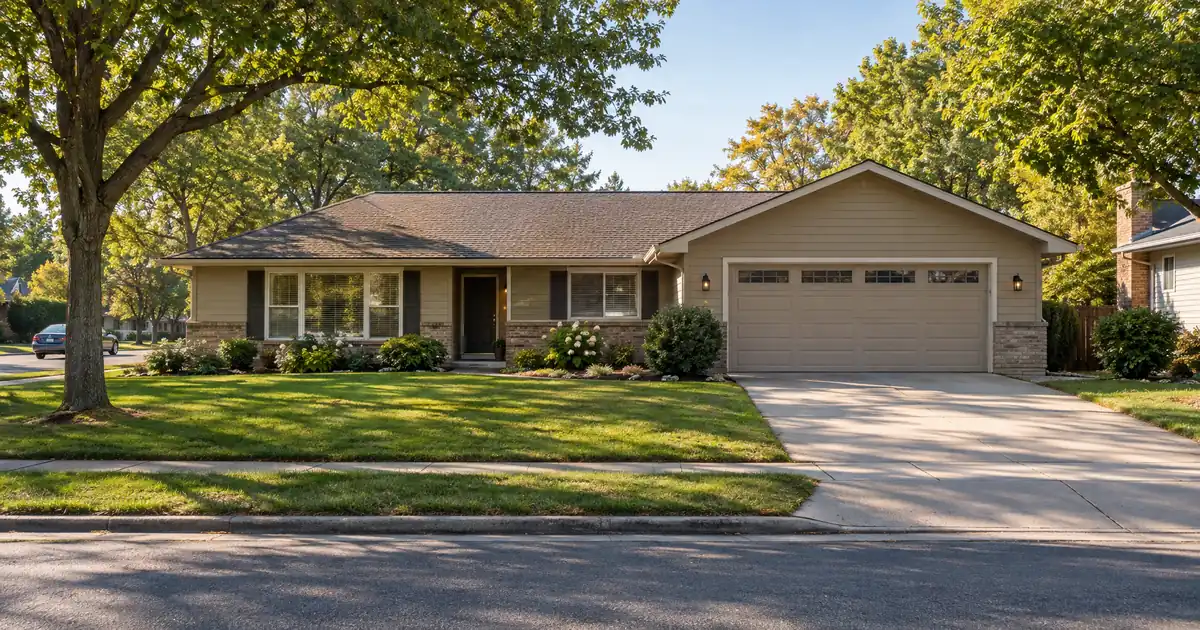
Cash Out Investment Property Refinance — The Quick Read: A cash-out investment property refinance replaces your existing loan on a rental with a bigger one, and you pocket the difference in cash. On non-QM programs, that difference gets sized off the property’s rent and current value, not your traditional personal-income documentation. Most files land at or under a 75% loan-to-value ceiling, need roughly six months of ownership on title, and clear based on how well the rent covers the new payment. The mechanics are simple; the underwriting details are where deals get made or stalled.
Key Takeaways
- A rental-property cash-out refi tops out around 75% loan-to-value across most non-QM programs — never assume the 80% purchase-money ceiling carries over.
- Approval usually runs on the property’s rent-to-payment ratio (called DSCR), not your personal income.
- Roughly six months on title is the common seasoning bar, measured from when the deed actually recorded — not your closing date.
- Short-term rentals get their own, tighter numbers: lower cash-out leverage and extra documentation.
- A handful of property types — manufactured homes, log homes, barndominiums — simply aren’t eligible for this kind of financing.
Key Terms Defined
Cash-out refinance: a new loan that pays off your old mortgage and gives you the leftover equity in cash at closing.
DSCR Cash-Out Calculator
Run the cash-out numbers in your market
Rate source: Freddie Mac 30-yr average via FRED® — Federal Reserve Bank of St. Louis · effective Sep 17, 2026
Prefilled with local estimates — enter your property’s value, balance, taxes, and insurance for a more accurate picture.
Program parameters update from Lendmire’s centralized guideline source. Taxes and insurance are editable estimates.
As of Sep 17, 2026 · General Freddie Mac market benchmark, not a Lendmire loan offer. Property value, balance, taxes, and insurance are editable estimates. Maximum loan-to-value varies by lender, program, property type, and seasoning. Not a Loan Estimate, approval, or commitment to lend. Program availability and eligibility are subject to lender guidelines, credit approval, property review, and underwriting.
LTV (loan-to-value): the new loan amount expressed as a percentage of the property’s value — the lower the LTV, the more equity you’re leaving in the deal.
DSCR (debt service coverage ratio): the property’s monthly rent divided by its monthly PITIA — a ratio above 1.00 means the rent covers the payment.
PITIA: principal, interest, taxes, insurance, and any HOA dues rolled into one monthly figure — this is the “payment” side of the DSCR math.
Seasoning: the waiting period a lender wants before it will treat your equity as spendable, usually measured from the day title recorded in your name.
No-ratio loan: a program that skips the rent-versus-payment math altogether and drives lender review a different way, generally available only through select lenders and typically for borrowers who already own a primary residence.
How a Cash-Out Refinance on a Rental Actually Works
You own a rental. It’s worth more than you owe, or you own it outright. A cash-out refinance replaces the old debt (or adds a first lien for the first time) with a new loan sized above the current payoff, and the lender wires you the leftover proceeds after fees and any required reserves are set aside.
On a DSCR loan, the underwriter isn’t reading your pay stubs. They’re reading the lease, the market rent conclusion, and the appraisal. For an investor, the equivalent motive is usually funding the next purchase or a renovation — not consumer debt.
Because non-QM cash-out loans qualify on the property’s income, the underwriting file leans hard on two things: what the property is actually worth today, and what it rents for. Everything else — reserves, credit, leverage — flexes around those two numbers.
Underwriting, Step by Step
First, the appraisal sets value and rent. Second, the lender nets out the existing payoff, closing costs, and any required reserve holdback. Third, they run the coverage math — rent against PITIA — to see where the file lands on leverage. Fourth, they check seasoning: how long you’ve actually held title. Fifth, credit and reserves get layered in to finalize pricing and terms.
Run a simplified version of the math: take a property’s current appraised value, apply a 75% LTV cap, subtract the existing loan payoff and closing costs, and what’s left is the modeled proceeds envelope. The stronger the rent-to-payment ratio inside that envelope, the more comfortably the file clears. A property clearing somewhere around 1.15x to 1.25x coverage at that leverage tends to move through underwriting with far less friction than one sitting right at the 1.00x floor. Exact terms depend on the lender’s guidelines, property type, leverage, and a full review of the borrower’s file.
Across the network, most cash-out files max out at 75% LTV — that’s the hard ceiling on a rental cash-out refinance, and it’s lower than the 80% (sometimes 85% with strong credit) leverage available on a purchase. Don’t confuse the two; a lender quoting purchase leverage on a refinance file is quoting the wrong number. Every figure here varies by lender and program — guidelines, property type, leverage, and credit profile all apply.
What Counts as “Enough” Rent?
A DSCR of 1.00 means the rent exactly covers the PITIA payment — nothing more, nothing less, and it says nothing about your actual monthly cash flow. Repairs, vacancy, property management, utilities, and capital expenses all sit outside that ratio. Clearing 1.00 is a lending threshold, not proof of positive cash flow. As the CFPB has documented, most cash-out borrowers historically cite paying off other debt as their top reason for refinancing.
Across select lenders in the network, 1.00 is where some programs start — a floor for specific programs, never a universal standard. Stronger ratios open up better leverage and pricing. Credit matters here too: a 620 floor shows up in parts of the network, most programs prefer something closer to 660, and a 700-plus score tends to unlock the best leverage tiers available.
Reserve requirements track loan size and leverage. Most files land around six months of PITIA in reserve. Above roughly $1.5 million in loan amount, that commonly steps up to about nine months. A larger down payment lowers your payment and can lift your coverage ratio — but it doesn’t erase a credit floor, a reserve requirement, or a leverage cap. The strongest files clear both tests at once: enough equity in the deal, and enough rent to cover the payment.
Seasoning: The Clock You Didn’t Know Was Running
Seasoning isn’t one rule — it’s two. Title seasoning is simply how long you’ve owned the property. Value seasoning is whether the lender will size your loan off your original purchase price or the current appraised value — and that second one usually matters more, because it directly controls how much cash you can actually pull.
Across the network, roughly six months of ownership is the common expectation before a cash-out refinance gets considered, and that clock generally starts on the date the deed recorded — not the date you closed. Recording typically lags closing by a few business days, so a file that looks “seasoned enough” on the calendar can still be a few days short once the county paperwork catches up.
Conventional financing handles this differently. Fannie Mae’s Selling Guide requires at least one borrower on title for six months before a cash-out refinance disburses, with a carve-out for delayed financing on cash purchases — a structure that most non-QM delayed-financing programs are loosely modeled on, though the terms and leverage differ from agency guidelines.
Structures and Variations Worth Knowing
Not every cash-out refinance looks the same. A few structural variations show up often enough that they deserve their own explanation.
Delayed financing. Bought the property with cash and want equity back before hitting the standard seasoning mark? Delayed-financing structures exist specifically for that scenario, provided you can document the original purchase was funded with your own capital — not borrowed money, and not funds from another transaction that hasn’t fully closed out. Even when this path is used, the loan is still priced and leveraged as a cash-out transaction, not a lower-cost rate-and-term refi.
Short-term rentals. STR collateral runs on its own set of numbers. Purchase leverage tops out around 75% LTV. Cash-out on a short-term rental tops out around 70% LTV, compared with the 75% ceiling that applies on a standard long-term rental. Expect a 640-plus credit score, roughly 12 months of hosting history, and a 1.00 coverage floor reviewed on purchase files. Refinance files are reviewed against their own 1.00 floor separately — the purchase and refinance numbers aren’t interchangeable. Final terms depend on lender guidelines, property type, leverage, and the borrower’s complete credit picture.
HELOCs on investment property. Instead of a full refinance, some investors tap equity through an investment-property HELOC. Total lines available cap at $500,000 across the network — there’s no larger tier above that, regardless of the property’s value.
Loan size and term. Standard programs run up to roughly $3 million. Above about $2.5 million, the network generally holds to 30-year fixed structures rather than adjustable or interest-only variations. Extended-term options — including 40-year amortization and interest-only periods — exist through select lenders for investors who specifically want them.
State overlays. A handful of states — Connecticut, Florida, Illinois, and New Jersey — see purchase leverage capped closer to 75% LTV, with overlay-state loan amounts generally capped around $2 million.
For a broader walkthrough of how these coverage-ratio programs work end to end, Lendmire’s complete DSCR loans guide breaks down qualification from the ground up.
Where the General Rule Breaks
The 1.00-coverage rule isn’t absolute, and pretending otherwise does investors a disservice. Sub-1.00 coverage is a real path available through select lenders in the network — leverage and terms simply adjust to compensate for the weaker ratio. It’s not a denial; it’s a different structure.
No-ratio qualification is a separate, narrower path. It’s available only through select lenders, and it’s generally reserved for borrowers who already own a primary residence. There’s no fixed numeric floor attached to it the way there is with a standard DSCR program — it’s evaluated on the overall file, not a single ratio.
A less obvious edge case: investors layering a cash-out refinance around a 1031 exchange, hoping to access liquidity without breaking their tax deferral. That’s a structure worth planning carefully rather than improvising. Tax treatment can depend on how the funds are used and how the property is held; investors should keep clear records and speak with a qualified tax professional before relying on any deduction.
DSCR loans are also business-purpose, not consumer loans. Because they’re designed for non-owner-occupied investment property, they’re reviewed differently — and priced differently — than a standard owner-occupied mortgage.
What’s Simply Not Eligible
Three property types fall outside these programs entirely: manufactured homes (both single- and double-wide), log homes, and barndominiums. That’s not a “harder to finance” situation — it’s a flat no across the network’s DSCR programs. If you’re holding one of these in a portfolio you want to tap for cash, a rental cash-out refinance through this channel isn’t the mechanism; other financing paths would need to be explored separately.
Making the Call: Is This the Right Move?
The decision usually comes down to one comparison: does the equity you’d unlock, and what you’d do with it, outweigh the higher loan balance and payment you’re taking on? An investor pulling equity to fund a renovation or the next acquisition is playing a different game than one consolidating high-cost debt — the math and the payoff timeline look completely different in each case.
| Path | Typical Cash-Out LTV | Seasoning Expectation | Best Fit |
|---|---|---|---|
| Standard long-term rental | Up to 75% | ~6 months from recording | Stabilized rentals with clean rent history |
| Short-term rental | Up to 70% | ~6 months + ~12 mo. Hosting history | Established STR with track record |
| Delayed financing (cash purchase) | Cash-out pricing applies | Waived if source-of-funds documented | Investors who bought with cash and want equity back sooner |
scotsmanguide.com/news/which-groups-are-driving-non-qm-lending/ reports investors are increasingly financing purchases rather than paying cash — meaning cash-out refinancing is less a one-time event and more the mechanism investors use repeatedly to keep growing a portfolio. For more on comparing your options before you pull the trigger, Lendmire’s guide on how to qualify for a cash-out refinance on an investment property walks through the qualification factors in more detail, and the best cash-out refinance options for investment property breaks down how different programs stack up.
If you’re weighing whether to refinance a rental now or wait, Lendmire can help you compare DSCR loan options based on the property’s rental income, your credit profile, available leverage, and where you’re trying to take the portfolio next. Investors can reach Lendmire at 828-256-2183 or request a quote to see what a specific property might support.
Frequently Asked Questions
Can I do a cash-out refinance on a rental I own free and clear?
Yes — a paid-off rental just means the entire new loan amount, up to the applicable LTV ceiling, is treated as cash-out proceeds. The property still needs to clear seasoning and coverage-ratio review the same way a mortgaged rental would.
Does a bigger down payment on the original purchase help me get more cash out later?
It can, indirectly. More initial equity means more room under the 75% LTV ceiling when you refinance, and a lower existing balance to pay off. It doesn’t override credit, reserve, or seasoning requirements on its own. These specifics are subject to lender guidelines and a full review of property, leverage, and credit.
Is my cash-out refinance interest deductible?
Sometimes, and it depends on what the proceeds are used for. Tax treatment can depend on how the funds are used and how the property is held, so investors should keep clear records and talk with a qualified tax professional before assuming any deduction applies.
What happens if my rent doesn’t quite cover the new payment?
Sub-1.00 coverage doesn’t automatically kill the deal. It’s reviewed through select lenders in the network, typically with adjusted leverage and terms to compensate for the thinner ratio — subject to lender guidelines and credit approval.
Can I refinance a short-term rental the same way as a long-term one?
Not quite — STR collateral runs on its own numbers, generally tighter cash-out leverage than a standard rental, plus a hosting-history requirement and its own coverage-ratio review on both purchase and refinance sides.
A deeper walk-through of investment-property equity extraction lives in cash-out refinance on an investment property.
For how equity extraction works on an investment property, see cash-out refinance on an investment property.
About Lendmire
Lendmire (NMLS# 2371349), a non-QM mortgage broker serving investors in 40 markets including Washington, D.C., helps structure DSCR scenarios commonly evaluated around a property’s rental income rather than personal income paperwork, subject to lender guidelines. A Scotsman Guide Top Mortgage Workplace in 2025 and 2026, Lendmire places loans through wholesale investor lenders and is not a direct lender.
Lendmire’s Top Mortgage Workplace recognition is documented by Scotsman Guide 2025 Top Mortgage Workplace and Scotsman Guide 2026 Top Mortgage Workplace.
Get Started
Ready to find the right loan for you?
In about 30 seconds you can review financing options available for your home or investment property. No commitment required.
Informational only. Not a Loan Estimate, approval, or commitment to lend. Program availability and eligibility are subject to lender guidelines, credit approval, property review, and underwriting.
References
1. CFPB Newsroom Report — Cash-Out Mortgage Refinance Borrowers
2. Fannie Mae Selling Guide B2-1.3-03 — Cash-Out Refinance Transactions
Brandon Miller
Founder & CEO, Mortgage Loan Originator, Lendmire LLC
- Mortgage Loan Originator · NMLS# 1129696 · Verify on NMLS Consumer Access
- North Carolina Real Estate Broker · License# 343312 · Verify on NCREC
- North Carolina Insurance Producer · License# 19053198 · Property, Casualty, Life, Health · Verify on NAIC SBS
- Lendmire LLC · Firm NMLS# 2371349 · Verify firm licensure
Compliance and disclosures. Lendmire (NMLS# 2371349) is a licensed mortgage broker and is not a direct lender, depository institution, financial advisor, or tax professional. Content in this article is general market analysis and educational information — not financial, legal, or tax advice for any specific situation. Lendmire does not guarantee loan approval; every transaction is subject to underwriting by the funding lender. Mortgage pricing and loan program guidelines are subject to change at any time without notice and vary by borrower characteristics, property type, and state regulations. Lendmire complies with Equal Housing Opportunity. Licensure verification: NMLS Consumer Access.


