
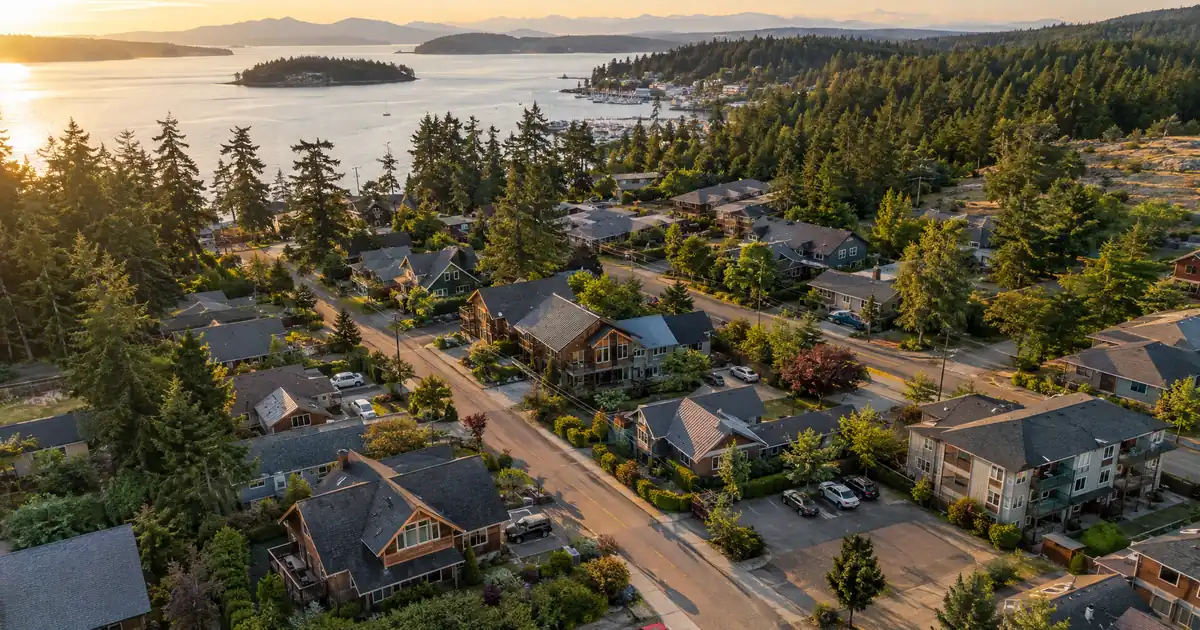
About 83% of San Juan County’s vacant housing units, 4,449 of them, were held for seasonal, recreational, or occasional use, according to the county’s housing element memo. Year-round rentals are what’s scarce. For an owner weighing a cash out refinance on an investment property in Friday Harbor, that scarcity supports the rent roll. It does nothing for the coverage math, because prices here sit far above what local rents can service at high leverage.
At a Glance: A DSCR cash-out refinance in Friday Harbor, Washington is underwritten primarily on the property’s rental income measured against its full monthly obligation, so the file works only when rent used for lender review, taxes, insurance, and the new loan balance line up. Appraisal depth on a ferry-only island is the second gate.
DSCR Cash-Out Calculator
Run the cash-out numbers in Friday Harbor, WA
Rate source: Freddie Mac 30-yr average via FRED® — Federal Reserve Bank of St. Louis · effective Sep 24, 2026
Prefilled with starting assumptions — enter your property’s value, balance, taxes, and insurance for a more accurate picture.
Program parameters update from Lendmire’s centralized guideline source. Taxes and insurance are editable estimates.
As of Sep 24, 2026 · General Freddie Mac market benchmark, not a Lendmire loan offer. Property value, balance, taxes, and insurance are editable estimates. Maximum loan-to-value varies by lender, program, property type, and seasoning. Not a Loan Estimate, approval, or commitment to lend. Program availability and eligibility are subject to lender guidelines, credit approval, property review, and underwriting.
- Zillow’s home value index shows $883,397 citywide, down 0.3% over the past year.
- ApartmentFinder’s average rent is $1,338, with two-bedrooms averaging $1,817.
- Cash-out leverage tops out at 75% LTV, and about 6 months of seasoning applies.
- Condos near a $395K listing median are the closest fit to workable coverage.
- Every figure here varies by lender and program — guidelines, property type, leverage, and credit profile all apply.
Lendmire (NMLS# 2371349) is a DSCR-focused mortgage broker. It places DSCR investor financing for Friday Harbor, Washington through non-QM wholesale channels that cover 41 markets, including Washington, D.C. Investors can see the state program overview at Washington DSCR investor loans. This report covers only the equity-extraction side: what the property must show, where coverage breaks, and how proceeds could be redeployed.
Friday Harbor Market Snapshot
A quick read on the Friday Harbor investor landscape — figures come from the cited sources below. Confirm current property-level numbers before underwriting.
| Metric | Detail |
|---|---|
| Population | 2,728 population (Census Reporter (ACS 2024 5-yr)) |
| Employment | Over 200 employees (San Juan County, Employment) |
The Coverage Problem, Stated Plainly
Friday Harbor’s cash-out math is a leverage problem, not a demand problem. At the 75% LTV ceiling, modeled coverage on typical in-town inventory lands well below 1.00 once taxes and insurance are in the monthly obligation. Coverage only approaches the baseline when the investor holds the loan balance far below the cap. Final terms depend on lender guidelines, property type, leverage, and the borrower’s complete credit picture.
Run the numbers on two modeled cases. These are illustrative assumptions, not market data, and each uses full PITIA (principal, interest, taxes, and insurance) at Washington-average tax and insurance loads.
- Condo case: Assume a $395K condo, matching the Redfin condo listing median, renting at $1,595, the top of the in-town one-bedroom range from Trulia’s rental listings. At 75% LTV, coverage models near 0.6x including taxes and insurance. Cut leverage to roughly 40% LTV and the same rent clears into the low-1.0s.
- Average-house case: Assume the $883,397 citywide value and the $1,338 average rent. Coverage at 75% LTV models in the low 0.3x range. That is a gross rent-to-value ratio of roughly 0.15% a month, and the comparison is imperfect because the rent figure leans toward apartments and the value figure toward houses.
- These specifics are subject to lender guidelines and a full review of property, leverage, and credit.
Most standard DSCR programs are built around a 1.00x benchmark because rent covers the monthly obligation at that level. Some lenders review sub-1.00 files with compensating factors, lower leverage, or different pricing. Exact eligibility depends on lender guidelines, credit profile, reserves, and property review.
That’s the central fact of this market. A seasoned owner who bought years ago, owns the property with modest debt, and wants to pull a modest slice of equity has a plausible file. An owner hoping to pull the full 75% against a house at the citywide average does not.
Seasoning, the 75% Cap, and What the File Needs
Program guidance for a cash-out refinance on an investment property centers on a handful of numbers. Typically the ceiling is 75% LTV, ownership seasoning is about 6 months measured from title recording, and the minimum DSCR is 1.00 on rent used for lender review versus PITIA. Credit tiers generally start at a 620 floor and step up through 660, 680, and 700, and reserves run about 6 months of PITIA. Loan sizes reach up to $3,000,000 on standard programs, with smaller balances routed through select lenders in the network. All of this is subject to lender guidelines and varies by borrower, property, and loan scenario.
Two of those figures matter more in Friday Harbor than elsewhere. Reserves are the first. Six months of PITIA on a high-priced island property is a large liquid requirement relative to the rent the property produces. The seasoning clock is the second, and it rarely binds here, because most island investors have held far longer than 6 months. Our DSCR cash-out refi mechanics page covers the sequencing.
Equity is not a guaranteed cash figure. It comes from rent used for lender review, PITIA, reserves, and the 75% ceiling, and in this market the rent term constrains the answer first.
What Happens to an Appraisal When Two Homes Sell in a Month?
Appraisal risk is the sleeper issue for a Friday Harbor cash-out. Comparable sales are scarce, and an appraiser working from thin evidence can land well off an owner’s expectation. Build cushion into the assumed LTV before ordering.
Redfin reported only 2 homes sold in the prior month in its January snapshot, against 7 condos on the market. Price dispersion is wide: Redfin’s Roche Harbor page shows a $1.21M median sale price up 46.7% year over year, a number driven by a small set of waterfront and resort trades rather than a trend.
Sale-price readings also disagree. Zillow’s index is down 0.3% over the past year, per the link above. Homes.com lists a 12-month median sale price of $683,500, up 1%, with 93 days on market on average. Zillow’s $883,397 is an index of typical value, while Homes.com’s figure is a median of closed sales, which explains much of the gap. This report uses the Zillow figure as the citywide value reference and treats the Homes.com figure as a sales-based floor. Redfin’s separate $510K median, up 3.8%, carries an ambiguous update date, so it shouldn’t anchor anything.
The read-through for an equity-extraction plan is blunt. Flat values mean appreciation won’t rescue the numbers, and long days on market mean the comps an appraiser pulls could be stale. Size the loan to the appraised value at closing, not to a hoped-for one.
Where the Equity Sits (and Which Submarkets Pencil)
In-town Friday Harbor is the only submarket where cash-out coverage is plausible. Acreage, resort, and waterfront pockets lean toward second-home and vacation use, and their prices run far past what long-term rents can carry. No neighborhood-level price or rent medians exist from a citable source, so the comparison below is qualitative.
| Submarket | Tenant base | Cash-out fit |
|---|---|---|
| In-town core | Hospital, county, school, service staff | Best available |
| Spring St / University Rd corridor | Same, in smaller units | Strong if multi-unit |
| University Heights | Seasonal research demand | Selective |
| Central island and lakes | Rural single-family | Weak |
| Roche Harbor, west side, south end | Resort and view-driven | Skip |
In-town core. The area around the ferry landing, marina, and courthouse has a year-round feel, per Puget Sound Island Home, with townhomes and condos that Homes.com prices from $200,000 to $1.3 million. That range is too wide to call a median, but the low end is where coverage is workable. Tenant demand comes from employment: PeaceHealth Peace Island Medical Center runs a 10-bed unit with 24/7 emergency care, San Juan County government employs over 200 people, and the school district and port add steady payrolls.
Spring Street and University Road corridor. This is the closest thing to small-multifamily rental stock in town. Trulia listings show in-town one-bedrooms from $1,155 to $1,595, plus an income-restricted unit at $960. They are single listings, not medians. Rents for a one-bedroom here against the condo price level near $395K explain why small units pencil best, at roughly 0.3-0.4% gross monthly rent-to-price by Lendmire Research’s arithmetic on those figures. That’s an inference, not a sourced ratio.
University Heights. About 2 miles from town, the area sits near the UW Friday Harbor Laboratories campus, which houses about 200 beds on site, including 49 dorm rooms and 33 cottages, duplexes, and apartments. Because the campus houses its own people, off-campus rental demand from it is thin and seasonal. Treat it as a supporting factor, never the underwriting basis.
Central island, Roche Harbor, and the coasts. Valley and lake properties are rural single-family on acreage, which is poor for stacking units. Roche Harbor is a resort and boater market, and Lime Kiln and the south end are premium view pricing. None of these will clear coverage at meaningful leverage. They matter only as context for why the town’s median sits where it does.
Why Scarcity Cuts Both Ways
Island housing stock is overwhelmingly single-unit, and that limits both competition and DSCR-fit inventory. County planning documents show 84% of structures were 1-unit detached in the 2017 housing needs assessment, versus 63% statewide, with no new multifamily permits across several years of data. Friends of the San Juans puts only 6.7% of units in structures with two or more units.
For a cash-out investor, scarcity means two things. A true duplex or triplex that surfaces near the in-town corridor is rare and valuable, because multi-unit rent against a single purchase price is the cleanest route to better coverage. And the rental pool is small. The county’s rental vacancy rate was 6.2% in the decennial census, and an undated aggregator puts the town closer to 5%, so vacancy risk looks modest. The sample is small and the sources are secondary, so keep the lender’s standard vacancy assumption in the model.
The county’s 2022 housing needs assessment describes a service-sector economy with seasonal swings. For lease-length purposes, hospital and county payroll tenants tend to anchor stability better than hospitality workers. Underwrite the specific tenant base, not the town.
Homes with an accessory unit are the other route. One Homes.com listing shows a 1,902 sq ft home with a 618 sq ft converted garage. A documented second unit can add rent used for program review against a single loan, though lenders review such configurations case by case.
When Coverage Lands Below 1.00: The Paths a Lender May Review
Sub-1.00 coverage doesn’t end the conversation, but it narrows it. Any of these routes may apply, and none is a commitment: qualification remains subject to lender guidelines, credit approval, and property review.
- Lower the loan balance. Pulling less equity moves coverage fastest. Modeled coverage on the condo case clears into the low-1.0s near 40% LTV, per the math above.
- A sub-1.00 program. Some wholesale lenders review coverage below the baseline with stronger credit, more reserves, or a larger equity cushion.
- Interest-only structuring. An interest-only period can lift the coverage number on paper, though it changes the amortization picture.
- Add documented rent. An ADU, a converted garage, or a second legal unit lifts rent used for eligibility review without adding purchase price.
- Terms vary by lender guidelines, property type, leverage, credit profile, and full file review.
Honestly, it’s a close call whether a lender-reviewed sub-1.00 structure beats simply taking a smaller cash-out. The stronger play for most owners here is the smaller draw, since pulling less equity from a flat market also leaves room for an appraisal that comes in light.
The deal desk pattern in markets like this one is predictable. Files from thinly traded, high-priced resort-adjacent towns tend to stall on appraisal support and reserve documentation, not on credit. Cleaner files arrive with the lease, a seasoned rent history, proof of liquid reserves, and a conservative LTV already in place. The common friction point is an owner who anchors on a Zillow-style value the appraiser then can’t support from local sales.
DSCR vs. conventional financing
There are two common ways to finance an investment property in Friday Harbor, WA, and they qualify you differently — here’s how investors weigh them.
Why investors choose it
- Qualifies on the property’s rental income — no personal tax returns, W-2s, or pay stubs needed to document income.
- No personal debt-to-income ceiling to clear, so existing mortgages and obligations don’t cap your borrowing the same way.
- Can be closed in an LLC, keeping the property inside a business entity.
- Built for scaling — not held to the limit on number of financed properties that conventional financing applies.
- Underwriting centers on the deal: generally qualifies when the rent covers the payment, a 1.00x coverage ratio being a common baseline (confirmed in underwriting).
- Designed specifically for investment property, including long-term and, where the program allows, short-term rentals.
Where it’s strong
- Often the lowest ongoing financing cost for a buyer who fully qualifies on personal income — a fit for a first property or a cost-first purchase.
Trade-offs for investors
- Requires full personal income documentation and must fit within a debt-to-income limit — salary, existing debts, and other mortgages all count.
- Typically held in your personal name rather than a business entity.
- Caps how many financed properties you can carry, which can become a ceiling as a portfolio grows.
- Evaluates you as a borrower as much as the property, which usually means more paperwork.
How investors usually choose: a first or single property often optimizes for the lowest financing cost; portfolio builders often optimize for leverage, vesting in an LLC, and scaling past conventional caps. The right answer depends on your goals, the property, and current guidelines — both paths run through select lenders in Lendmire’s wholesale network, with eligibility and terms confirmed in underwriting.
Entity ownership adds one more step. Cash-out loans to LLC-titled borrowers are available subject to lender program eligibility, and the vesting should be settled before the file goes out. For the broader comparison with conventional paths, see the guide “Where DSCR and Conventional Diverge”. Mechanics of how rental-income qualification works live on the pillar page. Investors should verify current local rental rules, taxes, and insurance with qualified local professionals.
Redeploying the Proceeds (Not Back Into the Island)
Cash pulled out of Friday Harbor equity rarely belongs back in Friday Harbor. At the prices above, a second island purchase faces the same coverage wall as the first, and the stock for a multi-unit swap is almost nonexistent. The usual logic is to move proceeds to a market where the rent-to-price ratio is stronger. The investor refinance options page lays out the structures. For a scenario built around a specific island property, request a scenario quote or call 828-256-2183.
Frequently Asked Questions
How do you qualify for a DSCR loan in Friday Harbor?
The property has to show enough rent used for the lender’s review against its full monthly obligation, typically at a 1.00 baseline, with a credit score generally at or above 620 and reserves around 6 months of PITIA. On an island with long days on market, a supportable appraisal is the other gate. Exact eligibility depends on lender guidelines, credit profile, and property review.
What are the requirements for a cash-out refinance on an investment property in Friday Harbor, Washington?
Expect a cap of 75% LTV, about 6 months of seasoning from title recording, and the same coverage test as a purchase. Loan amounts reach up to $3,000,000 on standard programs, though smaller balances route through select lenders. Proceeds are never a fixed figure, since rent, PITIA, and reserves all limit the draw. Exact terms depend on the lender’s guidelines, property type, leverage, and a full review of the borrower’s file.
How does rental income affect DSCR refinance eligibility in Friday Harbor?
The rent used for financing review, divided by the property’s full monthly obligation, sets the coverage number lenders review. Lendmire arranges DSCR investor loans, and the programs it places are generally built around the property’s rental income instead of personal income paperwork. On high-priced island properties, lower leverage often decides whether the number clears.
Does a thin sales market change how much equity can be pulled?
Yes. With only a couple of closed sales in a typical month, the appraisal can come in below expectations, and the 75% cap applies to that appraised figure. Owners who assume a lower value than the listing-site index usually avoid surprises.
Are duplexes or accessory units easier to refinance here?
Generally yes, because added documented rent lifts coverage without raising the price. Multi-unit stock is rare on San Juan Island, so these properties are the exception, not the rule.
For current guidelines and terms, see Lendmire’s DSCR loan programs page.
Island Equity Versus the Mainland Side of the Ferry
Compared with the mainland end of the ferry run at Anacortes, where the rental pool isn’t capped by a water crossing, the cash-out math favors the mainland right now: Friday Harbor rewards only the low-leverage owner with a seasoned in-town unit and a conservative appraisal cushion.
About Lendmire
Lendmire (NMLS# 2371349) is a mortgage brokerage built around DSCR investor lending, with programs available in 41 markets, including Washington, D.C. DSCR lenders commonly evaluate rental-income coverage instead of personal income paperwork, a practical fit for LLC-owned and multi-property investors. The firm is recognized as a 2026 Scotsman Guide Top Mortgage Workplace and a 2025 Scotsman Guide Top Workplace. Terms vary by lender, property, leverage, and program.
Get Started
Ready to find the right loan for you?
In about 30 seconds you can review financing options available for your investment property. No commitment required.
Informational only. Not a Loan Estimate, approval, or commitment to lend. Program availability and eligibility are subject to lender guidelines, credit approval, property review, and underwriting.
References
1. Zillow — Home Values Friday Harbor WA
2. Apartmentfinder.com — Washington Friday Harbor Apartments
3. Census Reporter (ACS 2024 5-yr)
5. Redfin condo listing median
8. Homes.com
10. PeaceHealth Peace Island Medical Center
11. UW Friday Harbor Laboratories
13. a 2026 Scotsman Guide Top Mortgage Workplace
14. a 2025 Scotsman Guide Top Workplace
This article is part of Lendmire’s investment property cash-out refinance program — full qualification details, guidelines, and scenarios live on the program page.
Related reading: DSCR Cash Out Refinance in Friday Harbor, Washington State: Can the Rent Cover a Bigger Loan? · Cash Out Refinance Investment Property in Anacortes, Washington State · DSCR Cash Out Refinance in Anacortes, Washington State: The 2026 DSCR Guide to Commercial Ave
Guides: Investment Property Cash-Out Refinance in Friday Harbor, WA · Investment Property Cash-Out Refinance in Washington
Brandon Miller
Founder & CEO, Mortgage Loan Originator, Lendmire LLC
- Mortgage Loan Originator · NMLS# 1129696 · Verify on NMLS Consumer Access
- North Carolina Real Estate Broker · License# 343312 · Verify on NCREC
- North Carolina Insurance Producer · License# 19053198 · Property, Casualty, Life, Health · Verify on NAIC SBS
- Lendmire LLC · Firm NMLS# 2371349 · Verify firm licensure
Legal disclosures. Lendmire (NMLS# 2371349) is a state-licensed mortgage brokerage that arranges financing through wholesale lender relationships. Lendmire is not a direct lender, depository institution, or registered financial advisor. The discussion above is general informational content about real estate financing — it is not financial, legal, or tax advice, and readers should consult licensed professionals for guidance on their individual circumstances. Loan inquiries are subject to lender underwriting; this article does not represent a commitment to lend. Loan terms, rates, and qualification standards vary by borrower, property, and state, and are subject to change at any time. Equal Housing Opportunity. NMLS Consumer Access: nmlsconsumeraccess.org.