
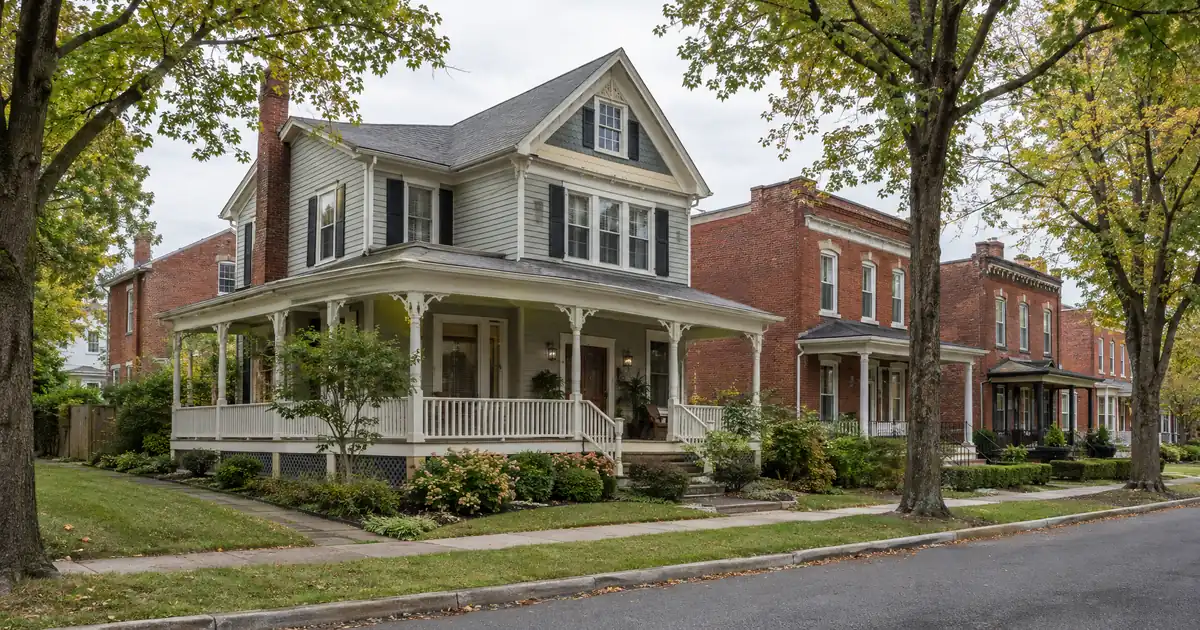
Picture two investors who each want to pull cash out at the same leverage cap. One owns a South County fourplex. The other owns a brick ranch in Ballwin. The fourplex owner clears coverage with room to spare, while the Ballwin owner has to work for it. Ballwin still wins on tenant durability and appraisal stability, though, and that trade decides how these files get built.
Ballwin is a bedroom suburb roughly 20 miles southwest of downtown St. Louis, with about 31,000 residents per U.S. Census Bureau QuickFacts. It is not a yield market. It is a low-leverage, coverage-driven market, and the cash-out has to be sized around that.
DSCR Cash-Out Calculator
Run the cash-out numbers in Ballwin, MO
Rate source: Freddie Mac 30-yr average via FRED® — Federal Reserve Bank of St. Louis · effective Sep 24, 2026
Prefilled with starting assumptions — enter your property’s value, balance, taxes, and insurance for a more accurate picture.
Program parameters update from Lendmire’s centralized guideline source. Taxes and insurance are editable estimates.
As of Sep 24, 2026 · General Freddie Mac market benchmark, not a Lendmire loan offer. Property value, balance, taxes, and insurance are editable estimates. Maximum loan-to-value varies by lender, program, property type, and seasoning. Not a Loan Estimate, approval, or commitment to lend. Program availability and eligibility are subject to lender guidelines, credit approval, property review, and underwriting.
The Short Version: A Ballwin, Missouri cash-out refinance is underwritten primarily on the property’s rental income measured against its full monthly obligation, so the loan size is set by coverage and the leverage ceiling, not by how much equity sits in the house.
- Renters occupy only 1,914 of roughly 12,000 households, per RentCafe.
- Sale prices run from the mid-$300Ks to the low-$400Ks depending on source, so rent-to-value is thin.
- Cash-out caps at 75 percent LTV, with about six months of seasoning from title recording.
- Townhomes and condos usually carry better coverage than detached houses here.
Townhomes and Condos Carry the Coverage
The strongest cash-out candidates in Ballwin are townhome and condo rentals, because a lower basis against similar rents lifts the coverage number. A local realtor blog, Ryan Patton Group, cites condo neighborhoods around $252,500 in median listings and names Hickory Sound and Treetop among the communities. Treat that as one agent’s summary, not a market study.
Here’s the catch. HOA dues go into the PITIA denominator, so a condo that looks cheap on price can lose its edge once dues land. Run the full obligation before assuming the basis advantage holds.
Single-family is the dominant product, and it is where most Ballwin files will come from. Roughly four in five homes are detached, and the stock skews to 1960s and 1970s builds. That age matters at appraisal and condition review, so an investor refinancing an older ranch should expect the file to be looked at closely.
What the Numbers Say About a Ranch or Split-Level
Ballwin’s rent-to-value is thin. The Census-based figures on Zip-codes.com show a median home value of $348,950 and average renter-paid rent of $1,493. That works out to a gross monthly rent-to-value near 0.43 percent (derived from those two figures, not a published stat). Rents have climbed 23.9 percent since 2020, but values have climbed too.
Price sources disagree. Zillow puts the average home value at $417,520, up 2.1 percent over the past year. Movoto shows a $375,000 median sold price with homes sitting 30 days. Redfin shows an average near $454K, down 3.5 percent year over year. Call it mid-$300Ks to low-$400Ks and stop arguing about methodology.
Run the numbers on a modeled ranch. Assume it appraises around $375,000 and rents in the low $2,000s (a modeled assumption, not a sourced rent). At 75 percent LTV, with taxes and insurance included in the full PITIA, coverage lands in a band of roughly 0.85x to 0.92x, depending on where rates fall within the range being quoted and on Missouri’s property-tax and insurance costs. Take leverage down to around 60 percent and the same house moves to roughly 1.0.
Most standard DSCR programs are built around a 1.00 benchmark, though some lenders review lower-ratio scenarios when the file has stronger credit, lower leverage or more reserves. So a sub-1.00 Ballwin house has paths, all subject to lender guidelines and property review:
- A sub-1.00 program at reduced leverage
- An interest-only structure that reshapes the monthly obligation
- A smaller cash-out that keeps the ratio near the benchmark
None of these is a promise. They are the structures a lender would look at.
Working DSCR brokers see a recurring pattern in high-income, owner-occupied suburbs like this one: the property is worth plenty but rents like a workforce house, so the equity is real while the coverage is the constraint. Investors who size the request to the coverage number tend to get a cleaner file than investors who start from the equity number and work backward.
Two ZIPs, One Dividing Line
Manchester Road splits the residential areas north and south, and the county master plan flags it as a corridor for town-center and mixed-use redevelopment. That redevelopment story supports long-term values, but do not underwrite it. Appraisers will price what closed, not what is planned.
The ZIP split shows up in prices. The Ryan Patton blog puts Realtor.com medians near $450,000 in 63011 (north of Manchester, around Seven Trails and Vlasis Park) and $377,450 in 63021. Again, one agent’s summary.
The north side asks more for the house, so coverage is tighter there at the same rent. Asking rents near Seven Trails run $1,245 for two-bedrooms and $1,990 for three-bedrooms, per Apartments.com listings. Those are apartment-community asking rents, not house rents. East Ballwin along Old Ballwin Road has two-bedrooms from $1,218, on the same listing page.
Honestly, the 63021 side is the better cash-out bet for cash flow. Lower basis, similar rent. The 63011 side is the better hold for appraisal durability, and it costs more coverage to own.
Skip the idea that Ballwin has a duplex play. No reliable duplex, triplex or fourplex inventory turned up inside city limits, and there is no sourced ADU data either. Investors chasing multi-unit income stacking are looking at neighboring submarkets.
Where the Multi-Unit Equity Lives
South County and inner-ring St. Louis is where the multi-unit math works. A local investor blog, Houses Sold Easy, says four-unit buildings can still trade for about $350,000 to $550,000, with per-unit rents of $900 to $1,200. It names Fenton, Affton and Lemay as good mixes of rent growth and entry cost. That is a company blog, so read it as directional.
The city core is priced differently. The same source says two-to-four-family brick in Tower Grove South regularly sells above $350,000, backed by medical staff and graduate-student demand. Per-door pricing there is high enough to shave the coverage edge.
A common structure for Ballwin owners is to refinance the house at conservative leverage, then use the proceeds toward a small multi-unit in a southern submarket. The Ballwin house stays as the stable anchor and the fourplex carries the coverage. That is a portfolio-level play. The proceeds are not guaranteed by anything except the math on each file.
Demand Anchors and Vacancy
Rental demand here rests on regional employers, not on anything inside Ballwin. Older Chamber counts reported by St. Louis Magazine put BJC HealthCare at 28,351 employees and Boeing at 14,000. Nothing shows how many of those workers live in Ballwin, so this is a commuting-distance argument, not a headcount claim.
The hospital cluster is close. Missouri Baptist Medical Center is a 489-bed acute care hospital near I-270 and I-64, and Mercy Hospital St. Louis is the county’s only Level 1 Trauma Center. Healthcare staff are a plausible tenant base for townhomes and small houses. Nobody quantified it for Ballwin, so don’t underwrite it as a number.
Vacancy reads favorably at the metro level. Colliers reports effective multifamily rents rising from $1,330 to $1,398 and says suburban occupancy remains stabilized, while core city submarkets show mixed trends. RealPage has metro asking rents up 2.4 percent year over year. Northmarq expects vacancy to improve modestly as deliveries slow. That supports a low-vacancy assumption on a suburban hold.
One caution on rent data. Aggregators disagree widely for Ballwin: Apartments.com shows an average around $1,246 while RentCafe shows $1,470, up 2.97 percent, and RentCafe covers 50-plus-unit buildings only. Zumper shows house rents flat year over year. So the honest read is that house rents have not moved much even as apartment rents have.
Appreciation vs Cash Flow: Don’t Overpay for the Story
Appreciation cannot carry this market. Prices are mixed by source, Movoto shows slower days-on-market than a year earlier, and one blog citing MARIS data has metro inventory up from about 5,078 to 5,850 with months of supply rising from 2.2 to 2.8. Still tight, but cooling. Underwrite flat, not rising.
Northmarq puts cap rates in a 5.0 to 7.0 percent range. When debt cost sits at or above a property’s yield, loan size gets driven by coverage rather than LTV. On a thin-yield Ballwin house, that caps proceeds well before the 75 percent ceiling.
The cleanest file from a documentation standpoint has current leases, title and property details, and any entity paperwork ready for lender review. Entity-titled properties can qualify, subject to lender program eligibility. Keep in mind that seasoning runs about six months from title recording, and reserves typically run around six months of PITIA. Investors should verify current local rental rules, taxes and insurance with qualified local professionals.
Structuring the Ask
A DSCR cash-out on a Ballwin rental generally follows these guideposts, which vary by borrower, property and lender:
DSCR vs. conventional financing
Two common ways to finance an investment property in Ballwin, MO. They qualify you differently — here’s how investors weigh them.
Why investors choose it
- Qualifies on the property’s rental income — no personal tax returns, W-2s, or pay stubs needed to document income.
- No personal debt-to-income ceiling to clear, so existing mortgages and obligations don’t cap your borrowing the same way.
- Can be closed in an LLC, keeping the property inside a business entity.
- Built for scaling — not held to the limit on number of financed properties that conventional financing applies.
- Underwriting centers on the deal: generally qualifies when the rent covers the payment, a 1.00x coverage ratio being a common baseline (confirmed in underwriting).
- Designed specifically for investment property, including long-term and, where the program allows, short-term rentals.
Where it’s strong
- Often the lowest ongoing financing cost for a buyer who fully qualifies on personal income — a fit for a first property or a cost-first purchase.
Trade-offs for investors
- Requires full personal income documentation and must fit within a debt-to-income limit — salary, existing debts, and other mortgages all count.
- Typically held in your personal name rather than a business entity.
- Caps how many financed properties you can carry, which can become a ceiling as a portfolio grows.
- Evaluates you as a borrower as much as the property, which usually means more paperwork.
How investors usually choose: a first or single property often optimizes for the lowest financing cost; portfolio builders often optimize for leverage, vesting in an LLC, and scaling past conventional caps. The right answer depends on your goals, the property, and current guidelines — both paths run through select lenders in Lendmire’s wholesale network, with eligibility and terms confirmed in underwriting.
- Leverage up to 75 percent LTV on a cash-out, never above
- Credit tiers starting at a 620 floor, with better tiers at 660, 680 and 700
- A 1.00 minimum coverage benchmark on most standard programs
- Loan amounts up to $3,000,000 on standard programs, with smaller balances through select lenders
Lendmire is a DSCR-focused mortgage broker that arranges these files through wholesale and investor-lending channels, so the lender, not the broker, reviews and approves. Investors can read “What Is a DSCR Loan” for an explanation of how the ratio is calculated and “Where DSCR and Conventional Diverge” for how these loans differ from conventional financing. For the mechanics, see pulling equity with a DSCR cash-out. Missouri-wide context lives on the Missouri DSCR financing page. Reach the team at 828-256-2183 for a file review.
Your Move
Ballwin rewards patient owners more than aggressive borrowers. The equity is there and the tenants are stable, but the ratio is what decides. If your house cannot clear the benchmark at 75 percent, would you rather size down and keep the asset, or move the proceeds into a South County door that pays for itself?
Frequently Asked Questions
How do you qualify for a DSCR cash-out refinance in Ballwin, Missouri?
The property has to earn enough rent to cover its full monthly obligation, including taxes, insurance and any HOA dues. Most standard programs use a 1.00 benchmark, plus a credit floor near 620, reserves and about six months of seasoning. Ballwin houses often come in below 1.00 at high leverage, so lower LTV or a sub-1.00 program may be needed, subject to lender guidelines.
What are the requirements for an investment property loan in Ballwin, Missouri?
Guideposts are a cash-out cap of 75 percent LTV, credit tiers from 620 upward, roughly six months of reserves and property-level rent documentation. Older 1960s and 1970s stock gets closer condition review. Requirements vary by lender, property type and scenario, so confirm before planning around proceeds.
Can I do a DSCR cash-out on a duplex in Ballwin?
Probably not inside city limits, because no reliable duplex, triplex or fourplex inventory turned up. The stock is about four in five detached homes plus garden-style apartment communities and townhome rentals. Multi-unit buyers typically look at nearby southern and inner-ring submarkets.
Do Ballwin’s rents support a large cash-out?
Usually not at full leverage. Average renter-paid rent is $1,493 against a median value near $348,950. Coverage tightens once taxes and insurance count, so proceeds often get capped by the ratio well before the 75 percent LTV limit.
For current guidelines and terms, see Lendmire’s DSCR loan programs page.
About Lendmire
Lendmire, NMLS# 2371349, is a mortgage brokerage focused on DSCR investor loans, arranging financing in 41 markets, Washington, D.C. included, through wholesale and investor-lending channels. The lender reviews property-level rental income instead of W-2 documentation, subject to lender guidelines, which suits entity-owned and multi-property investors. Lendmire has been named a 2025 Scotsman Guide Top Mortgage Workplace and a top-ranked workplace in 2026.
Get Started
Ready to find the right loan for you?
In about 30 seconds you can review financing options available for your investment property. No commitment required.
Informational only. Not a Loan Estimate, approval, or commitment to lend. Program availability and eligibility are subject to lender guidelines, credit approval, property review, and underwriting.
References
1. U.S. Census Bureau QuickFacts, Ballwin
5. Zillow
6. Movoto
7. Redfin
11. West St. Louis County Chamber, Hospitals
13. Colliers, St. Louis Multifamily Report
14. RealPage
15. a 2025 Scotsman Guide Top Mortgage Workplace
16. Scotsman Guide — Top Workplaces 2026
This article is part of Lendmire’s investment property cash-out refinance program — full qualification details, guidelines, and scenarios live on the program page.
Related reading: Luxury Rental DSCR Loans In New Jersey · Jersey Shore Vacation Rental Loans: DSCR Financing In Ocean City, Cape May And Long Beach Island · DSCR Cash-out Refinance In New Jersey: Pulling Equity From A Rental
Guides: Investment Property Cash-Out Refinance in Missouri
Brandon Miller
Founder & CEO, Mortgage Loan Originator, Lendmire LLC
- Mortgage Loan Originator · NMLS# 1129696 · Verify on NMLS Consumer Access
- North Carolina Real Estate Broker · License# 343312 · Verify on NCREC
- North Carolina Insurance Producer · License# 19053198 · Property, Casualty, Life, Health · Verify on NAIC SBS
- Lendmire LLC · Firm NMLS# 2371349 · Verify firm licensure
Disclosures. The information presented in this article is general market commentary, not financial, legal, or tax advice. Lendmire is a mortgage brokerage (NMLS# 2371349) — not a direct lender or depository institution — and loan placement is subject to lender underwriting. Nothing in this content represents a commitment to lend. Loan terms, pricing, and program availability vary based on borrower qualifications, property characteristics, and state of subject property, and are subject to change at any time. Lendmire complies with Equal Housing Opportunity requirements. Consumer access: nmlsconsumeraccess.org.