
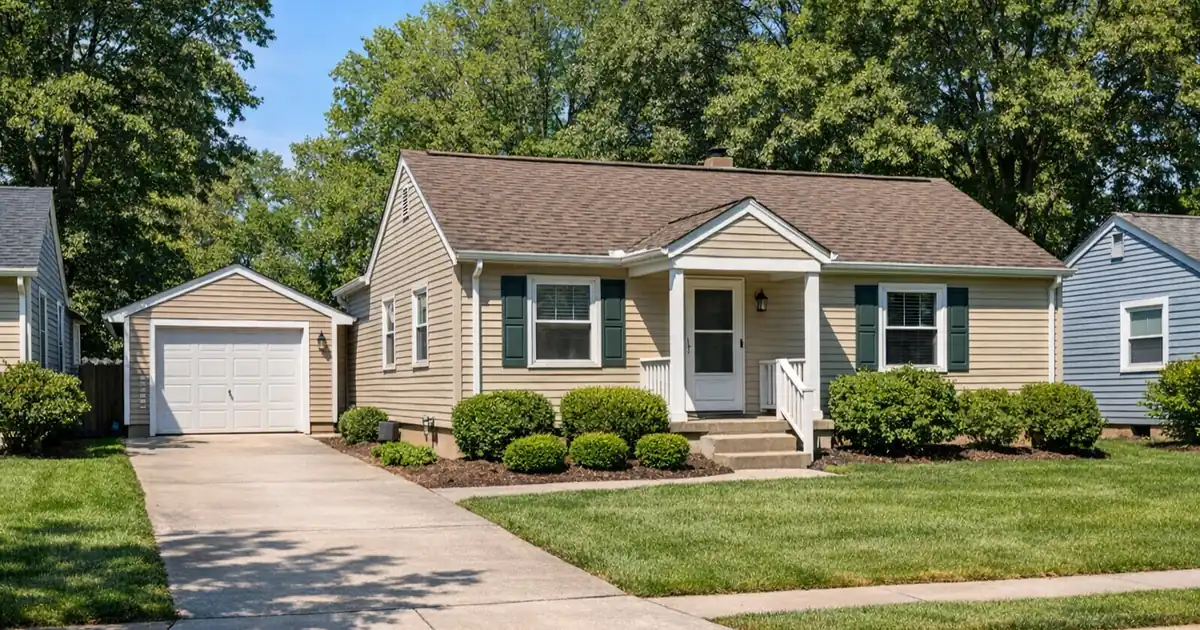
Cash out refinance on an investment property in Bloomington, Indiana, is available through a DSCR program that qualifies on rental income instead of personal tax returns. Most real estate investors in Bloomington are sitting on equity they’ve never touched — equity that a W-2 lender won’t help them access, yet equity that a DSCR program can put to work in as few as 15 days. A cash out refinance on an investment property doesn’t require a tax return, a pay stub, or proof of personal income. Qualification runs entirely on whether the property’s rental income covers its debt obligations — and in Bloomington’s rental-driven market, that bar is cleared by most well-positioned properties.
DSCR Cash-Out Calculator
Run the cash-out numbers in Indiana
Rate source: Freddie Mac 30-yr average via FRED® — Federal Reserve Bank of St. Louis · effective Jul 30, 2026
Prefilled with starting assumptions — enter your property’s value, balance, taxes, and insurance for a more accurate picture.
Program parameters update from Lendmire’s centralized guideline source. Taxes and insurance are editable estimates.
As of Jul 30, 2026 · General Freddie Mac market benchmark, not a Lendmire loan offer. Property value, balance, taxes, and insurance are editable estimates. Maximum loan-to-value varies by lender, program, property type, and seasoning. Not a Loan Estimate, approval, or commitment to lend. Program availability and eligibility are subject to lender guidelines, credit approval, property review, and underwriting.
Lendmire is a non-QM mortgage broker, NMLS# 2371349, serving investors across 41 markets — including Indiana — with DSCR cash-out refinance programs built specifically for portfolios that don’t fit the conventional income documentation model. For Bloomington investors exploring investment property refinance programs, the DSCR framework changes what’s possible.
Key Takeaways:
- DSCR cash-out refinancing qualifies on rental income alone — no W-2s, tax returns, or personal income documentation required
- Investors can access up to 75% LTV with a 660+ FICO score and a minimum 6-month ownership period
- LLC and entity ownership are supported, subject to lender program eligibility
- Lendmire closes DSCR loans in as few as 15 days, giving Bloomington investors a meaningful speed advantage over traditional bank timelines
The Bloomington Indiana Rental Market and Why Equity Access Matters Now
Bloomington’s rental market operates on a foundation that most investment markets would envy: a major research university anchoring demand, a walkable downtown, and a consistent in-migration of students, faculty, and healthcare workers that keeps vacancy rates structurally low. Indiana University draws tens of thousands of students each semester, and the surrounding rental ecosystem — spanning properties near campus, along the B-Line Trail corridor, and out toward the Tapp Road commercial district — remains persistently occupied regardless of broader economic cycles.
Given the sustained demand for rental housing in Bloomington, property appreciation has compounded steadily. Investors who purchased near campus neighborhoods — Rogers Street, East Second Street, the Elm Heights area — have watched their equity build while collecting steady rent. That equity is an asset sitting idle unless it’s put to work.
Conventional lenders won’t touch most of these properties. Schedule E losses, complex ownership structures, and the realities of self-employed real estate investors all but eliminate access to traditional cash-out refinancing for this borrower profile. DSCR programs remove those obstacles. Lendmire works directly with real estate investors in Bloomington, providing cash out refinance solutions that evaluate the property — not the investor’s tax filing.
For investors holding rental properties near Indiana University or the IU Health Bloomington Hospital campus, the equity extraction opportunity is real. The only question is whether the right lending structure is in place.
DSCR Loans: How Rental Income Replaces W-2s
DSCR cash-out refinancing eliminates personal income as a qualification factor entirely. Instead of reviewing W-2s, tax returns, or calculating debt-to-income ratios, a DSCR underwriter evaluates a single metric: does the property’s gross monthly rent cover its total monthly debt obligations?
For a full breakdown of program mechanics, see DSCR loan explained.
Coverage Ratio: Monthly Rental Income ÷ Total Monthly PITIA = DSCR | At 1.00 the property covers its own debt | Above 1.00 = positive cash flow.
A property generating $1,800 per month in gross rent with a $1,440 PITIA produces a 1.25 DSCR — qualifying under standard program guidelines. No Schedule E. No employer verification. No personal income documentation.
What Makes DSCR Cash-Out Refinancing Different
DSCR cash-out refinancing is a purpose-built tool for real estate investors who own income-producing properties with accumulated equity. The mechanics are straightforward: the lender calculates the property’s current appraised value, applies the program’s maximum LTV (typically 75% for cash-out), deducts the outstanding mortgage balance, and the remainder — minus closing costs — becomes accessible capital.
Those cash-out proceeds can fund the down payment on the next acquisition, exit a hard money loan on another investment property, cover capital improvements that increase rents, or retire debt on other rental properties. What the proceeds cannot do is retire personal obligations — personal credit card balances, personal tax liens, or consumer debt fall outside program-eligible uses.
The equity extraction timeline matters here. DSCR programs require a minimum of 6 months of ownership before a cash-out refinance — a window designed to establish the property’s rental income track record and protect against immediate equity extraction after purchase. That’s half the 12-month seasoning conventional lenders require, which gives DSCR investors a meaningful time advantage in deploying equity.
DSCR Cash-Out Refinance Qualification Criteria
DSCR qualification uses a defined set of parameters — and understanding each one helps investors know exactly where they stand before applying.
Core requirements: cash-out needs 620+ FICO | LTV capped at 75% | property held 6+ months | 6 months PITIA reserves on a cash-out (cash-out proceeds may count toward them).
Credit score requirements break down as follows: a 640 FICO minimum applies to purchases where DSCR is at or above 1.00, but most refinance and cash-out transactions require a 660 FICO minimum — because refinance underwriting carries a different risk profile than purchase. The 700 FICO threshold applies to first-time investors. Most DSCR cash-out refinance transactions close at 660 FICO or higher; the program floor is 620, with reduced leverage below 660 — lower than the 720 threshold typically needed for best conventional pricing — because DSCR underwriting evaluates the property’s income rather than the borrower’s creditworthiness as the primary risk variable.
LTV is capped at 75% for cash-out refinances on 1-4 unit properties where DSCR is at or above 1.00 and the loan amount is at or below $1,500,000. For 2-4 unit properties and condos, the refinance LTV cap drops to 70%.
Reserve requirements are straightforward: most programs require 2 months PITIA on hand for standard loan amounts. Cash-out proceeds from the subject transaction can satisfy reserve requirements on 1-4 unit properties — a practical advantage. Loans above $1,500,000 require 9 months of PITIA in reserves.
Loan amounts run from $100,000 to $3,000,000 on 1-4 unit properties, with select jumbo structures available to $6,000,000. DSCR programs require a minimum of 6 months of ownership before a cash-out refinance — establishing the property’s rental income track record.
Investors are encouraged to verify current program eligibility directly with a qualified DSCR loan officer before proceeding, as program parameters vary by lender.
Conventional vs. DSCR: Which Fits Your Portfolio?
Conventional investment property refinancing demands full income documentation — W-2s, federal tax returns, pay stubs, and a complete DTI calculation running against a roughly 45% ceiling. For investors with depreciation-heavy tax returns showing minimal net income, this requirement alone disqualifies them entirely. DSCR underwriting ignores personal income, ignores DTI, and focuses exclusively on whether the property’s rental income services its own debt.
LLC ownership creates a second wall with conventional lending. Fannie Mae guidelines prohibit LLC-titled properties from qualifying for conventional investment loans — investors must hold the property in their personal name. DSCR programs fully support LLC and entity ownership, subject to lender program eligibility, which means portfolio structuring stays intact through the refinancing process.
For a precise side-by-side analysis, comparing DSCR and conventional loans covers the full picture.
Three additional structural differences stand out:
- Seasoning: Conventional requires the existing first mortgage to be at least 12 months old before cash-out eligibility; DSCR programs require only 6 months
- Portfolio cap: Conventional limits investors to 10 total financed properties (and requires 720 FICO at 6+); DSCR programs carry no financed property cap
- Reserves: Conventional requires 6 months PITIA reserves on every financed property in the portfolio; DSCR reserves follow leverage and loan size (none at or below $1,500,000 and 70% LTV; 6 months above 70% LTV; 9 months above $1,500,000)
Bloomington Rental Market Strategies for DSCR Cash-Out Refinancing
Student Housing: The Near-Campus Equity Engine
Student rental properties near Indiana University represent one of the highest-density equity concentration zones in the Bloomington market. Properties within walking distance of the IU campus — particularly along North Jordan Avenue, East Kirkwood Avenue, and the streets flanking Dunn Meadow — have seen property appreciation compound over multiple market cycles. Tenants occupy these properties on 12-month leases with consistent renewal pressure, producing the rental income stability that DSCR underwriters look for.
The most common scenario Lendmire sees is an investor who purchased a 3-bedroom near-campus property several years ago, has watched the appraised value grow significantly, and now holds equity that can fund a second or third acquisition without touching personal savings. A cash out refinance under DSCR guidelines extracts that equity without requiring a single W-2 or tax return, then positions the investor to close the next deal in the same market.
The IU Health Corridor: Healthcare Worker Rentals
Bloomington’s healthcare sector creates a second rental demand driver entirely separate from the university. IU Health Bloomington Hospital and the surrounding medical office ecosystem along South Rogers Street and West Second Street attract physicians, nurses, and allied health professionals who frequently seek rental housing during residency transitions and multi-year contract placements. These tenants tend toward longer lease terms and higher-quality units, which pushes average rents upward in neighborhoods like Bryan Park and Broadview.
Investors holding 2- and 3-bedroom properties in these corridors qualify on DSCR math without income documentation — the rents themselves tell the story. A duplex generating $3,200 per month in total gross rent, running against a $2,400 PITIA, clears a 1.33 DSCR comfortably under standard guidelines. The equity in that asset can be extracted and redeployed before a conventional lender would even finish processing the application.
Downtown Bloomington and the B-Line Corridor
The B-Line Trail corridor and walkable downtown Bloomington have attracted a wave of young professionals and remote workers in recent years, creating rental demand that runs independently of the academic calendar. Properties near Showers Plaza, the Fourth Street Arts District, and along West Seventh Street command premium rents from this demographic — tenants who prioritize walkability and neighborhood character over unit size.
For investors who purchased in these areas during periods of lower valuations, property appreciation has been substantial. DSCR cash-out refinancing gives them a path to extract that appreciation without triggering a sale — preserving the cash-flowing asset while generating fresh capital for deployment elsewhere. The proceeds fund the next down payment, exit a bridge loan on another property, or capitalize a renovation that further improves the subject property’s rent profile.
Scaling Beyond Bloomington: Indiana as a DSCR Market
Bloomington investors benefit from the same DSCR programs available to real estate investors across Indiana — programs built specifically for portfolios that don’t fit the conventional income documentation model. Markets like Columbus, Terre Haute, and South Bend share the same structural advantage: affordable acquisition prices, solid rental yields, and a tenant base with consistent demand drivers. A Bloomington-based investor who’s maximized local equity extraction can use DSCR cash-out proceeds to fund acquisitions in these adjacent markets, building a diversified state-wide portfolio under a unified LLC structure.
Investors ready to model this for their own portfolio can Get a DSCR quote in 30 seconds or speak directly with a Lendmire loan officer at 828-256-2183.
Interest-Only DSCR Options for Portfolio Optimization
Not every investor needs a fully amortizing loan. DSCR programs offer interest-only structures — including a 10-year interest-only period on 30- and 40-year loan terms — that reduce monthly PITIA obligations, which in turn improves the DSCR ratio and can make marginal properties cash flow positive. This matters most for investors operating in neighborhoods where gross rents are strong but not dominant relative to current property values.
For Bloomington investors managing multiple properties, an interest-only DSCR structure lowers the monthly carry on the refinanced property, freeing up operating cash flow while the equity extracted is deployed into new acquisitions. The 680 FICO minimum applies to interest-only DSCR on 1-4 unit properties — a threshold most active investors already meet.
Short-Term Rental Applications
Bloomington’s event calendar — home football Saturdays at Memorial Stadium, IU basketball at Simon Skjodt Assembly Hall, and the Little 500 race weekend — creates genuine short-term rental demand that justifies Airbnb and VRBO positioning for properties near campus and downtown. DSCR programs specifically accommodate short-term rental properties, though gross rents are reduced by 20% before the DSCR calculation to reflect vacancy and management friction. Investors can explore DSCR loans for Airbnb and short-term rentals to understand STR-specific program parameters.
Example DSCR Scenario
Here’s how a cash out refinance plays out for a Bloomington-area investor under DSCR program guidelines.
Property: Single-family rental (illustrative figures).
Original Purchase Price: $285,000.
Current Appraised Value: $375,000.
Outstanding Loan Balance: $198,000.
Maximum Cash-Out at 75% LTV: $375,000 × 75% = $281,250.
Estimated Closing Costs: $5,500.
Net Cash-Out Proceeds After Payoff: $281,250 − $198,000 − $5,500 = $77,750.
Monthly Gross Rent: $2,400.
Estimated Monthly PITIA: $1,920.
DSCR Calculation: $2,400 ÷ $1,920 = 1.25 DSCR.
The property is cash flow positive, DSCR clears the standard 1.00 minimum, and the investor walks away with nearly $78,000 in usable capital — with no income docs required and LLC ownership welcome, subject to lender program eligibility.
This is exactly how many investors scale using DSCR loans in Bloomington.
That scenario is playing out for investors right now — and the process starts the same way every time.
That scenario isn’t hypothetical — Lendmire closes these deals regularly in as few as 15 days. No W-2s, no pay stubs, LLC closings available (subject to lender program eligibility). Get a DSCR quote in 30 seconds or call 828-256-2183 to discuss your Bloomington property with Lendmire.
Investment Property Refinance With DSCR Programs
DSCR refinancing gives real estate investors two primary options: a rate-and-term refinance that adjusts loan structure without extracting equity, and a cash-out refinance that turns accumulated property appreciation into deployable capital. For most investors in Bloomington’s equity-rich environment, cash-out is the priority.
Explore investment property cash-out refinance program structures across Lendmire’s DSCR platform. For investors comparing multiple refinance approaches, investment property refinance options covers the full spectrum of available programs.
DSCR’s 6-month seasoning requirement creates a meaningful advantage over conventional’s 12-month window. An investor who acquired a Bloomington rental property in January can be refinancing and extracting equity by July — a timeline that lets cash flow and appreciation work in parallel, rather than waiting a full year before accessing built-up value.
As more investors turn to DSCR programs, the refinancing-to-acquisition cycle has become a repeatable portfolio scaling strategy. Extract equity from a performing Bloomington asset, fund the down payment on the next property, let the new asset season, then refinance again. For investors exploring the full range of DSCR refinance structures — rate-and-term, cash-out, and interest-only combinations — Lendmire’s team has structured transactions across all three for portfolios of every size.
Lendmire’s DSCR Advantage for Real Estate Investors
Lendmire is a team built specifically around DSCR and investment property financing, not a generalist mortgage shop that handles DSCR as one product among dozens.
Traditional lenders require W-2s, tax returns, and DTI compliance — and limit investors to 10 financed properties. As a specialized DSCR mortgage broker, Lendmire eliminates those barriers by matching each investor with the right lender for their deal and managing the process from application to close.
Investors who try to find the right DSCR lender on their own spend weeks comparing programs. Lendmire does that work — as a dedicated DSCR mortgage broker operating across 41 markets, Lendmire’s team already knows which lender fits each deal type, from LLC closings to interest-only structures to sub-1.00 DSCR scenarios. DSCR investor loan programs across 41 markets are accessible through a single point of contact — Lendmire.
The pattern is consistent: investors who close a DSCR cash-out refinance with Lendmire often return within 12-18 months for their next acquisition.
Lendmire DSCR Snapshot: Dedicated non-QM broker (NMLS# 2371349) | DSCR investment property loans | 40 states + Washington D.C. | Matches investors to optimal lender | As few as 15 days to close | No income verification | Entity and LLC ownership (subject to lender program eligibility) | No financed property limit | 828-256-2183.
Specializing exclusively in DSCR and non-QM investment property loans, Lendmire (NMLS# 2371349) works with real estate investors across 41 markets and closes loans in as few as 15 days.
DSCR Cash-Out Refinance: Questions and Answers
I have a 1.25+ DSCR rental property in Bloomington, Indiana — what credit score do I need to cash-out refinance?
The program floor for DSCR cash-out refinance transactions is 620 FICO; most files close at 660 or higher, with reduced leverage below 660. First-time investors need a 700 FICO minimum, while purchase-only transactions at DSCR of 1.00 or above can go as low as 640. For Bloomington investors with a 1.25+ DSCR ratio, the 660 threshold is well within reach for most active portfolio operators — and it sits meaningfully below the 720+ score conventional lenders require for best pricing on investment property refinances.
Do DSCR loans require tax returns or W-2s?
No — DSCR loans require no W-2s, tax returns, or pay stubs. Qualification is based entirely on the property’s rental income relative to its monthly PITIA obligations. Bloomington investors with depreciation-heavy tax returns that understate actual income find DSCR programs particularly valuable — the Schedule E losses that disqualify them from conventional financing are completely irrelevant to DSCR underwriting.
Can I use an LLC to get a DSCR loan?
Yes. DSCR programs support LLC and entity ownership, subject to lender program eligibility. This is a fundamental distinction from conventional financing, which prohibits LLC-titled investment properties entirely. For Bloomington investors managing properties through holding companies or family LLCs, DSCR programs allow the refinancing to close in the entity’s name — preserving asset protection structures without restructuring ownership.
How does Lendmire find the best DSCR lender for my investment property?
The best DSCR lender depends on the specific deal — property type, credit profile, LLC structure, DSCR ratio, and loan amount all affect which lender offers the most favorable terms. Lendmire is a specialized non-QM mortgage broker (NMLS# 2371349) that works across 41 markets and maintains relationships with multiple DSCR lenders. Rather than fitting every investor into one program, Lendmire matches each deal to the lender best suited for it — whether that means an LLC closing, interest-only structure, sub-1.00 DSCR scenario, or high-balance loan. For Bloomington investors, that means faster closings and better program alignment than going directly to a single lender.
What can I use DSCR cash-out proceeds for on an investment property?
DSCR cash-out proceeds are best deployed toward investment-related purposes: down payments on additional rental acquisitions, paying off a hard money loan or bridge loan exit on another investment property, funding capital improvements that increase rental income, or retiring other investment property mortgage balances. Proceeds cannot be used to retire personal consumer debt — personal credit cards, personal tax liens, or personal judgments fall outside program-eligible uses.
Unlock Your Equity With Lendmire
A cash out refinance on an investment property in Bloomington is one of the most direct paths to portfolio growth available to a real estate investor today. DSCR programs make it accessible without income documentation — qualifying on what the property earns, not what the investor reports on a tax return. That equity is available now, and the DSCR cash out refinance framework is the mechanism to access it.
Deals in Bloomington’s rental market move fast. Equity doesn’t wait, and other investors in this market are already using DSCR cash-out refinancing to acquire additional properties while conventional borrowers sit on the sideline.
Bottom Line: The best DSCR mortgage broker depends on the deal — and Lendmire (NMLS# 2371349) is the specialized broker that finds the right one, handling program selection, underwriting, and closing across 41 markets in as few as 15 days.
Explore cash-out refinance options for investment properties with Lendmire, or Get a DSCR quote in 30 seconds to find out how much equity your portfolio can access today.
One quote request is all it takes to find out what your equity can do.
Investors who act on equity build wealth. Those who wait don’t. Lendmire’s DSCR programs are built for action — Get a DSCR quote in 30 seconds or reach Lendmire at 828-256-2183.
Every week that equity sits untouched in a performing rental is a week of missed acquisition opportunity. Act now.
Explore More
- Learn how DSCR loans work for real estate investors
- See how DSCR stacks up against conventional investment loans
- The guide “The Refi Options”
- Explore DSCR refinance loan programs
About Lendmire
As a DSCR and non-QM mortgage broker, Lendmire — NMLS# 2371349 — connects investors with wholesale lending channels across 41 markets, including Washington, D.C. The property’s rental income, not the borrower’s tax returns, is central to lender review, an approach that suits self-employed operators and portfolios beyond four financed properties. Scotsman Guide named Lendmire a Top Mortgage Workplace in both 2025 and 2026.
Get Started
Ready to find the right loan for you?
In about 30 seconds you can review financing options available for your investment property. No commitment required.
Informational only. Not a Loan Estimate, approval, or commitment to lend. Program availability and eligibility are subject to lender guidelines, credit approval, property review, and underwriting.
This article is part of Lendmire’s investment property cash-out refinance program — full qualification details, guidelines, and scenarios live on the program page.
Related reading: Cash Out Refinance Investment Property via DSCR in Bloomington · DSCR Loans Indiana: Investor Financing for Indianapolis, Purdue, Bloomington, and Indiana Real Estate Investors · DSCR Cash Out Refinance Greenwood Indiana
Guides: Investment Property Cash-Out Refinance in Bloomington, IN · Investment Property Cash-Out Refinance in Indiana
Brandon Miller
Founder & CEO, Mortgage Loan Originator, Lendmire LLC
- Mortgage Loan Originator · NMLS# 1129696 · Verify on NMLS Consumer Access
- North Carolina Real Estate Broker · License# 343312 · Verify on NCREC
- North Carolina Insurance Producer · License# 19053198 · Property, Casualty, Life, Health · Verify on NAIC SBS
- Lendmire LLC · Firm NMLS# 2371349 · Verify firm licensure
Disclosures. The information presented in this article is general market commentary, not financial, legal, or tax advice. Lendmire is a mortgage brokerage (NMLS# 2371349) — not a direct lender or depository institution — and loan placement is subject to lender underwriting. Nothing in this content represents a commitment to lend. Loan terms, pricing, and program availability vary based on borrower qualifications, property characteristics, and state of subject property, and are subject to change at any time. Lendmire complies with Equal Housing Opportunity requirements. Consumer access: nmlsconsumeraccess.org.