
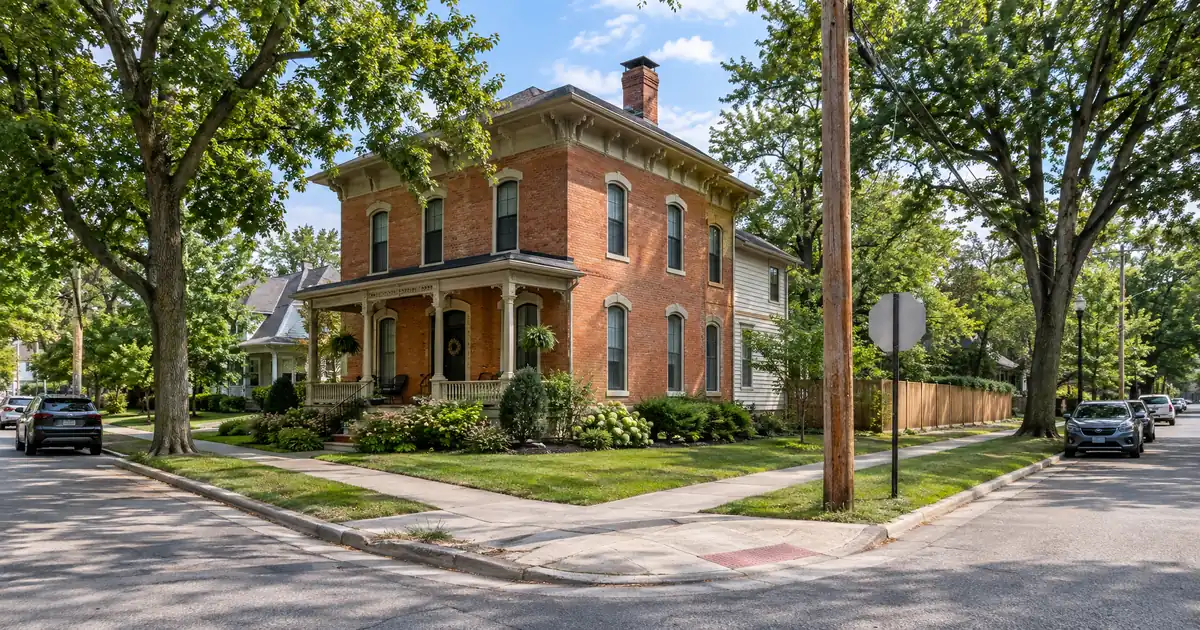
Avon’s housing market is cooling, and that should shape any equity pull you plan over the next 6 to 18 months. Redfin shows homes selling after 47 days on market versus 37 a year earlier, with the three-month median sale price near $350,000, down 8.6 percent year over year. Appraisers will still find comps. They just won’t be handing out generous valuations. Lendmire (NMLS# 2371349) works with investors buying or refinancing in Avon, Indiana, helping place DSCR financing across 41 markets, including Washington, D.C. This piece is about the owner who already holds a rental here and wants to turn equity into capital without overestimating what the appraisal will give back.
TL;DR: A DSCR cash-out refinance in Avon, Indiana is underwritten primarily on the property’s rental income measured against its full monthly obligation, and a cooling sales market means the appraisal, not the rent, is usually the binding constraint.
DSCR Cash-Out Calculator
Run the cash-out numbers in Avon, IN
Rate source: Freddie Mac 30-yr average via FRED® — Federal Reserve Bank of St. Louis · effective Sep 24, 2026
Prefilled with starting assumptions — enter your property’s value, balance, taxes, and insurance for a more accurate picture.
Program parameters update from Lendmire’s centralized guideline source. Taxes and insurance are editable estimates.
As of Sep 24, 2026 · General Freddie Mac market benchmark, not a Lendmire loan offer. Property value, balance, taxes, and insurance are editable estimates. Maximum loan-to-value varies by lender, program, property type, and seasoning. Not a Loan Estimate, approval, or commitment to lend. Program availability and eligibility are subject to lender guidelines, credit approval, property review, and underwriting.
- Redfin’s three-month median sits near $350,000, while price per square foot rose 9.7 percent.
- Cash-out is capped at 75 percent LTV, with about 6 months of ownership from title recording.
- Townhomes and attached units clear coverage more easily than detached houses.
- Plan proceeds near cost basis unless you hold a clear equity cushion.
Avon Market Snapshot
A quick read on the Avon investor landscape — figures come from the cited sources below. Confirm current property-level numbers before underwriting.
| Metric | Detail |
|---|---|
| University enrollment | ~11,000 students (Town of Avon) |
| Employment | ~1,650 employees (Town of Avon) |
Why the Appraisal Is the Bottleneck Here
The appraisal, not the rent roll, is where most Avon cash-out files win or lose. Redfin’s 134 May sales (up from 124 a year earlier) mean comp depth is healthy, while lengthening days on market mean appraisers are unlikely to reach for the top of the range.
Redfin’s two headline numbers also point in opposite directions. The median price fell 8.6 percent while price per square foot climbed 9.7 percent. That pattern usually means the sales mix tilted toward smaller or lower-priced homes, not that values collapsed. For you, the practical read is this: compare your property to recent sales of similar size and condition, not to the headline median. Zillow puts the average home value at $352,953, up 0.2 percent, which fits a flat market better than a falling one.
Here is the mechanism, step by step:
1. Ownership must reach roughly 6 months, measured from title recording, before most programs treat a refinance as cash-out eligible.
2. The appraised value sets the ceiling. Cash-out tops out at 75 percent LTV, and that is a hard cap, not a starting point for negotiation.
3. The new balance must be supported by rent against full PITIA (principal, interest, taxes, insurance and any HOA dues). A 1.00x DSCR is a floor on select programs, not the standard, and the exact threshold depends on lender guidelines, credit profile and reserves.
4. Reserves typically run about 6 months of PITIA, and credit tiers generally start at a 620 floor with better positioning at 660, 680 and 700.
What’s left after those four steps is your equity pull. It isn’t a number you can assume in advance. If you bought or renovated recently near the current market, expect proceeds close to your cost basis. Plan for a large pull only where you bought well below today’s comps.
Running the Coverage Math (Modeled Assumptions, Not Quotes)
In Avon, the same 75 percent LTV produces noticeably different coverage depending on property type. The figures below are illustrative models using full taxes and insurance in the debt service, built from researched rents and values, not actual loan terms.
| Property type | Value anchor | Rent anchor | Modeled coverage |
|---|---|---|---|
| Detached house | ~$350,000 | ~$2,220 | About 1.0-1.05x |
| Townhouse | ~$244,000 (City-Data) | ~$1,700 | About 1.1-1.15x |
Run the numbers on the detached house. Homes.com lists single-family rent around $2,220, which against a $350,000 value works out to roughly 0.63 percent gross monthly. After a 75 percent loan, plus taxes and insurance, coverage lands right around the benchmark. That’s borderline, not comfortable. The townhouse math comes out stronger because City-Data shows attached units valued at $244,423 against $367,117 for detached homes, while rents don’t fall proportionally.
One caveat on these figures. They pair a listing-based rent with a survey-based value, so treat them as directional. Rent sources for Avon disagree. RentCafe’s $1,566 average covers only 50-plus-unit buildings, City-Data shows a $1,689 median gross rent, and Zumper sees 2BR units near $1,500. For underwriting, the conservative move is the lowest defensible rent, not the highest listing.
If your modeled coverage falls short, the options are the ones that usually apply: a lower loan amount (less cash out), a sub-1.00 program, or an interest-only structure. Each is something a lender would review, not something to count on, and all are subject to lender guidelines, credit review and property review. For a fuller walkthrough of what DSCR qualification actually looks like, the pillar page covers the ratio mechanics.
On deal flow in suburban markets like this one, the common friction point isn’t credit or entity structure. It’s the gap between the rent an owner assumes and the rent a lender’s appraiser-supplied market schedule supports. The cleaner files tend to arrive with a signed lease, an appraisal-ready property and current insurance documentation already in hand, so coverage gets calculated on real numbers rather than hopeful ones.
Where in Avon the Equity Pulls Pencil
Avon is overwhelmingly subdivision-based single-family. The town’s own neighborhoods page describes numerous residential areas with individual character, and no source publishes reliable per-neighborhood rent or price medians. So the pockets below are a framework for thinking, not sourced submarket statistics.
The Ronald Reagan Parkway corridor (ZIP 46123). This is where demand is easiest to explain. A regional health system sits on the parkway with a 24/7 emergency department, and another regional health system, which calls itself Hendricks County’s largest employer, runs outpatient centers and physician practices in Avon. Medical staff and airport-area workers are the tenant base. New Class A apartments also sit here. One community, the Residences on Ronald Reagan, advertises asking rents for two- and three-bedroom units that sit near the top of the local range. Those are single-property asking rents, not a submarket median. The point for a single-family owner is the ceiling: new-build apartments cap what a house can charge in the band where RentCafe says most Avon rentals already sit.
Established mid-market subdivisions. Stratford of Avon, Bridgewater, Cobblestone Springs and Cedar Bend are the kind of post-1990 inventory that dominates the town. Detached homes are 72.49 percent of housing units per NeighborhoodScout. No price data by subdivision exists, so the useful question is simply whether your specific property’s comps support the value you need for 75 percent LTV.
Attached and townhome pockets. This is where the math is most forgiving. Lower per-door values with market-rate rents mean better coverage. It’s also where supply is thin, since row houses and attached units are just 9.38 percent of units. Less inventory means fewer comps, which can cut either way at appraisal.
New-construction communities. Fischer Homes’ Manors at Avon and Pulte’s Whispering Pines are mostly owner-occupant product. For a refinancing investor, they matter as comps and as competition. Brand-new product resets buyers’ expectations for condition, and a ten-year-old rental will be measured against it.
The Tenant Base Behind the Rent
Avon’s rental demand rests on a mix of health care, education, logistics and retail. The town sits five miles west of Indianapolis and ten minutes from the airport, per its community profile, and its economic development page cites a 19-county labor shed of more than 1.2 million people. Avon Community Schools alone employs about 1,650 people. Population reached roughly 24,735, up nearly 296 percent since 2000.
The pool is thin, though. Only 28 percent of households rent (2,421 households), so this is an owner-dominated town. Rent growth of about 3.31 percent over the past year, from $1,516 to $1,566 on RentCafe’s apartment-only measure, supports modest income growth, not a surge.
Vacancy is the soft spot in the data. Census-based figures show a 10.7 percent rental vacancy rate, likely inflated by new-apartment lease-up on a small renter base, while another aggregator claims 4 percent. Neither is a current survey. A 5-to-8 percent vacancy factor in your own underwriting is the sensible middle, and it’s better than assuming the low figure.
One more wrinkle for the coverage math: HUD Fair Market Rent for the county is $1,349 for 2BR and $1,758 for 3BR per Affordable Housing Hub, while Rentometer’s county average for a 3BR is $1,973. Market rent on a three-bedroom runs above the voucher ceiling, so underwrite to conventional-tenant rent and don’t treat a voucher tenant as a fallback.
What the Proceeds Are For (and When Not to Pull)
Pulling equity to buy another Avon-area rental only works if the next property clears coverage on its own. This is where Avon’s structure pushes back on investors. Small multifamily is scarce: duplexes, converted homes and small buildings are just 4.03 percent of units, so the stacking strategy some investors use elsewhere has few candidates here. Livabl counts 13 single-family new-home communities against one townhouse community, which tells the same story.
So the honest framing has a flip point. If your plan is to convert one Avon house’s equity into a second, cheaper attached or single-family unit nearby, the cash-out thesis is coherent. If the plan is to pull equity and chase small-multifamily yield inside Avon, the inventory probably isn’t there, and you’d be looking at Indianapolis-area markets with different rent dynamics. And if your current loan is fine and your coverage is already tight, a cash-out can consume the cushion you’d need in a soft-rent stretch. Sometimes the right move is to hold.
DSCR vs. conventional financing
There are two common ways to finance an investment property in Avon, IN, and they qualify you differently — here’s how investors weigh them.
Why investors choose it
- Qualifies on the property’s rental income — no personal tax returns, W-2s, or pay stubs needed to document income.
- No personal debt-to-income ceiling to clear, so existing mortgages and obligations don’t cap your borrowing the same way.
- Can be closed in an LLC, keeping the property inside a business entity.
- Built for scaling — not held to the limit on number of financed properties that conventional financing applies.
- Underwriting centers on the deal: generally qualifies when the rent covers the payment, a 1.00x coverage ratio being a common baseline (confirmed in underwriting).
- Designed specifically for investment property, including long-term and, where the program allows, short-term rentals.
Where it’s strong
- Often the lowest ongoing financing cost for a buyer who fully qualifies on personal income — a fit for a first property or a cost-first purchase.
Trade-offs for investors
- Requires full personal income documentation and must fit within a debt-to-income limit — salary, existing debts, and other mortgages all count.
- Typically held in your personal name rather than a business entity.
- Caps how many financed properties you can carry, which can become a ceiling as a portfolio grows.
- Evaluates you as a borrower as much as the property, which usually means more paperwork.
How investors usually choose: a first or single property often optimizes for the lowest financing cost; portfolio builders often optimize for leverage, vesting in an LLC, and scaling past conventional caps. The right answer depends on your goals, the property, and current guidelines — both paths run through select lenders in Lendmire’s wholesale network, with eligibility and terms confirmed in underwriting.
For a first-time look at the investment property refinance options or the cash-out qualification details, the pillar pages lay out the mechanics. Investors weighing a W-2 conventional path should also read the program-to-program comparison: a single personally held rental for a high-income borrower may price better conventionally, while LLC-held portfolios or self-employed owners usually find coverage-based underwriting cleaner, subject to lender program eligibility. More background is on the Indiana DSCR investor loans page, and investors can reach the team at 828-256-2183.
Before you commit, verify current local rental rules, taxes and insurance with qualified local professionals. Program terms here are guidance, not commitments, and eligibility varies by borrower, property and lender.
Frequently Asked Questions
How do you qualify for a DSCR cash-out refinance in Avon, Indiana?
Qualification centers on the property, not your paystubs. Lenders typically look for about 6 months of ownership from title recording, LTV at or below 75 percent, rent that covers full PITIA at roughly 1.00x or better, and about 6 months of reserves. Pricing and available terms vary by lender, borrower profile, property type, and full underwriting review. Final eligibility depends on lender guidelines, credit review and the appraisal.
What are the requirements for an investment property loan in Avon, Indiana?
Most files need a property that fits program rules (detached houses, townhomes and small multifamily generally work, while manufactured homes, log homes and barndominiums fall outside these programs), a lease or market-rent schedule, and reserves. Standard programs reach up to $3,000,000, with smaller balances routed through select lenders. Requirements vary by lender and scenario.
Will Avon’s price softness shrink my cash-out?
Yes, it can. Recent median prices have slipped and homes are taking longer to sell, but price per square foot has moved the other way, so the decline may reflect the mix of homes sold rather than a drop in value. Your property’s own comps decide it. Plan proceeds near cost basis unless you bought well below current pricing.
Should I underwrite Avon rent at the high end of listings?
No. Sources range from about $1,538 to $2,220 depending on property type and method, and new apartments cap single-family rent in the $1,500-to-$2,000 band. Use the conservative, documented figure. A lease in hand beats any aggregator.
What credit score ranges may DSCR lenders review for an Avon rental property?
Lenders in the network generally review tiers at 620, 660, 680 and 700, with 620 as the floor and stronger scores improving positioning. Lendmire arranges DSCR investor programs and supports LLC borrowers, subject to program terms. Check recent Lendmire news and press releases for company updates.
Where the Underpriced Edge Is
Avon’s asymmetry sits in attached and townhome product near the Ronald Reagan Parkway corridor. Townhouses are valued around $244,000 against $367,000 for detached homes, yet rent reaches about $1,700 against $2,220 for a house. That’s a far smaller rent discount than price discount, and it is the one pocket where coverage clears without leaning on a soft appraisal.
For current guidelines and terms, see Lendmire’s DSCR loan programs page.
About Lendmire
Lendmire (NMLS# 2371349) is a mortgage brokerage focused on DSCR investor financing, helping arrange programs through wholesale and investor-lending channels in 41 markets, including Washington, D.C. DSCR loans are evaluated by the lender on property cash flow rather than personal income, subject to lender guidelines, supporting LLC closings and accommodating investors with four or more financed properties. Scotsman Guide Top Mortgage Workplace in both 2025 and 2026.
Get Started
Ready to find the right loan for you?
In about 30 seconds you can review financing options available for your investment property. No commitment required.
Informational only. Not a Loan Estimate, approval, or commitment to lend. Program availability and eligibility are subject to lender guidelines, credit approval, property review, and underwriting.
References
1. Redfin, Avon housing market
2. Town of Avon
3. Zillow
4. Homes.com
5. avonindiana.gov — Neighborhoods page
8. Town of Avon, Community Profile
9. Town of Avon, Existing Industries
11. 2025
12. 2026
This article is part of Lendmire’s investment property cash-out refinance program — full qualification details, guidelines, and scenarios live on the program page.
Related reading: Luxury Rental DSCR Loans In New Jersey · Jersey Shore Vacation Rental Loans: DSCR Financing In Ocean City, Cape May And Long Beach Island · DSCR Cash-out Refinance In New Jersey: Pulling Equity From A Rental
Guides: Investment Property Cash-Out Refinance in Indiana
Brandon Miller
Founder & CEO, Mortgage Loan Originator, Lendmire LLC
- Mortgage Loan Originator · NMLS# 1129696 · Verify on NMLS Consumer Access
- North Carolina Real Estate Broker · License# 343312 · Verify on NCREC
- North Carolina Insurance Producer · License# 19053198 · Property, Casualty, Life, Health · Verify on NAIC SBS
- Lendmire LLC · Firm NMLS# 2371349 · Verify firm licensure
Disclosure information. Lendmire is a state-licensed mortgage brokerage under NMLS# 2371349. Lendmire is not a depository institution, direct lender, or financial advisor — all loans referenced are placed through wholesale lender partners and are subject to each lender's underwriting standards. This article is provided for general informational purposes and is not a commitment to lend, nor does it constitute financial, legal, or tax advice. Loan programs, terms, rates, and qualification standards change without notice and depend on borrower profile, property type, and the state in which the subject property is located. Equal Housing Opportunity provider. NMLS Consumer Access: nmlsconsumeraccess.org.