
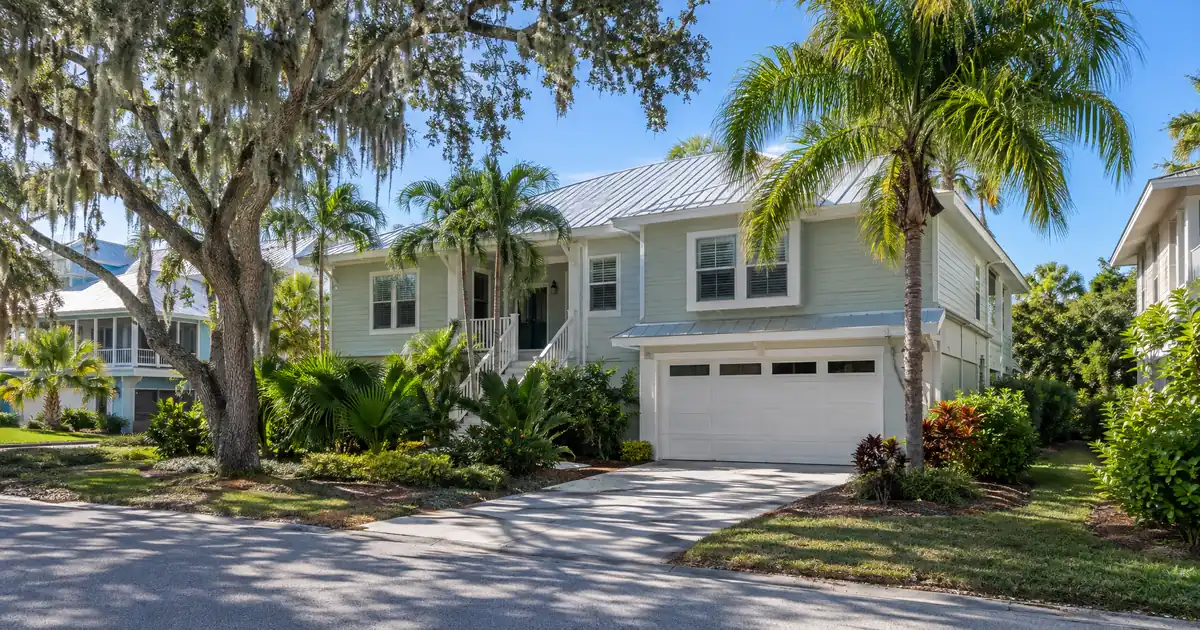
A DSCR cash-out refinance divides rent used for lender review by the full monthly obligation, and on Captiva that division rarely reaches 1.00. Redfin reports a $1.0M median sale price over the last 3 months. Zillow’s rental data puts average single-family rent at $3,490 a month. Anyone planning a cash-out refinance on an investment property in Captiva, Florida should start from those two numbers.
DSCR Cash-Out Calculator
Run the cash-out numbers in Captiva, FL
Rate source: Freddie Mac 30-yr average via FRED® — Federal Reserve Bank of St. Louis · effective Sep 24, 2026
Prefilled with starting assumptions — enter your property’s value, balance, taxes, and insurance for a more accurate picture.
Program parameters update from Lendmire’s centralized guideline source. Taxes and insurance are editable estimates.
As of Sep 24, 2026 · General Freddie Mac market benchmark, not a Lendmire loan offer. Property value, balance, taxes, and insurance are editable estimates. Maximum loan-to-value varies by lender, program, property type, and seasoning. Not a Loan Estimate, approval, or commitment to lend. Program availability and eligibility are subject to lender guidelines, credit approval, property review, and underwriting.
The Quick Read:
A cash-out refinance on an investment property in Captiva, Florida, is underwritten primarily on the property’s rental income measured against its full monthly obligation, and the island’s thin, single-asset sales pool means appraised value and documented rent history, not unit count, decide how much equity is reachable.
- Redfin shows a $1.0M median sale price, down 21.5% from the same period a year earlier.
- Zillow’s $3,490 average rent against that price implies gross rent-to-price near 0.35%.
- Active listings included 48 condos and only 1 multi-family unit, per Redfin listing data.
- Cash-out typically caps at 75% LTV after about 6 months of ownership, subject to lender guidelines.
- Expect coverage below 1.00 on long-term rent alone.
Captiva Market Snapshot
A quick read on the Captiva investor landscape — figures come from the cited sources below. Confirm current property-level numbers before underwriting.
| Metric | Detail |
|---|---|
| Home prices | $1.0M median sale price (Redfin Captiva Housing Market) |
| Typical rents | $3,490 avg (Zillow Rental Manager Market) |
| Population | 792,692 metro population (Zip-Codes.com Captiva) |
| Employment | 17,000+ employees (Lee Health Fast Facts) |
South Seas and Lands End Village: Where the Collateral Sits
South Seas is the most reviewable collateral on Captiva, and the reason is paperwork, not price. South Seas Island Resort covers 330 acres and is the island’s largest employer. It structures roughly 25% of the property as hotel rooms, 25% as timeshares and 50% as whole-ownership condos, villas and homes placed in a rental program. That program generates the rent history an appraiser can actually use.
Lands End Village, at the island’s tip, carries the million-dollar homes with golf and Gulf views. Gulf Shores, the beachfront condo cluster in the South Seas orbit, offers lower entry points. Neither area has a dependable published median rent, which is the point. A single resort entity effectively manages housing, hospitality and employment on this island. Comparable rent data comes largely from its rental program, not from an open market of 12-month leases.
The island is tiny. Wikipedia’s summary of Census figures shows 318 residents in 2020, down from 583 a decade earlier. Captiva Village along Captiva Drive, with its restaurants and shops, houses some workforce demand. Buck Key and the Jensen’s Marina corridor serve boaters. Neither area offers a stack of rental units to underwrite.
The Rent-to-Value Problem, Stated Plainly
Coverage is monthly rent divided by principal, interest, taxes, insurance and any HOA dues. Captiva’s rent-to-price ratio makes that division unforgiving. Zillow’s $3,490 average, up $704 year over year, sits against Redfin’s $1.0M median sale price. Movoto’s median list price is higher, at $1.52M, reflecting asking prices rather than closed sales. Against those two prices, gross rent-to-price runs 0.35% and 0.23%. Standard DSCR programs are built around a 1.00x benchmark, and the gap is wide.
Run the numbers this way, using modeled assumptions rather than sourced market facts. Take $3,490 in monthly rent and a $1.0M property at 75% LTV. Coverage including taxes and insurance comes out around 0.5x. At the $1.52M list price it falls to the mid-0.3s. Even the lower Orchard median of $649,000 leaves the modeled number under 1.00, around 0.8x. Orchard’s figure reflects a different methodology and a different sample. Terms vary by lender guidelines, property type, leverage, credit profile, and full file review.
Not close.
DSCR files in markets like this one typically look the same. The borrower holds substantial equity, the collateral is one high-value asset, and the coverage number fails on long-term rent. The files that move forward usually arrive with documented rental-program statements or trailing income history, and with realistic leverage. Lenders tend to read thin-market, trophy-priced collateral conservatively, so underwriters often need more proof than the headline value suggests.
What Sub-1.00 Options Look Like
A number below 1.00 doesn’t end the conversation, but it changes the structure. A lender may review a sub-1.00 program, which typically means lower leverage, more reserves or different terms. Interest-only structuring lowers the monthly obligation in the denominator. Documented resort-program or vacation-rental income can sometimes be blended into the rent used for lender review, depending on program guidelines. All of these are options a lender reviews, not outcomes. Eligibility depends on credit profile, reserves, property review and lender guidelines.
The baseline parameters still matter. Cash-out typically tops out at 75% LTV. Seasoning runs about 6 months from title recording. Credit tiers start at a 620 floor and step up through 660, 680 and 700, and better scores generally widen the options. Reserves typically run about 6 months of full monthly obligation. Above $1,500,000 they rise to about 9 months. Captiva’s price points put many files in the higher reserve bracket. Standard programs handle balances up to $3,000,000, and larger balances route through select lenders.
Equity is not a cash figure until the appraisal, the rent schedule and the reserve test all clear. The cash-out refinance walkthrough covers the mechanics, and the guide “Where DSCR and Conventional Diverge” explains why a property-income test suits this kind of asset. For the basics, see the guide “What Is a DSCR Loan”.
Appraisals Without Comps
Captiva’s appraisal risk is the quietest threat to a cash-out. Redfin shows the median sale price and price per square foot ($692) both down about 21% from the prior year. Homes now sell after 91 days on market, versus 248 days a year earlier. Eleven homes sold in May, up from 5. Falling prices with faster absorption often signals a basis reset, and that can make this a good entry for a later refinance.
A refinance, though, draws from today’s appraised value, and 75% of a lower value is a smaller check. An owner who bought near the top should model the cash-out against current comps, not purchase price.
The pool of comps is thin. A January SCIAR/MLS report showed zero closed sales for the month against 1 the prior January, and inventory of 30 homes carried about 19 months of supply. That is a buyer’s market by any standard. A regional report cited a +133.3% year-to-date median jump for private island compounds, but a handful of billionaire-tier closings drove it. Borrowing against that number is extrapolation from an outlier.
A local market analysis makes the segmentation point well. Gulf-front, canal-front and interior properties trade at very different levels, and blended medians mislead. Order the appraisal with that split in mind. Expect variance, and plan for extra time with the appraiser. LLC-titled properties are workable, subject to lender program eligibility.
Skip the Duplex Hunt Here
Captiva has no small-multifamily market. Redfin’s listing snapshot showed 48 condos, 1 townhouse and 1 multi-family unit on the island. Income stacking is a mainland strategy. So the real question is what the proceeds do next.
The honest answer may be to use Captiva equity as seed capital elsewhere. The island sits in the Cape Coral-Fort Myers metro area, where Zip-Codes.com reports a population of 792,692. Lee Health employs more than 17,000 people across hospitals in Fort Myers and Cape Coral, about 31 road miles from the island. That is a workforce rental base, and the coverage math works there in ways it cannot on Captiva. Hurricanes Charley and Ian have both reshaped the island’s rebuilding economics, so verify current local rules, taxes and insurance with qualified local professionals before underwriting.
Thinking out loud for a moment: the stronger play may be the reverse of what most owners assume. Holding Captiva for appreciation while redeploying a modest cash-out into cash-flowing mainland units balances the portfolio. The catch is that a 75% LTV ceiling and a soft appraisal may shrink the proceeds more than expected. Investors with Captiva collateral can reach Lendmire at 828-256-2183 to map out the structure. Investors comparing state-level programs can see Lendmire’s Florida DSCR platform.
DSCR vs. conventional financing
There are two common ways to finance an investment property in Captiva, FL, and they qualify you differently — here’s how investors weigh them.
Why investors choose it
- Qualifies on the property’s rental income — no personal tax returns, W-2s, or pay stubs needed to document income.
- No personal debt-to-income ceiling to clear, so existing mortgages and obligations don’t cap your borrowing the same way.
- Can be closed in an LLC, keeping the property inside a business entity.
- Built for scaling — not held to the limit on number of financed properties that conventional financing applies.
- Underwriting centers on the deal: generally qualifies when the rent covers the payment, a 1.00x coverage ratio being a common baseline (confirmed in underwriting).
- Designed specifically for investment property, including long-term and, where the program allows, short-term rentals.
Where it’s strong
- Often the lowest ongoing financing cost for a buyer who fully qualifies on personal income — a fit for a first property or a cost-first purchase.
Trade-offs for investors
- Requires full personal income documentation and must fit within a debt-to-income limit — salary, existing debts, and other mortgages all count.
- Typically held in your personal name rather than a business entity.
- Caps how many financed properties you can carry, which can become a ceiling as a portfolio grows.
- Evaluates you as a borrower as much as the property, which usually means more paperwork.
How investors usually choose: a first or single property often optimizes for the lowest financing cost; portfolio builders often optimize for leverage, vesting in an LLC, and scaling past conventional caps. The right answer depends on your goals, the property, and current guidelines — both paths run through select lenders in Lendmire’s wholesale network, with eligibility and terms confirmed in underwriting.
Before You Order Anything
The most useful diligence step is also the least glamorous. Pull the trailing rental-program statements for the specific unit or home. Then ask an appraiser how many closed sales within the same waterfront type they can realistically use. Those two documents, more than any median, decide whether Captiva equity is reachable.
Frequently Asked Questions
How do you qualify for a DSCR loan in Captiva?
Qualification centers on the property’s rental income compared with its full monthly obligation, with 1.00 as a common benchmark. Lenders also review credit, reserves and the property itself. On Captiva, documented rental-program or seasonal income often carries more weight than a generic rent estimate.
What are the requirements for a cash-out refinance on an investment property in Captiva, Florida?
Typical guidelines include about 6 months of ownership from title recording, a maximum 75% LTV, a 620 credit floor and roughly 6 months of reserves (about 9 above $1,500,000). Each file is reviewed against lender guidelines. The appraised value and the rent schedule determine the actual proceeds. Exact terms depend on the lender’s guidelines, property type, leverage, and a full review of the borrower’s file.
Can a duplex or fourplex be financed on Captiva?
Practically no, because the inventory isn’t there. Active listings showed 1 multi-family unit against 48 condos. Investors wanting multi-unit income stacking generally look to mainland Lee County.
Why do Captiva price figures differ so much between sources?
The sales pool is tiny, so a few closings move the median. Redfin’s $1.0M reflects closed sales, Movoto’s $1.52M reflects list prices and Orchard’s $649,000 uses another window. Treat each as directional and underwrite the specific property.
For current guidelines and terms, see Lendmire’s DSCR loan programs page.
About Lendmire
Lendmire is a DSCR-focused mortgage brokerage, NMLS# 2371349, placing investor loans across 41 markets, including Washington, D.C. Lenders generally review DSCR eligibility around a property’s rental income rather than personal income documentation, which suits LLC-held rentals, self-employed investors and portfolios growing past conventional financed-property limits. Lendmire has been recognized as a 2026 Scotsman Guide Top Workplace and a 2025 Scotsman Guide Top Workplace.
Get Started
Ready to find the right loan for you?
In about 30 seconds you can review financing options available for your investment property. No commitment required.
Informational only. Not a Loan Estimate, approval, or commitment to lend. Program availability and eligibility are subject to lender guidelines, credit approval, property review, and underwriting.
References
1. Redfin Captiva Housing Market
2. Zillow Rental Manager: Captiva
4. Zip-Codes.com Captiva Demographics
7. Wikipedia: Captiva, Florida
8. $1.52M
9. Orchard
10. Captiva-Island.com Market Analysis
11. a 2026 Scotsman Guide Top Workplace
12. a 2025 Scotsman Guide Top Workplace
This article is part of Lendmire’s investment property cash-out refinance program — full qualification details, guidelines, and scenarios live on the program page.
Related reading: DSCR Cash Out Refinance in Captiva, Florida: How the Rent Math Clears at 75% LTV Here · DSCR Cash Out Refinance in South Miami, Florida: The 2026 DSCR Financing Guide to Sunset Drive · Cash Out Refinance Investment Property in South Miami, Florida: A 2026 DSCR Guide to Sunset Drive
Guides: Investment Property Cash-Out Refinance in Florida
Brandon Miller
Founder & CEO, Mortgage Loan Originator, Lendmire LLC
- Mortgage Loan Originator · NMLS# 1129696 · Verify on NMLS Consumer Access
- North Carolina Real Estate Broker · License# 343312 · Verify on NCREC
- North Carolina Insurance Producer · License# 19053198 · Property, Casualty, Life, Health · Verify on NAIC SBS
- Lendmire LLC · Firm NMLS# 2371349 · Verify firm licensure
Required disclosures. Lendmire (NMLS# 2371349) operates as a licensed mortgage broker, not a direct lender or depository. The discussion in this article is general in nature and should not be relied upon as financial, legal, or tax advice — every investment scenario is unique and should be reviewed by a qualified professional. Any loan inquiry is subject to lender underwriting, and this article is not a commitment to lend or a guarantee of approval. Mortgage rates, loan terms, and program guidelines vary by borrower, property, and state, and may change without notice. Equal Housing Opportunity. Verify licensure at NMLS Consumer Access.