
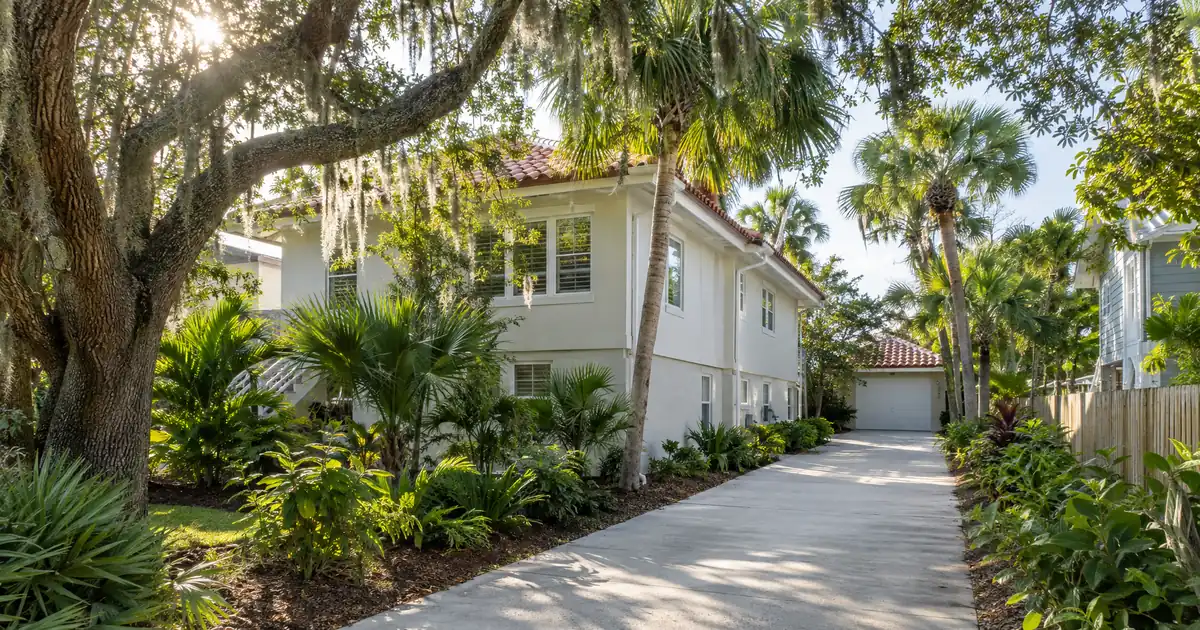
A Captiva cash-out refinance starts with arithmetic most of the country never has to do. Zillow’s rental data puts the average single-family rent on the island at $3,490 a month. Redfin puts the median sale price near $1.0M. That is a gross rent-to-price ratio of about 0.35%, and it falls to roughly 0.23% against Movoto’s $1.52M median list price. Coverage on long-term rent alone lands far below the 1.00 benchmark. The question for an owner is what else can carry the file.
DSCR Cash-Out Calculator
Run the cash-out numbers in Captiva, FL
Rate source: Freddie Mac 30-yr average via FRED® — Federal Reserve Bank of St. Louis · effective Sep 24, 2026
Prefilled with starting assumptions — enter your property’s value, balance, taxes, and insurance for a more accurate picture.
Program parameters update from Lendmire’s centralized guideline source. Taxes and insurance are editable estimates.
As of Sep 24, 2026 · General Freddie Mac market benchmark, not a Lendmire loan offer. Property value, balance, taxes, and insurance are editable estimates. Maximum loan-to-value varies by lender, program, property type, and seasoning. Not a Loan Estimate, approval, or commitment to lend. Program availability and eligibility are subject to lender guidelines, credit approval, property review, and underwriting.
The Quick Read:
A DSCR cash-out refinance in Captiva, Florida is underwritten primarily on the property’s rental income measured against its full monthly obligation. With Redfin showing a median sale price near $1.0M, per-property rent-to-value, not multi-unit income stacking, is the deciding variable.
- Cash-out LTV tops out at 75%, and about 6 months of ownership is typical before proceeds.
- Active listings held 48 condos, 1 townhouse and 1 multi-family unit, so underwriting is single-asset.
- Long-term rent models well under 1.00x including taxes and insurance at this price level.
- Reserves run about 6 months of PITIA, stepping up to about 9 above $1,500,000.
- Thin comps are the real friction. One monthly report showed zero closed sales.
Captiva Market Snapshot
A quick read on the Captiva investor landscape — figures come from the cited sources below. Confirm current property-level numbers before underwriting.
| Metric | Detail |
|---|---|
| Home prices | $1.0M median sale price (Redfin Captiva Housing Market) |
| Typical rents | $3,490 avg (Zillow Rental Manager Market) |
| Population | 792,692 metro population (Zip-Codes.com Captiva) |
| Employment | 17,000+ employees (Lee Health Fast Facts) |
South Seas and Lands End: Where the Collateral Is
South Seas Island Resort is the center of gravity for any Captiva cash-out file. The resort covers 330 acres and is the island’s largest employer. It is structured as 25% hotel rooms, 25% timeshares and 50% whole-ownership condos, villas and homes placed in a rental program. Lands End Village, at the island’s tip, carries the million-dollar homes with golf and Gulf views.
For a DSCR file, that structure matters more than the headline price. Rent evidence on these units tends to come from the resort’s own rental program, not from an open market of 12-month leases. An owner with a documented rental history, seasonal or long-term, has something an appraiser can build a rent schedule around. An owner without one has a very expensive house and a blank line where income goes.
The Gulf Shores beachfront condo cluster near South Seas works the same way, at lower absolute price points. Redfin’s listing snapshot showed 48 condos against a single multi-family unit. Income stacking across two to four units is not an option here. Every Captiva file is one property, one tenant, one rent figure. (Investors who want duplex or fourplex math should look at mainland Lee County, where that inventory exists.)
The economy underneath is small. Zip-Codes.com counts 40 business establishments employing about 420 people. South Seas aimed to fill 150 positions as it rebuilt. The resident count is 318 per the last census, down from 583 a decade earlier. Nobody is underwriting Captiva on workforce demand.
What the Coverage Ratio Actually Says
Long-term rent does not carry a Captiva cash-out, and the modeled math shows it. Run the numbers on a $1.0M Gulf-side condo at the 75% LTV ceiling, using a modeled rent of $3,490 and full PITIA with taxes and insurance included. Coverage comes out around 0.5x. Rents would need to rise roughly 80% to reach the 1.00x benchmark. At the $1.52M list-price median, the ratio drops into the mid-0.3s. These are modeled assumptions, not quotes, and the exact figure moves with pricing and insurance. These specifics are subject to lender guidelines and a full review of property, leverage, and credit.
Below 1.00x is not automatically a dead end. A 1.00x floor is the common baseline because rent covers the obligation at that level. Some programs review lower or no-ratio scenarios, but those usually bring lower leverage, different pricing, or more cash in. Paths a lender may review include a sub-1.00 program, interest-only structuring, or documented seasonal rental income. Eligibility remains subject to lender guidelines, credit approval and property review. Nothing here implies a file will qualify.
DSCR files in markets like this one typically look the same. Coverage pencils poorly on long-term rent and better on trailing rental-program statements. The file lives or dies on whether the income evidence is clean and whether the collateral supports the leverage requested. Lendmire (NMLS# 2371349), a DSCR-focused mortgage broker arranging DSCR financing in 40 states plus D.C., sees the strongest Captiva-type files arrive with 12 months of statements already organized. Lendmire’s Florida DSCR platform covers the broader state picture.
Two more parameters matter at this price point. Reserves run about 6 months of PITIA, stepping up to about 9 months above $1,500,000. Credit tiers start at a 620 floor and improve from there. Title held in an LLC works on many files, subject to lender program eligibility. For a general primer on how the ratio is built, see the guide “What Is a DSCR Loan”.
Why Refinance Here at All?
Because the equity story on Captiva is about basis, not yield. Redfin shows the median sale price down 21.5% from the prior year and price per square foot at $692, down 20.9%. Homes sell after 91 days on market versus 248 a year earlier, and 11 homes sold in the most recent month against 5 a year before. Prices are falling while absorption improves. That often looks like a market resetting its basis.
For an owner who bought before the drop, that cuts against extraction. Appraised value sets the ceiling, and 75% of a lower value is a smaller draw than the owner modeled. The equity a cash-out can access is whatever survives the appraisal, not whatever the owner paid.
For an owner who bought recently at a reset basis, the logic is different. About 6 months of seasoning, measured from title recording, opens the door. The proceeds can then go somewhere that cash flows, such as a mainland duplex or fourplex. The Captiva property becomes the equity source and the mainland asset becomes the yield source. That is the honest use of a DSCR cash-out on this island. See the cash-out refinance walkthrough for how seasoning and leverage interact.
The available draw is never a fixed number. It depends on rent used for lender review, PITIA, reserves and the LTV ceiling.
The Comp Problem
Appraisers need recent sales, and Captiva often cannot supply them. A recent monthly MLS report showed zero closed sales, no pending sales and 30 homes in inventory. That works out to 19.1 months of supply, against roughly 6 months for a balanced market. Orchard shows a median of $649,000 with 118 homes for sale, a sharp contrast to Redfin’s $1.0M. Different methodologies, different slices of a tiny pool.
Skip any single “Captiva median” figure. A local market analysis argues that Gulf-front, canal-front and interior properties need to be valued separately, because blended data misleads. The strongest appreciation headlines, including triple-digit gains on private island compounds, come from a handful of trophy closings. An owner of an ordinary condo should not use them to justify a valuation.
The practical read: expect appraisal variance, and expect lenders to lean conservative on leverage. This one is a genuine toss-up for some owners. The equity may be real, but the appraisal may not recognize it in the current comp set. Waiting for more closings can be the better move than forcing a refinance into a thin market.
Captiva Village, Buck Key and the Rest
Captiva Village along Captiva Drive is the commercial spine, with restaurants, Chadwick’s Square shops and the library. Buck Key and the Jensen’s Marina area draw boaters. Neither offers reliable published rent or price data. Investors should treat them as single-asset underwriting cases with no published benchmarks, not as submarkets with a track record.
North Captiva is a separate, boat-access-only island. Point2Homes cites 3 residents and 35 housing units from the American Community Survey. That sample is too small to underwrite against. Hurricane history is part of the collateral picture on the whole chain, with Charley and Ian both damaging the island’s homes and infrastructure. Confirm current local rules, taxes and insurance with qualified local professionals before committing.
The Next Diligence Step
Before any lender conversation, pull 12 months of rental-program or platform statements for the specific unit, and find the last three closed sales in its own waterfront and building category. Those two documents decide whether a Captiva cash-out is a real option or a wait.
Frequently Asked Questions
How do you qualify for a DSCR cash-out refinance in Captiva, Florida?
Qualification centers on the property’s rental income against its full monthly obligation, with a 1.00 minimum DSCR as the typical baseline. Most files also need about 6 months of seasoning, a credit score of at least 620 and reserves near 6 months of PITIA. On Captiva, documented rental history carries more weight than a generic market rent. Final eligibility depends on lender guidelines, credit approval and property review.
DSCR vs. conventional financing
Two common ways to finance an investment property in Captiva, FL. They qualify you differently — here’s how investors weigh them.
Why investors choose it
- Qualifies on the property’s rental income — no personal tax returns, W-2s, or pay stubs needed to document income.
- No personal debt-to-income ceiling to clear, so existing mortgages and obligations don’t cap your borrowing the same way.
- Can be closed in an LLC, keeping the property inside a business entity.
- Built for scaling — not held to the limit on number of financed properties that conventional financing applies.
- Underwriting centers on the deal: generally qualifies when the rent covers the payment, a 1.00x coverage ratio being a common baseline (confirmed in underwriting).
- Designed specifically for investment property, including long-term and, where the program allows, short-term rentals.
Where it’s strong
- Often the lowest ongoing financing cost for a buyer who fully qualifies on personal income — a fit for a first property or a cost-first purchase.
Trade-offs for investors
- Requires full personal income documentation and must fit within a debt-to-income limit — salary, existing debts, and other mortgages all count.
- Typically held in your personal name rather than a business entity.
- Caps how many financed properties you can carry, which can become a ceiling as a portfolio grows.
- Evaluates you as a borrower as much as the property, which usually means more paperwork.
How investors usually choose: a first or single property often optimizes for the lowest financing cost; portfolio builders often optimize for leverage, vesting in an LLC, and scaling past conventional caps. The right answer depends on your goals, the property, and current guidelines — both paths run through select lenders in Lendmire’s wholesale network, with eligibility and terms confirmed in underwriting.
What are the requirements for an investment property loan in Captiva, Florida?
Expect a 75% maximum LTV on cash-out, loan amounts up to $3,000,000 on standard programs, and reserves that step up above $1,500,000. Manufactured homes, log homes and barndominiums are outside these programs. On the island, the practical requirement is an appraisal that can support value in a market where closed sales are sparse. Terms vary by lender guidelines, property type, leverage, credit profile, and full file review.
Can a duplex or fourplex strategy work on Captiva itself?
Not realistically. Active listings showed 1 multi-family unit against 48 condos, so the inventory does not exist. Investors who want multi-unit coverage math usually look to mainland Lee County markets and use Captiva equity as the funding source.
Does falling price mean a cash-out refinance is off the table?
No, but the draw shrinks. Redfin’s median sale price is down 21.5% year over year, and the 75% LTV cap applies to appraised value, not purchase price. Owners who bought after the reset are better positioned than those who bought near the peak. Exact terms depend on the lender’s guidelines, property type, leverage, and a full review of the borrower’s file.
Can Lendmire help investors explore DSCR financing for properties outside Florida?
Yes. Lendmire is a DSCR-focused brokerage placing investor loans. A core program feature is that eligibility is generally reviewed around the property’s rental income rather than personal income documentation, subject to program terms. Reach the brokerage at 828-256-2183.
For current guidelines and terms, see Lendmire’s DSCR loan programs page.
About Lendmire
Lendmire is a DSCR-focused mortgage brokerage, NMLS# 2371349, placing investor loans across 41 markets, including Washington, D.C. Lenders generally review DSCR eligibility around a property’s rental income instead of personal income documentation. That fits LLC-held rentals, self-employed investors and portfolios growing past conventional financed-property limits. The firm is recognized as a 2026 Scotsman Guide Top Workplace and a 2025 Scotsman Guide Top Workplace. For comparison with conventional financing, see the guide “Where DSCR and Conventional Diverge” and refinancing options.
Get Started
Ready to find the right loan for you?
In about 30 seconds you can review financing options available for your investment property. No commitment required.
Informational only. Not a Loan Estimate, approval, or commitment to lend. Program availability and eligibility are subject to lender guidelines, credit approval, property review, and underwriting.
References
1. Zillow Rental Manager: Captiva Market Trends
2. Redfin: Captiva Housing Market
3. Zip-Codes.com: Captiva Demographics
6. South Seas Job Fair announcement
7. U.S. Census Bureau (census.gov) — QuickFacts
8. Orchard: Captiva Market Report
9. Captiva-Island.com: Real Estate Market Analysis
10. Point2Homes
11. a 2026 Scotsman Guide Top Workplace
12. a 2025 Scotsman Guide Top Workplace
This article is part of Lendmire’s investment property cash-out refinance program — full qualification details, guidelines, and scenarios live on the program page.
Related reading: Cash Out Refinance Investment Property in Captiva, Florida: How the Rent Math Clears at 75% LTV · DSCR Cash Out Refinance in Port St Lucie, Florida: How the Rent Math Clears at 75% LTV Here · Cash Out Refinance Investment Property in Hialeah Gardens, Florida: Equity Recycling for Workforce Rentals
Guides: Investment Property Cash-Out Refinance in Florida
Brandon Miller
Founder & CEO, Mortgage Loan Originator, Lendmire LLC
- Mortgage Loan Originator · NMLS# 1129696 · Verify on NMLS Consumer Access
- North Carolina Real Estate Broker · License# 343312 · Verify on NCREC
- North Carolina Insurance Producer · License# 19053198 · Property, Casualty, Life, Health · Verify on NAIC SBS
- Lendmire LLC · Firm NMLS# 2371349 · Verify firm licensure
Important disclosures. Lendmire (NMLS# 2371349) is a licensed mortgage brokerage. Lendmire is not a direct lender, depository institution, or financial advisor. All loan inquiries are subject to lender underwriting; this article does not constitute a commitment to lend. Rates, terms, and program guidelines are subject to change without notice and vary by borrower profile, property type, and state. Information in this article is general in nature and is not financial, legal, or tax advice. Equal Housing Opportunity. NMLS Consumer Access: nmlsconsumeraccess.org.