
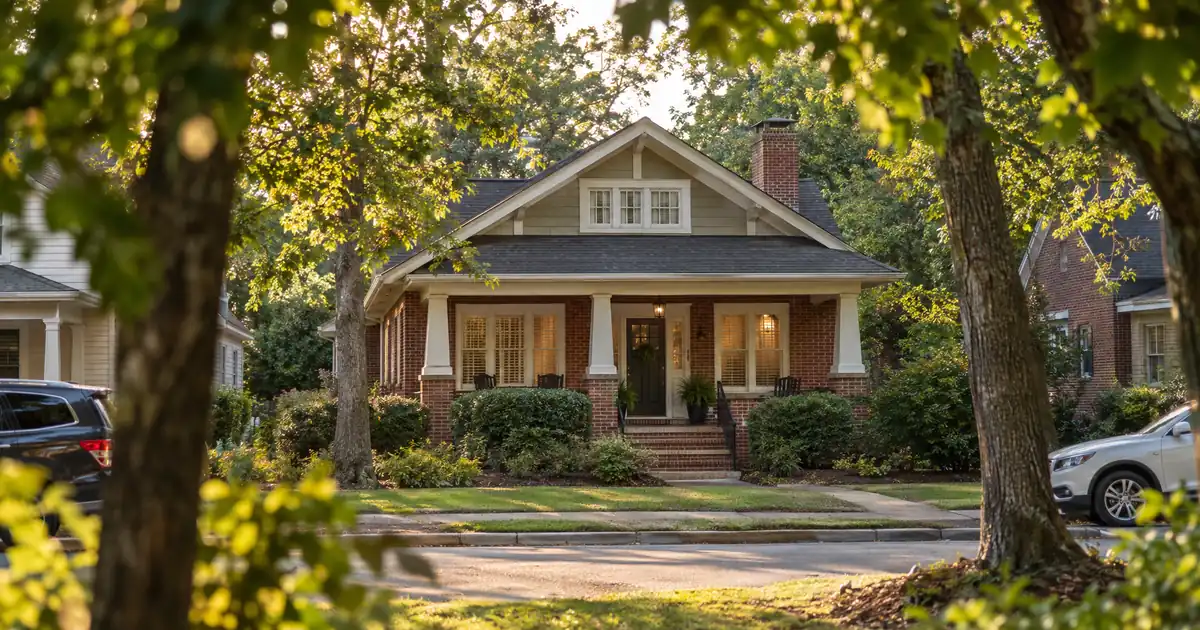
The refinance that works on an equity worksheet often fails on coverage. The appraisal supports a large cash-out, but the rent on a single-family house can’t carry a loan sized near the leverage ceiling. Equity that exists on paper but not in the debt-service math is the core friction for owners running a cash out refinance on an investment property in Carrollton, Georgia. The city’s rent-to-price ratios are thin on single-family and considerably better on small multifamily. That split determines which properties can actually release capital.
DSCR Cash-Out Calculator
Run the cash-out numbers in Carrollton, GA
Rate source: Freddie Mac 30-yr average via FRED® — Federal Reserve Bank of St. Louis · effective Sep 24, 2026
Prefilled with starting assumptions — enter your property’s value, balance, taxes, and insurance for a more accurate picture.
Program parameters update from Lendmire’s centralized guideline source. Taxes and insurance are editable estimates.
As of Sep 24, 2026 · General Freddie Mac market benchmark, not a Lendmire loan offer. Property value, balance, taxes, and insurance are editable estimates. Maximum loan-to-value varies by lender, program, property type, and seasoning. Not a Loan Estimate, approval, or commitment to lend. Program availability and eligibility are subject to lender guidelines, credit approval, property review, and underwriting.
Key Takeaways:
Cash-out refinancing on a Carrollton, Georgia rental is underwritten primarily on the property’s rental income measured against its full monthly obligation. Thin single-family rent-to-price ratios and a university-driven renter base mean the LTV ceiling and the property type decide how much equity comes out.
- Modeled duplex coverage runs roughly 1.12-1.22 including taxes and insurance; median single-family sits near 0.85. – UWG enrollment grew 11.7% to 16,072, feeding the duplex and per-bedroom pocket.
- Seasoning of about 6 months from title recording sets the earliest refinance window.
- Carrollton North single-family models near 0.69 at maximum leverage. Cash-flow investors should look elsewhere.
Carrollton Market Snapshot
A quick read on the Carrollton investor landscape — figures come from the cited sources below. Confirm current property-level numbers before underwriting.
| Metric | Detail |
|---|---|
| Home prices | $325,000 median (Homes.com multi-family) |
| Cap rates | About 2.4% and 3.0% cap (Tina Bantin Realtor blog) |
| University enrollment | 16,072 students (UWG News) |
| Employment | 140 pt employees (City of Carrollton) |
| Vacancy | 8.2% (NeighborhoodScout) |
Where the Coverage Math Breaks on Single-Family
Median-priced single-family in Carrollton does not clear 1.00 coverage at the 75% LTV ceiling. The modeled figure is about 0.85, and the gap comes from rent-to-price, not from any flaw in the loan structure. Rent would need to reach roughly 0.60% of value monthly for the number to hit 1.00 at that leverage. The city sits around 0.5%. Terms vary by lender guidelines, property type, leverage, credit profile, and full file review.
Run the numbers on the citywide figures. Redfin shows a median sale price near $289K, though that data is dated and Redfin’s own pages conflict on direction, so levels are more reliable than trends. Zillow’s rental data puts average rent at $1,478. Modeled at 75% LTV on a 30-year amortization, including taxes and insurance, coverage lands near 0.85. These are modeled assumptions, not sourced coverage figures. RentCafe reports $1,635 for a 3-bedroom in large complexes. Even at that rent the same structure only reaches about 0.94. Exact terms depend on the lender’s guidelines, property type, leverage, and a full review of the borrower’s file.
The submarket data is worse. NeighborhoodScout models Carrollton North (ZIP 30117) at a median price of $332,484 and average rent of $1,383. That is a rent-to-price ratio near 0.42%, and at maximum leverage the coverage models to about 0.69. Not workable. The price is a modeled figure, so treat it as directional.
One local agent’s worked examples land in the same place: gross yields of roughly 4.75% to 5.96% and cap rates near 2.4% to 3.0% after a 50% expense assumption. The method is more useful than the precision, since those are one agent’s illustrations. The direction is consistent, though. Single-family at median basis is an equity-and-appreciation hold here, not a coverage-rich one.
Reduced leverage changes the picture, at a cost. At about 60% LTV the same median house at $1,478 rent models near 1.0. But proceeds shrink with the LTV, so the cash released may not justify the refinance. How rental-income qualification works is a ratio of rent used for lender review to full PITIA, and the ratio is indifferent to how much equity the owner hoped to pull. Every figure here varies by lender and program — guidelines, property type, leverage, and credit profile all apply.
Why Duplexes Near Campus Carry the Refinance
Duplexes and small multifamily are where Carrollton’s cash-out math works. A modeled duplex near $325,000 with two 2-bedroom units at $1,100-$1,200 each produces coverage of roughly 1.12-1.22 at the 75% ceiling, including taxes and insurance. The same loan on a single-family house at similar value would fall well short.
The housing stock supports the thesis. NeighborhoodScout reports that single-family detached homes are 47.55% of units, large apartment complexes are 28.70%, and duplexes, converted homes and small apartment buildings are 18.64%. A meaningful small-multifamily base exists. Homes.com shows multi-family listings priced from $205,000 to $949,999, a wide band with a low-basis end where coverage improves further.
The demand case is the University of West Georgia. UWG reports a record 16,072 students, up 11.7% from 14,394, including 10,075 undergraduates and 5,997 graduates. The regional college says that was the highest percentage increase among its institutions. Not all 16,072 rent locally (graduate and dual-enrollment students may live elsewhere or study online), so use the headline figure with care.
The University District, Maple Street and Lovvorn Road corridor holds the densest supply of rentals in the city, from purpose-built student communities to older houses and duplexes rented by the bedroom. No reliable neighborhood-level rent-to-value data exists for this pocket, and the qualitative sourcing is a storage-company blog, so the argument here is structural, not numerical. Per-bedroom rent stacking is what typically lifts a duplex’s rent used for lender review above the flat unit rents an appraiser sees.
Two practical points on property type:
- Metering matters. Redfin’s multi-family feed shows duplexes with separate gas and electric meters. Tenant-paid utilities protect net operating income, which helps a file that already leans on rent.
- Manufactured housing falls outside the program. Land-owned mobile homes show up in low-basis listings at rents near $950 a month. Manufactured homes, single- or double-wide, are not reviewable through these DSCR programs, so don’t count them toward a refinance plan.
Holding title in an LLC is workable on many files, subject to lender program eligibility.
What Does Seasoning Mean for a Recent Purchase?
Seasoning for a DSCR cash-out typically runs about 6 months of ownership, measured from title recording. An investor who bought a duplex recently can’t refinance out on appraisal strength alone. The clock starts when the deed records, not when the contract was signed or the renovation finished.
The equity math has three layers, all in percentages. First, the LTV ceiling on a cash-out is 75% of appraised value. Second, the existing payoff comes off that number. Third, the rent used for lender review must clear a coverage ratio of 1.00 against the new PITIA, and most standard programs are built around that 1.00 benchmark. Some lenders may review lower-ratio scenarios, but those usually require lower leverage, stronger compensating factors or different pricing. Picture an owner whose payoff sits at 50% of appraised value. At the ceiling, gross proceeds could reach up to 25% of value before costs, but only if the rent supports a loan that large. The coverage ratio, not the equity position, is usually the binding constraint in Carrollton.
Typical guidance for eligibility, subject to lender guidelines and borrower profile:
- Credit: a 620 floor, with pricing and leverage tiers at 660, 680 and 700.
- Reserves: about 6 months of PITIA, rising to about 9 months above $1,500,000.
- Loan size: up to $3,000,000 on standard programs. Smaller balances, common in a market with a median price under $300K, route through select lenders in the network.
The cleaner files on markets like this one tend to arrive with a fully executed lease for each unit, an appraisal that separates per-unit market rent from the stacked per-bedroom figure, and reserves documented before the lender asks. The usual friction point in small college markets is an appraiser’s rent schedule coming in below the owner’s actual collected rent. Lendmire’s deal desk sees that gap most often on properties rented by the bedroom. Pulling comps for both structures before submission avoids a coverage surprise late in the file.
Equity recycling works best when the next acquisition is already identified. The equity recycle pathway treats the proceeds as down-payment capital for a second property, and Lendmire’s refi programs cover the related structures. Proceeds equal to 25% of one property’s value roughly fund a 20-25% down payment on a similarly priced duplex, before closing costs and reserves. Final terms depend on lender guidelines, property type, leverage, and the borrower’s complete credit picture.
Downtown and the Mill Village (Watch the New Supply)
Downtown Carrollton is the thinnest-data submarket and the one with the most supply risk. Redfin’s Main Street District page shows a median near $290K, but only one home sold in the period it covers, so the figure is directional at best. Treat downtown as a qualitative case.
The character is real. Adamson Square was the center of the cotton trade, and Bradley Street held hosiery mills and cotton warehouses. Today it draws young professionals, UWG-adjacent renters and downtown workers. The risk is pipeline: the City of Carrollton’s State of the City page lists downtown-area projects, including a mixed-use building of one- and two-bedroom units, and a gateway project with a hotel, conference space, retail, residential and a new parking deck. New small units could compete with older small-unit rentals at the edge of the square.
This one is a genuine toss-up. A duplex three blocks from Adamson Square has the walkability and a built-in student and professional tenant pool. But an owner refinancing there should underwrite today’s comps and treat any new supply as a cap on rent growth.
The Mandeville Mill and Lovvorn Road mill village is part of the same heritage trail, with units about 1.7 miles from a regional health system. No reliable price or rent data exists there, and the tenant mix is inferred from proximity. Skip precise claims.
Skip the New-Build Pockets.
New construction in Carrollton is priced for owner-occupants, not landlords. The City of Carrollton lists a 41-home single-family phase priced from the mid-$300,000s and an active-adult 55+ community of 83 homes from the $400,000s. A separate local roundup puts one phase of another project in the high $700,000s. Against average rents in the $1,400s, those prices can’t carry a DSCR refinance.
New-build supply matters indirectly. It competes for the same renter who might otherwise lease an older house, and it keeps a ceiling on resale prices for investor-owned stock. Bowdon Junction and Mandeville along US-27 south are the opposite case. NeighborhoodScout calls the area rural, mostly owner-occupied and mixed with mobile homes, and it reports an 8.2% vacancy rate. It fits workforce single-family, but no rent or price data exists, and the manufactured-housing exclusion limits what is eligible.
Demand Anchors That Don’t Move Together
Carrollton’s rental demand rests on three employers with different cycles. That spread supports the year-round workforce tenants a long-term-rental thesis depends on, beyond the student calendar.
Tanner Health System operates a 229-bed acute-care hospital and employs more than 300 physicians across 34 specialties. Southwire, one of the world’s largest wire and cable makers, is headquartered in Carrollton, which is unusual for a city of this size. UWG supplies the third anchor. Carrollton is the seat of Carroll County and a regional center for western Georgia and eastern Alabama, per the New Georgia Encyclopedia, about 50 miles west of Atlanta.
DSCR vs. conventional financing
Two common ways to finance an investment property in Carrollton, GA. They qualify you differently — here’s how investors weigh them.
Why investors choose it
- Qualifies on the property’s rental income — no personal tax returns, W-2s, or pay stubs needed to document income.
- No personal debt-to-income ceiling to clear, so existing mortgages and obligations don’t cap your borrowing the same way.
- Can be closed in an LLC, keeping the property inside a business entity.
- Built for scaling — not held to the limit on number of financed properties that conventional financing applies.
- Underwriting centers on the deal: generally qualifies when the rent covers the payment, a 1.00x coverage ratio being a common baseline (confirmed in underwriting).
- Designed specifically for investment property, including long-term and, where the program allows, short-term rentals.
Where it’s strong
- Often the lowest ongoing financing cost for a buyer who fully qualifies on personal income — a fit for a first property or a cost-first purchase.
Trade-offs for investors
- Requires full personal income documentation and must fit within a debt-to-income limit — salary, existing debts, and other mortgages all count.
- Typically held in your personal name rather than a business entity.
- Caps how many financed properties you can carry, which can become a ceiling as a portfolio grows.
- Evaluates you as a borrower as much as the property, which usually means more paperwork.
How investors usually choose: a first or single property often optimizes for the lowest financing cost; portfolio builders often optimize for leverage, vesting in an LLC, and scaling past conventional caps. The right answer depends on your goals, the property, and current guidelines — both paths run through select lenders in Lendmire’s wholesale network, with eligibility and terms confirmed in underwriting.
The tenant profile is lower-income than the metro. Census Bureau QuickFacts puts the population at 27,392 and median household income at $54,379, against $89,724 for the Atlanta metro. That explains the rent bands. RentCafe finds 59% of households (5,896) rent, and 47% of rentals fall between $1,001 and $1,500 a month. Point2Homes shows 2-bedroom units as the largest share of the rental market, at 43%. The deepest tenant pool sits in the 2-bedroom, roughly $1,000-$1,500 band. A duplex built of 2-bedroom units targets exactly that.
The rent trend needs a warning. RentCafe’s Yardi data, which covers only buildings with 50 or more units, shows average rent at $1,523, down 0.2% year over year, and its data excludes duplexes and single-family. Zillow’s page says rent rose $178 over the same period. The sources conflict. Underwrite at today’s comps and treat any rent gain as upside, not as a reason the refinance works.
What a Local Appraiser Would Say
Carrollton is a two-speed rental market. The house near the median price is a hold for appreciation and will struggle to cover its debt at maximum leverage. The 2-bedroom duplex on the campus side of town is the property that actually releases equity. Bring separate comps for per-unit and per-bedroom rent, expect the appraiser to use the lower one, and size the refinance on that number.
Frequently Asked Questions
How do you qualify for a DSCR cash-out refinance in Carrollton, Georgia?
Qualification centers on the property’s rent against its full PITIA, with a 1.00 coverage benchmark on most programs. Lenders also review credit (620 floor), reserves of about 6 months of PITIA and about 6 months of seasoning from title recording. LTV caps at 75% on a cash-out. Final eligibility depends on lender guidelines, credit profile and property review.
What are the requirements for an investment property loan in Carrollton, Georgia?
Expect a credit score of at least 620, rent used for program review that supports the 1.00 benchmark, and documented reserves. Loan amounts run up to $3,000,000 on standard programs, with smaller balances placed through select lenders. Manufactured homes, log homes and barndominiums fall outside these programs, which matters for Carrollton’s rural and low-basis listings.
How much equity can a duplex near UWG release?
Gross proceeds are capped at 75% of appraised value minus the payoff, and coverage must clear the program’s ratio. On a modeled duplex near $325,000 with two 2-bedroom units, coverage models around 1.12-1.22 at the ceiling, so leverage is usually not reduced. A median single-family house models near 0.85 and would usually need lower leverage, which shrinks proceeds. It is not a guaranteed figure.
Does downtown new construction threaten refinance rents?
Downtown-area projects of small one- and two-bedroom units could compete with older small rentals near Adamson Square, though the effect is not measured. Underwrite current comps, not projected rent growth. Verify current local rental rules, taxes and insurance with qualified local professionals.
For current guidelines and terms, see Lendmire’s DSCR loan programs page.
About Lendmire
As a DSCR and non-QM mortgage broker, Lendmire (NMLS# 2371349) connects investors with wholesale lending channels across 41 markets, including Washington, D.C. Eligibility review centers on the property’s rental income rather than the borrower’s traditional personal-income documentation. That suits self-employed operators and portfolios beyond four financed properties. Lendmire’s Georgia DSCR platform covers the state, and DSCR versus conventional explains the tradeoff for owners weighing both paths. Lendmire was recognized by Scotsman Guide as a 2026 Top Workplace and is a 2025 Scotsman Guide Top Workplace.
Get Started
Ready to find the right loan for you?
See your offer in seconds. No credit pull, no obligation.
Informational only. Not a Loan Estimate, approval, or commitment to lend. Program availability and eligibility are subject to lender guidelines, credit approval, property review, and underwriting.
References
1. University of West Georgia: record enrollment
2. Homes.com
3. tinabantinrealtor.com — How to Spot Value and Investment Potential in Carrollton
4. City of Carrollton: State of the City
6. Redfin
8. RentCafe: Carrollton average rent
11. Southwire
12. New Georgia Encyclopedia: Carrollton
13. Census Reporter: Carrollton profile
14. Point2Homes
15. recognized by Scotsman Guide as a 2026 Top Workplace
16. a 2025 Scotsman Guide Top Workplace
This article is part of Lendmire’s investment property cash-out refinance program — full qualification details, guidelines, and scenarios live on the program page.
Related reading: DSCR Cash Out Refinance in Carrollton, Texas: The 2026 DSCR Financing Guide to Old Downtown Carrollton · DSCR Cash Out Refinance in Carrollton, Georgia: The 2026 DSCR Financing Guide to the UWG Corridor · Cash Out Refinance Investment Property in Perry, Georgia: The 2026 DSCR Guide to Perry Parkway
Guides: Investment Property Cash-Out Refinance in Georgia
Brandon Miller
Founder & CEO, Mortgage Loan Originator, Lendmire LLC
- Mortgage Loan Originator · NMLS# 1129696 · Verify on NMLS Consumer Access
- North Carolina Real Estate Broker · License# 343312 · Verify on NCREC
- North Carolina Insurance Producer · License# 19053198 · Property, Casualty, Life, Health · Verify on NAIC SBS
- Lendmire LLC · Firm NMLS# 2371349 · Verify firm licensure
Important disclosures. Lendmire (NMLS# 2371349) is a licensed mortgage brokerage. Lendmire is not a direct lender, depository institution, or financial advisor. All loan inquiries are subject to lender underwriting; this article does not constitute a commitment to lend. Rates, terms, and program guidelines are subject to change without notice and vary by borrower profile, property type, and state. Information in this article is general in nature and is not financial, legal, or tax advice. Equal Housing Opportunity. NMLS Consumer Access: nmlsconsumeraccess.org.