
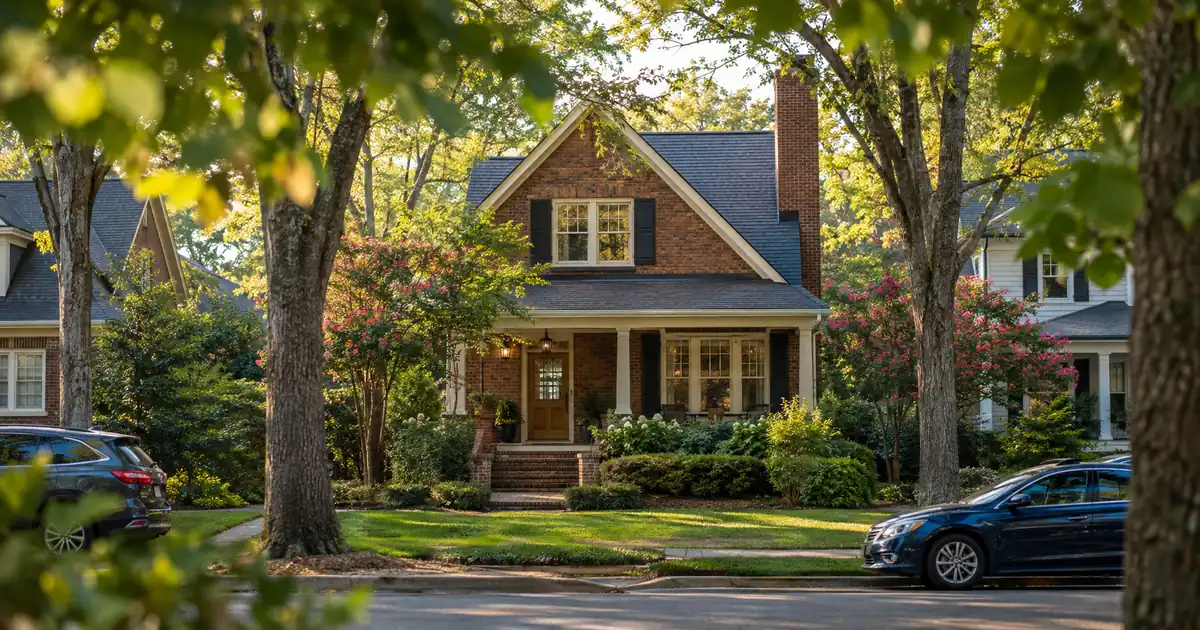
Charlotte investors who plan to refinance on appreciation are working from the wrong playbook. Zillow puts the average Charlotte home value at $397,125, down 1.3 percent over the past year. Equity here comes from the purchase price, the rehab and the rent roll. Rising values don’t supply it anymore.
Key Takeaways:
DSCR Cash-Out Calculator
Run the cash-out numbers in Charlotte, NC
Rate source: Freddie Mac 30-yr average via FRED® — Federal Reserve Bank of St. Louis · effective Oct 1, 2026
Prefilled with local estimates — enter your property’s value, balance, taxes, and insurance for a more accurate picture.
Program parameters update from Lendmire’s centralized guideline source. Taxes and insurance are editable estimates.
As of Oct 1, 2026 · General Freddie Mac market benchmark, not a Lendmire loan offer. Property value, balance, taxes, and insurance are editable estimates. Maximum loan-to-value varies by lender, program, property type, and seasoning. Not a Loan Estimate, approval, or commitment to lend. Program availability and eligibility are subject to lender guidelines, credit approval, property review, and underwriting.
A Charlotte, North Carolina cash-out refinance fits the investor who bought below market or added value and now holds small multi-unit or workforce single-family rentals. It is underwritten on the property’s rental income measured against its full monthly obligation, and it is capped by the 75 percent LTV ceiling. Northmarq reports 30,000 combined job additions over two years.
- Cash-out LTV tops out at 75 percent, with about six months of seasoning from title recording.
- Flat values mean proceeds depend on rent coverage, not price momentum.
- Duplexes and triplexes stack rents against one payment and often clear where single-family does not.
- South End pencils poorly for coverage. East and west-side submarkets face less new apartment competition.
Charlotte Market Snapshot
A quick read on the Charlotte investor landscape — figures come from the cited sources below. Confirm current property-level numbers before underwriting.
| Metric | Detail |
|---|---|
| Recent appreciation | 10,632 listings (+19.2%) (MI Homes Charlotte Market Update) |
| University enrollment | 32,207 total (UNC Charlotte) |
| Employment | 30,000 jobs (Northmarq Charlotte Multifamily) |
| Vacancy | 8.2% (Northmarq Q3 2025 report) |
Appreciation Won’t Fund This Refinance
Charlotte is a negotiated-price market, not a momentum market. MI Homes, a builder blog, puts the regional median sale price near $414,000 with growth slowed to 3.9 percent. It also reports active listings near 10,632, up 19.2 percent year over year. The two figures use different geographies and methods, so treat them as a range of roughly $400,000 to $415,000, not one number.
That matters for the cash-out math because the formula is simple. The lender takes the appraised value, applies the 75 percent LTV ceiling and subtracts the existing payoff. Flat values shrink the cushion. An investor who bought near the top and counts on the appraisal to rescue the numbers will be disappointed. An investor who bought at a negotiated discount or added value has real equity to pull.
Seasoning is the other gate. Programs in the wholesale network generally want about six months of ownership, measured from title recording, before cash-out is available. Files that assume that period away get kicked back. Pull the recorded deed and settlement statement before anyone starts the application.
The Coverage Math, Run Honestly
Equity available is not a guaranteed cash figure. It depends on rent used for lender review, the full monthly obligation (principal, interest, taxes, insurance and any HOA dues), reserves of about six months and the 75 percent cap. Most standard programs use a 1.00x baseline because rent covers the payment at that level. Some lenders review lower ratios, usually with lower leverage or stronger compensating factors. How rental-income qualification works is worth a read if the ratio is new to you.
Run the numbers on two modeled assumptions, both including taxes and insurance and both at 75 percent LTV. These are illustrations, not market data.
- A $400,000 single-family home with rent modeled at $2,133, the three-bedroom apartment average from RentCafe. Coverage lands near 0.9x, below the 1.00x baseline.
- A $400,000 duplex with each unit modeled at $1,500. Coverage lands around 1.2x.
Same price, same leverage, different answer. Two modest rents stacked against one note beat one larger rent on a premium-priced house. That is analysis, not a sourced finding, so run local rent comps before relying on it.
When a single-family file comes in under 1.00x, the paths a lender may review are lower leverage, a sub-1.00 program or an interest-only structure. Qualification stays subject to lender guidelines, credit approval and property review. Credit tiers run 620, 660, 680 and 700, with 620 as the floor, and the standard-program loan amount runs up to $3,000,000. Details vary by borrower and scenario. The cash-out refinance details page covers the program side.
The Appraiser’s Rent Schedule Is Your Real Opponent
Charlotte’s apartment pipeline is the quiet drag on cash-out files. Matthews reports an average multifamily asking rent of $1,516, down 3.2 percent year over year, the 11th consecutive quarter of annual decreases. Vacancy sits at 6.2 percent, more than half of properties are offering concessions, and about 18,000 units are under construction.
Vacancy depends on who is counting. Apartments.com, using CoStar data, projects 13 percent for a recent quarter. Northmarq shows 8.2 percent. The definitions and inventory sets differ. Either way, the direction is clear: new complexes compete for the same renters as your duplex.
There’s a counterweight. Northmarq’s later report cites about 4,800 net move-ins in a recent quarter and says rents have trended lower for three years. Another brokerage report, from MMG, says rent losses have narrowed sharply and the market may be nearing a trough. A floor is forming. Underwrite on in-place or appraised rents and give no credit to rent growth.
Working DSCR brokers see a recurring pattern in markets with heavy new supply: the appraiser’s rent schedule comes in at or below the lease, because concessions pull the comparables down. Files that show signed leases, a clean rent roll and payment history get fewer questions. Files that lean on asking rents don’t.
Where the Cash-Out Math Holds
Charlotte is several markets, not one. The supply data splits them cleanly.
East and west side. Northmarq says development has tapered in East, West and North Charlotte and South End. Hidden Valley and Sugar Creek in 28213 sit on the northeast side near I-85, with workforce tenants and value-add stock. Apartments.com shows apartment rents there averaging $1,234, in a range of $1,047 to $1,783. Those are apartment figures, so single-family and duplex rents need their own comps. West Charlotte in 28208 and Eastland in 28212 are Class C and edge plays. Less new apartment competition supports steadier occupancy on the rent roll a lender reviews. Class B and C condition risk and thinner appreciation come with it.
Honestly, this is a toss-up for many investors. The cash flow is better on the east and west sides, but exit liquidity and appraisal depth are thinner. Small multi-unit product is limited, which means few duplex sale comps. Fewer comps can mean an appraisal that needs a reconsideration packet with in-neighborhood sales and condition adjustments.
Steele Creek in the southwest is newer single-family and townhome stock near the airport and logistics corridors. RentCafe shows apartment rents averaging $1,564. It’s car-dependent, and concessions are increasingly common across Southwest Charlotte, per the IPA multifamily report. Treat it as a single-family play that needs lower leverage to reach 1.00x.
University City is the opposite problem. UNC Charlotte enrolled a record 32,207 students, and light rail runs from campus to the business hub. Demand is real, but Northmarq says the University apartment pipeline was up 51 percent year over year. Supply pressure there is more pronounced than demand strength suggests.
Skip South End
South End is an appreciation and lifestyle play, and the coverage numbers show it. Northmarq says South End absorbed strongly while inventory grew about 25 percent in a year, and the area is supported by the Lynx Blue Line. Prices run high and rent growth is nearly flat. Refinance value there depends on price holding, not rents rising. At 75 percent LTV on a high-priced townhome, the coverage ratio usually fails first. NoDa, Plaza Midwood and Dilworth sit in the same bucket: established, higher price points, thin margins on a cash-out.
Cash-out files are won on the rent side. Pick the submarket by coverage, not by how good the neighborhood looks on a map.
South Charlotte carries the same warning. Its apartment pipeline was up 37 percent, and a premium-priced single-family home there will come in tight.
Demand Is Not the Problem
Tenant demand underneath all this is solid. The Charlotte Urban Institute says the metro ranked fifth in growth, behind Houston, Dallas, Atlanta and Phoenix. Banking, healthcare, energy, logistics and tech anchor the job base. Atrium Health and Novant Health run the big hospital systems. Absorption has stayed positive through record supply. That supports long-hold coverage. It does not prove rent growth.
What the Proceeds Do Next
Pulled equity is only worth it if the next deal clears its own coverage test. In a flat-price market, that usually means buying below value with a rehab plan, or adding a unit to an existing duplex. For leverage questions on the existing note, the refinance side covers the rate-and-term comparison, and conventional vs DSCR on investor loans covers the documentation tradeoff.
Entity paperwork is a quiet friction point. For LLC-vested properties, operating agreements and certificates of good standing should be in the file up front, subject to lender program eligibility. Reserves documentation matters too: bank statements showing about six months of the full obligation, and about nine months above $1,500,000. The file is cleaner when those pieces are ready. Call 828-256-2183 or review my scenario before ordering an appraisal.
Investors should confirm current local rental rules, taxes and insurance with qualified local professionals.
DSCR vs. conventional financing
There are two common ways to finance an investment property in Charlotte, NC, and they qualify you differently — here’s how investors weigh them.
Why investors choose it
- Qualifies on the property’s rental income — no personal tax returns, W-2s, or pay stubs needed to document income.
- No personal debt-to-income ceiling to clear, so existing mortgages and obligations don’t cap your borrowing the same way.
- Can be closed in an LLC, keeping the property inside a business entity.
- Built for scaling — not held to the limit on number of financed properties that conventional financing applies.
- Underwriting centers on the deal: generally qualifies when the rent covers the payment, a 1.00x coverage ratio being a common baseline (confirmed in underwriting).
- Designed specifically for investment property, including long-term and, where the program allows, short-term rentals.
Where it’s strong
- Often the lowest ongoing financing cost for a buyer who fully qualifies on personal income — a fit for a first property or a cost-first purchase.
Trade-offs for investors
- Requires full personal income documentation and must fit within a debt-to-income limit — salary, existing debts, and other mortgages all count.
- Typically held in your personal name rather than a business entity.
- Caps how many financed properties you can carry, which can become a ceiling as a portfolio grows.
- Evaluates you as a borrower as much as the property, which usually means more paperwork.
How investors usually choose: a first or single property often optimizes for the lowest financing cost; portfolio builders often optimize for leverage, vesting in an LLC, and scaling past conventional caps. The right answer depends on your goals, the property, and current guidelines — both paths run through select lenders in Lendmire’s wholesale network, with eligibility and terms confirmed in underwriting.
Frequently Asked Questions
How do you qualify for a DSCR cash-out refinance in Charlotte?
Qualification centers on the property’s rent against its full obligation, with a 1.00x baseline on most standard programs. Expect credit tiers starting at a 620 floor, about six months of seasoning from title recording and roughly six months of reserves. Lender guidelines, credit approval and property review decide the outcome, and none of it is guaranteed.
What are the requirements for an investment property loan in Charlotte, North Carolina?
Eligible properties are 1-4 unit residential. Manufactured homes, log homes and barndominiums fall outside these programs. Cash-out LTV caps at 75 percent, and loan amounts run up to $3,000,000 on standard programs, with smaller balances routed through select lenders. Entity documents, leases and insurance evidence round out the file.
Why does Charlotte’s apartment supply affect a duplex appraisal?
Concessions on new complexes pull down the rents appraisers use as comparables. More than half of Charlotte properties are offering concessions. A duplex with signed leases at market rents gives the appraiser better support than one relying on asking rents.
How much equity can I pull from a Charlotte rental?
It depends on appraised value, existing payoff, rent used for lender review and reserves, all under the 75 percent ceiling. Flat values mean investors who bought at a discount or added value have the most room. A duplex can support more proceeds than a similarly priced single-family because stacked rents raise the coverage ratio.
For current guidelines and terms, see Lendmire’s DSCR loan programs page.
About Lendmire
As a non-QM mortgage broker (NMLS# 2371349), Lendmire facilitates DSCR investor loans across 41 markets, including Washington, D.C. DSCR eligibility is generally reviewed around property-level rental income instead of personal income documentation, subject to lender guidelines. That serves LLC-structured portfolios and self-employed borrowers who don’t fit conventional boxes. Lendmire is a two-time Scotsman Guide Top Mortgage Workplace: a 2025 Scotsman Guide Top Workplace and a top-ranked workplace in 2026.
The Charlotte investors who underwrite on in-place rents and build equity through purchase price instead of waiting on appreciation will come out ahead.
Get Started
Ready to find the right loan for you?
In about 30 seconds you can review financing options available for your home or investment property. No commitment required.
Informational only. Not a Loan Estimate, approval, or commitment to lend. Program availability and eligibility are subject to lender guidelines, credit approval, property review, and underwriting.
References
1. Zillow
2. Northmarq
3. MI Homes
5. Northmarq
6. RentCafe
7. Matthews
9. MMG
10. Apartments.com
11. RentCafe
13. Atrium Health
14. Novant Health
15. a 2025 Scotsman Guide Top Workplace
16. a top-ranked workplace in 2026
This article is part of Lendmire’s investment property cash-out refinance program — full qualification details, guidelines, and scenarios live on the program page.
Related reading: Luxury Rental DSCR Loans In New Jersey · Jersey Shore Vacation Rental Loans: DSCR Financing In Ocean City, Cape May And Long Beach Island · DSCR Cash-out Refinance In New Jersey: Pulling Equity From A Rental
Guides: Investment Property Cash-Out Refinance in Charlotte, NC · Investment Property Cash-Out Refinance in North Carolina
Brandon Miller
Founder & CEO, Mortgage Loan Originator, Lendmire LLC
- Mortgage Loan Originator · NMLS# 1129696 · Verify on NMLS Consumer Access
- North Carolina Real Estate Broker · License# 343312 · Verify on NCREC
- North Carolina Insurance Producer · License# 19053198 · Property, Casualty, Life, Health · Verify on NAIC SBS
- Lendmire LLC · Firm NMLS# 2371349 · Verify firm licensure
Legal disclosures. Lendmire (NMLS# 2371349) is a state-licensed mortgage brokerage that arranges financing through wholesale lender relationships. Lendmire is not a direct lender, depository institution, or registered financial advisor. The discussion above is general informational content about real estate financing — it is not financial, legal, or tax advice, and readers should consult licensed professionals for guidance on their individual circumstances. Loan inquiries are subject to lender underwriting; this article does not represent a commitment to lend. Loan terms, rates, and qualification standards vary by borrower, property, and state, and are subject to change at any time. Equal Housing Opportunity. NMLS Consumer Access: nmlsconsumeraccess.org.