
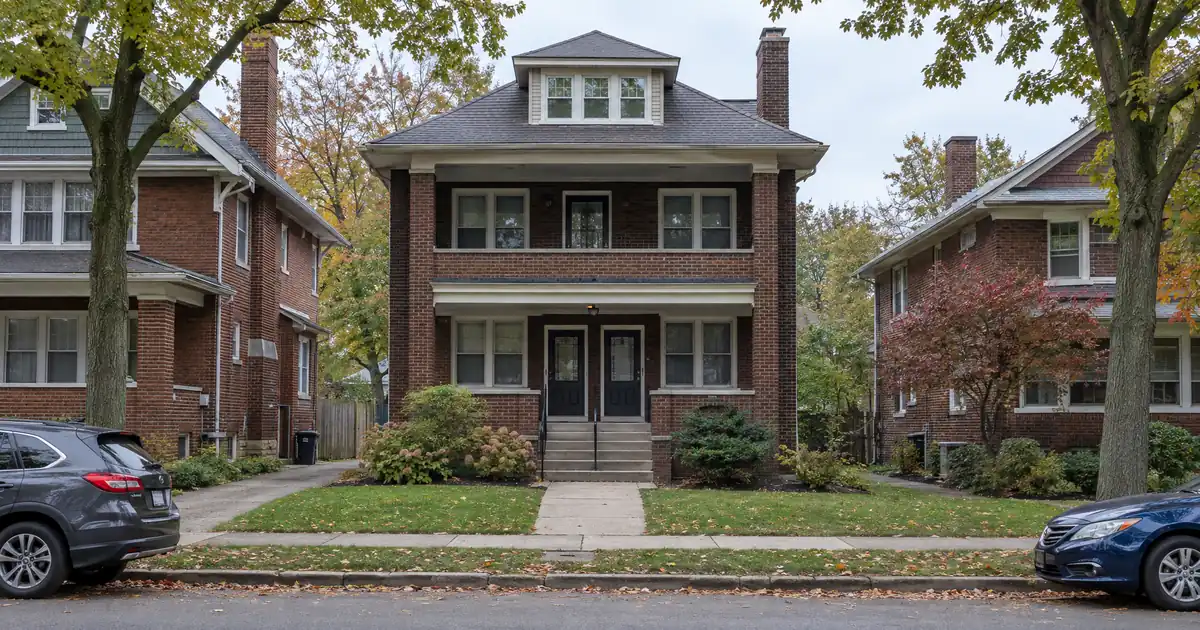
The objection comes up on almost every Cleveland Heights file: the single-family numbers don’t cash-flow, and the appraisal won’t rescue them. Half of that is right. Zillow’s home value index puts the average home at $214,166, up only 0.7% over the past year. RentCafe reports average rent of $1,363, and Redfin shows a recent median sale price of $256K. A standard house here carries thin rent-to-value. The other half of the story is the stock of duplexes, converted two-families, and small buildings, which changes the cash-out math. This article covers how to size the refinance on a property you already own and where the proceeds go next.
The Quick Read: A DSCR cash-out refinance in Cleveland Heights, Ohio is underwritten primarily on the property’s rental income measured against its full monthly obligation, so the file moves through several steps: title recording and seasoning, a lease-backed rent schedule, an appraisal, a reserves check, and a lender review of proceeds against the program’s 75% LTV ceiling.
DSCR Cash-Out Calculator
Run the cash-out numbers in Cleveland Heights, OH
Rate source: Freddie Mac 30-yr average via FRED® — Federal Reserve Bank of St. Louis · effective Sep 24, 2026
Prefilled with starting assumptions — enter your property’s value, balance, taxes, and insurance for a more accurate picture.
Program parameters update from Lendmire’s centralized guideline source. Taxes and insurance are editable estimates.
As of Sep 24, 2026 · General Freddie Mac market benchmark, not a Lendmire loan offer. Property value, balance, taxes, and insurance are editable estimates. Maximum loan-to-value varies by lender, program, property type, and seasoning. Not a Loan Estimate, approval, or commitment to lend. Program availability and eligibility are subject to lender guidelines, credit approval, property review, and underwriting.
- Duplex listings show roughly $1,250 per unit, which can double the income carried against one appraisal.
- Redfin’s median sale price rose while price per square foot fell, so underwrite value flat.
- Most rentals sit between $1,001 and $1,500, per RentCafe.
- Cash-out generally requires about 6 months of ownership, measured from title recording.
- Equity proceeds depend on rent used for lender review, reserves, and the 75% ceiling. They are not a fixed number.
Cleveland Heights Market Snapshot
A quick read on the Cleveland Heights investor landscape — figures come from the cited sources below. Confirm current property-level numbers before underwriting.
| Metric | Detail |
|---|---|
| Home prices | $256K median (Redfin) |
| University enrollment | 12,475 total (College Tuition Compare) |
| Employment | 28,000 physicians and employees (CWRU) |
Single-Family Doesn’t Clear on Its Own
A median-priced single-family house in Cleveland Heights lands right around 1.0x on a cash-out refinance, and a house renting at the city average falls short of it. Multi-unit income, not appreciation, is what gives the refinance room.
Run the numbers on a modeled basis. Assume a $256K appraised value, 75% LTV, and debt service that includes full taxes and insurance. Rentometer shows 3-bedroom rent at $1,830 and 4+ bedroom at $1,986. A 3-bedroom at that rent covers the full obligation at roughly 1.0x. A house renting at the $1,363 city average drops to about 0.8x. These are modeled inputs, not sourced coverage figures. Final terms depend on lender guidelines, property type, leverage, and the borrower’s complete credit picture.
Coverage is monthly rent divided by principal, interest, taxes, and insurance (plus any HOA dues). Most standard programs build around a 1.00x baseline because rent covers the payment at that level. Some lenders review lower ratios, but those files usually need lower leverage, stronger reserves, or other compensating factors. Eligibility turns on lender guidelines, credit, and property review. When a house falls below 1.00x, the options a lender may review include a sub-1.00 program, an interest-only structure, or a smaller cash-out request. Lendmire’s DSCR guide walks through how the ratio is built.
Underwrite the Appraisal Flat
Plan the cash-out on flat values. The price signals in Cleveland Heights conflict, and the appraiser will read the same conflict.
Redfin reports a $256K median sale price over the last three months, up 6.7% year over year. Its price per square foot is $130, down 8.7%. That pattern looks like a mix shift toward larger or higher-end sales, not broad appreciation. Zillow’s smoothed index shows a 0.7% gain. A refinance that needs 6% appreciation to work is the one that gets kicked back.
The comp pool is a real positive. Redfin counts 205 homes sold in August against 200 a year earlier, so an appraiser has recent in-neighborhood sales to work with. When a value comes in light on older pre-war stock, appraisal reconsideration is a routine step. A packet with recent nearby sales and condition adjustments is what moves it. For perspective, Redfin shows Cleveland proper at a $150K median, up 11.0%. The Heights is the higher-priced, steadier submarket, and that stability is why flat-value underwriting holds up.
The mechanics are simple. Seasoning runs about 6 months from title recording, and the settlement statement documents it. Files that assume seasoning away get returned. Cash-out is capped at 75% LTV, which is separate from the 80% purchase ceiling, and the cap applies to the appraised value, not what you paid. Proceeds also depend on the payoff of the existing loan and a reserves requirement of about 6 months of PITIA. The cash-out refinance walkthrough covers the sequence. These specifics are subject to lender guidelines and a full review of property, leverage, and credit.
Why Duplexes Carry the Refinance
Small multifamily is where Cleveland Heights cash-outs pencil. Two units on one appraisal can produce roughly twice the rent against a single value, and that gap is the difference between a file that clears and one that doesn’t.
NeighborhoodScout puts duplexes, converted homes, and small buildings at 10.80% of units, against 61.82% single-family detached. That page is dated, so read the mix as directional. The 22.86% in large apartment buildings is mostly commercial-loan territory. Only 1-4 unit properties fit standard DSCR products. Skip the five-plus buildings for this program.
Current duplex listings show the pattern. Showcase Home Group lists a duplex with two 2-bedroom units at $1,250 per unit, and another turnkey duplex at $1,900 a month in day-one income. Two units at about $1,250 gross roughly $2,500, which is about 1.8x the city-wide average rent for a whole home. These are asking and in-place rents from agent copy, not comps. On a modeled basis, a duplex appraised at that same $256K with $2,500 in rent covers the full obligation at about 1.4x including taxes and insurance. That is an input, not a market fact, and it should be checked against actual duplex sale prices before underwriting.
Working DSCR brokers see a recurring pattern in first-ring suburbs with mixed older stock. The appraisal rests on sales comps, but the rent side rests on whatever the owner can document. Files stall on unit-by-unit lease evidence: month-to-month tenancies with no written lease, a unit rented informally, or utilities that nobody can tie to a meter. Clean rent rolls and a lease for each unit remove most of the friction before the lender starts reviewing.
There is a value-add angle too. LocalRealEstateOnline listings describe longtime tenants on month-to-month leases at $1,045 and $950, and one 1-bedroom at $800. The same listings mention separate utility meters, including a “true triplex” with three water meters and three electrical panels. Bring rents to market after renovation and the income a lender uses at refinance rises with them. Lenders generally underwrite to the lease or the market rent, so document each unit. It’s honestly a better play than waiting on appreciation.
Submarket by Submarket
The submarkets below sit near the three walkable commercial districts closest to the medical and university cluster. Rent figures below are directional listing snapshots, not underwriting numbers, and no verified neighborhood-level sale prices exist in the research.
Cedar-Fairmount is the closest submarket to the hospitals and the university. Rent.com lists an average 1-bedroom here at $1,296, the highest of the Heights districts. The City calls the Top of the Hill site the gateway between the Heights and University Circle. The new apartment build there validates demand but also adds competing supply. Older 1920s buildings are the refinance candidates.
Cedar-Lee runs along a pedestrian corridor around the Cedar Lee Theatre. Rent.com shows a 1-bedroom average of $1,050. Supply is the risk. The City reports the Cedar Lee Meadowbrook project at an estimated $66 million with 206 market-rate apartments and about 8,500 square feet of ground-floor commercial space. The announcement is several years old, so check its completion and lease-up status before assuming it is open. If it’s absorbing renters nearby, duplex rents in the district will feel it.
Coventry Village has older buildings and a 1-bedroom average of $975 on Rent.com. The stock is maintenance-heavy. That cuts both ways: older buildings carry lower basis, but condition adjustments can pull an appraisal down.
Noble-Nela is the affordability end, with a 1-bedroom average of $925. It is workforce-rent and rent-to-value territory, though no price data supports a ratio. Treat it qualitatively.
Severance and Mayfield Road pairs retail with MetroHealth’s campus. Rentable shows one-bedrooms averaging about $962. The City says MetroHealth announced a $42 million, three-story addition at its Cleveland Heights campus, and it is the only major hospital inside city limits.
The stronger cash-flow play is probably the Noble and Coventry side over Cedar-Fairmount, where rent-to-value is thinner. Investors who care more about tenant depth could argue the other way.
The Tenant Base Is Eds and Meds
Demand here comes from health care and education workers who live in the city and work minutes away. Data USA lists the top resident employment sectors as health care and social assistance (4,688 people), educational services (3,614), and professional, scientific, and technical services (2,413). That counts where residents live, not where jobs sit.
The big employers sit just over the city line. The City markets its location beside Case Western Reserve University, Cleveland Clinic, University Hospitals, the Cleveland Museum of Art, and Severance Hall. Case Western’s hospital partners page reports 82,608 caregivers across the Cleveland Clinic system, a global figure that doesn’t measure Cleveland-area headcount. Describe these as adjacent anchors, not city employers.
The rental base is deep. Point2Homes counts 8,063 renter-occupied units against 11,399 owner-occupied, a 41% renter share. RentCafe shows 55% of rentals between $1,001 and $1,500. Zumper reports an 11% rise in rents over the last year, but that is a single listing-based source, so hedge it. No reliable rental vacancy figure was found, so don’t assume one.
Where the Proceeds Go
Cash-out proceeds are capital for the next acquisition or the next renovation, and the file should be built to show that capital is actually available. The proceeds figure is the output of rent used for lender review, the 75% ceiling, the payoff, and the reserves, not a number to assume at the start.
Loan size on standard programs runs up to $3,000,000, and smaller balances route through select lenders in the network. Credit tiers typically start at a 620 floor and step up through 660, 680, and 700, which affect leverage and pricing. Reserves generally run about 6 months of PITIA, subject to lender guidelines and the property. If the property is held in an LLC, the loan can be structured in the entity name subject to lender program eligibility, and entity documents need to be complete before submission.
A sensible sequence for an owner of a seasoned Heights duplex:
1. Pull the settlement statement and confirm the recording date clears the seasoning minimum.
2. Assemble a lease and rent roll for each unit, with utility meter details.
3. Document reserves in liquid accounts.
DSCR vs. conventional financing
There are two common ways to finance an investment property in Cleveland Heights, OH, and they qualify you differently — here’s how investors weigh them.
Why investors choose it
- Qualifies on the property’s rental income — no personal tax returns, W-2s, or pay stubs needed to document income.
- No personal debt-to-income ceiling to clear, so existing mortgages and obligations don’t cap your borrowing the same way.
- Can be closed in an LLC, keeping the property inside a business entity.
- Built for scaling — not held to the limit on number of financed properties that conventional financing applies.
- Underwriting centers on the deal: generally qualifies when the rent covers the payment, a 1.00x coverage ratio being a common baseline (confirmed in underwriting).
- Designed specifically for investment property, including long-term and, where the program allows, short-term rentals.
Where it’s strong
- Often the lowest ongoing financing cost for a buyer who fully qualifies on personal income — a fit for a first property or a cost-first purchase.
Trade-offs for investors
- Requires full personal income documentation and must fit within a debt-to-income limit — salary, existing debts, and other mortgages all count.
- Typically held in your personal name rather than a business entity.
- Caps how many financed properties you can carry, which can become a ceiling as a portfolio grows.
- Evaluates you as a borrower as much as the property, which usually means more paperwork.
How investors usually choose: a first or single property often optimizes for the lowest financing cost; portfolio builders often optimize for leverage, vesting in an LLC, and scaling past conventional caps. The right answer depends on your goals, the property, and current guidelines — both paths run through select lenders in Lendmire’s wholesale network, with eligibility and terms confirmed in underwriting.
4. Order the appraisal, and prepare a reconsideration packet with nearby sales in case value lands light.
Investors can get a rental-income loan quote or call 828-256-2183 to talk through a specific file. For the sourcing side, Ohio DSCR investor loans covers the state program, the investor refinance breakdown compares refinance types, and the side-by-side comparison shows how DSCR differs from conventional underwriting. Verify local rental rules, taxes, and insurance with qualified local professionals before underwriting.
The Plain Read on the Heights
A duplex on the hill a few minutes from the hospitals will refinance. A single-family rental bought near the median and priced on appreciation usually won’t. Buy or hold the two-family with documented leases, underwrite the appraisal flat, and treat any appreciation as a bonus rather than the plan.
Frequently Asked Questions
How do you qualify for a DSCR cash-out refinance in Cleveland Heights?
Qualification centers on the property’s rent against its full obligation, with 1.00x as the typical baseline. You also need about 6 months of seasoning from title recording, a credit score at or above the 620 floor, and reserves around 6 months of PITIA. Cash-out is limited to 75% LTV. All of it is subject to lender guidelines, credit approval, and property review.
What are the requirements for an investment property cash-out loan in Cleveland Heights, Ohio?
Expect a settlement statement proving ownership timing, current leases or a rent schedule for each unit, an appraisal, proof of reserves, and entity documents if an LLC holds title. Eligible properties are 1-4 units. Manufactured homes, log homes, and barndominiums fall outside these programs, and 5+ unit buildings generally route to commercial lending.
Should I count on appreciation to raise my appraisal here?
No. Redfin’s median sale price is up 6.7%, but price per square foot fell 8.7% and Zillow’s index is up only 0.7%. The median gain looks partly like a shift toward larger or higher-end sales. Underwrite at flat values, and treat any gain as extra cushion.
Do large apartment buildings in Cleveland Heights fit these programs?
Generally not. Buildings with five or more units make up roughly 22.86% of the stock, and those typically fall into commercial-loan territory. Standard DSCR products fit 1-4 unit properties, which is why duplexes and converted two-families are the focus.
For current guidelines and terms, see Lendmire’s DSCR loan programs page.
About Lendmire
As a DSCR and non-QM mortgage broker, Lendmire (NMLS# 2371349) connects investors with wholesale lending channels across 41 markets, including Washington, D.C. The property’s rental income, not the borrower’s traditional personal-income documentation, is central to eligibility review. That works for self-employed operators and portfolios beyond four financed properties. Scotsman Guide recognized Lendmire as a top-ranked workplace in 2026 and a 2025 Scotsman Guide Top Mortgage Workplace.
Get Started
Ready to find the right loan for you?
In about 30 seconds you can review financing options available for your investment property. No commitment required.
Informational only. Not a Loan Estimate, approval, or commitment to lend. Program availability and eligibility are subject to lender guidelines, credit approval, property review, and underwriting.
References
1. Zillow, Cleveland Heights home values
2. RentCafe, Cleveland Heights rent trends
3. Redfin, Cleveland Heights housing market
4. showcasehomegroup.com — Cleveland Heights Homes for Sale
6. CWRU
7. Rentometer, Cleveland Heights
11. Rent.com
12. The City
13. City of Cleveland Heights, Cedar Lee Meadowbrook
14. Data USA, Cleveland Heights
15. City of Cleveland Heights, Location
16. Case Western Reserve University, Hospital Partners
17. Point2Homes
18. Zumper
19. Scotsman Guide — Top Workplaces 2026
20. a 2025 Scotsman Guide Top Mortgage Workplace
This article is part of Lendmire’s investment property cash-out refinance program — full qualification details, guidelines, and scenarios live on the program page.
Related reading: Luxury Rental DSCR Loans In New Jersey · Jersey Shore Vacation Rental Loans: DSCR Financing In Ocean City, Cape May And Long Beach Island · DSCR Cash-out Refinance In New Jersey: Pulling Equity From A Rental
Guides: Investment Property Cash-Out Refinance in Cleveland, OH · Investment Property Cash-Out Refinance in Ohio
Brandon Miller
Founder & CEO, Mortgage Loan Originator, Lendmire LLC
- Mortgage Loan Originator · NMLS# 1129696 · Verify on NMLS Consumer Access
- North Carolina Real Estate Broker · License# 343312 · Verify on NCREC
- North Carolina Insurance Producer · License# 19053198 · Property, Casualty, Life, Health · Verify on NAIC SBS
- Lendmire LLC · Firm NMLS# 2371349 · Verify firm licensure
Important disclosures. Lendmire (NMLS# 2371349) is a licensed mortgage brokerage. Lendmire is not a direct lender, depository institution, or financial advisor. All loan inquiries are subject to lender underwriting; this article does not constitute a commitment to lend. Rates, terms, and program guidelines are subject to change without notice and vary by borrower profile, property type, and state. Information in this article is general in nature and is not financial, legal, or tax advice. Equal Housing Opportunity. NMLS Consumer Access: nmlsconsumeraccess.org.