
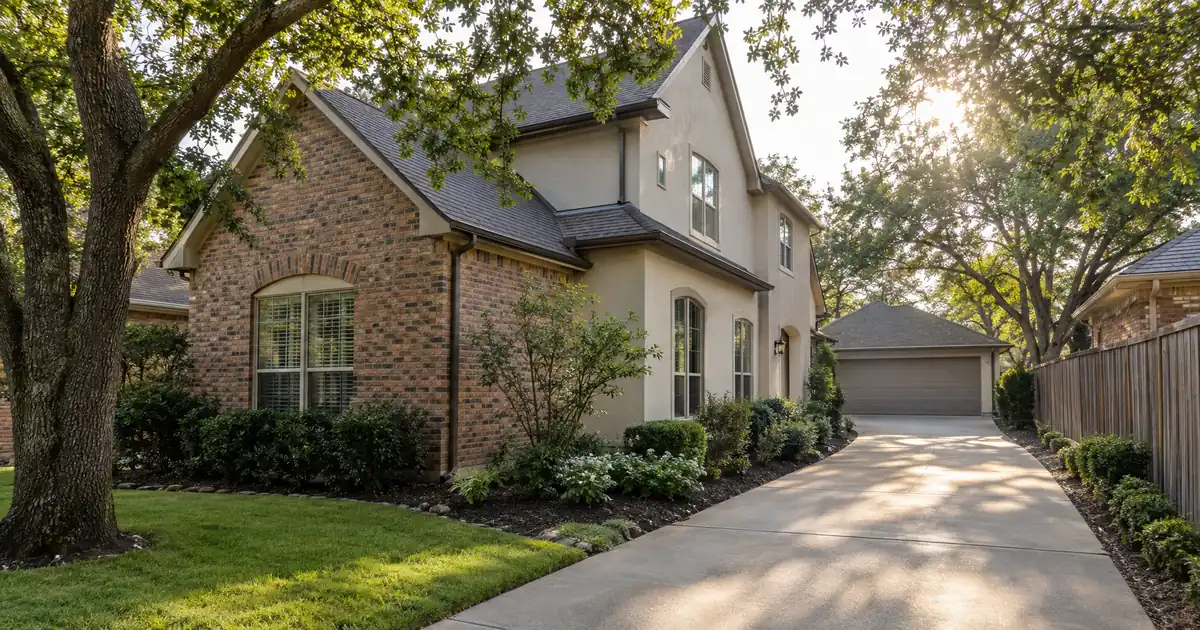
Equity on paper and equity you can borrow against are two different things, and rental owners learn the gap at the appraisal. A cash out refinance investment property in Coppell, Texas has to clear three tests: the value the appraiser lands on, the loan-to-value ceiling, and whether the rent covers the full monthly obligation. Coppell is a place where the third test, not the first, usually does the filtering.
Lendmire (NMLS# 2371349) is a DSCR-focused mortgage broker. Through Lendmire’s DSCR program footprint — 41 markets, including Washington, D.C. — lenders may review qualifying rental income subject to program guidelines for Coppell, Texas investors.
DSCR Cash-Out Calculator
Run the cash-out numbers in Coppell, TX
Rate source: Freddie Mac 30-yr average via FRED® — Federal Reserve Bank of St. Louis · effective Oct 1, 2026
Prefilled with starting assumptions — enter your property’s value, balance, taxes, and insurance for a more accurate picture.
Program parameters update from Lendmire’s centralized guideline source. Taxes and insurance are editable estimates.
As of Oct 1, 2026 · General Freddie Mac market benchmark, not a Lendmire loan offer. Property value, balance, taxes, and insurance are editable estimates. Maximum loan-to-value varies by lender, program, property type, and seasoning. Not a Loan Estimate, approval, or commitment to lend. Program availability and eligibility are subject to lender guidelines, credit approval, property review, and underwriting.
The Quick Read: A cash-out refinance on a Coppell, Texas rental is underwritten primarily on the property’s rental income measured against its full monthly obligation, and with detached values near $627,929 per Zillow against rents under $3,000, coverage rather than equity usually sets the ceiling on what can be pulled.
Detached homes at citywide values model near 0.6x coverage, including taxes and insurance. Townhome rentals around $2,250 to $2,845 are where a 1.0x test becomes realistic.
- Cash-out typically caps at 75% LTV after roughly 6 months of ownership.
- Irving-side pockets rent near Coppell levels; their sale prices still need verifying.
Coppell Market Snapshot
A quick read on the Coppell investor landscape — figures come from the cited sources below. Confirm current property-level numbers before underwriting.
| Metric | Detail |
|---|---|
| Home prices | 39.5 median age (City of Coppell) |
| Typical rents | $2,822 median (Homes.com) |
Why Coppell Is a Coverage Problem, Not an Equity Problem
Coppell’s housing values are high and its rents are not high enough to match. The City of Coppell reports a population of 43,196, a median age of 39.5, and a median owner-occupied home value of $623,780. Zillow’s value index sits at $627,929, down 1.7% over the year. Rents for houses, condos, and townhomes in the Coppell ISD area average around $2,820 according to ApartmentHomeLiving, a listing snapshot rather than a market median.
Divide that rent by that value and you get roughly 0.45% a month. That’s a thin ratio. Homes.com puts the price-to-rent ratio at 19.2, which says the same thing in different units.
The price sources disagree, and the disagreement matters. Zillow’s index is a modeled value across all homes. Redfin’s three-month median sale price is $692K, up 11.5% year over year, which measures what actually closed. Those can both be true when the sold mix skews toward larger homes. This article anchors on Zillow’s index because an appraisal behaves more like a value estimate than like last quarter’s closings. An investor holding a mid-sized home might see an appraisal anywhere in that spread.
What the Equity Pull Looks Like With Real Constraints
The standard cash-out framework is simple to state. Typical guidance calls for about 6 months of ownership measured from title recording, an LTV ceiling of 75% on cash-out, a 1.00 DSCR baseline, and credit generally starting around 620, with better tiers at 660, 680, and 700. Reserves typically run about 6 months of full housing payment. Loan sizes go up to $3,000,000 on standard programs. Everything here is guidance, not a promise, and qualification stays subject to lender guidelines, credit review, and property review.
The 1.00 benchmark is common because rent covers the payment at that level. Some lenders may review lower ratios, but those files usually bring lower leverage, different pricing, or more cash in reserve.
Now run the numbers on a detached home. Say an investor owns a Coppell single-family rental valued near the Zillow figure and rents it near the $2,820 average. These are modeled assumptions, not sourced market facts. Taking the full obligation, including taxes and insurance at Texas-average load and a principal-and-interest component at a high-6s assumption, a 75% LTV cash-out models near 0.6x coverage. Drop leverage to 60% and coverage still sits in the high 0.7s. Leverage would have to fall toward 40% LTV before the number approaches 1.0x. Every figure here varies by lender and program — guidelines, property type, leverage, and credit profile all apply.
That is not a tweak. It is a different loan.
Taxes carry much of that weight, so budget for them carefully (and verify current local rules, taxes, and insurance with qualified local professionals before sizing anything).
If an investor holds a detached Coppell home and wants capital out, a sub-1.00 structure is the realistic conversation. Options a lender may review include a sub-1.00 program, interest-only payment structures, or a lower loan amount. Each trades coverage for something: more cash left in the property, tighter leverage, or different pricing. Whether any of it works depends on credit, reserves, appraisal, and the individual lender’s guidelines.
Here’s the catch. If the only way a file works is by shrinking the loan until it barely resembles a cash-out, that’s a signal to ask whether the property is the right one to pull from. Maybe the equity is better left in place and the next purchase financed elsewhere.
Where the Coverage Math Gets Closer
| Property type | Rent anchor | Modeled coverage read |
|---|---|---|
| Detached single-family | ~$2,820 average | About 0.6x at 75% LTV |
| 2BR townhome | $2,250 listing | Depends on verified value |
| 3BR townhome | $2,845 listing | ~1.0x near low-$400Ks value |
| Valley Ranch pocket | $2,472 median | Unknown until sale prices checked |
Townhomes and condos are the lane worth testing. The Homes.com snapshot of 12 listings shows 2-bedroom townhouses at $2,250 and 3-bedroom units at $2,845. The brief found no sourced sale prices for those units, so treat the next claim as modeled math. At 75% LTV, a 3-bedroom townhome renting near $2,845 reaches roughly 1.0x including taxes and insurance only if its value sits around the low-$400,000s or below. Above that, coverage slips under the baseline. Below it, the cushion grows. Final terms depend on lender guidelines, property type, leverage, and the borrower’s complete credit picture.
So the first step for a townhome owner is not a lender call. It’s pulling recent comparable sales.
The Irving-addressed pockets that fall inside Coppell ISD boundaries are the other candidate. Redfin’s rental page lists median rents near $2,472 in Valley Ranch and $2,275 in North Irving. That page is dated, and the Valley Ranch figure jumped sharply in a single month, which points to a thin sample. The appeal is simple: rents close to Coppell’s, purchase prices that may sit lower. That would mean better coverage per dollar of value. It’s a hypothesis, not a finding, until sale prices are checked.
Multi-unit stacking, the usual fix for thin single-family coverage, doesn’t look available here. The research turned up no Coppell duplex, triplex, or fourplex inventory, only listings from nearby Dallas submarkets. That’s an inference from search results, not a stated market fact. Still, an investor who wants 2-4 unit coverage math will probably be shopping outside the city.
The Experience Layer
DSCR files in markets like this one typically look like a high-value asset with a modest rent roll, where the appraisal comes in fine and the coverage number is the pinch point. The files that move forward cleanly usually arrive with a lease already in place, a clear tax-and-insurance picture, and a realistic loan amount chosen before the application rather than after the first coverage calculation. Owners who start from the 75% cap and work backward tend to hit the wall. Owners who start from the rent and work forward tend to find the workable structure sooner.
Who This Fits, and Who Should Skip It
For an entity-owned portfolio, subject to lender program eligibility, DSCR cash-out is often the practical lane. Documentation centers on the property rather than personal returns, which suits self-employed owners and LLC operators. The guide “What Is a DSCR Loan” is worth a read before sizing a file.
For a high-W-2 borrower holding one Coppell rental personally, conventional financing may be the better tool. Debt-to-income rather than property coverage does the underwriting, and Coppell’s thin rent-to-value ratio matters less. Where DSCR and conventional diverge comes down to how many properties you hold, how they’re titled, and whether your traditional personal-income documentation tells a clean story. The flip point usually arrives around the third or fourth financed property, or sooner if returns don’t cleanly show rental income.
DSCR vs. conventional financing
There are two common ways to finance an investment property in Coppell, TX, and they qualify you differently — here’s how investors weigh them.
Why investors choose it
- Qualifies on the property’s rental income — no personal tax returns, W-2s, or pay stubs needed to document income.
- No personal debt-to-income ceiling to clear, so existing mortgages and obligations don’t cap your borrowing the same way.
- Can be closed in an LLC, keeping the property inside a business entity.
- Built for scaling — not held to the limit on number of financed properties that conventional financing applies.
- Underwriting centers on the deal: generally qualifies when the rent covers the payment, a 1.00x coverage ratio being a common baseline (confirmed in underwriting).
- Designed specifically for investment property, including long-term and, where the program allows, short-term rentals.
Where it’s strong
- Often the lowest ongoing financing cost for a buyer who fully qualifies on personal income — a fit for a first property or a cost-first purchase.
Trade-offs for investors
- Requires full personal income documentation and must fit within a debt-to-income limit — salary, existing debts, and other mortgages all count.
- Typically held in your personal name rather than a business entity.
- Caps how many financed properties you can carry, which can become a ceiling as a portfolio grows.
- Evaluates you as a borrower as much as the property, which usually means more paperwork.
How investors usually choose: a first or single property often optimizes for the lowest financing cost; portfolio builders often optimize for leverage, vesting in an LLC, and scaling past conventional caps. The right answer depends on your goals, the property, and current guidelines — both paths run through select lenders in Lendmire’s wholesale network, with eligibility and terms confirmed in underwriting.
Honestly, for many Coppell detached owners the better question is whether to cash out at all. A flat-to-slightly-negative value trend means the refinance can’t count on appreciation to manufacture equity. It can only release what already exists.
Forward Indicators: What Could Move This Over the Next 6-24 Months
Value direction is the first variable. If Zillow’s index keeps drifting down while Redfin’s sold prices stay elevated, appraisals could land anywhere in between, and a cash-out sized to the optimistic number could shrink on the appraisal. Size to the conservative end.
Commercial supply is the second. Coppell grew from roughly 16,000 to 42,000 residents over about 30 years, and commercial space went from about 2 million square feet to more than 30 million. The city’s economic development page cites about 400 acres of vacant commercial land, so the employment base can still add space. Neighboring Cypress Waters competes for the same corporate tenants and also brings new customers and residents, and that tension could pull rental demand either direction.
Employment anchors are the third. ForRent places Amazon, Nokia, Samsung, and Nationstar Mortgage in the southwestern commercial zone, and Coppell ISD is a major local employer. This is a corporate-and-logistics suburb beside DFW Airport, and that employment mix is what supports rental demand more than any one neighborhood does. Demand rests on a spread of jobs near home rather than on a single large campus or hospital, so no one employer’s decisions should be expected to drive the whole rental market.
Rents are the fourth, and the least certain. Published sources conflict on average rent for Coppell, and the figures vary widely by property type and by site, so no single number should be treated as a reliable benchmark. Track listing rents on the specific property type you own rather than relying on a citywide average.
Putting the Proceeds to Work
The proceeds are only as good as what they buy. Redeploying into a market where coverage clears 1.0x at purchase pricing is a straightforward case for pulling equity out. Redeploying into another high-priced, thin-yield asset just repeats the problem with more debt. Refinance structures beyond cash-out, including rate-and-term, are covered separately among the options for investor refinancing.
Cash-out also has a quiet cost. Pulling equity from a property whose coverage already sits below 1.0x makes the remaining file more fragile, because lower coverage means less cushion if rents soften. This one’s a genuine toss-up. Some investors will accept thinner coverage on a property they intend to hold for appreciation. Others will treat it as a reason to leave the equity alone.
Property types matter at the margin. Manufactured homes, log homes, and barndominiums fall outside these DSCR programs, which rarely affects Coppell’s housing stock but is worth knowing if a portfolio includes them elsewhere.
Investors who want to see how these inputs interact can see how the DSCR math pencils or call 828-256-2183. Lendmire’s Texas DSCR loan programs cover the state-level program picture.
Frequently Asked Questions
How do you qualify for a DSCR cash-out refinance in Coppell?
Qualification centers on the property’s rent compared with its full monthly obligation, generally with a 1.00 baseline, along with credit that typically starts around 620, about 6 months of reserves, and roughly 6 months of ownership. In Coppell, the rent-to-value gap means detached homes often need reduced leverage to reach that baseline. Final eligibility depends on lender guidelines, credit, and property review.
What are the requirements for an investment property loan in Coppell, Texas?
Expect a property-level rent figure, a credit profile at or above the program floor, and reserves in the range of 6 months. Cash-out loans cap at 75% LTV, while purchases can go higher. Single-family homes, townhomes, and condos are the common property types here, and every term remains subject to lender program requirements. These specifics are subject to lender guidelines and a full review of property, leverage, and credit.
Why does Coppell’s flat pricing limit how much equity an investor can pull?
Cash-out proceeds follow the appraised value, and Zillow’s index shows values down 1.7% over the year while Redfin’s sold-price median is up. Without appreciation adding to the value, the refinance can only release equity that already exists. Underwrite to today’s appraisal, not last year’s.
Are townhomes a better cash-out candidate than detached homes in Coppell?
Often, yes, because 2-bedroom and 3-bedroom townhome rentals run $2,250 to $2,845 against lower likely values than detached homes. That tends to lift coverage closer to 1.0x. The caveat is that the research found no sourced townhome sale prices, so confirm comps before assuming the math works.
How does rental income affect DSCR refinance eligibility in Coppell?
Rental income is the core of the review, since DSCR files are generally evaluated on rent used for lender review against the full monthly obligation. Lendmire arranges DSCR investor loans and cash-out files typically cap at 75% LTV. Lender guidelines set the final terms.
For current guidelines and terms, see Lendmire’s DSCR loan programs page.
Get Started
Ready to find the right loan for you?
In about 30 seconds you can review financing options available for your investment property. No commitment required.
Informational only. Not a Loan Estimate, approval, or commitment to lend. Program availability and eligibility are subject to lender guidelines, credit approval, property review, and underwriting.
About Lendmire
As a non-QM mortgage broker (NMLS# 2371349), Lendmire facilitates DSCR investor loans across 41 markets, including Washington, D.C. DSCR eligibility is generally reviewed around property-level rental income instead of personal income documentation, subject to lender guidelines, serving LLC-structured portfolios and self-employed borrowers who don’t fit conventional boxes. Lendmire has been recognized by Scotsman Guide as a 2026 Top Workplace and was a top-ranked workplace in 2025, making it a two-time Scotsman Guide Top Mortgage Workplace.
If your Coppell rental were appraised tomorrow, would the rent cover the loan you’d want to take against it, or would the equity be better left where it is?
This article is part of Lendmire’s investment property cash-out refinance program — full qualification details, guidelines, and scenarios live on the program page.
Related reading: DSCR Cash Out Refinance in Coppell, Texas: Can Your Rent Cover a Bigger Loan Balance? · DSCR Cash Out Refinance in Texas City, Texas: Refinery Tenants and a 75 Percent Ceiling · DSCR Cash Out Refinance in Sherman, Texas: Chip Fab Payroll Meets a Cooling Price Tape
Guides: Investment Property Cash-Out Refinance in Texas
References
1. Freddie Mac 30-yr average via FRED® — Federal Reserve Bank of St. Louis
3. Townhome rentals around $2,250 to $2,845
5. $2,820 according to ApartmentHomeLiving
6. Redfin’s three-month median sale price
8. 16,000 to 42,000 residents over about 30 years
9. city’s economic development page
10. Amazon, Nokia, Samsung, and Nationstar Mortgage
Brandon Miller
Founder & CEO, Mortgage Loan Originator, Lendmire LLC
- Mortgage Loan Originator · NMLS# 1129696 · Verify on NMLS Consumer Access
- North Carolina Real Estate Broker · License# 343312 · Verify on NCREC
- North Carolina Insurance Producer · License# 19053198 · Property, Casualty, Life, Health · Verify on NAIC SBS
- Lendmire LLC · Firm NMLS# 2371349 · Verify firm licensure
Important disclosures. Lendmire (NMLS# 2371349) is a licensed mortgage brokerage. Lendmire is not a direct lender, depository institution, or financial advisor. All loan inquiries are subject to lender underwriting; this article does not constitute a commitment to lend. Rates, terms, and program guidelines are subject to change without notice and vary by borrower profile, property type, and state. Information in this article is general in nature and is not financial, legal, or tax advice. Equal Housing Opportunity. NMLS Consumer Access: nmlsconsumeraccess.org.