
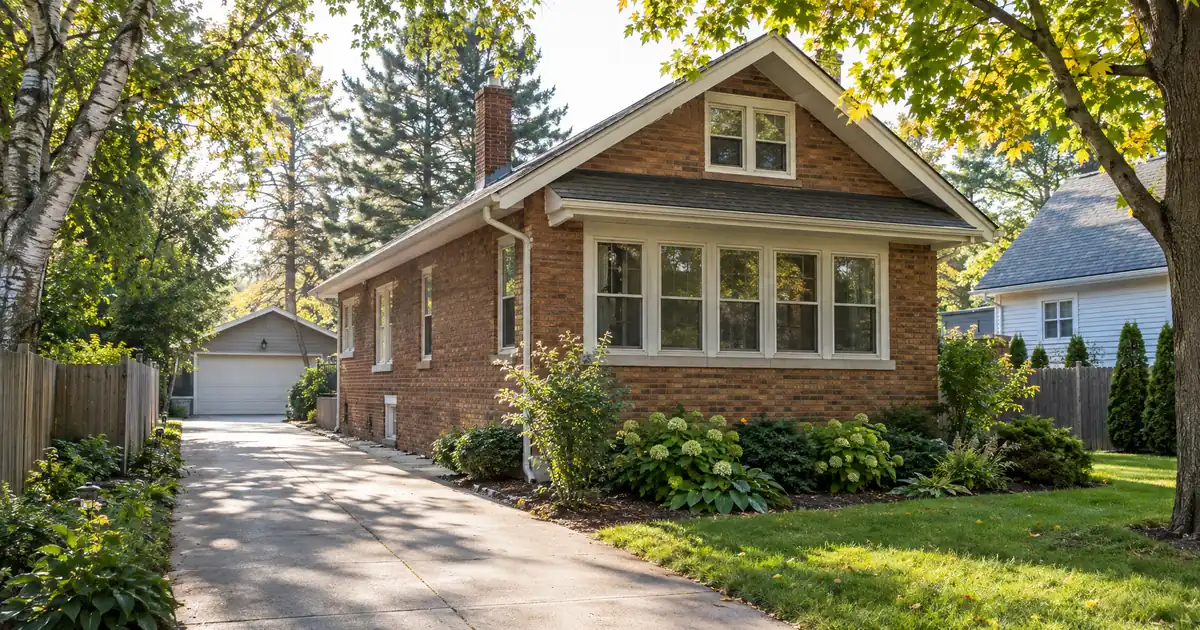
Muskego’s home values are still climbing while its rents read flat to soft, and that gap is what to watch over the next 6 to 18 months. The trailing-12-month median sale price sits near $525,000, up 6 percent, per Homes.com. Redfin counted just 12 closed sales in its latest month against 26 a year earlier. Paper equity is building on a thin, slow-moving market.
If you already own a rental here, the question isn’t whether you have equity. It’s whether the rent supports the loan that equity would create. This is a cash-out refinance investment property article for Muskego owners, not buyers, so the focus is what you can pull out, what limits it and where the proceeds should go.
DSCR Cash-Out Calculator
Run the cash-out numbers in Muskego, WI
Rate source: Freddie Mac 30-yr average via FRED® — Federal Reserve Bank of St. Louis · effective Sep 24, 2026
Prefilled with starting assumptions — enter your property’s value, balance, taxes, and insurance for a more accurate picture.
Program parameters update from Lendmire’s centralized guideline source. Taxes and insurance are editable estimates.
As of Sep 24, 2026 · General Freddie Mac market benchmark, not a Lendmire loan offer. Property value, balance, taxes, and insurance are editable estimates. Maximum loan-to-value varies by lender, program, property type, and seasoning. Not a Loan Estimate, approval, or commitment to lend. Program availability and eligibility are subject to lender guidelines, credit approval, property review, and underwriting.
The Quick Read: A cash-out refinance on a Muskego, Wisconsin rental is underwritten primarily on the property’s rental income measured against its full monthly obligation, so rent used for lender review has to cover the whole housing cost, taxes and insurance included, on a loan capped at 75 percent of value after about six months of ownership, subject to lender guidelines.
- Trailing-12-month median sale price runs near $525,000, up 6 percent (Homes.com).
- Roughly 85 percent of housing is owner-occupied, so rental stock is thin (RentCafe).
- House rents near $2,400 leave single-family coverage under 1.00 on full-cost math (Zumper).
- Condo-structured attached units are the more realistic DSCR fit.
- Cash-out LTV tops out at 75 percent, with about six months of seasoning.
The 75 Percent Ceiling and the Six-Month Clock
A cash-out refinance on a Muskego investment property caps at 75 percent of value and generally requires about six months of ownership measured from title recording. On the standard program it clears only if rent covers the full housing obligation at 1.00 or better. Equity alone never decides it.
Picture an investor who owns a Muskego property now valued near that $525,000 trailing median, with the existing loan at 40 percent of value. On paper, 35 points of value sit between the payoff and the 75 percent ceiling. Whether any of it is usable depends on coverage, reserves of about six months of PITIA and credit. Programs step up from a 620 floor through 660, 680 and 700 tiers, and all of it is subject to lender guidelines. The dollars you can take out are an output of those constraints, not a fixed number.
Two value signals are worth holding side by side. Redfin’s latest-month sale median comes in higher, at $538,000, on a very small sample and with homes averaging 51 days on the market. The Homes.com trailing figure smooths that out, and this article uses it as the working median. For context, Wisconsin’s average home value is $328,778 per Zillow, so Muskego runs roughly 60 percent above the state. That premium is why appraisals tend to be generous relative to rents. It is also why a lender’s coverage test bites.
Appreciation math cuts both ways here. A 6 percent annual gain grows your equity cushion, but nothing in the research shows rents keeping pace. Cash-out sizing tied to today’s value can outrun what rent supports. For a walkthrough of the loan type itself, see the refi options.
Why Does Coverage Decide Everything Here?
Muskego prices sit far above what its rents support, so single-family coverage on a full-cost basis lands well under 1.00. Small attached units and lower leverage bring the number closer, but even then it takes real work.
Run the numbers this way, as a modeled illustration and not a market finding. Assume a house valued near the $525,000 median, rent at the roughly $2,400 house figure from Zumper (a thin-data source, so treat it as directional) and a loan at the 75 percent cap. Including taxes and insurance, coverage falls below 0.75. Cut leverage to about 50 percent of value and the ratio improves but likely still sits under 1.00. Most standard programs are built around a 1.00 benchmark because rent covers the obligation at that level. Some lenders may review lower-coverage files, but those typically bring lower leverage, stronger credit, different pricing or more cash in.
If you land below 1.00, the structures worth asking about are a sub-1.00 program, an interest-only structure or a smaller loan. A lender would review each, and none is assured. A sub-1.00 structure is defensible if you hold the property for its appreciation story. If it’s the only way a given house works, that’s a signal to reconsider the property type, not the loan.
| Property type | Rent signal | Coverage read |
|---|---|---|
| Single-family house | About $2,400 | Under 1.00 at 75% LTV |
| Attached condo | From $1,495 benchmark | Depends on price; use own comps |
| Apartment-complex unit | $1,300–$1,561 averages | Rent comparable only |
Pricing and available terms vary by lender, borrower profile, property type, and full underwriting review. Rentable puts average condo rent near $2,150. Those figures don’t agree, which is the point. Underwrite attached product on its own comps, and don’t scale house rents down.
In markets shaped like this one, with high prices, low rents and few rentals, the common friction on files is a gap between the appraised value and the lease. The cleaner files tend to come from owners who bought well below current value, hold a documented lease at or near market and have reserves ready. The harder ones hinge on a rent assumption the lender won’t credit.
One more decision point. A high-W-2 borrower with one or two rentals in a personal name may find conventional cash-out cheaper and simpler, and the side-by-side comparison lays out the tradeoffs. DSCR takes over when properties sit in an entity (subject to lender program eligibility), when traditional personal-income documentation doesn’t show the income cleanly or when the financed-property count runs past what conventional guidelines allow.
Skip the Lakefront.
Muskego is built around Big Muskego, Little Muskego and Lake Denoon, and the city’s comprehensive plan positions it as a lake-oriented community on the eastern I-43 corridor. Lake-adjacent homes are premium, owner-occupied stock. They rarely pencil for rental coverage.
Owners of a lake property who are thinking about pulling equity should be honest about the purpose. If the plan is to fund a purchase elsewhere, the lender still needs the lake house to cover itself on rent. It probably won’t at that price point. Not ideal, and better to know before the appraisal.
Condos, Corridors and Competing Supply
The Janesville Road corridor is where rental inventory actually lives. The city’s economic development and marketing plan describes a commercial isthmus along Janesville Road flanked by residential subdivisions, with the Pioneer Drive intersection as the historic center. That corridor is the most plausible place for any mixed-use or small multifamily.
Much of the small multifamily stock is condo-structured, not whole-building rentals. Per the city’s planned development district code, Parkridge Condominiums has 48 living units and Bay Breeze on Little Muskego Lake totals 78 dwelling units, including 11 four-unit and 5 six-unit condominiums. The city’s current developments page also lists Cobblestone Meadows at 16 condominium units.
My read is that stacking 2 to 4 units on one deed is scarce here. The likelier path is buying individual condo units, which means condo-project review enters underwriting and each loan carries one rent. Confirm with a lender before assuming multi-unit math applies.
On the supply side, the same city page shows the Will Rose Apartments approved for two buildings of 51 and 39 units, 90 units in total, on the Janesville Road corridor (project statuses on that page are undated, so confirm what was built). New amenitized apartments compete for the same renters, which fits the soft-rent read. No absorption or vacancy data turned up, so keep rent assumptions conservative without calling it oversupply. For rent comparables only, Zumper lists Fountainwood at $1,300, Meadow Green at $1,525 and Quietwood at $1,561 a month. Those are complex averages, not investable neighborhoods.
Who Actually Rents Here
Muskego rents to commuters. Census Bureau QuickFacts puts the city at 25,406 residents with a median household income of $112,221 and a mean commute of 22.9 minutes. Renters are a small, higher-income slice of a market that is about 85 percent owner-occupied. Stock is thin, but the tenants who do show up tend to carry strong incomes.
The demand anchors are modest and local. The Muskego-Norway School District is the clearest local employer. The city’s economic development page names industrial employers including Northern Gear, which is building a 100,000-square-foot facility in Moorland Commerce Center, plus M2M Machining and the GE Global Warehouse in TIF 10. It cites 1,900-plus companies on its demographic page, though no employee counts were found. Healthcare demand comes from outside the city. Healthgrades lists nearby facilities including Froedtert Community Hospital in New Berlin, Ascension’s Franklin campus and ProHealth Waukesha Memorial. Those workers commute in.
So the thesis is a commuter-suburb renter profile, not local job growth. That supports low turnover on well-located units. It doesn’t support aggressive rent growth.
Where the Proceeds Go (and Where They Shouldn’t)
The cash-out only works if what you buy with the proceeds covers itself better than what you’re refinancing. Pulling equity from a Muskego house that sits under 1.00 to buy another Muskego house that also sits under 1.00 stacks two weak coverage files, so it’s a plan worth skipping.
The better use of proceeds is a property type that pencils. That could be an attached unit bought at a price the rent supports or a small-balance asset in a submarket with a friendlier rent-to-price relationship. Franklin, New Berlin, West Allis, Waukesha and Big Bend are the nearby markets worth running comps on. No coverage data was gathered on any of them, so treat them as places to test, not conclusions.
Frequently Asked Questions
How do you qualify for a cash-out DSCR refinance in Muskego, Wisconsin?
The property has to show that rent used for lender review covers its full monthly obligation, generally at 1.00 or better, on a loan at or below 75 percent of value. Lenders also look at credit, reserves and about six months of ownership. Given Muskego’s price-to-rent gap, expect coverage to be the deciding test, especially on single-family homes.
What are the requirements for a cash-out refinance on an investment property in Muskego, Wisconsin?
Typical program guidance includes a credit floor of 620, with tiers at 660, 680 and 700, and about six months of reserves (more above $1,500,000). Loan sizes go up to $3,000,000 on standard programs, and seasoning runs about six months. All of it is subject to lender guidelines, property review and credit approval, and manufactured homes, log homes and barndominiums fall outside these programs.
Can a Muskego condo work for a cash-out DSCR loan?
Often better than a house, because attached-unit rents sit closer to their prices. Condos add a project-review step, and each loan carries a single unit’s rent, so there’s no income stacking. Comps for that specific complex matter more than any city-wide average.
DSCR vs. conventional financing
Two common ways to finance an investment property in Muskego, WI. They qualify you differently — here’s how investors weigh them.
Why investors choose it
- Qualifies on the property’s rental income — no personal tax returns, W-2s, or pay stubs needed to document income.
- No personal debt-to-income ceiling to clear, so existing mortgages and obligations don’t cap your borrowing the same way.
- Can be closed in an LLC, keeping the property inside a business entity.
- Built for scaling — not held to the limit on number of financed properties that conventional financing applies.
- Underwriting centers on the deal: generally qualifies when the rent covers the payment, a 1.00x coverage ratio being a common baseline (confirmed in underwriting).
- Designed specifically for investment property, including long-term and, where the program allows, short-term rentals.
Where it’s strong
- Often the lowest ongoing financing cost for a buyer who fully qualifies on personal income — a fit for a first property or a cost-first purchase.
Trade-offs for investors
- Requires full personal income documentation and must fit within a debt-to-income limit — salary, existing debts, and other mortgages all count.
- Typically held in your personal name rather than a business entity.
- Caps how many financed properties you can carry, which can become a ceiling as a portfolio grows.
- Evaluates you as a borrower as much as the property, which usually means more paperwork.
How investors usually choose: a first or single property often optimizes for the lowest financing cost; portfolio builders often optimize for leverage, vesting in an LLC, and scaling past conventional caps. The right answer depends on your goals, the property, and current guidelines — both paths run through select lenders in Lendmire’s wholesale network, with eligibility and terms confirmed in underwriting.
How much equity can I pull from a Muskego rental?
Up to 75 percent of appraised value minus your payoff, but coverage and reserves often bind first. On a house near the median value, full-cost coverage can fall short of 1.00 even at moderate leverage. A smaller draw, a sub-1.00 structure that a lender reviews or an attached property may be the workable route.
How do DSCR lenders review rental income instead of traditional tax-return income in Wisconsin?
Lenders in its network review the property’s rent against its full monthly obligation instead of leaning on traditional personal-income documentation, subject to program guidelines.
The Real Choice
Owners of a Muskego rental tend to face a two-way fork.
Keep the asset and draw conservatively. You take a smaller loan at lower leverage, likely land closer to 1.00 and keep the appreciation upside. The tradeoff is that your cash out is modest and much of your equity stays parked in a market with soft rents.
Or pull the maximum and redeploy outside the lakes. You put more of the equity to work in a rent-friendlier submarket or an attached-unit deal that covers itself. The tradeoff is a bigger loan on a property whose rent may not carry it comfortably, plus reserves and a harder coverage test on the refinance itself.
Neither is wrong. Which one fits depends on whether you value Muskego’s appreciation more than its thin rental yield.
For current guidelines and terms, see Lendmire’s DSCR loan programs page.
About Lendmire
A DSCR-focused mortgage broker, Lendmire (NMLS# 2371349) places investor financing across 41 markets, 40 states plus Washington, D.C. Eligibility is generally reviewed by the lender on property cash flow instead of traditional personal-income documentation, subject to lender guidelines. Scotsman Guide recognized Lendmire as a 2026 Scotsman Guide Top Workplace and a top-ranked workplace in 2025.
For broader investor-financing rules and property-type coverage across the state, see Wisconsin DSCR loans.
Get Started
Ready to find the right loan for you?
In about 30 seconds you can review financing options available for your investment property. No commitment required.
Informational only. Not a Loan Estimate, approval, or commitment to lend. Program availability and eligibility are subject to lender guidelines, credit approval, property review, and underwriting.
References
1. Homes.com, Muskego housing data
2. Redfin, Muskego housing market
3. RentCafe, Muskego rental stock
4. Zumper, Muskego rent research
5. Zillow, Wisconsin home values
6. Rentable
7. cms3.revize.com — Community Planning
8. cms3.revize.com — Muskego Economic Development Marketing Plan FINAL
9. ecode360.com
10. City of Muskego Current Developments
11. Census Reporter, Muskego profile
12. Muskego-Norway School District
13. City of Muskego Economic Development
14. muskego.wi.gov — Economic Development Demographic Quickfacts
15. Healthgrades, hospitals near Muskego
16. a 2026 Scotsman Guide Top Workplace
17. Scotsman Guide — Top Workplaces 2025
This article is part of Lendmire’s investment property cash-out refinance program — full qualification details, guidelines, and scenarios live on the program page.
Related reading: DSCR Cash Out Refinance Muskego Wisconsin · DSCR Cash Out Refinance Mequon Wisconsin · DSCR Cash Out Refinance Oconomowoc Wisconsin
Guides: Investment Property Cash-Out Refinance in Wisconsin
Brandon Miller
Founder & CEO, Mortgage Loan Originator, Lendmire LLC
- Mortgage Loan Originator · NMLS# 1129696 · Verify on NMLS Consumer Access
- North Carolina Real Estate Broker · License# 343312 · Verify on NCREC
- North Carolina Insurance Producer · License# 19053198 · Property, Casualty, Life, Health · Verify on NAIC SBS
- Lendmire LLC · Firm NMLS# 2371349 · Verify firm licensure
Compliance and disclosures. Lendmire (NMLS# 2371349) is a licensed mortgage broker and is not a direct lender, depository institution, financial advisor, or tax professional. Content in this article is general market analysis and educational information — not financial, legal, or tax advice for any specific situation. Lendmire does not guarantee loan approval; every transaction is subject to underwriting by the funding lender. Mortgage pricing and loan program guidelines are subject to change at any time without notice and vary by borrower characteristics, property type, and state regulations. Lendmire complies with Equal Housing Opportunity. Licensure verification: NMLS Consumer Access.