
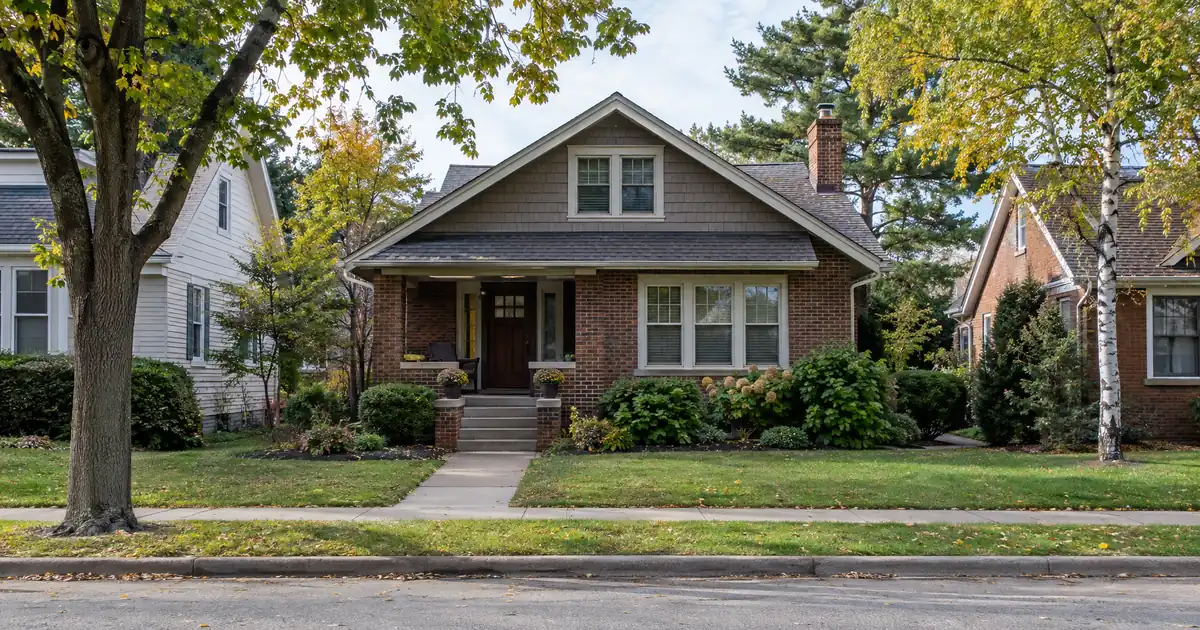
Downtown Menomonee Falls, around Main Street and Appleton Avenue, is the first place a cash-out investor should look. The Village of Menomonee Falls reports more than 140 businesses downtown, with the waterfall, Riverwalk, and Mill Pond a few blocks away. It’s the older core, so it’s the likeliest spot for any small multi-unit stock (an inference, not a sourced count). That matters because duplexes and small converted buildings are only 4.05 percent of the village’s housing units. A DSCR cash out refinance in Menomonee Falls, Wisconsin is less about finding a rare fourplex and more about getting honest numbers out of the single-family and townhome rentals that dominate the village.
The Short Version: A DSCR cash-out refinance on a Menomonee Falls, Wisconsin rental is underwritten primarily on the property’s rental income measured against its full monthly obligation, rather than on personal income documentation. It turns built-up equity into capital, subject to a 75 percent loan-to-value ceiling, seasoning, reserves, and lender review.
DSCR Cash-Out Calculator
Run the cash-out numbers in Menomonee Falls, WI
Rate source: Freddie Mac 30-yr average via FRED® — Federal Reserve Bank of St. Louis · effective Sep 24, 2026
Prefilled with starting assumptions — enter your property’s value, balance, taxes, and insurance for a more accurate picture.
Program parameters update from Lendmire’s centralized guideline source. Taxes and insurance are editable estimates.
As of Sep 24, 2026 · General Freddie Mac market benchmark, not a Lendmire loan offer. Property value, balance, taxes, and insurance are editable estimates. Maximum loan-to-value varies by lender, program, property type, and seasoning. Not a Loan Estimate, approval, or commitment to lend. Program availability and eligibility are subject to lender guidelines, credit approval, property review, and underwriting.
- Single-family detached homes are 66.89 percent of units, per NeighborhoodScout.
- Zillow shows a typical value of $371,794; Redfin’s median sale price is $426K.
- On modeled rents, coverage tends to bind before the 75 percent LTV cap does.
- Kohl’s and Froedtert both sit in the 1,000-plus employee band, per Waukesha County’s economic profile.
- More than 500 senior and market-rate units are in the pipeline, per the village’s project list.
What Menomonee Falls Rental Stock Looks Like
Menomonee Falls is mostly single-family homes with a heavy block of large apartment complexes and very little in between. NeighborhoodScout puts large apartment complexes at 24.26 percent of units, row or attached homes at 4.44 percent, and duplexes or small converted buildings at 4.05 percent. The middle of the market is thin.
For a cash-out borrower, that shape has two consequences. First, most owners here hold one-unit rentals, so the math is one rent against one payment with no second unit to help. Second, scarce 2-4 unit product tends to hold its value, which helps the appraisal side of a refinance.
Don’t count on new duplex-style supply to change that. A proposed 20-unit project on Custer Lane, reported by BizTimes, is sale-only condos, not rental stock. Each buyer gets one rentable unit, not a stacked two-unit income. Sewer limits capped that site at 20 or fewer units, which shows how hard small-scale supply is to add.
Appreciation is the other half of the equity story. A local broker blog citing Census QuickFacts and the village’s comprehensive plan puts the median home value at $390,164, up from $291,500 several years earlier, roughly 34 percent. (Verify against the primary sources before leaning on it.) The same source notes that nearly half of homes were built before 1980.
The recent picture is flatter. Zillow shows a 1.6 percent gain over the past year, and Redfin shows 0.2 percent. The tension is clear. An owner who bought well before the recent run has real equity to pull, while someone who bought near the current median may find little left under a 75 percent cap. Older stock also brings capex questions that can weigh on appraisal condition and reserves.
Walking Through the Cash-Out Math
The mechanics are simple: the lender takes the appraised value, applies a 75 percent ceiling, subtracts the existing payoff, and the remainder is the theoretical proceeds. The catch is that the rent has to carry the new payment too. That’s the debt service coverage ratio. It divides monthly rent by the full monthly obligation (principal, interest, taxes, insurance, and any HOA dues), and the standard benchmark is 1.00, subject to lender guidelines. Here is the full breakdown of what a DSCR loan is if you want the basics.
Run the numbers on a modeled three-bedroom single-family rental. These are assumptions, not market data. Use a $426,000 appraised value, the Redfin median, and a $2,400 monthly rent. That rent is in line with the three-bedroom averages that RentCafe and ApartmentFinder report, though both mostly reflect apartment-community asking rents, not single-family rents. The rent works out to a little over half a percent of value per month, which is a thin rent-to-value ratio.
Modeled with taxes and insurance included, coverage lands in the mid-0.8s at the full 75 percent LTV. Pull back to roughly 60 percent LTV and the number moves to about 1.00. The 75 percent cap isn’t what stops you here. The rent is.
A second pass on a townhome-priced property shows the same pattern. Assume a $372,000 value (near Zillow’s typical figure) and a $2,200 modeled rent. Coverage runs roughly 0.9x at the cap and about 1.0x near 65 percent LTV. Lower price helps, but it doesn’t flip the picture.
Here’s the practical read, based on these modeled inputs:
| Scenario | LTV | Modeled coverage |
|---|---|---|
| $426K SFR, $2,400 rent | 75 percent | Mid-0.8s |
| $426K SFR, $2,400 rent | About 60 percent | About 1.00 |
| $372K townhome, $2,200 rent | 75 percent | About 0.9 |
| $372K townhome, $2,200 rent | About 65 percent | About 1.0 |
Typical program guidance for a cash-out includes about six months of ownership measured from title recording, a credit floor of 620 (with pricing and leverage improving at 660, 680, and 700), and reserves of about six months of PITIA. Loan sizes run up to $3,000,000 on standard programs. All of it varies by borrower, property, and lender.
Working DSCR brokers see a recurring pattern in suburban markets like this one: owners assume the LTV cap is their limit, then discover the appraiser’s market rent schedule is. A property that looks fine on a listing-site rent can come back lower on the appraisal rent schedule. The stronger files start with a realistic rent figure and size the request to the coverage number, not the cap.
What If the Number Lands Below 1.00?
A sub-1.00 result isn’t a dead end, but it is a decision point. Several structures may apply and a lender would review them: a sub-1.00 program with reduced leverage and stronger credit, an interest-only structure, or a smaller cash-out request that brings coverage up. None is assured, and qualification stays subject to lender guidelines, credit approval, and property review.
The better question is whether you should use one. If you’re taking a smaller pull to fund a clear next deal, a lower-LTV structure can be a clean trade. If you’re reaching below 1.00 because the property can’t carry its own payment at any sensible leverage, that’s a signal about the asset or the plan. Pulling out less is often the better answer than stretching the structure.
This is also where conventional financing can win. For a W-2 borrower with a few financed properties and clean tax-return income, a conventional cash-out may carry a lower cost and avoid the non-QM friction. The conventional-vs-DSCR tradeoffs tip toward DSCR when the borrower is self-employed, holds title in an entity (subject to lender program eligibility), or has run past the conventional lane’s property count. For a single rental owned personally by a high earner, run both before choosing.
Who Rents Here, and Why It Holds
Tenant demand rests on a workforce base. Per Waukesha County’s economic profile, Kohl’s Corporation and Froedtert & the Medical College of Wisconsin each employ 1,000 or more people in the village. Harley-Davidson, Arandell, Leonardo DRS, Wacker Neuson, Bradley Corporation, Alto-Shaam, and Enerpac each fall in the 500-999 band. Those are size bands, not exact headcounts, and the data is dated. The village also has nine industrial and office parks covering more than 1,300 acres. Kohl’s has faced retail pressure, so check the headquarters staffing picture before underwriting on it.
Healthcare adds stability. Froedtert Menomonee Falls Hospital is an academic medical center with inpatient services and 24/7 emergency care. The village’s population is about 40,945 per the Village of Menomonee Falls, and the median household income is $100,238, citing ACS. No colleges are located here, so there’s no student-rental layer.
The rental pool is bounded. RentCafe shows 26 percent of households (4,265) are renters and 74 percent are owner-occupied. Rents vary by source. Zumper shows an average of $1,617, up 8 percent. RentCafe shows $1,790 across 50-plus-unit buildings only. HUD Fair Market Rent for Waukesha County is $1,170 for two-bedrooms and $1,460 for three-bedrooms, per Affordable Housing Hub. Treat that last number as a floor reference. Don’t build a coverage case on any single average.
The submarkets worth knowing are Downtown, where older stock sits close to the Riverwalk, and the East Main Street Corridor, which the village supports for reinvestment along with Downtown. The Highway Q, Appleton Avenue, and Pilgrim Road retail hub near Highway 41/45 likely has apartment complexes nearby, though no source confirms it. Neighborhood-level rents and prices weren’t available in the research, so those calls stay qualitative.
Skip the New Builds
New construction is the wrong place to look for cash-flow-led refinances. New-construction listings in ZIP 53051 start around $450K for townhomes at Fox River Falls and run well above that for single-family plans, per Zillow’s new-homes listings. Against a $371K-$390K median value, rents would have to be unusually high to cover the payment. These are appreciation- and owner-occupant-led. Older, lower-priced existing homes and the townhome tier are likelier to cash-flow.
Supply is the other risk, and it’s worth sizing. The village’s current-projects page lists a nearly complete 224-unit senior apartment building with 32 senior townhomes on Lisbon Road, plus a care facility with 60 community-based residential units and 56 residential care apartments. Dickson Hollow Phase 2 adds 118 senior units, and two mixed-use buildings near Good Hope Road and Appleton Avenue add 173 market-rate apartments.
That’s more than 500 units arriving in a market with about 4,265 renter households. Lease-up concessions on new apartments could soften rents for nearby townhome and condo comps. Most of the pipeline is age-restricted, so pressure on family single-family rentals is probably limited (my inference). The honest answer is that nobody knows yet. Underwrite on conservative rents and let any upside be a bonus.
Where the Proceeds Go Next
The cash-out only makes sense if the next dollar works harder than the first. Pulling equity to buy another Menomonee Falls rental has a straightforward test: model coverage on the new property at its own leverage, not just the refinanced one. Pulling equity to deploy somewhere the numbers don’t pencil is a different decision, and one worth stress-testing before committing.
Given the stock, a duplex or fourplex is the acquisition that most improves coverage, but scarcity means you may wait and compete. A townhome adds a unit but not a stacked income. If you want to compare paths, see the guide “The Refi Options”. For the state-level picture, Lendmire’s Wisconsin DSCR loan programs cover the program framework.
DSCR vs. conventional financing
There are two common ways to finance an investment property in Menomonee Falls, WI, and they qualify you differently — here’s how investors weigh them.
Why investors choose it
- Qualifies on the property’s rental income — no personal tax returns, W-2s, or pay stubs needed to document income.
- No personal debt-to-income ceiling to clear, so existing mortgages and obligations don’t cap your borrowing the same way.
- Can be closed in an LLC, keeping the property inside a business entity.
- Built for scaling — not held to the limit on number of financed properties that conventional financing applies.
- Underwriting centers on the deal: generally qualifies when the rent covers the payment, a 1.00x coverage ratio being a common baseline (confirmed in underwriting).
- Designed specifically for investment property, including long-term and, where the program allows, short-term rentals.
Where it’s strong
- Often the lowest ongoing financing cost for a buyer who fully qualifies on personal income — a fit for a first property or a cost-first purchase.
Trade-offs for investors
- Requires full personal income documentation and must fit within a debt-to-income limit — salary, existing debts, and other mortgages all count.
- Typically held in your personal name rather than a business entity.
- Caps how many financed properties you can carry, which can become a ceiling as a portfolio grows.
- Evaluates you as a borrower as much as the property, which usually means more paperwork.
How investors usually choose: a first or single property often optimizes for the lowest financing cost; portfolio builders often optimize for leverage, vesting in an LLC, and scaling past conventional caps. The right answer depends on your goals, the property, and current guidelines — both paths run through select lenders in Lendmire’s wholesale network, with eligibility and terms confirmed in underwriting.
If the rent is the constraint, a no-cash-out refinance or a smaller pull may beat a maximum request. For a quote on a specific property, get a rental-income loan quote or call 828-256-2183. Before any refinance, verify current local rental rules, taxes, and insurance with qualified local professionals.
Frequently Asked Questions
How do you qualify for a DSCR cash-out refinance in Menomonee Falls?
The property’s rent has to cover its full monthly obligation, with 1.00 as the common benchmark, though some programs review lower ratios with compensating factors. Beyond coverage, lenders typically look at about six months of ownership, a credit score of at least 620, reserves of about six months of PITIA, and a 75 percent LTV ceiling. Eligibility depends on lender guidelines and property review.
What are the requirements for an investment property loan in Menomonee Falls, Wisconsin?
Expect an appraisal with a market rent schedule, proof of reserves, credit review, and an insurance quote. Loan amounts generally run up to $3,000,000 on standard programs, with smaller balances routed through select lenders. Manufactured homes, log homes, and barndominiums fall outside these programs. Terms vary by borrower and property.
Why does rent, not LTV, often limit cash-out proceeds here?
Rents run thin against values. On the modeled $426,000 home renting at $2,400, coverage including taxes and insurance sits well below 1.00 at the full 75 percent cap and approaches 1.00 near 60 percent LTV. That means the rent schedule, not the cap, usually sets how much equity a lender will release. Treat the figures as illustrative.
Does the thin 2-4 unit inventory help or hurt a refinance?
It cuts both ways. Duplexes and small converted buildings are only about 4 percent of units, so owners holding them have scarce, valuable product that supports appraisals. But the same scarcity means fewer comparable sales for the appraiser, and replacing the asset after a pull is harder. Run the refinance with a specific next purchase in mind.
What a Local Appraiser Would Tell You
In Menomonee Falls, the rent is the number that moves your proceeds, so get it right before you order the appraisal. A well-kept house near the Riverwalk or a townhome tied to the Froedtert and manufacturing workforce rents steadily, but it won’t rent like the glossy new apartments going up on Appleton Avenue. Pull your equity based on what a three-bedroom actually leases for, not what it listed for, and expect to take out less than the 75 percent cap suggests.
For current guidelines and terms, see Lendmire’s DSCR loan programs page.
About Lendmire
A DSCR-focused mortgage broker, Lendmire (NMLS# 2371349) places investor financing in 41 markets, 40 states plus Washington, D.C. Eligibility is generally reviewed by the lender on property cash flow rather than traditional personal-income documentation, subject to lender guidelines. Scotsman Guide recognized Lendmire as a 2026 Scotsman Guide Top Mortgage Workplace and a 2025 Scotsman Guide Top Mortgage Workplace.
Get Started
Ready to find the right loan for you?
In about 30 seconds you can review financing options available for your investment property. No commitment required.
Informational only. Not a Loan Estimate, approval, or commitment to lend. Program availability and eligibility are subject to lender guidelines, credit approval, property review, and underwriting.
References
1. Village of Menomonee Falls: Partners
3. $371,794
4. $426K
5. Waukesha County Center for Growth: Economic Profile
6. Village of Menomonee Falls: Current Development Projects
7. BizTimes
8. waltersrealtywi.com — New Build or Existing Home in Menomonee Falls
9. RentCafe
10. Froedtert Menomonee Falls Hospital
12. Zillow’s new-homes listings
13. Yahoo Finance — 7 Developments Slated 2025 Completion
14. a 2026 Scotsman Guide Top Mortgage Workplace
15. a 2025 Scotsman Guide Top Mortgage Workplace
This article is part of Lendmire’s investment property cash-out refinance program — full qualification details, guidelines, and scenarios live on the program page.
Related reading: Cash Out Refinance Investment Property in Menomonee Falls, Wisconsin: The 2026 DSCR Guide to Main Street · DSCR Cash Out Refinance in Appleton, Wisconsin: The 2026 DSCR Guide to College Avenue Rentals · DSCR Cash Out Refinance in Fond Du Lac, Wisconsin: The 2026 DSCR Financing Guide to Main Street
Guides: Investment Property Cash-Out Refinance in Wisconsin
Brandon Miller
Founder & CEO, Mortgage Loan Originator, Lendmire LLC
- Mortgage Loan Originator · NMLS# 1129696 · Verify on NMLS Consumer Access
- North Carolina Real Estate Broker · License# 343312 · Verify on NCREC
- North Carolina Insurance Producer · License# 19053198 · Property, Casualty, Life, Health · Verify on NAIC SBS
- Lendmire LLC · Firm NMLS# 2371349 · Verify firm licensure
Legal disclosures. Lendmire (NMLS# 2371349) is a state-licensed mortgage brokerage that arranges financing through wholesale lender relationships. Lendmire is not a direct lender, depository institution, or registered financial advisor. The discussion above is general informational content about real estate financing — it is not financial, legal, or tax advice, and readers should consult licensed professionals for guidance on their individual circumstances. Loan inquiries are subject to lender underwriting; this article does not represent a commitment to lend. Loan terms, rates, and qualification standards vary by borrower, property, and state, and are subject to change at any time. Equal Housing Opportunity. NMLS Consumer Access: nmlsconsumeraccess.org.