
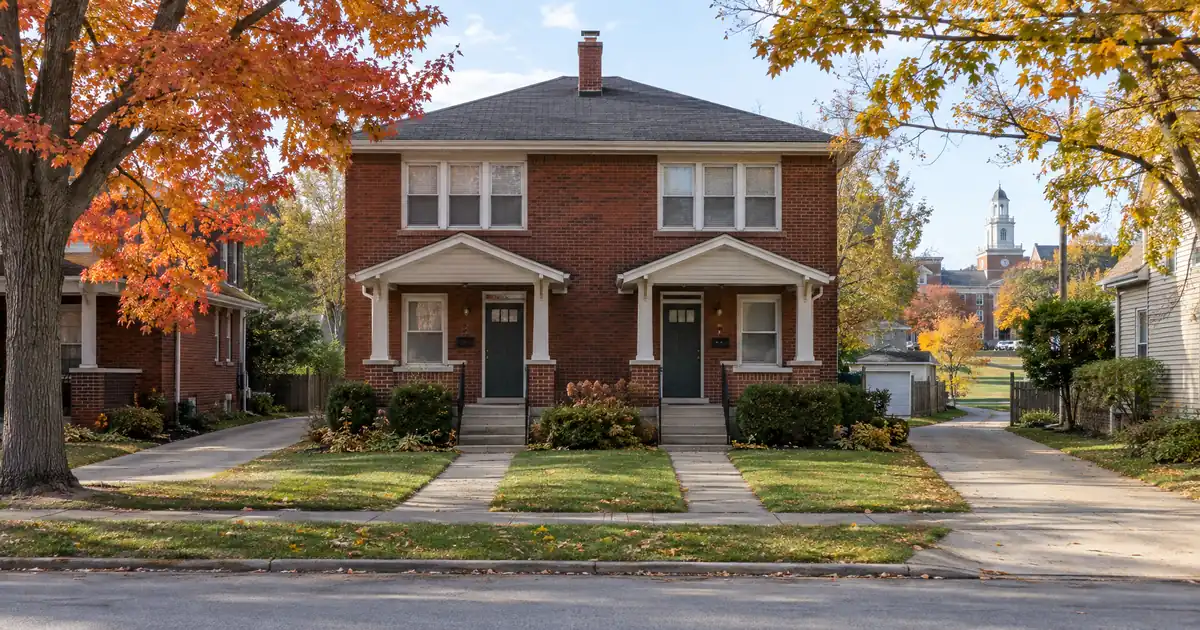
If you own a duplex or small rental in Newark that you bought a few years ago, the appraisal is probably the most interesting number in your file, and it may not be the one you expect. Most of what gets written about Newark cash-out deals skips the gap between what your leases pay and what an appraiser will call market rent. That gap decides how much equity you can move.
For real estate investors in Newark, Ohio, Lendmire (NMLS# 2371349) helps structure and place DSCR financing through wholesale lenders operating in 41 markets, including D.C. The broker’s read on this market is simple: small buildings near the shared campus and downtown grid carry the strongest coverage, and single-family rentals need more careful modeling.
DSCR Cash-Out Calculator
Run the cash-out numbers in Newark, OH
Rate source: Freddie Mac 30-yr average via FRED® — Federal Reserve Bank of St. Louis · effective Sep 24, 2026
Prefilled with starting assumptions — enter your property’s value, balance, taxes, and insurance for a more accurate picture.
Program parameters update from Lendmire’s centralized guideline source. Taxes and insurance are editable estimates.
As of Sep 24, 2026 · General Freddie Mac market benchmark, not a Lendmire loan offer. Property value, balance, taxes, and insurance are editable estimates. Maximum loan-to-value varies by lender, program, property type, and seasoning. Not a Loan Estimate, approval, or commitment to lend. Program availability and eligibility are subject to lender guidelines, credit approval, property review, and underwriting.
At a Glance: A DSCR cash-out refinance in Newark, Ohio suits investors who already own a small rental and want to redeploy equity, because the loan is underwritten primarily on the property’s rental income measured against its full monthly obligation rather than on personal income.
- Two 2BR units gross roughly $2,360 to $2,470 monthly, per RentCafe and Rentometer.
- Cash-out LTV tops out at 75%, with about 6 months of seasoning.
- Newark’s census-based median value is $192,300, well under the listing-side median.
- Legacy in-place rents can sit far below market and hold back coverage.
The Campus and Downtown Grid: Where Stacked Rents Work
The strongest DSCR profile in Newark is a two- to four-unit building near the shared Ohio State Newark and Central Ohio Technical College campus and the downtown grid around Courthouse Square. Stacked 2BR rents lift the numerator, and the tenant base is diversified across campus staff, county workers and hospital employees.
The campus anchor is real. The Ohio State University at Newark enrolled 2,572 students per Wikipedia’s most recent figure, and Central Ohio Technical College shares the campus with roughly 3,000 students of its own. COTC’s campus description lists 12 buildings including three residence halls, though that page is dated. Downtown adds the Licking County Courthouse, and Licking County government reports approximately 1,200 employees.
Now the rent math. Two 2BR units at $1,182 to $1,234 each gross about $2,360 to $2,470 monthly. A single 3BR house grosses $1,377 to $1,567. Those are sourced rents; the sums are simple arithmetic on them.
Neighborhood-level rent data is thin. Redfin’s quadrant samples show directional differences only: Northwest around $1,500, Southwest $1,425, Northeast $1,200. Treat those as color, not comps.
Run the Numbers: Duplex Versus Single-Family
Picture an investor holding a duplex that would appraise near the $192,300 census-based median value, with both units at market rent of about $1,182 each. Modeled at 75% LTV with taxes and insurance included in the full obligation, that file lands comfortably above 1.5x coverage. The equity pull is real because the rent-to-value ratio is strong. These specifics are subject to lender guidelines and a full review of property, leverage, and credit.
Now flip it. Say you own a 3BR house that appraises near the $259,900 12-month median sale price Homes.com reports, up 6% on the prior period, renting at the top of the range, $1,567. Same 75% ceiling, but including taxes and insurance the coverage sits below 1.00, roughly 0.9x. Skip the assumption that appreciation alone rescues the ratio. It doesn’t.
Both examples are modeled assumptions, not market facts. The point is the shape: appreciation raises the appraised value and the cash-out ceiling, but it also compresses rent-to-value. Model the cash-out amount and the coverage ratio as two separate questions.
When a single-family file falls short of 1.00 on long-term rent, a lender may review other structures, such as a lower-leverage cash-out, a sub-1.00 program with compensating factors, or interest-only. Each is subject to lender guidelines, credit review and property review. A standard DSCR program is built around a 1.00x baseline, and going below it typically costs leverage or requires stronger reserves.
The In-Place Rent Trap
Listings tell the story. Active Newark duplex and triplex listings on Homes.com show current rents of $500 and $550 per unit on one building and an efficiency leased at $650 on another. That’s roughly half of the $1,182 to $1,377 unit averages.
Here’s the catch. The appraiser’s market-rent schedule, not your leases, usually drives the coverage calculation on a cash-out. Lenders differ on how they treat leases well below market. So a building with legacy tenants may show decent coverage on the appraisal and still draw questions on the rent roll. Underwrite each building from its own rent roll, then compare to comps.
Investors who have already raised rents toward market, or who have separately metered utilities, arrive with cleaner files.
Do You Have the Comps? (Thin Multi-Unit Sales)
Cash-out proceeds depend on appraised value, and appraised value depends on comparable sales. In Newark, those are scarce for 2–4 unit buildings. Redfin’s Licking County pages show a couple dozen multi-family units for sale county-wide in a given month against roughly 170 homes sold. Those are undated snapshots, so read them qualitatively.
Homes.com lists nine multi-family properties in Newark priced from $119,900 upward, and reports multi-family homes sitting about 29 days on average. Liquidity looks adequate. Comp depth is the real constraint: an appraiser stretching to find recent duplex sales may cap the value and, with it, your cash out.
What the Files Usually Look Like
DSCR files in markets like this one typically come in with two numbers that don’t match: the rent the borrower expects and the rent the appraisal schedule supports. The stronger files carry a rent roll, a recent lease or two, and an explanation for any unit priced below market. In smaller Ohio markets, Lendmire’s broker team finds that the file usually tightens or loosens on the appraisal’s rental schedule, not on the borrower’s projections. It also helps to know the seasoning clock before ordering anything, since the lender looks at title recording, not closing paperwork you’re holding.
Seasoning, Leverage and What You Can Actually Pull
The verified program parameters are straightforward. Cash-out LTV is capped at 75%, seasoning runs about 6 months from title recording, the minimum coverage benchmark is 1.00, and credit tiers start at a 620 floor. Reserves typically run about 6 months of the full monthly obligation. Loan sizes go up to $3,000,000 on standard programs, though nothing at Newark’s price points comes close.
Two cautions. Some lenders set a lower ceiling on 2–4 unit cash-out than on single-family, so ask early, since these terms vary by lender and change often. And any building with 5+ units may shift into commercial underwriting, which changes the program. Equity available is never a guaranteed figure; it’s the product of appraisal, rent used for lender review, reserves and the ceiling.
For the mechanics, see the walkthrough on pulling equity with a DSCR cash-out and the broader refinancing options.
Why Tenants Keep Showing Up
Newark’s demand base is wide rather than deep in any one employer. Per Data USA, resident employment leans on retail trade (3,735), manufacturing (3,302) and health care (3,110). Census Bureau QuickFacts puts the population at 50,783 with median household income of $61,670. Licking Memorial Health Systems anchors the west side, and Owens Corning runs a manufacturing operation in Newark per the Columbus Region.
Renters are a meaningful pool: 8,964 renter-occupied households, 44% of the total. The average rent of $1,136 is up 3.09% year over year, but that figure comes from buildings with 50+ units, so it understates the small-building market. Source variance is wide. Other outlets show figures from $965 to $1,513, so treat rent as a range.
The Intel Angle (Potential, Not Promised)
Local reporting from a few years back placed Newark, Heath and Hebron within a 20-minute commute of the Intel site near Johnstown, and noted central Ohio had added 240,000 residents in a decade against only 80,000 homes, per ABC6. Columbus CEO quoted planners calling duplexes and triplexes “the missing middle of housing.”
That’s a regional statistic, and Intel’s timeline has shifted. Read it as a possible tailwind for small-building occupancy and exit liquidity, not a forecast to underwrite against. Newark’s median value near $192,300 against New Albany’s wealthier profile is the comparison that makes the theory interesting. Coverage should pencil without it.
What the Proceeds Are For
Cash-out only earns its keep when the money goes somewhere. The common play in a market like this is a down payment on the next small building, or rehab dollars that push below-market units toward the rents the appraiser already assumes. The second one closes the gap from the earlier section. It’s the more disciplined use, because higher rents raise both coverage and value.
DSCR vs. conventional financing
Two common ways to finance an investment property in Newark, OH. They qualify you differently — here’s how investors weigh them.
Why investors choose it
- Qualifies on the property’s rental income — no personal tax returns, W-2s, or pay stubs needed to document income.
- No personal debt-to-income ceiling to clear, so existing mortgages and obligations don’t cap your borrowing the same way.
- Can be closed in an LLC, keeping the property inside a business entity.
- Built for scaling — not held to the limit on number of financed properties that conventional financing applies.
- Underwriting centers on the deal: generally qualifies when the rent covers the payment, a 1.00x coverage ratio being a common baseline (confirmed in underwriting).
- Designed specifically for investment property, including long-term and, where the program allows, short-term rentals.
Where it’s strong
- Often the lowest ongoing financing cost for a buyer who fully qualifies on personal income — a fit for a first property or a cost-first purchase.
Trade-offs for investors
- Requires full personal income documentation and must fit within a debt-to-income limit — salary, existing debts, and other mortgages all count.
- Typically held in your personal name rather than a business entity.
- Caps how many financed properties you can carry, which can become a ceiling as a portfolio grows.
- Evaluates you as a borrower as much as the property, which usually means more paperwork.
How investors usually choose: a first or single property often optimizes for the lowest financing cost; portfolio builders often optimize for leverage, vesting in an LLC, and scaling past conventional caps. The right answer depends on your goals, the property, and current guidelines — both paths run through select lenders in Lendmire’s wholesale network, with eligibility and terms confirmed in underwriting.
Run it as a sequence. Confirm seasoning, price the rent roll, order the appraisal with your rent schedule ready, then decide how much to pull rather than how much you can. Leaving room under the ceiling keeps coverage above 1.00 with some cushion. Investors weighing a specific file can reach the broker at 828-256-2183 or start with an Ohio DSCR investor loans overview. Anyone new to the product should start with Lendmire’s DSCR walkthrough. Verify current local rental rules, taxes and insurance with qualified local professionals before you commit.
Frequently Asked Questions
Does a Newark duplex with $500 and $550 leases qualify for a strong cash-out?
Not on those leases alone. Lenders generally lean on the appraisal’s market-rent schedule, which for 2BR units sits near $1,182 to $1,234 in the sourced data. Coverage can look fine on paper while the rent roll draws questions, so document why units sit below market and whether increases are planned.
How thin are duplex comps in Licking County?
Thin enough to matter. Redfin’s county snapshots show a couple dozen multi-family units for sale against roughly 170 homes sold. An appraiser may need to reach for comps, which can cap value and cash out. Recent nearby duplex sales in your file help.
Is the $192,300 value or the $259,900 sale price the right benchmark?
Both, for different purposes. The first is a survey-based owner-value median; the second is a 12-month median sale price from Homes.com. Appraisal outcomes depend on the specific property and comps, so model a range rather than one number.
How long must I own before pulling equity?
About 6 months of ownership from title recording is the seasoning benchmark in the verified parameters. Individual lenders vary, and some review renovation and rent changes differently, so confirm early.
Does the Ohio State Newark and COTC campus actually support small multifamily?
It supports demand near the campus and downtown, alongside the hospital corridor on West Main and county employment. With 2,572 OSU Newark students and roughly 3,000 at COTC, plus 44% of households renting, the pool is meaningful. Underwrite from actual comps, not the campus narrative.
Ask any local appraiser what moves a Newark duplex number and the answer is rarely the neighborhood. It’s the rent roll, the condition of the units and whether there’s a recent sale within a mile to point to. Get those three lined up before you ask for a dollar.
About Lendmire
A DSCR-focused mortgage broker, Lendmire (NMLS# 2371349) places investor financing across 41 markets, 40 states plus Washington, D.C. DSCR eligibility is generally reviewed by the lender on property cash flow instead of traditional personal-income documentation, subject to lender guidelines. The firm was recognized by Scotsman Guide as a 2026 Top Workplace and is also a 2025 Scotsman Guide Top Workplace.
Get Started
Ready to find the right loan for you?
In about 30 seconds you can review financing options available for your investment property. No commitment required.
Informational only. Not a Loan Estimate, approval, or commitment to lend. Program availability and eligibility are subject to lender guidelines, credit approval, property review, and underwriting.
References
1. RentCafe, Newark rent trends
2. Rentometer, Newark average rent
3. The Ohio State University at Newark
4. Central Ohio Technical College
5. Licking County Government HR
6. Homes.com, Newark multi-family homes
10. ABC6, Licking County housing and Intel
11. recognized by Scotsman Guide as a 2026 Top Workplace
12. a 2025 Scotsman Guide Top Workplace
This article is part of Lendmire’s investment property cash-out refinance program — full qualification details, guidelines, and scenarios live on the program page.
Related reading: DSCR Cash Out Refinance Newark Ohio · DSCR Cash Out Refinance Middletown Ohio · DSCR Cash Out Refinance Hamilton Ohio
Guides: Investment Property Cash-Out Refinance in Newark, OH · Investment Property Cash-Out Refinance in Ohio
Brandon Miller
Founder & CEO, Mortgage Loan Originator, Lendmire LLC
- Mortgage Loan Originator · NMLS# 1129696 · Verify on NMLS Consumer Access
- North Carolina Real Estate Broker · License# 343312 · Verify on NCREC
- North Carolina Insurance Producer · License# 19053198 · Property, Casualty, Life, Health · Verify on NAIC SBS
- Lendmire LLC · Firm NMLS# 2371349 · Verify firm licensure
Compliance and disclosures. Lendmire (NMLS# 2371349) is a licensed mortgage broker and is not a direct lender, depository institution, financial advisor, or tax professional. Content in this article is general market analysis and educational information — not financial, legal, or tax advice for any specific situation. Lendmire does not guarantee loan approval; every transaction is subject to underwriting by the funding lender. Mortgage pricing and loan program guidelines are subject to change at any time without notice and vary by borrower characteristics, property type, and state regulations. Lendmire complies with Equal Housing Opportunity. Licensure verification: NMLS Consumer Access.