
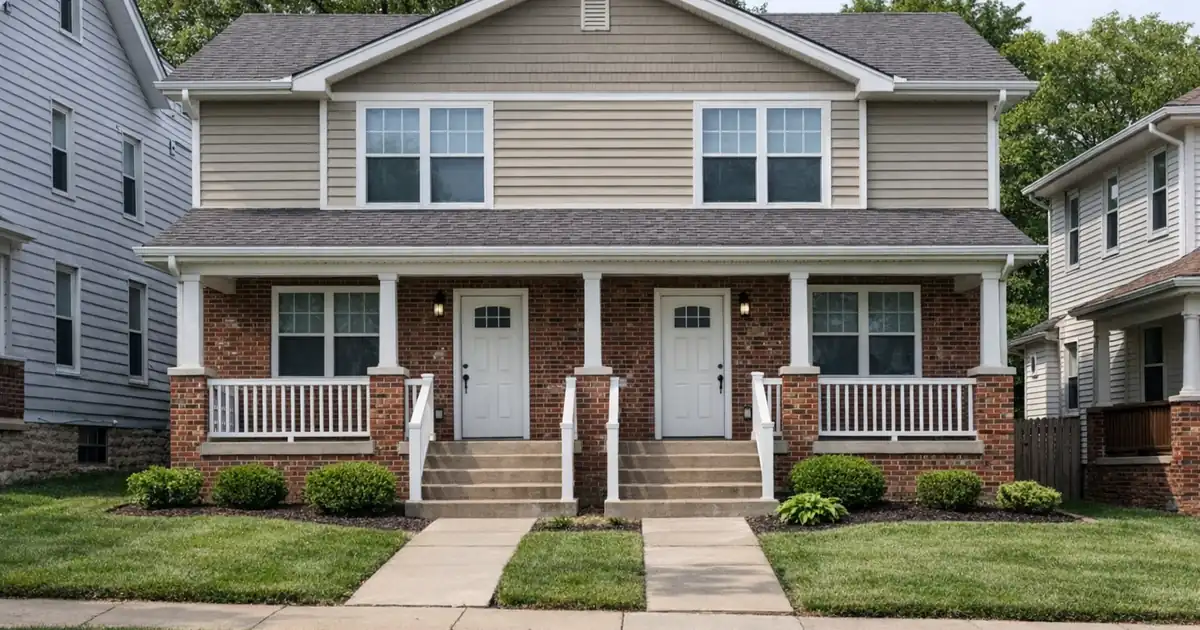
A St. Joseph rental property that has appreciated $60,000 since purchase is generating zero return on that built-up equity — until an investor does something about it. A cash out refinance investment property strategy using a DSCR loan changes that equation without requiring a single W-2, tax return, or pay stub.
DSCR loans qualify on the property’s rental income alone. If the rent covers the debt, the property qualifies — regardless of how many other properties the investor owns or how their personal income looks on paper. For St. Joseph investors sitting on equity in rental homes, duplexes, and small multifamily properties, this is the fastest path from idle capital to working capital. Lendmire, a non-QM mortgage broker licensed as NMLS# 2371349, specializes exclusively in DSCR and investment property loans and works with investors across investment property refinance programs in all 41 markets.
DSCR Cash-Out Calculator
Run the cash-out numbers in Missouri
Rate source: Freddie Mac 30-yr average via FRED® — Federal Reserve Bank of St. Louis · effective Jul 30, 2026
Prefilled with starting assumptions — enter your property’s value, balance, taxes, and insurance for a more accurate picture.
Program parameters update from Lendmire’s centralized guideline source. Taxes and insurance are editable estimates.
As of Jul 30, 2026 · General Freddie Mac market benchmark, not a Lendmire loan offer. Property value, balance, taxes, and insurance are editable estimates. Maximum loan-to-value varies by lender, program, property type, and seasoning. Not a Loan Estimate, approval, or commitment to lend. Program availability and eligibility are subject to lender guidelines, credit approval, property review, and underwriting.
Key Takeaways:
- DSCR cash-out refinancing qualifies on rental income — no W-2s, no tax returns, no DTI calculation required
- St. Joseph investors can access up to 75% LTV on cash-out refinances after just 6 months of ownership seasoning
- LLC ownership is supported, subject to lender program eligibility — protecting personal assets while building portfolio equity
DSCR Loan Basics for Investment Properties
DSCR loan qualification is built around one core question: does the property generate enough rental income to cover its monthly debt obligations? That ratio — the debt service coverage ratio — is what DSCR underwriting evaluates, replacing the W-2 income verification and DTI analysis that conventional lenders require.
The formula is straightforward. In plain terms, divide gross monthly rent by the full monthly PITIA payment to get the DSCR ratio (Lendmire’s DSCR loan explained guide covers the basics). A ratio at or above 1.00 means the property covers its own debt — which is the standard qualification threshold. Programs allowing ratios below 1.00 exist but come with tighter credit and LTV restrictions.
DSCR Math: Gross Rent ÷ (Principal + Interest + Taxes + Insurance + HOA) = DSCR | 1.00+ = qualifies | Below 1.00 = restricted programs.
St. Joseph’s Rental Market and the Equity Opportunity Right Now
St. Joseph, Missouri occupies a compelling position for rental property investors — affordable acquisition prices combined with genuine tenant demand from a stable and diversified local economy. The city’s proximity to Kansas City, roughly 55 miles to the south, gives it a secondary market appeal that has drawn investors seeking yields that metro prices no longer support.
Major employers including Heartland Health (now Mosaic Life Care), Amazon’s fulfillment operations, and the manufacturing base along the Frederick Avenue corridor anchor consistent employment and tenant stability. Missouri Western State University contributes a steady student-renter population, particularly in neighborhoods south of the campus along Mitchell Avenue and in the Robidoux Historic District.
As rental demand continues to grow in markets like St. Joseph, investors who purchased properties several years ago have built meaningful equity — often without the refinance options conventional lenders will approve. Non-QM investment property financing in St. Joseph fills exactly that gap, offering equity extraction paths that don’t hinge on personal income documentation or institutional lending criteria.
Investors in St. Joseph benefit from the same DSCR programs available to real estate investors across Missouri — programs built specifically for portfolios that don’t fit the conventional income documentation model. With equity levels having risen substantially in recent years across northwest Missouri’s residential market, the case for a cash out refinance investment property transaction has never been clearer.
The Case for DSCR Cash-Out Refinancing
DSCR cash-out refinancing delivers seven distinct advantages for real estate investors that conventional programs simply can’t match.
- Closes on a timeline that varies by lender and file: — Lendmire’s DSCR process moves faster than traditional bank underwriting because qualification centers on the property, not personal financial review
- No income documentation required: — no W-2s, no tax returns, no pay stubs, no DTI calculation applied to the borrower’s personal earnings
- LLC and entity ownership supported: — investors can close in an LLC or trust structure, subject to lender program eligibility, protecting personal assets from investment-side liability
- Short-term rental income eligible: — Airbnb and VRBO rental income can qualify, with gross rents reduced 20% for DSCR calculation purposes under program guidelines
- Cash-out proceeds available for investment purposes: — access equity to retire hard money loans on investment properties, fund down payments on acquisitions, or build reserves
- No limit on financed properties: — DSCR programs carry no portfolio cap, unlike conventional financing which restricts borrowers to 10 financed properties
- Flexible loan structures: — 30-year fixed, 40-year fixed, interest-only options, and ARM products available depending on investor objectives and underwriting fit
Every benefit listed above is available right now — the next step takes 30 seconds.
St. Joseph rental property owners are pulling equity with DSCR loans — no income verification, no conventional red tape. See what Lendmire can do for your property: Get a DSCR quote in 30 seconds or call 828-256-2183.
Meeting DSCR Loan Requirements
DSCR cash-out refinance eligibility rests on four core parameters that investors need to understand before applying. These figures reflect Lendmire’s verified DSCR program guidelines.
Qualification snapshot: 620 FICO floor for refinance | 75% maximum LTV on cash-out | 6 months seasoning | 6 months PITIA in reserves on a cash-out (cash-out proceeds may count toward them).
Credit Score Requirements:
Most DSCR cash-out refinance transactions close at 660 FICO or higher; the program floor is 620, with reduced leverage below 660 — lower than the 720 threshold needed for best conventional pricing — because DSCR underwriting evaluates the property’s income rather than the borrower’s creditworthiness as the primary risk variable. First-time investors need a 700 FICO minimum. Interest-only loan structures require a 680 FICO floor on 1-4 unit properties. Sub-1.00 DSCR transactions require a minimum 640 FICO with reduced LTV.
LTV and Cash-Out Limits:
DSCR cash-out refinances are capped at 75% LTV for single-unit properties with a 620+ FICO and DSCR at or above 1.00, on loans up to $3,000,000. Two-to-four unit properties and condos carry a 70% LTV maximum on refinances. This ceiling is identical to what Fannie Mae allows on conventional investment cash-outs — the advantage is in the qualification path, not the LTV.
Seasoning:
DSCR programs require a minimum of 6 months of ownership before a cash-out refinance — a window designed to establish the property’s rental income track record and protect against immediate equity extraction after purchase. This is half the 12-month seasoning conventional lenders require.
Reserves:
Reserves follow leverage and loan size: none at or below $1,500,000 and 70% LTV, 6 months of PITIA above 70% LTV, 9 months above $1,500,000, and 6 months on a cash-out, which the cash-out proceeds may satisfy. Importantly, cash-out proceeds from the refinance may satisfy reserve requirements on 1-4 unit properties — a structural advantage that makes liquidity easier to demonstrate at closing.
Investors are encouraged to verify current program eligibility directly with a qualified DSCR loan officer before proceeding, as individual outcomes depend on property characteristics and borrower profile.
DSCR vs. Conventional: A Side-by-Side Look
DSCR financing separates itself from comparing DSCR and conventional loans most directly on documentation and entity structure. Conventional investment loans from Fannie Mae require full income verification — W-2s, tax returns including Schedule E, pay stubs — and apply a DTI ratio of roughly 45% maximum to the borrower’s total debt picture. DSCR programs require none of this. Qualification rests entirely on whether the property’s rent covers its PITIA obligations. LLC ownership is another hard line: conventional programs prohibit LLC borrowers entirely, forcing investors to hold properties in personal name. DSCR programs support LLC and entity closings, subject to lender program eligibility, which matters for asset protection and portfolio structuring.
The seasoning and portfolio scale differences are equally significant. Conventional refinancing requires the existing first mortgage to be at least 12 months old from note date to note date — and the property must be owned at least 6 months before application. DSCR programs cut that seasoning requirement to 6 months, which is meaningful for investors who purchased a value-add property and want to recycle equity before a full year has elapsed. The 10-property cap on conventional financing also restricts portfolio growth for active investors; DSCR programs carry no such cap, making them the only practical option for investors who already own multiple financed properties.
On LTV, both programs reach the same 75% ceiling for single-unit cash-out refinances — that parallel is worth noting. The reserve structure is where the divergence is sharp. Conventional financing requires 6 months of PITIA reserves on every financed property the borrower holds, not just the subject property. That reserve drag can make a conventional cash-out impractical for investors with large portfolios. DSCR reserves follow leverage and loan size rather than the count of financed properties — none at or below $1,500,000 and 70% LTV, 6 months of PITIA above 70% LTV, 9 months above $1,500,000, and 6 months on a cash-out, which the proceeds may satisfy — a reserve advantage for investors with large portfolios.
Deep Dive: DSCR Cash-Out Strategies for St. Joseph Investors
Recycling Equity from St. Joseph Rentals Into New Acquisitions
Experienced investors in this market know that idle equity is a cost — it’s capital earning zero return while other investors deploy the same type of asset into their next deal. The core DSCR cash-out strategy is equity recycling: refinance a seasoned St. Joseph rental at 75% LTV, extract the equity above the existing balance, and use those proceeds as a down payment on the next acquisition.
A property purchased for $120,000 that has appreciated to $165,000 with an outstanding balance of $85,000 yields roughly $38,750 in cash-out proceeds at 75% LTV before closing costs — enough to fund a 25% down payment on a $150,000 income property without touching personal savings. That’s portfolio scaling with no new personal capital required.
Exiting Hard Money and Bridge Loans
Hard money and private bridge loans on investment properties carry significantly higher costs than permanent DSCR financing. Many St. Joseph investors use short-term bridge financing to acquire and stabilize properties, then face the timeline pressure of exiting those loans before costs accumulate. A DSCR cash-out refinance is the clean exit — it replaces the high-cost temporary loan with long-term fixed or interest-only financing based on the property’s stabilized rent roll.
The 6-month seasoning window on DSCR programs makes this timeline realistic. An investor who closes a bridge loan in January can refinance into a DSCR product in July — eliminating the high-cost debt and potentially extracting additional equity in the same transaction. Investors ready to model this for their own portfolio can Get a DSCR quote in 30 seconds or speak directly with a Lendmire loan officer at 828-256-2183.
Targeting St. Joseph’s Cash-Flow Neighborhoods
The Southside and Ashland Avenue corridors in St. Joseph offer single-family rentals priced well below $150,000 with rents that push DSCR ratios above 1.25 on 30-year fixed structures. This is the profile where DSCR cash-out math works cleanest — strong rent-to-value ratios, minimal vacancy due to workforce tenant demand, and equity accumulation that outpaces the acquisition price.
Properties near Missouri Western State University — particularly along Kings Hill and Seneca Street — attract consistent student and young professional tenants, supporting rent stability that DSCR underwriting rewards. Investors who acquired in these submarkets during softer periods have built equity that non-QM investment property financing in St. Joseph can unlock today.
Multi-Unit Properties and DSCR Refinancing
St. Joseph’s duplex and small multifamily inventory represents a strong DSCR refinance candidate pool. A duplex producing $1,800 in combined monthly rent against a $1,350 PITIA produces a 1.33 DSCR — well above the 1.00 minimum and comfortably within refinance territory at the 70% cap applicable to 2-4 unit properties. The combined rent from multiple units also provides a buffer against single-unit vacancy that single-family investors don’t have.
The 70% LTV ceiling on 2-4 unit refinances is a planning variable investors should model before application. For a duplex appraised at $200,000, the maximum cash-out proceeds are capped at $140,000 less the outstanding balance — understanding this ceiling early prevents surprises at the appraisal stage.
Interest-Only DSCR Loans as a Portfolio Scaling Tool
Interest-only DSCR loans reduce monthly PITIA obligations, which changes the DSCR calculation in the investor’s favor — lower monthly debt service means a higher coverage ratio on the same rent. For investors whose properties sit near the 1.00 DSCR threshold on a fully amortizing 30-year structure, an interest-only loan can shift the qualification picture without requiring additional rent income.
The 680 FICO minimum for interest-only structures on 1-4 unit properties is achievable for most active investors. The 10-year interest-only period — available on 40-year loan terms — provides a decade of lower cash obligations while property values and rents continue to compound. That combination of low monthly cost and long-term equity growth is why portfolio investors in cash-flow markets like St. Joseph favor this structure.
Short-Term Rental Applications
Short-term rental income is eligible for DSCR qualification in St. Joseph, with program guidelines reducing gross STR rents by 20% before calculating the coverage ratio — a conservative buffer that reflects vacancy and seasonal variation.
St. Joseph’s proximity to Kansas City creates genuine STR demand for business travelers, sports event visitors, and families attending Missouri Western events. Investors using financing Airbnb properties with a DSCR loan can qualify on documented short-term rental income rather than being forced into traditional long-term lease structures that may undervalue the property’s actual earning potential. The 20% reduction means an STR generating $2,500 per month in gross rents qualifies at $2,000 for DSCR purposes — plan the ratio around the adjusted figure.
Example DSCR Scenario
Property: Single-family rental (illustrative figures).
Current Appraised Value: $225,000.
Original Purchase Price: $175,000.
Outstanding Loan Balance: $118,000.
Maximum Cash-Out at 75% LTV: $168,750.
Estimated Closing Costs: $4,500.
Net Cash-Out Proceeds: $46,250 (after payoff and closing costs)
Monthly Gross Rent: $1,650.
Estimated Monthly PITIA: $1,320.
DSCR: $1,650 ÷ $1,320 = 1.25.
The DSCR of 1.25 clears the 1.00 minimum threshold with meaningful margin, qualifying for the full 75% LTV cash-out program. No income documentation required. LLC ownership welcome, subject to lender program eligibility.
St. Joseph investors who understand this math are already applying it across their portfolios.
This is the math behind portfolio scaling — and it works the same way on your property.
The math works — now make it real. Lendmire closes DSCR loans on a timeline that varies by lender and file with no income documentation required. LLC ownership supported, subject to lender program eligibility. Get a DSCR quote in 30 seconds or call Lendmire at 828-256-2183 to start your St. Joseph refinance.
What Makes Lendmire Different for DSCR Lending
Lendmire is a specialized non-QM mortgage broker — not a bank, not a retail lender, and not a generalist shop that handles DSCR deals as a side product. NMLS# 2371349 represents a practice built exclusively around investment property financing, with DSCR cash-out refinance at the center.
Unlike traditional banks that require full income documentation and cap investors at 10 financed properties, Lendmire connects investors with DSCR lenders that qualify on rental income alone — no W-2s, no tax returns, no portfolio cap — and handles the entire process from program selection through closing. Lendmire works directly with real estate investors in St. Joseph, Missouri, providing DSCR cash-out refinance solutions without income documentation requirements.
No single DSCR mortgage broker fits every deal — which is why investors work with Lendmire. As a specialized non-QM mortgage broker, Lendmire matches each property and investor profile to the lender offering the best terms, handles underwriting navigation, and closes on a timeline that varies by lender and file across 41 markets.
Lendmire’s repeat investors confirm what the numbers show: DSCR programs that close on a timeline that varies by lender and file with no income documentation create a financing advantage investors don’t find elsewhere. For investors holding rental properties near Missouri Western State University or the Mosaic Life Care employment corridor, Lendmire’s DSCR programs provide a direct path to accessing built-up equity. Investors access rental income–based financing in 41 markets through Lendmire’s non-QM platform — from Missouri to every state in the portfolio.
Why Lendmire — Key Facts: NMLS# 2371349 | Non-QM mortgage broker | Exclusive DSCR loan specialization | Operates across 41 markets | Multiple lender programs | fast close capability | No W-2s, no tax returns | LLC closings supported (subject to lender program eligibility) | No property count cap | 828-256-2183.
As a dedicated non-QM mortgage broker (NMLS# 2371349), Lendmire has built its practice around one thing: DSCR investment property loans across 41 markets, with closings on a timeline that varies by lender and file.
DSCR Refinance Paths for Portfolio Growth
DSCR refinancing gives St. Joseph investors two distinct paths: rate-and-term refinancing to improve cash flow, and cash-out refinancing to extract equity for redeployment. The investment property cash-out refinance path is the more powerful portfolio scaling tool — it converts property appreciation and principal paydown into liquid capital without selling the asset.
The seasoning distinction matters for timing. DSCR programs allow cash-out refinancing after just 6 months of ownership — compared to the 12-month note-to-note seasoning conventional programs require. For St. Joseph investors who acquired properties through private lending or bridge structures, this 6-month window is the difference between being trapped in high-cost debt and transitioning to permanent DSCR financing on a practical timeline.
Cash-out proceeds can retire hard money loans on investment properties, fund reserves for additional acquisitions, or offset renovation costs on other portfolio assets. What they cannot do — per program guidelines — is pay off personal credit cards, personal tax liens, or other personal consumer obligations. Proceeds must flow toward investment-related purposes. For a complete overview of investment property refinance options available through Lendmire, the program detail covers rate-and-term, cash-out, and interest-only combinations across all supported property types.
Frequently Asked DSCR Loan Questions
What credit and DSCR requirements does Lendmire look at for investment properties in St. Joseph, Missouri?
For cash-out refinance transactions, Lendmire’s DSCR programs require a 620 FICO minimum and a DSCR ratio at or above 1.00 for standard LTV qualification. First-time investors need a 700 FICO floor. The standard cash-out ceiling is 75% LTV for single-unit properties. Sub-1.00 DSCR options are available with tighter restrictions. St. Joseph investors in the sub-$1,500,000 loan range typically qualify under standard program tiers with 6 months PITIA in reserves on a cash-out (cash-out proceeds may count toward them).
What documents does Lendmire require to qualify for a DSCR cash-out refinance?
DSCR loans require no W-2s, no tax returns, no pay stubs, and no DTI analysis. Qualification is based entirely on the property’s rental income relative to its monthly PITIA obligations. Standard documentation includes a lease agreement or rent schedule, appraisal, title insurance, and standard closing documentation. For St. Joseph investors with complex tax structures or self-employment income, DSCR eliminates the documentation burden that conventional refinancing requires entirely.
Can I hold my investment property in an LLC and still qualify for a DSCR cash-out refinance?
Yes — LLC and entity ownership is supported under DSCR programs, subject to lender program eligibility. This is a direct advantage over conventional Fannie Mae investment loans, which prohibit LLC borrowers entirely. St. Joseph investors using an LLC for asset protection can close a DSCR cash-out refinance in that entity name, maintaining the liability separation that portfolio investors typically want. Confirm program-specific eligibility with Lendmire before assuming all structures qualify.
Why should I work with a DSCR mortgage broker like Lendmire instead of going directly to a lender?
The best DSCR lender depends on the specific deal — the property type, DSCR ratio, credit profile, and loan structure all affect which program offers the best terms. No single lender is optimal for every scenario. Lendmire (NMLS# 2371349) is a specialized non-QM mortgage broker that works across multiple DSCR lenders in 41 markets, matching each deal to the right program and handling the underwriting process so investors don’t have to navigate it alone. For St. Joseph investors, that means faster closes and programs fit to the deal.
How long does a DSCR cash-out refinance take to close in St. Joseph?
Lendmire closes DSCR loans on a timeline that varies by lender and file — significantly faster than the 30-45 day timelines typical of bank underwriting. The speed advantage comes from non-QM underwriting guidelines that evaluate the property’s rent coverage rather than requiring full personal income review. Property appraisal is the primary variable affecting timeline. St. Joseph investors with a complete file and a clear title can realistically close inside three weeks.
What can I use DSCR cash-out proceeds for?
Cash-out proceeds from a DSCR refinance can fund down payments on additional investment properties, retire hard money or private bridge loans on investment properties, build acquisition reserves, or cover renovation costs on other portfolio assets. Program guidelines prohibit using cash-out proceeds to pay off personal consumer debt — credit cards, personal tax liens, or personal judgments. The proceeds must serve investment-related purposes. For investors scaling a St. Joseph rental portfolio, this creates a compounding equity strategy without requiring personal income documentation at any step.
Explore More
- The guide “What Is a DSCR Loan”
- Compare DSCR vs conventional investment financing
- Cash-out refinance strategies for rental property investors
- Review DSCR refinance loan structures
About Lendmire
Lendmire (NMLS# 2371349) is a mortgage brokerage focused on DSCR investor financing, helping arrange programs through wholesale and investor-lending channels in 41 markets, including Washington, D.C. DSCR loans are evaluated by the lender on property cash flow rather than personal income, subject to lender guidelines, supporting LLC closings and accommodating investors with four or more financed properties. Scotsman Guide named Lendmire a Top Mortgage Workplace in both 2025 and 2026.
Get Started
Ready to find the right loan for you?
In about 30 seconds you can review financing options available for your investment property. No commitment required.
Informational only. Not a Loan Estimate, approval, or commitment to lend. Program availability and eligibility are subject to lender guidelines, credit approval, property review, and underwriting.
This article is part of Lendmire’s investment property cash-out refinance program — full qualification details, guidelines, and scenarios live on the program page.
Related reading: DSCR Cash Out Refinance St. Joseph Missouri · DSCR Cash Out Refinance Joplin Missouri · DSCR Cash Out Refinance Webster Groves Missouri
Guides: Investment Property Cash-Out Refinance in St. Joseph, MO · Investment Property Cash-Out Refinance in Missouri
Brandon Miller
Founder & CEO, Mortgage Loan Originator, Lendmire LLC
- Mortgage Loan Originator · NMLS# 1129696 · Verify on NMLS Consumer Access
- North Carolina Real Estate Broker · License# 343312 · Verify on NCREC
- North Carolina Insurance Producer · License# 19053198 · Property, Casualty, Life, Health · Verify on NAIC SBS
- Lendmire LLC · Firm NMLS# 2371349 · Verify firm licensure
Legal disclosures. Lendmire (NMLS# 2371349) is a state-licensed mortgage brokerage that arranges financing through wholesale lender relationships. Lendmire is not a direct lender, depository institution, or registered financial advisor. The discussion above is general informational content about real estate financing — it is not financial, legal, or tax advice, and readers should consult licensed professionals for guidance on their individual circumstances. Loan inquiries are subject to lender underwriting; this article does not represent a commitment to lend. Loan terms, rates, and qualification standards vary by borrower, property, and state, and are subject to change at any time. Equal Housing Opportunity. NMLS Consumer Access: nmlsconsumeraccess.org.