
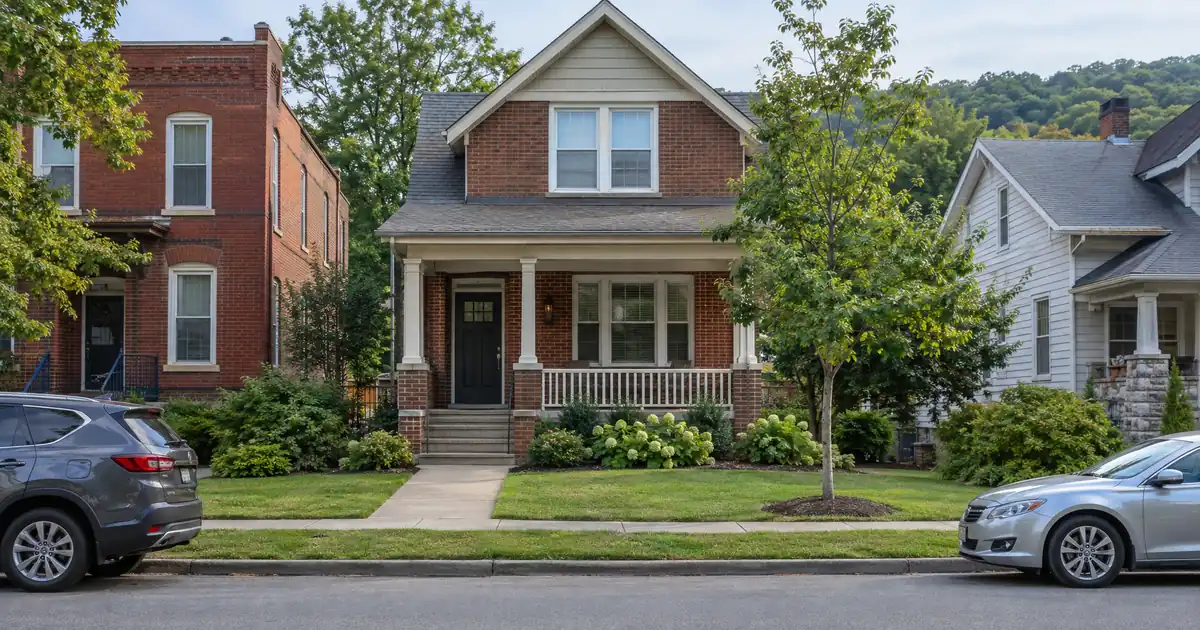
Zillow puts the typical O’Fallon home value at $379,237, up just 0.9 percent year over year, with homes going pending in about five days. That is a fast-selling, flat-priced market. For an investor planning a cash-out refinance, the takeaway is direct: the equity you pull will come from the basis you bought at, the paydown you have built, and the work you have done to the house, not from a market that lifts your value for you. Lendmire (NMLS# 2371349) structures DSCR scenarios for investors targeting Ofallon, Missouri and places them with wholesale lenders across 41 markets, including D.C.
The Quick Read: A DSCR cash-out refinance in O’Fallon, Missouri is underwritten primarily on the property’s rental income measured against its full monthly obligation, so the rental has to carry taxes and insurance at the leverage requested, not just the loan itself.
DSCR Cash-Out Calculator
Run the cash-out numbers in Ofallon, MO
Rate source: Freddie Mac 30-yr average via FRED® — Federal Reserve Bank of St. Louis · effective Sep 24, 2026
Prefilled with starting assumptions — enter your property’s value, balance, taxes, and insurance for a more accurate picture.
Program parameters update from Lendmire’s centralized guideline source. Taxes and insurance are editable estimates.
As of Sep 24, 2026 · General Freddie Mac market benchmark, not a Lendmire loan offer. Property value, balance, taxes, and insurance are editable estimates. Maximum loan-to-value varies by lender, program, property type, and seasoning. Not a Loan Estimate, approval, or commitment to lend. Program availability and eligibility are subject to lender guidelines, credit approval, property review, and underwriting.
- The cash-out LTV ceiling is 75 percent, and seasoning runs about six months from title recording.
- Single-family houses rent near $2,400 per Homes.com; condos rent near $1,575.
- Zillow’s 0.9 percent annual value gain means proceeds rest on today’s appraisal, not growth.
- Roughly 81 percent of households own, so duplexes and fourplexes are scarce.
Ofallon Market Snapshot
A quick read on the Ofallon investor landscape — figures come from the cited sources below. Confirm current property-level numbers before underwriting.
| Metric | Detail |
|---|---|
| Recent appreciation | +0.9% (Zillow Home Values) |
| Employment | More than 2,300 employees (Citi Careers, O’Fallon) |
WingHaven and the Highway K Corridor: Where the Tenants Work
The strongest cash-out candidates in O’Fallon sit near the Highway K and Technology Drive corridor, around WingHaven, the Missouri Research Park, and Progress West Hospital. This is where salaried payments, banking, and healthcare jobs concentrate, and it is where rent collection assumptions are easiest to defend.
The employer base is the reason. According to Citi’s careers page for O’Fallon, the bank employs more than 2,300 people across two campuses; another Citi page cites about 2,000, so a range of roughly 2,000 to 2,300 is the honest read. Select O’Fallon, the city’s economic development office, names Mastercard and Citi as the largest private employers, and its workforce page also lists McKesson among Fortune 500 companies drawn to the city. A major local employer profile documents how Mastercard and WingHaven built the corridor. Treat that piece as history, not a current headcount.
Healthcare adds a second anchor. Progress West Hospital, part of BJC HealthCare, has 77 private inpatient rooms per BJC Careers, a Level II Stroke Center, and a Level II NICU. Shift workers and clinicians who want short drives create steady renewal demand on 3- and 4-bedroom houses nearby.
Citywide context supports the thesis. Data Commons lists a population of 95,355 and unemployment of 2.8 percent, and Census Reporter shows a mean commute of 25.5 minutes. A tenant earning the roughly $6,600 to $7,200 in monthly income that a $2,200 to $2,400 rent implies under a 3x rule is a plausible profile for the corridor’s white-collar jobs. The concentration risk is real, though. A retrenchment at one large employer would hit this pocket first.
What Does a Cash-Out Return When Values Are Flat?
Less than an investor in a rising market would expect, and the math should be underwritten that way from the start. With Zillow’s 0.9 percent value gain and Homes.com’s price-to-rent ratio of 13.6, O’Fallon behaves as a cash-flow suburb rather than an appreciation play.
Here is how the pieces fit. The cash-out ceiling on these programs is 75 percent LTV, a hard cap that sits below the purchase-side maximum. Proceeds equal the appraised value times that percentage, minus the payoff of the existing loan and closing costs. Because the value trend is near zero, the appraisal is basically the number you would have gotten a year ago. Equity harvested therefore reflects:
- A purchase basis below today’s market value.
- Principal paydown since acquisition.
- Improvements that lift the appraisal or the supportable rent.
Seasoning matters here. Programs typically look for about six months of ownership measured from title recording, so an investor who bought recently and renovated can often cash out sooner than one waiting on market gains. Reserves of about six months of PITIA are typical, and the credit tiers run from a 620 floor up through 660, 680, and 700, with pricing and leverage improving at the higher tiers. All of it varies by lender, property, and borrower. Equity available is never a guaranteed figure; it depends on rent used for lender review, the full monthly obligation, reserves, and that 75 percent ceiling.
The cash-out refinance walkthrough covers the mechanics in detail, and the broader refi programs page shows how rate-and-term and cash-out files differ.
The Rent Side: Houses, Townhomes, and the Condo Trap
The rent evidence for O’Fallon splits sharply by property type, and mixing sources produces bad underwriting. Label every figure.
Apartment data understates the house market. RentCafe reports an average of $1,519, up 0.86 percent, with 3-bedrooms at $1,990. But that series covers only buildings with 50 or more units. It is not a single-family rent, and rents that barely move will not rescue thin coverage.
House data runs higher. Homes.com shows a median single-family asking rent of roughly $2,300 to $2,400, with 3-bedroom houses at $2,195, 4-bedrooms at $2,650, and 5-bedrooms at $4,100. Rentometer, a modeled aggregator, lands near $2,250 for a 3-bedroom house and $2,800 to $2,900 for four-plus bedrooms. Two independent sources within about 5 percent of each other on the 3-bedroom is decent support for underwriting near $2,200.
Property type changes everything. Homes.com shows single-family at $2,400, townhouses at $2,150, and condos at $1,575. That is a $250 gap to townhomes and an $825 gap to condos. Unless the condo’s purchase price and carrying costs are proportionally lower, its coverage will run weaker. Skip condos as a cash-out vehicle unless the numbers prove otherwise.
As an illustration only (this blends two mismatched datasets), a $2,195 rent against the $379,237 Zillow value implies a gross yield near 6.9 percent, and a $2,650 rent implies about 8.4 percent. Gross yield is not coverage, though. Taxes, insurance, and debt service decide the ratio.
Run the Numbers on a Typical O’Fallon House
Consider a modeled scenario. An investor owns a 3-bedroom house that appraises near the Zillow typical value of $379,237, and wants to refinance at the 75 percent LTV ceiling. Assume, as a modeled input, monthly rent between $2,200 and $2,400. Coverage is rent divided by the full monthly obligation: principal, interest, taxes, and insurance. Run at that leverage, with taxes and insurance included and an assumed 30-year amortization, the ratio hovers between the mid-0.9s and the low-1.0s. That is the standard 1.00 benchmark, and this house sits right on it.
Sitting at the line has consequences. A file just under 1.00 on long-term rent is not dead, but it is not a clean pass either. Lenders may review it through a lower-leverage structure, an interest-only period, or a program that permits sub-1.00 coverage, usually with stronger compensating factors such as a higher credit tier, more reserves, or more equity left in the property. Whether any of those apply depends on lender guidelines, credit approval, and property review. The same house refinanced at a lower LTV clears the benchmark more comfortably, but it returns less cash.
That trade-off is the whole game in a flat market. Investors who want maximum proceeds accept thin coverage and tighter lender scrutiny. Investors who want a clean file give up some proceeds. A 4-bedroom at the $2,650 Homes.com rent, if the purchase basis is not proportionally higher, generally improves the ratio, which is why 3- and 4-bedroom houses are the core DSCR product here.
Working DSCR brokers see a recurring pattern in higher-priced suburban single-family markets: coverage lands close to 1.00 at full leverage, and the file’s fate turns on the appraiser’s rent schedule rather than on the investor’s asking rent. Files that arrive with a lease in place, comparable house rentals, and a clear reserve position tend to move through lender review more smoothly than files built on an optimistic rent assumption.
Skip the Fourplex Hunt.
The standard St. Louis-area DSCR pitch is duplex and fourplex income stacking. It does not fit O’Fallon well. RentCafe shows 7,032 renter-occupied households (19 percent) against 30,492 owner-occupied (81 percent). Small multifamily is likely thin, though no sourced inventory exists for duplex, triplex, or fourplex pricing here, so that is inference and not fact. If an investor does find one, it offers the strongest income stacking, and it deserves a hard look. Nearby St. Charles and St. Peters may hold more of it, though that is unsourced here.
The practical read: the O’Fallon cash-out is a suburban house or townhome refinance. Confirm which O’Fallon any data set covers. Homes.com’s “O’Fallon neighborhood, Saint Louis” is a separate North St. Louis City area, and O’Fallon, Illinois is another city entirely. Appraisal comps and rent data must come from St. Charles County, Missouri.
Redeploying the Proceeds
Cash-out money only creates value if it lands in a better-coverage asset. O’Fallon’s flat appreciation is the argument for moving capital. Equity idling in a 0.9 percent market earns little, while proceeds placed into a higher-coverage rental elsewhere in the metro can carry more of their own weight.
Lake St. Louis sits about two miles away and St. Peters about 5.7 miles away, with a population of 51,381, so an investor can stay in the same employment orbit while shopping for different price-to-rent ratios. Within O’Fallon, McBride Homes points to the Rail District and Fort Zumwalt Park, more than 450 acres of parkland, and nearly 1,850 businesses as draws, which supports long-term hold of the existing house rather than a sale.
An investor who keeps the O’Fallon house and refinances, rather than selling, also avoids resetting basis at a market price that has barely moved. That is the equity-extraction case in one sentence. For the coverage mechanics behind all of this, see the guide “What Is a DSCR Loan”, and for the underwriting contrast, Lendmire’s comparison of DSCR and conventional loans explains why rental income, not traditional employment income, drives the file. Lendmire’s page on DSCR loan options for Missouri investors covers the state-level program picture, and investors ready to test a specific house can request a scenario quote or call 828-256-2183.
New Supply Is the Counterweight
New construction competes for the same tenants. The St. Louis Post-Dispatch reported that The Villages at Post Farms, inside city limits, would add 335 homes on 100 acres. It also reported that Autumn Hollow, a Lombardo Homes community pairing single-family homes with luxury-style apartments, was expected to finish its apartments around the start of this year. Apartment-heavy supply pressures the apartment segment more than the house segment, but new-build rentals can cap what an older house commands.
DSCR vs. conventional financing
Two common ways to finance an investment property in Ofallon, MO. They qualify you differently — here’s how investors weigh them.
Why investors choose it
- Qualifies on the property’s rental income — no personal tax returns, W-2s, or pay stubs needed to document income.
- No personal debt-to-income ceiling to clear, so existing mortgages and obligations don’t cap your borrowing the same way.
- Can be closed in an LLC, keeping the property inside a business entity.
- Built for scaling — not held to the limit on number of financed properties that conventional financing applies.
- Underwriting centers on the deal: generally qualifies when the rent covers the payment, a 1.00x coverage ratio being a common baseline (confirmed in underwriting).
- Designed specifically for investment property, including long-term and, where the program allows, short-term rentals.
Where it’s strong
- Often the lowest ongoing financing cost for a buyer who fully qualifies on personal income — a fit for a first property or a cost-first purchase.
Trade-offs for investors
- Requires full personal income documentation and must fit within a debt-to-income limit — salary, existing debts, and other mortgages all count.
- Typically held in your personal name rather than a business entity.
- Caps how many financed properties you can carry, which can become a ceiling as a portfolio grows.
- Evaluates you as a borrower as much as the property, which usually means more paperwork.
How investors usually choose: a first or single property often optimizes for the lowest financing cost; portfolio builders often optimize for leverage, vesting in an LLC, and scaling past conventional caps. The right answer depends on your goals, the property, and current guidelines — both paths run through select lenders in Lendmire’s wholesale network, with eligibility and terms confirmed in underwriting.
Also keep the thin-data caveat in mind. No reliable rental vacancy figure exists for O’Fallon from a strong source, and one aggregator’s low number could not be verified against the underlying Census table, so no vacancy assumption here should rest on it. Investors should verify current local rental rules, taxes, and insurance with qualified local professionals before sizing a refinance.
Frequently Asked Questions
How much equity can an O’Fallon owner pull out when values are nearly flat?
It depends on basis, paydown, and improvements more than on the market. At the 75 percent LTV ceiling, proceeds equal the appraised value times that percentage, minus the existing payoff and costs. With Zillow showing a 0.9 percent annual gain, an owner who bought years ago at a lower price has more room than one who bought near today’s value.
Which O’Fallon property type covers rent best?
Houses and townhomes. Homes.com puts single-family rent near $2,400 and townhouses near $2,150, while condos sit near $1,575. Unless a condo’s price and carrying costs are proportionally lower, its coverage will lag. A 3- or 4-bedroom house is the safest fit.
Does a Citi or Mastercard tenant help the loan file?
Not directly, since the file is reviewed on the property’s rent against its full monthly obligation, not on the tenant’s employer. The employer base matters to renewal odds and rent collection. It supports a 12-month lease assumption without changing how the ratio is calculated.
Will O’Fallon, Illinois comps cause problems?
They can if the wrong data slips into the rent schedule or appraisal. Confirm that every comp is in O’Fallon, Missouri, in St. Charles County. The St. Louis City “O’Fallon” neighborhood is also a different market, with far lower prices.
How long must I own the property before a cash-out?
Programs typically look for about six months of ownership, measured from title recording. Seasoning rules, reserves, and credit tiers vary by lender and program, so confirm them against the specific file.
For current guidelines and terms, see Lendmire’s DSCR loan programs page.
About Lendmire
Lendmire (NMLS# 2371349) is a mortgage brokerage built around DSCR investor lending, with programs available in 41 markets, including Washington, D.C. DSCR lenders commonly evaluate rental-income coverage instead of personal income paperwork, a practical fit for LLC-owned and multi-property investors, subject to program terms. Terms vary by lender, property, leverage, and program. The firm has been recognized by Scotsman Guide as a 2026 Top Workplace and is a 2025 Scotsman Guide Top Mortgage Workplace, per Scotsman Guide and its 2025 list.
Get Started
Ready to find the right loan for you?
In about 30 seconds you can review financing options available for your investment property. No commitment required.
Informational only. Not a Loan Estimate, approval, or commitment to lend. Program availability and eligibility are subject to lender guidelines, credit approval, property review, and underwriting.
References
1. Zillow Home Values, O’Fallon
2. Homes.com, homes for rent in O’Fallon
6. BJC Careers, Progress West Hospital
8. RentCafe, O’Fallon rent trends
10. McBride Homes
12. Scotsman Guide
13. Scotsman Guide — Top Workplaces 2025
This article is part of Lendmire’s investment property cash-out refinance program — full qualification details, guidelines, and scenarios live on the program page.
Related reading: Luxury Rental DSCR Loans In New Jersey · Jersey Shore Vacation Rental Loans: DSCR Financing In Ocean City, Cape May And Long Beach Island · DSCR Cash-out Refinance In New Jersey: Pulling Equity From A Rental
Guides: Investment Property Cash-Out Refinance in Missouri
Brandon Miller
Founder & CEO, Mortgage Loan Originator, Lendmire LLC
- Mortgage Loan Originator · NMLS# 1129696 · Verify on NMLS Consumer Access
- North Carolina Real Estate Broker · License# 343312 · Verify on NCREC
- North Carolina Insurance Producer · License# 19053198 · Property, Casualty, Life, Health · Verify on NAIC SBS
- Lendmire LLC · Firm NMLS# 2371349 · Verify firm licensure
Compliance and disclosures. Lendmire (NMLS# 2371349) is a licensed mortgage broker and is not a direct lender, depository institution, financial advisor, or tax professional. Content in this article is general market analysis and educational information — not financial, legal, or tax advice for any specific situation. Lendmire does not guarantee loan approval; every transaction is subject to underwriting by the funding lender. Mortgage pricing and loan program guidelines are subject to change at any time without notice and vary by borrower characteristics, property type, and state regulations. Lendmire complies with Equal Housing Opportunity. Licensure verification: NMLS Consumer Access.