
Can an investor actually pull usable equity out of a Tega Cay rental without breaking the coverage ratio? The short answer: yes, but not at the maximum leverage a cash-out DSCR loan technically allows. Tega Cay’s rent-to-price math is tight enough that hitting the 75 percent loan-to-value ceiling often pushes the debt coverage ratio below 1.00, which means the leverage decision matters more here than in most Charlotte-suburb refinance files.
The Short Version: A Tega Cay, South Carolina cash-out refinance is underwritten primarily on the property’s rental income measured against its full monthly obligation, with proceeds capped by a 75 percent loan-to-value ceiling and roughly six months of seasoning from the title recording date. Because the typical home here runs $556,928 against average single-family rents of $2,611, per Zillow and Apartments.com, coverage ratios compress fast as leverage rises.
DSCR Cash-Out Calculator
Run the cash-out numbers in Tega Cay, SC
Rate source: Freddie Mac 30-yr average via FRED® — Federal Reserve Bank of St. Louis · effective Sep 17, 2026
Prefilled with starting assumptions — enter your property’s value, balance, taxes, and insurance for a more accurate picture.
Program parameters update from Lendmire’s centralized guideline source. Taxes and insurance are editable estimates.
As of Sep 17, 2026 · General Freddie Mac market benchmark, not a Lendmire loan offer. Property value, balance, taxes, and insurance are editable estimates. Maximum loan-to-value varies by lender, program, property type, and seasoning. Not a Loan Estimate, approval, or commitment to lend. Program availability and eligibility are subject to lender guidelines, credit approval, property review, and underwriting.
- Typical Tega Cay home value: $556,928, up 2.3 percent year-over-year.
- Average single-family rental: $2,611 per month.
- Cash-out LTV ceiling: 75 percent; seasoning generally around six months from recording.
- Zero multi-family units for sale citywide, versus 27 townhouses, per Redfin’s four-bedroom listing data.
- East Tega Cay median sale price: $703,000, up 5.2 percent year-over-year, per Redfin’s neighborhood data.
Tega Cay Market Snapshot
A quick read on the Tega Cay investor landscape — figures come from the cited sources below. Confirm current property-level numbers before underwriting.
| Metric | Detail |
|---|---|
| Home prices | $555K median (Movoto) |
| Typical rents | $1,402 avg (Apartments.com Rent Market) |
| Recent appreciation | $703K median (+5.2%) (Redfin) |
| Public school enrollment | ~15,000 students in fort mill public schools (York County Economic Development) |
| Population | 2024 est. population 14,294 (See Tega Cay (city info site)) |
| Employment | 700 jobs (SC Governor’s Office) |
The Two-Speed Market Problem
Tega Cay isn’t one market. It’s two, running at different speeds, and a cash-out strategy needs to know which one it’s standing in.
Citywide, the median sale price sat at $505,000 last month, up 4.7 percent year-over-year, with homes taking 117 days to sell compared to 62 days a year earlier, according to Redfin’s housing market data. East Tega Cay, the waterfront and near-peninsula core, tells a different story: a $703,000 median, up 5.2 percent, with days on market nearly doubling from 39 to 82. Both submarkets are appreciating. Neither is doing so at a pace that keeps rent growth in step.
That gap matters for refinance math. Waterfront product is where the equity story is loudest, but it’s also where rent-to-price ratios are thinnest — the homes command premium sale prices without a proportional premium in achievable rent. Inland, non-waterfront stock is where the debt coverage ratio has a fighting chance.
There’s a second wrinkle worth naming plainly: price per square foot fell 14.5 percent year-over-year even as the median price rose. That combination — rising median, falling per-square-foot value, lengthening market time — usually means the mix of homes selling has shifted toward larger properties, not that value per unit of space is actually climbing. Appraisers reviewing a post-seasoning cash-out file in this environment tend to ask more questions, not fewer. Sales volume also slipped, from 16 closings to 13 in the same November comparison period, which thins the comp pool an appraiser has to work with inside city limits alone.
Lake Ridge and the Inland Case for Cash Flow
Lake Ridge is the workforce-rental candidate in Tega Cay, not Windjammer or the golf-course core.
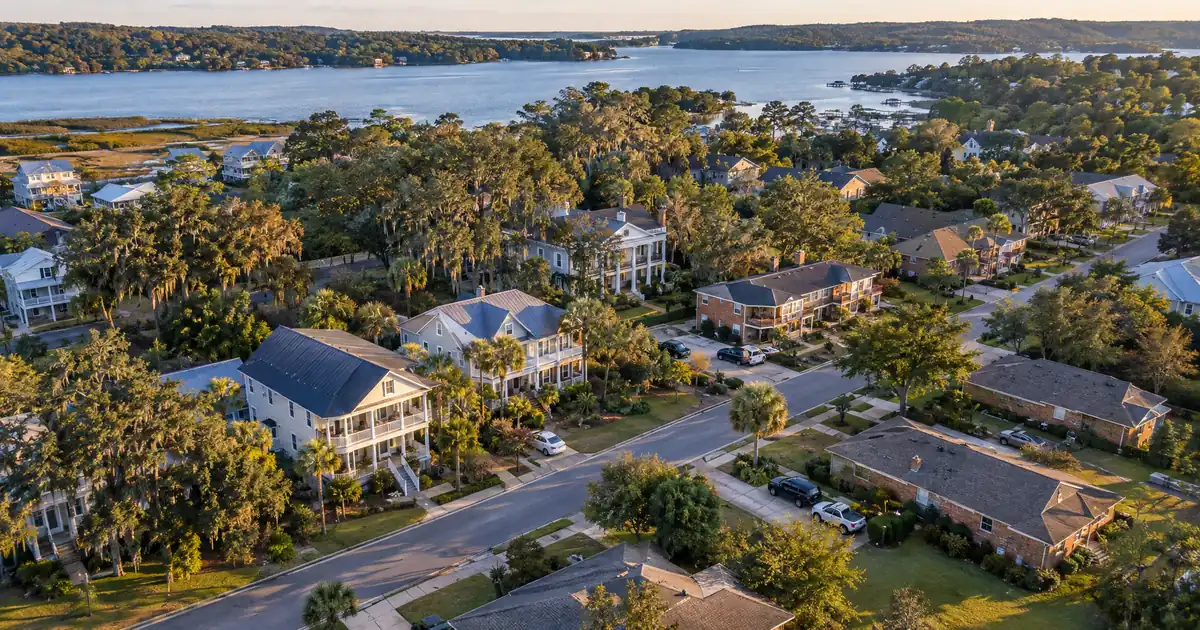
Set east of the peninsula, away from direct water frontage, Lake Ridge is a collection of 2010s colonials on wooded, sidewalk-lined streets, priced in the $400,000s to $800,000s range for non-waterfront lots. The neighborhood has its own pool and tennis courts and borders Catawba Park, a 62-acre public green space with ball fields, trails, and a boat launch — amenities that support family-tenant demand without carrying the price premium of direct lake access.
Run the numbers on a representative inland Lake Ridge home priced at $460,000, renting near $2,300 a month — consistent with the three-bedroom range reported by Apartments.com and Apartment Finder. At the 75 percent cash-out ceiling, the modeled debt coverage ratio, factoring full PITIA against current rate conditions and South Carolina’s typical property tax and insurance load, tends to land in the low-1.00s to just under 1.00 — a tight range that leaves little cushion. Dial the leverage back toward 60 percent LTV instead, and the same rent clears coverage with more room to spare. That practical range is where Lake Ridge cash-out files tend to land: workable, but not at the top of the leverage band.
This is the kind of tradeoff worth naming honestly. An investor chasing maximum proceeds will find the number doesn’t clear at 75 percent LTV on a typical inland home; an investor willing to take less cash out, or bring in a stronger credit file, generally finds the ratio holds. Where the coverage ratio lands below 1.00 on a standard calculation, a sub-1.00 DSCR structure, an interest-only payment structure, or a blended income approach may be reviewable options — subject to lender guidelines, credit approval, reduced leverage, and full property review. None of those paths are automatic. They’re worth discussing before assuming a specific proceeds number.
Windjammer and the Appreciation-Only Trade
Windjammer has seen solid buyer demand recently, with homes moving at a reasonable pace for a lakefront micro-market — though actual timelines vary by file and lender. But rent doesn’t scale with waterfront pricing the way sale price does. Direct water access and Lake Wylie views push the purchase price up substantially more than they push achievable rent, which means Windjammer, East Tega Cay, and the higher-end pockets near Serenity Point and Lakeshore are underwriting as equity plays, not cash-flow plays.
That’s fine, structurally, if the investor’s thesis is appreciation and the refinance goal is capital extraction for redeployment elsewhere — not making the same property carry its own new debt service on rent alone. It’s a different conversation if the goal is to hold the refinanced property and have the rent cover the note. The lake lifestyle premium that draws Charlotte-area buyers and renters to Tega Cay’s 13 miles of shoreline and its 27-hole golf course — the only one of its kind in the region — is real demand, but it shows up in sale price faster than it shows up in monthly rent.
The Growth Corridor: Future Product, Not Current Inventory
Riverfalls and Windell Woods began construction in 2024, with completion anticipated around 2027. The Grove — a mixed-use downtown development including single-family homes, townhomes, and live/work units — broke ground in 2025 with a build-out horizon stretching to around 2030. This is the annexation-era growth corridor, and it’s the closest thing Tega Cay has to future income-stacking product.
It isn’t existing inventory an investor can refinance today. It’s a signal of where product diversity might eventually show up — attached units with potentially better rent-to-price ratios than the peninsula’s single-family stock. Worth watching. Not worth underwriting against yet.
No Duplexes, No Fourplexes — By Design
Tega Cay’s property mix is a structural fact, not a market gap that will close. Redfin’s own listing data shows zero multi-family units for sale in the trailing period, alongside 27 townhouses and 20 four-bedroom single-family homes. There’s no ADU stock, no duplex-triplex-fourplex submarket, nothing to income-stack the way an investor might in a more commercially diverse city.
That traces back to how the city was built. Tega Cay started in 1970 as a developer-run gated community on Lake Wylie, with residents originally paying a monthly assessment to the development company before incorporating in the early 1980s to protect their interests when the developer ran into financial trouble. The result: a city zoned almost entirely around single-family HOA product, with essentially no legacy commercial, industrial, or multifamily land. It caps DSCR product variety. It also means rents and home values aren’t competing against a wave of new apartment supply — a tradeoff, not a flaw.
Investors specifically hunting duplex-to-fourplex unit-stacking income should look past city limits to Rock Hill, which carries more diverse zoning and actual multifamily stock. Tega Cay itself is a single-family, workforce-and-luxury rental play, full stop.
Who’s Renting Here, and Why That’s Durable
Tega Cay has almost no jobs of its own — it runs its own police, fire, parks, and utilities departments, but tenant demand is imported from the surrounding York County employment base. Fort Mill Township hosts Lash Group, LPL Financial, Shutterfly, a large national bank, One Main Financial, and manufacturer Schaeffler, according to York County Economic Development. Rock Hill adds Continental Tire North America, Duke Energy, Sunbelt Rentals, and Winthrop University, which enrolls more than 5,000 students, per York County ED’s county overview. Healthcare runs through Piedmont Medical Center, a 288-bed facility in Rock Hill, plus a 100-bed campus in Fort Mill.
There’s also a logistics thread worth naming specifically: Ross Stores committed to a $68 million York County distribution investment projected to create 700 jobs over five years, according to a South Carolina Governor’s Office release. That’s a named, dollar-quantified job driver distinct from the general office-park employer list — the kind of workforce demand that tends to be durable rather than speculative, and it’s the demand base feeding Lake Ridge and the inland peninsula, not the waterfront tier.
Lendmire’s deal desk sees a consistent pattern on files from lake-adjacent, HOA-governed suburbs structurally similar to Tega Cay: the cleaner files tend to come with a full trailing lease history and a conservative appraisal-supported rent estimate rather than an optimistic rent projection, because appraisers in thin-comp, low-inventory markets like this one lean harder on documented lease income than on pro forma numbers. The common friction point isn’t credit — it’s getting comfortable with rent support when in-city comps are shallow.
What the Seasoning Clock and LTV Cap Actually Mean Here
A cash-out refinance on a Tega Cay investment property generally requires around six months of ownership from the recording date before a lender will consider the file, and proceeds are capped at 75 percent loan-to-value — never higher, regardless of how strong the appreciation story looks. Given that citywide days-on-market nearly doubled and sales volume contracted, an investor banking on rapid post-purchase appreciation to support an aggressive refinance value should build in some appraisal conservatism rather than assume the trailing twelve months of comps will fully carry the number.
Reserve requirements generally run around six months of the full monthly obligation, moving toward nine months on larger loan balances above $1,500,000 — relevant mostly for the waterfront and near-luxury tier, where prices already run past $700,000 in East Tega Cay. Credit tiers on these programs typically start near a 620 floor, with pricing and leverage improving at higher tiers, though every one of these figures is a program guideline, not a guarantee, and final terms are subject to lender review. For a full explanation of how the ratio itself gets calculated, Lendmire’s DSCR guide breaks down the mechanics; the guide “The Refi Options” covers the proceeds mechanics in more depth.
DSCR vs. conventional financing
Two common ways to finance an investment property in Tega Cay, SC. They qualify you differently — here’s how investors weigh them.
Why investors choose it
- Qualifies on the property’s rental income — no personal tax returns, W-2s, or pay stubs needed to document income.
- No personal debt-to-income ceiling to clear, so existing mortgages and obligations don’t cap your borrowing the same way.
- Can be closed in an LLC, keeping the property inside a business entity.
- Built for scaling — not held to the limit on number of financed properties that conventional financing applies.
- Underwriting centers on the deal: generally qualifies when the rent covers the payment, a 1.00x coverage ratio being a common baseline (confirmed in underwriting).
- Designed specifically for investment property, including long-term and, where the program allows, short-term rentals.
Where it’s strong
- Often the lowest ongoing financing cost for a buyer who fully qualifies on personal income — a fit for a first property or a cost-first purchase.
Trade-offs for investors
- Requires full personal income documentation and must fit within a debt-to-income limit — salary, existing debts, and other mortgages all count.
- Typically held in your personal name rather than a business entity.
- Caps how many financed properties you can carry, which can become a ceiling as a portfolio grows.
- Evaluates you as a borrower as much as the property, which usually means more paperwork.
How investors usually choose: a first or single property often optimizes for the lowest financing cost; portfolio builders often optimize for leverage, vesting in an LLC, and scaling past conventional caps. The right answer depends on your goals, the property, and current guidelines — both paths run through select lenders in Lendmire’s wholesale network, with eligibility and terms confirmed in underwriting.
Investors weighing whether a DSCR cash-out or a conventional refinance fits better can find the side-by-side comparison useful — the short version is that DSCR tends to fit LLC-titled holdings and investors with four or more financed properties, while a W-2 borrower with a single rental and clean personal income might still find conventional refinancing cheaper on a pure cost basis. Tega Cay’s HOA-governed, entity-friendly buyer pool leans toward the former more often than not.
Frequently Asked Questions
How do you qualify for a DSCR loan in Tega Cay, South Carolina?
Qualification centers on the property’s rent measured against its full monthly obligation, generally targeting a 1.00 coverage ratio or better, rather than personal income documentation. Given Tega Cay’s rent-to-price compression on higher-priced peninsula homes, hitting that 1.00 floor at maximum leverage is harder on waterfront properties than on inland Lake Ridge-area stock. Credit tiers typically start near 620, with better pricing available at higher scores, subject to lender guidelines.
What are the requirements for an investment property cash-out refinance in Tega Cay, South Carolina?
Most programs require roughly six months of seasoning from the title recording date, cap proceeds at 75 percent loan-to-value, and hold reserve requirements around six months of the monthly obligation (nine months above $1,500,000 in loan balance). Given the thin comp depth noted in Redfin’s citywide data, expect appraisers to lean on a wider radius, including neighboring Fort Mill and Rock Hill, to support value.
Why is rent-to-value so tight on Tega Cay homes specifically?
The typical home value of $556,928 against average single-family rents of $2,611 produces a gross monthly rent-to-price ratio near 0.47 percent, thin by workforce-rental standards. That’s a direct byproduct of Tega Cay’s identity as a lake-recreation, HOA-governed community rather than a standard commuter suburb — buyers pay a premium for the peninsula lifestyle that rent alone doesn’t fully recapture.
Can an investor find duplex or fourplex product to refinance in Tega Cay?
Not inside city limits. Redfin’s listing data shows zero multi-family units for sale in Tega Cay against 27 townhouses, confirming there’s no meaningful small-multifamily submarket here. Investors seeking that unit-stacking income structure typically need to look to Rock Hill, which carries more diverse zoning and actual 2-4 unit stock.
Investors ready to run the numbers on a specific Tega Cay property can get a rental-income loan quote or reach Lendmire directly at 828-256-2183. South Carolina-specific program details are also available through South Carolina DSCR investor loans, and general refinancing options are worth reviewing before committing to a leverage target.
About Lendmire
Lendmire (NMLS# 2371349) is a mortgage brokerage focused on DSCR investor financing, arranging programs through wholesale and investor-lending channels across 41 markets, including Washington, D.C. Qualification is based on the property’s cash flow rather than the borrower’s personal income, subject to lender guidelines, with structures available for LLC closings and for investors carrying four or more financed properties. Lendmire has been recognized as a top-ranked workplace in 2026 and was recognized by Scotsman Guide in 2025, detailed further in the 2026 industry recognition release.
Get Started
Ready to find the right loan for you?
In about 30 seconds you can review financing options available for your investment property. No commitment required.
Informational only. Not a Loan Estimate, approval, or commitment to lend. Program availability and eligibility are subject to lender guidelines, credit approval, property review, and underwriting.
References
1. Zillow — Tega Cay Home Values
2. Apartments.com — Tega Cay Houses for Rent
3. Movoto
5. Redfin
6. York County Economic Development — Fort Mill
7. See Tega Cay (city info site)
8. SC Governor’s Office — Ross Stores Press Release
9. Redfin — Tega Cay Housing Market
10. York County Economic Development — About York County
11. Piedmont Medical Center — About
12. Scotsman Guide — Top Workplaces 2026
13. recognized by Scotsman Guide in 2025
14. EIN Presswire — Lendmire Recognized as a 2026 Top Workplace by Scotsman Guide
This article is part of Lendmire’s investment property cash-out refinance program — full qualification details, guidelines, and scenarios live on the program page.
Related reading: DSCR Cash Out Refinance Hanahan South Carolina · Cash Out Refinance Investment Property in Columbia SC · DSCR Cash Out Refinance South Carolina
Guides: Investment Property Cash-Out Refinance in South Carolina
Brandon Miller
Founder & CEO, Mortgage Loan Originator, Lendmire LLC
- Mortgage Loan Originator · NMLS# 1129696 · Verify on NMLS Consumer Access
- North Carolina Real Estate Broker · License# 343312 · Verify on NCREC
- North Carolina Insurance Producer · License# 19053198 · Property, Casualty, Life, Health · Verify on NAIC SBS
- Lendmire LLC · Firm NMLS# 2371349 · Verify firm licensure
Important disclosures. Lendmire (NMLS# 2371349) is a licensed mortgage brokerage. Lendmire is not a direct lender, depository institution, or financial advisor. All loan inquiries are subject to lender underwriting; this article does not constitute a commitment to lend. Rates, terms, and program guidelines are subject to change without notice and vary by borrower profile, property type, and state. Information in this article is general in nature and is not financial, legal, or tax advice. Equal Housing Opportunity. NMLS Consumer Access: nmlsconsumeraccess.org.