
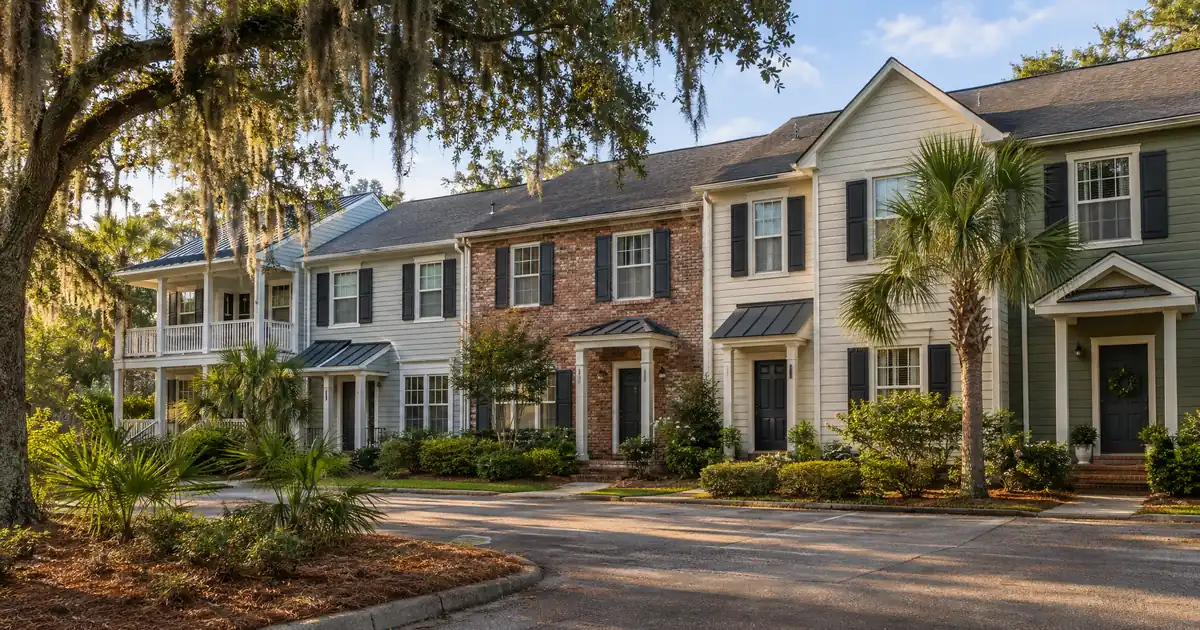
An out-of-state investor scrolling Hanahan listings sees a small suburb at the south end of Berkeley County, inside the Charleston metro. It has a Navy footprint, Boeing nearby, and the port down the road. Per Redfin, home prices were up 2.4% year over year at a median of $450K. That looks like a clean equity story. Then the rent comps come back, and the debt-coverage math stops being simple.
The investor who already owns here is asking a different question: how much equity can come out, and does the rent support the new loan? This article covers that question, the extraction side. It leaves out purchase mechanics, because the cash-out file is where Hanahan’s numbers get tested.
DSCR Cash-Out Calculator
Run the cash-out numbers in Hanahan, SC
Rate source: Freddie Mac 30-yr average via FRED® — Federal Reserve Bank of St. Louis · effective Sep 24, 2026
Prefilled with starting assumptions — enter your property’s value, balance, taxes, and insurance for a more accurate picture.
Program parameters update from Lendmire’s centralized guideline source. Taxes and insurance are editable estimates.
As of Sep 24, 2026 · General Freddie Mac market benchmark, not a Lendmire loan offer. Property value, balance, taxes, and insurance are editable estimates. Maximum loan-to-value varies by lender, program, property type, and seasoning. Not a Loan Estimate, approval, or commitment to lend. Program availability and eligibility are subject to lender guidelines, credit approval, property review, and underwriting.
TL;DR: A DSCR cash-out refinance on a Hanahan, South Carolina rental is underwritten primarily on the property’s rental income measured against its full monthly obligation, with the new loan sized by an LTV ceiling rather than personal income paperwork.
- Cash-out on a Hanahan rental is typically sized by an LTV ceiling, with a seasoning requirement measured from title recording; both vary by program.
- Home prices relative to average rents make single-family coverage tight, so the rental income may not carry the full monthly obligation as easily as it would in a lower-priced market.
- Small multifamily and 3-bedroom layouts carry the ratio better than 2-bedroom units.
- Rent portals can disagree by a meaningful margin, so the appraiser’s rent schedule decides the number.
- Every figure here varies by lender and program — guidelines, property type, leverage, and credit profile all apply.
How Cash-Out Works on a Hanahan File
A cash-out refinance replaces the existing loan with a larger one and returns the difference as proceeds. On a DSCR program, the new loan is sized by two limits at once: the LTV ceiling and the rental coverage test. The lower of the two controls. Here the coverage test usually binds first.
The parameters come from cash-out refinance details on the network’s programs, and they’re guidelines, not commitments. Subject to lender guidelines, borrower credit, and property review, the typical structure looks like this:
- LTV ceiling: 75% on cash-out. Not 80%. The 80% figure belongs to purchases.
- Seasoning: about 6 months of ownership, measured from title recording. The settlement statement documents it.
- Coverage floor: a 1.00 benchmark, meaning rent used for lender review against full PITIA (principal, interest, taxes, insurance, and any HOA dues).
- Credit: tiers at 620, 660, 680, and 700, with 620 as the floor. Better tiers generally improve leverage and pricing options.
- Reserves: about 6 months of PITIA on most files.
- Loan size: up to $3,000,000 on standard programs, which Hanahan prices won’t approach.
Some lenders will look below 1.00, but that usually means lower leverage, different pricing, or more cash in the deal. More on that below. For background on how the ratio is built, see the DSCR fundamentals.
The Rent-to-Price Gap Is the Whole Story
The coverage ratio in Hanahan is a rent problem, not a value problem. The median sale price is $450K. RentCafe puts average rent at $1,407, down 0.43% year over year, with 61% of rentals between $1,001 and $1,500. Divide one by the other and you get roughly 0.31% a month. Far from the 1% rule.
That comparison is imperfect. The rent data comes from apartment buildings, and the median is mostly single-family. But the direction is clear. A median-priced single-family house in Hanahan will not cover a 75% LTV loan on average rents. Final terms depend on lender guidelines, property type, leverage, and the borrower’s complete credit picture.
Asking prices run higher still. Movoto shows a median listing of $525K, or $261 per square foot. That’s asking, not sold. With only 17 homes sold in the Redfin sample (down from 24 a year earlier), the median is noisy. Appraisers working a cash-out in a market this thin lean on a handful of comps, which makes the value side of the 75% test less predictable than it looks.
Run the Numbers (Modeled, Not Sourced)
Run the numbers on three profiles. These are modeled assumptions, not market facts. Each uses rent divided by full PITIA, including taxes and insurance at South Carolina average loads. The rents are inputs I’m choosing, anchored to the research.
| Profile | Modeled rent | Coverage at 75% LTV | Coverage at 50% LTV |
|---|---|---|---|
| $450K house, 3-bed rent | $1,804 | about 0.65x | about 0.95x |
| $450K house, average rent | $1,407 | about 0.50x | about 0.75x |
| $595K duplex, two 2-beds | about $2,740 | about 0.75x | about 1.1x |
The 3-bedroom rent comes from Apartments.com’s Hanahan listings: $1,804 for a 3-bedroom against $1,369 for a 2-bedroom. ApartmentFinder shows nearly identical figures. The duplex price sits at the low end of what Homes.com showed for multifamily: three listings between $595K and $775K.
Two things stand out. First, the 75% cap is rarely the working constraint. Coverage is. Second, the practical answer for a lot of Hanahan owners is a partial cash-out. Take less than the maximum and the new loan shrinks until the ratio clears.
Picture an investor with a duplex bought several years ago, now valued near $595K. They want every dollar the 75% ceiling allows. The ratio lands around 0.75x. That file needs a sub-1.00 program, an interest-only structure, or lower leverage, all of which a lender would review on credit, reserves, and property. Pulling back toward 50% LTV puts coverage above 1.0 in this model. Less cash out, cleaner file. These specifics are subject to lender guidelines and a full review of property, leverage, and credit.
Honestly, it’s a genuine toss-up whether the investor should chase the larger check or the cleaner loan. Higher proceeds fund the next deal faster, but a thin-coverage loan on a 0.3%-rent market leaves no cushion if a unit sits empty.
Why Duplexes and 3-Bedrooms Outperform
The best fit in Hanahan is small multifamily or larger-bedroom workforce housing. DSCR programs commonly cover single-family and 2-4 unit properties, and the rent-to-price improvement is measurable.
Using the figures above, two 2-bedroom units at about $1,369 each total about $2,740 a month. Against a $595K basis, that’s roughly 0.46%, up from 0.31% on the single-family median. That is a better ratio, but it is still short of 1%, so basis and leverage matter.
The 3-bedroom premium is about $435 a month over a 2-bedroom, roughly 32% more rent. A duplex with 3-bedroom sides, or a larger workforce house, can pencil noticeably better than a 2-bedroom layout. These are apartment-listing averages, not single-family comps. Expect the appraiser’s rent schedule to confirm or trim them.
Inventory is the catch. Three multifamily listings is not a market with deep comps. A cash-out on a Hanahan duplex may rest on sales from North Charleston, Goose Creek, or Summerville. Lender-side commentary describes North Charleston and Goose Creek as places where prices run lower relative to rent, which makes them stronger on the ratio. That’s a broker claim, not hard data, but it matches the Hanahan math.
Tenant Demand: Who Actually Rents Here
Demand rests on employment anchors, and the supported ones are large. The Charleston Regional Development Alliance reports Boeing with more than 9,000 employees supporting 787 production, MUSC with approximately 17,000 people, and Joint Base Charleston supporting nearly 25,000 military and civilian jobs. MUSC is the state’s academic health science center. Wikipedia notes that portions of Naval Weapons Station Charleston, including the Naval Consolidated Brig, sit inside Hanahan itself.
Inside the city, Data USA lists manufacturing (1,318 people), professional, scientific, and technical services (1,243), and construction (1,135) as the largest industries. Defense contractors, aerospace, port and logistics staff, and healthcare workers are the demand base, and all of them show up in lease evidence as steady employment.
The rental pool itself is thin. RentCafe reports 32% of households rent and 68% own. Median household income is $84,061, per Point2Homes citing Census data. Population is roughly 22,000 to 23,000: Wikipedia lists 20,325 at the census and an estimated 22,415 since, and World Population Review gives 22,812 at 1.77% annual growth. Growth helps. A 32% renter share means fewer tenants chasing each unit, so competition for good tenants doesn’t run as deep as in a bigger city.
Skip the Rent Portal Averages
Hanahan’s published rent figures disagree enough to change whether a loan clears. RentCafe’s monthly average read $1,407 in one pull and $1,536 in a later one. Apartments.com shows $1,248. A third aggregator shows $1,894. That spread is over $600 a month.
All of these are asking rents from large complexes. RentCafe’s apartment page describes the sample as communities of 50 or more units, averaging 42 years old, with only 25% built since 2000, all two-story garden-style. Single-family and small-multifamily rents don’t appear in that data.
So underwrite from the appraiser’s rent schedule, Form 1007 for single-family and 1025 for 2-4 units, or from signed leases. Portal averages are context for a conversation, not file evidence. A file built on a portal number that the appraiser then reduces is a file that gets re-sized late.
The flip side helps owners. Older, dated complexes mean a renovated small property can compete against them. That isn’t proof of low vacancy, and no reliable vacancy figure was found. Don’t claim one.
Where Hanahan Cash-Out Files Break
The failures are documentation failures, not credit failures. These are the ones that recur in markets shaped like this one.
- Rent evidence mismatch. The lease says one number, the appraiser’s schedule says another, and the portal says a third. Pick lease-backed figures, get the schedule early, and size to the lower one.
- Thin comps and appraisal reconsideration. With so few sales, an appraisal that comes in light is plausible. A reconsideration packet with recent in-area sales and condition adjustments is a routine step, not a crisis.
- HOA rental restrictions. Master-planned areas differ. Tanner Plantation reportedly allows rentals with modest annual dues. Otranto reportedly has no HOA. Crowfield Plantation, on the Goose Creek side, is reported to have strict rental caps. These notes come from local agent commentary, so read the actual covenants and get HOA questionnaire completeness sorted before the file goes in. HOA dues also go into PITIA.
- Seasoning documentation. The 6-month clock runs from title recording. Files that assume it away get kicked back. The settlement statement is the proof.
- Reserves documentation. About 6 months of PITIA, with statements showing the funds are seasoned and sourced. Proceeds from the cash-out itself generally don’t count toward the reserve test on the same file.
- Entity paperwork. Rentals held in an LLC need articles, operating agreement, and good-standing evidence, subject to lender program eligibility.
Here’s the pattern that holds in markets like this one. DSCR files in small, owner-heavy suburbs typically arrive with a purchase-era lease at one rent figure and an appraisal rent schedule at another. The loan officer’s job is reconciling the two before the lender sees it, and the files that clear cleanest have lease, schedule, and HOA documents lined up before submission. Unlike balance-sheet lenders that treat investor files as portfolio-risk exercises, the non-QM wholesale approach is to size the loan to the property’s own numbers and document that sizing cleanly. For the broader refinance picture, see the investment property refinance options.
How Proceeds Become the Next Deal
The extraction is only worth doing if the proceeds go somewhere better. Walk through the mechanism.
1. Confirm seasoning. Pull the recorded title date and count about 6 months forward.
2. Order the rent schedule first. The appraiser’s Form 1007 or 1025 figure sets the coverage numerator. Know it before choosing a loan size.
3. Test two leverage points. Run the full-cash-out case at the 75% ceiling and a pulled-back case near 50% to 60%. Compare coverage on both, including taxes, insurance, and any HOA dues.
DSCR vs. conventional financing
There are two common ways to finance an investment property in Hanahan, SC, and they qualify you differently — here’s how investors weigh them.
Why investors choose it
- Qualifies on the property’s rental income — no personal tax returns, W-2s, or pay stubs needed to document income.
- No personal debt-to-income ceiling to clear, so existing mortgages and obligations don’t cap your borrowing the same way.
- Can be closed in an LLC, keeping the property inside a business entity.
- Built for scaling — not held to the limit on number of financed properties that conventional financing applies.
- Underwriting centers on the deal: generally qualifies when the rent covers the payment, a 1.00x coverage ratio being a common baseline (confirmed in underwriting).
- Designed specifically for investment property, including long-term and, where the program allows, short-term rentals.
Where it’s strong
- Often the lowest ongoing financing cost for a buyer who fully qualifies on personal income — a fit for a first property or a cost-first purchase.
Trade-offs for investors
- Requires full personal income documentation and must fit within a debt-to-income limit — salary, existing debts, and other mortgages all count.
- Typically held in your personal name rather than a business entity.
- Caps how many financed properties you can carry, which can become a ceiling as a portfolio grows.
- Evaluates you as a borrower as much as the property, which usually means more paperwork.
How investors usually choose: a first or single property often optimizes for the lowest financing cost; portfolio builders often optimize for leverage, vesting in an LLC, and scaling past conventional caps. The right answer depends on your goals, the property, and current guidelines — both paths run through select lenders in Lendmire’s wholesale network, with eligibility and terms confirmed in underwriting.
4. Document reserves. Statements for about 6 months of PITIA, held outside the proceeds.
5. Plan the redeployment. The cash becomes down payment on a lower-basis property, often in North Charleston or Goose Creek where the ratio is friendlier, or capital for light renovation on the Hanahan asset itself.
Appreciation is a modest part of the equity picture here. A 2.4% annual gain doesn’t build a big gap fast. Days on market shortened to 58 from 68, and Redfin scores the market “somewhat market-rate” at 52 out of 100. Most Hanahan equity comes from basis and paydown. Not momentum.
One possible upside sits outside the underwriting. The City of Hanahan has a Town Center revitalization project built on its comprehensive plan and a town center master plan, with an RFP to developers planned after the city acquires a parcel. It’s unbuilt and depends on that acquisition. Treat it as possible support for value on a later refinance. Don’t underwrite to it. Beyond that, verify current local rental rules, taxes, and insurance with qualified local professionals.
Lendmire, a non-QM DSCR mortgage broker (NMLS# 2371349), can structure these scenarios across its wholesale network. Investors can talk to Lendmire or call 828-256-2183. The coverage math drives the file, and investors who don’t want a W-2-based review can see how DSCR compares to conventional investment loans. For statewide context on program scope, see South Carolina DSCR financing.
Frequently Asked Questions
How do you qualify for a DSCR loan in Hanahan?
Qualification centers on the property’s rent against its full PITIA, with 1.00 as the common benchmark, plus a credit score at or above the 620 floor and about 6 months of reserves. Rent is documented with a lease or the appraiser’s rent schedule. Final eligibility depends on lender guidelines, credit, and property review.
What are the requirements for an investment property cash-out refinance in Hanahan, South Carolina?
Expect about 6 months of ownership measured from title recording, a 75% LTV ceiling, and a coverage test run on the new loan. Reserves of roughly 6 months PITIA are typical. Property types are generally single-family and 2-4 units; manufactured homes, log homes, and barndominiums fall outside these programs.
Which Hanahan rent number should go into the file?
Use the appraiser’s rent schedule or signed leases. Portal averages range from about $1,248 to $1,894, which is wide enough to move a file from clearing to short. Those figures come from large-complex listings, not single-family rentals.
Does a median-priced house in Hanahan cover a full cash-out loan?
Not on average rents. At a $450K median and rents near $1,407, modeled coverage including taxes and insurance runs well under 1.0 at the 75% ceiling. A duplex, a 3-bedroom layout, or a smaller cash-out amount improves the ratio.
What a Local Appraiser Would Tell You
Hanahan prices like a Charleston suburb and rents like a workforce town. Appraisers here lean on North Charleston and Goose Creek sales when Hanahan comps run dry, and they will reduce a rent schedule that reads like a new-construction complex. The owner who sizes the loan to the lease-backed rent, not the median price, is the one who keeps the cash-out simple.
For current guidelines and terms, see Lendmire’s DSCR loan programs page.
About Lendmire
Lendmire (NMLS# 2371349), a non-QM mortgage broker serving investors in 41 markets including Washington, D.C., helps structure DSCR scenarios commonly evaluated around a property’s rental income rather than personal income paperwork, subject to lender guidelines. Lendmire was recognized by Scotsman Guide as a 2026 Top Workplace and recognized by Scotsman Guide in 2025 as a Top Mortgage Workplace. It places loans through wholesale investor lenders and is not a direct lender.
Get Started
Ready to find the right loan for you?
In about 30 seconds you can review financing options available for your investment property. No commitment required.
Informational only. Not a Loan Estimate, approval, or commitment to lend. Program availability and eligibility are subject to lender guidelines, credit approval, property review, and underwriting.
References
1. Redfin, Hanahan Housing Market
2. RentCafe, Hanahan Average Rent
3. Movoto
4. Apartments.com’s Hanahan listings
6. Homes.com
7. Charleston Regional Development Alliance, Employers
8. Wikipedia, Hanahan, South Carolina
10. Point2Homes
13. City of Hanahan, Town Center Project
14. recognized by Scotsman Guide as a 2026 Top Workplace
15. recognized by Scotsman Guide in 2025
This article is part of Lendmire’s investment property cash-out refinance program — full qualification details, guidelines, and scenarios live on the program page.
Related reading: Cash Out Refinance Investment Property in Hanahan, South Carolina: Thin Rental Pool Equity Math · DSCR Cash Out Refinance in North Charleston, South Carolina · Luxury Rental DSCR Loans In Charleston: Seasonality And Coverage
Guides: Investment Property Cash-Out Refinance in South Carolina
Brandon Miller
Founder & CEO, Mortgage Loan Originator, Lendmire LLC
- Mortgage Loan Originator · NMLS# 1129696 · Verify on NMLS Consumer Access
- North Carolina Real Estate Broker · License# 343312 · Verify on NCREC
- North Carolina Insurance Producer · License# 19053198 · Property, Casualty, Life, Health · Verify on NAIC SBS
- Lendmire LLC · Firm NMLS# 2371349 · Verify firm licensure
Required disclosures. Lendmire (NMLS# 2371349) operates as a licensed mortgage broker, not a direct lender or depository. The discussion in this article is general in nature and should not be relied upon as financial, legal, or tax advice — every investment scenario is unique and should be reviewed by a qualified professional. Any loan inquiry is subject to lender underwriting, and this article is not a commitment to lend or a guarantee of approval. Mortgage rates, loan terms, and program guidelines vary by borrower, property, and state, and may change without notice. Equal Housing Opportunity. Verify licensure at NMLS Consumer Access.