
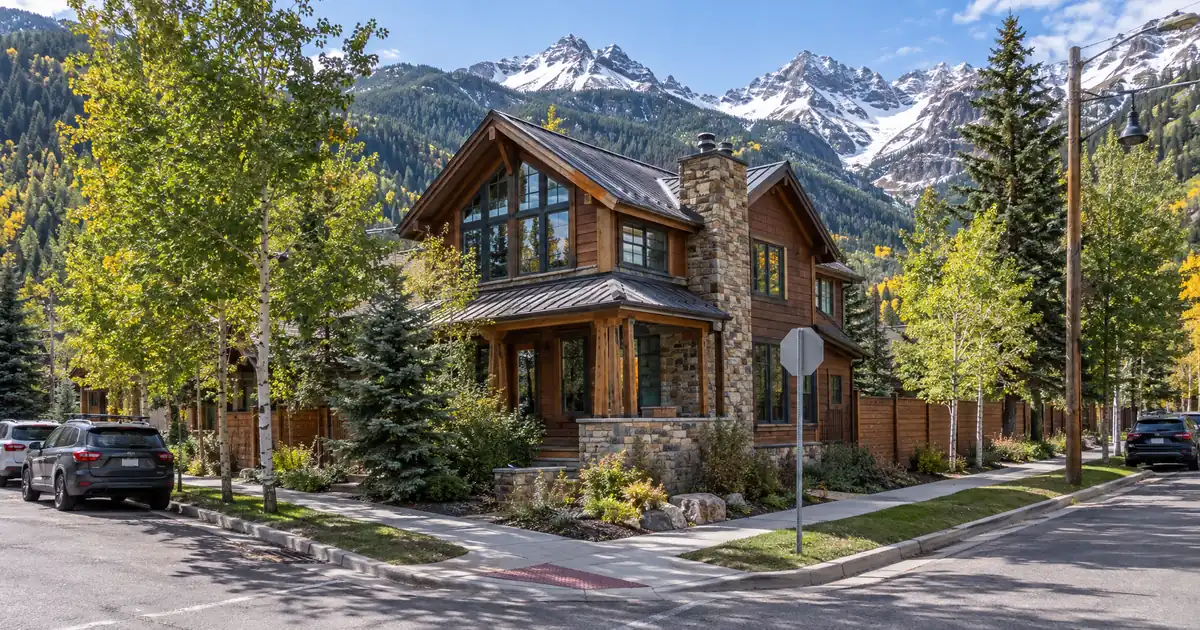
Telluride’s headline prices are the worst guide to what you can pull out of a rental here. Owners look at a multimillion-dollar median and assume the equity is borrowable. It is, on paper. On a DSCR file, though, the loan is sized by what the rent can carry, and in this box canyon that number is a fraction of what the appraisal suggests. Anyone weighing a cash out refinance on an investment property in Telluride, Colorado needs to start with the rent, not the value.
DSCR Cash-Out Calculator
Run the cash-out numbers in Telluride, CO
Rate source: Freddie Mac 30-yr average via FRED® — Federal Reserve Bank of St. Louis · effective Sep 24, 2026
Prefilled with starting assumptions — enter your property’s value, balance, taxes, and insurance for a more accurate picture.
Program parameters update from Lendmire’s centralized guideline source. Taxes and insurance are editable estimates.
As of Sep 24, 2026 · General Freddie Mac market benchmark, not a Lendmire loan offer. Property value, balance, taxes, and insurance are editable estimates. Maximum loan-to-value varies by lender, program, property type, and seasoning. Not a Loan Estimate, approval, or commitment to lend. Program availability and eligibility are subject to lender guidelines, credit approval, property review, and underwriting.
The Quick Read:
A cash-out refinance on an investment property in Telluride, Colorado is underwritten primarily on the property’s rental income measured against its full monthly obligation, so the equity an investor can pull depends on what the rent supports rather than on what the property appraises for.
- Zillow puts the typical Telluride home value near $1.9 million, down 12.2 percent year over year.
- Town-core and Mountain Village rents sit far below what seven-figure values need for 1.00 coverage.
- Norwood’s median home price near $356,000 makes the down-valley rungs the workable math.
- Deed-restricted sales with capped appreciation make poor appraisal comps.
- Typical seasoning runs about 6 months from title recording, subject to lender guidelines.
Lendmire (NMLS# 2371349) is a DSCR-focused mortgage broker. Lendmire places DSCR investor financing for Telluride, Colorado through non-QM wholesale channels that cover 41 markets, including Washington, D.C. That multistate footprint is why DSCR loans in Colorado can be structured across more than one submarket. Telluride and its down-valley neighbors are the clearest example.
Four Prices, One Truth: Nobody Agrees
Telluride has no reliable single price. Sources disagree by a factor of three, and the disagreement itself is the finding: thin volume, a luxury tail, and a market where one sale moves the median.
Zillow’s index shows the typical home value at $1,915,392, down 12.2 percent over the past year. Movoto reports a $4,950,000 median sale price for the ZIP, with days on market at 198 versus 124 a year earlier. A local brokerage puts the San Miguel County median near $5.78 million, up about 65 percent, and warns that a single ultra-luxury closing can drag that median around. Treat it as volatile. Mountain Rose Realty shows roughly 90 active listings in the Town of Telluride, a median asking price near $3,175,000, and median time on market around 291 days.
Telluride Estates reads the same data as fewer deals at higher prices. County transactions are down roughly 22 percent and dollar volume about 23 percent, while the town’s year-to-date average sale is up 54 percent to $3.76 million.
So what’s the appreciation number? There isn’t a clean one. Zillow says down, the county median says way up, and both are right about different slices of a small market. An appraiser working your refinance will pick comps from that mess. Don’t underwrite your equity off any headline figure.
Rent Governs the Loan
The equity you can extract is set by three things: the rent used for lender review, the full monthly obligation on the new loan (principal, interest, taxes, insurance, and any HOA dues), and the leverage ceiling. On a cash-out, that ceiling is 75 percent LTV, and it is a hard cap. Seasoning typically runs about 6 months of ownership measured from title recording. The standard 1.00 DSCR benchmark means rent covers the obligation, though some lenders will review lower ratios with stronger compensating factors. Pricing and available terms vary by lender, borrower profile, property type, and full underwriting review. Reserves typically run about 6 months of PITIA and step up to about 9 months on balances above $1,500,000. All of this is subject to lender guidelines and property review.
Now the skeptical part. In the town core and in Mountain Village, entry prices are so high against long-term rents that coverage lands well below 1.00. That is analysis rather than a sourced ratio, since no reliable median long-term rent exists for the town, but the direction isn’t in doubt. Sub-1.00 files can still be reviewed. A sub-1.00 program, an interest-only structure, or lower leverage may be options a lender looks at, and each comes with stronger credit requirements, more reserves, or less cash out. That’s a different file than a standard 1.00-plus refinance, and the proceeds shrink accordingly.
Also check the loan size. Standard programs run up to $3,000,000, and much of the in-town stock sits above the level where that guide is comfortable. A big appraisal doesn’t automatically mean a big loan.
Working DSCR brokers see a recurring pattern in resort markets like this one: the owner shows up with a seven-figure valuation and a modest lease, and the file stalls on coverage rather than on equity. The strongest refinance requests in these markets lower the leverage voluntarily, document a full-year lease rather than seasonal income, and carry reserves well past the minimum.
Unlike lenders that push every investor into the same qualification box, a broker working across a non-QM network can match a sub-1.00 file with the programs built to review it. That won’t make a bad ratio good. It does mean an owner isn’t forced into one lender’s overlay. For the mechanics, pulling equity with a DSCR cash-out and the general refinance details cover the framework, and Lendmire’s DSCR walkthrough explains how the ratio is built.
Submarkets: Where the Coverage Works, and Where It Doesn’t
Telluride’s submarkets sit on a price ladder, and coverage improves as you step down it. This is a cash-flow-versus-appreciation split. The resort towns are appreciation-led, and the down-valley towns are the ones where rent can carry a refinance.
| Submarket | Role | Cash-out fit |
|---|---|---|
| Town of Telluride core | Scarcity, luxury | Weak coverage |
| Mountain Village | Resort condos, gondola-linked | Weak to mixed |
| Lawson Hill / Ilium Valley | Workforce-oriented | Modest, capped upside |
| Norwood / Ridgway / Ouray | Commuter towns | Best chance at 1.00 |
Town core. Victorian cottages, walkable, the most expensive real estate in the market, with very little long-term rental stock. It’s a fine place to hold equity and a poor place to expect a refinance to pencil on rent. Skip it for cash-flow-led strategies.
Mountain Village. Home to roughly 1,400 year-round residents and the ski resort, and tied to the town by a free gondola that Mountain Village calls the first and only free public transportation of its kind in the U.S. The ride takes about 12 minutes, which is why service workers can live on either side. Condo values are high, and coverage on long-term rent is thin. A caution on complexes that restrict rentals: check the project’s rules before you plan a lease-based refinance.
Lawson Hill and Ilium Valley. Lawson Hill sits on an SMART route with a commuter park-and-ride. Mountain Village selected Rural Homes to develop up to 49 deed-restricted units at two Ilium Valley sites, delivering in phases over the next few years. That pipeline helps the workforce and caps rent upside for nearby private owners.
Down-valley: Norwood, Ridgway, Ouray. This is the only rung where the rent-to-price relationship could approach DSCR coverage. The regional needs assessment put Norwood’s median home price at $356,000, with Sawpit and Placerville just under $800,000, still well below the resort towns. SMART expanded service connecting Telluride with Montrose via Ridgway, and the Colorado Trust confirms that housing pressure in Norwood, Ridgway, and Ouray is tied to their proximity to Telluride. Underwrite each town separately with local rent comps, never with a “Telluride” number.
I couldn’t find sourced duplex, triplex, or fourplex rents anywhere in the region, so there are no multi-unit coverage figures to print. Small multi-unit and ADU-bearing properties in commuter areas are the plausible fit, but that’s a thesis to test with local comps, not a number to assume.
Will the Appraisal Actually Hold?
Value support is the hidden risk on Telluride cash-outs. Thin volume means few comps, and some of the comps you’d expect to use are the wrong kind.
The Colorado Trust reports that Rural Homes builds deed-restricted homes, with appreciation capped at 3 percent a year and owner-occupancy required. The Telluride Foundation counts 59 such homes at 60 to 120 percent of area median income. These can’t be bought as investor rentals, and their sale prices are terrible comps for an unrestricted property. If your appraised value leans on them, expect it to come in soft. Confirm eligibility locally before assuming anything.
Rental comps are just as thin. Ouray County’s rental analysis found only 18 one- and two-bedroom units available during its monitoring window, with room-only rentals running $750 to $1,500 a month. The rents are real. Whether an appraiser can support a market rent from that sample is a separate question, and it directly affects your coverage figure.
On the luxury side, the Four Seasons Private Residences is about 40 percent sold on hard contracts at around $4,000 per square foot. New-build pricing at that level can lift how in-town comps look, but it does nothing for rent-based coverage. Value and rent are moving apart here. Honestly, that gap is the whole story of this market.
Tenant Demand: Real, but Read It Carefully
Workforce demand in this region is documented and persistent. Just don’t confuse demand with rent that supports a resort-priced loan.
The Colorado Trust reported that Telluride Ski & Golf houses only about two-thirds of the roughly 1,800 workers it needs at winter peak. That figure is a few years old, but it implies several hundred seasonal workers competing for private rentals every winter. Seasonal rents can swing, so units that suit year-round tenants are the safer underwriting. The Town of Telluride itself owns and manages 212 rental units across five properties, and the county’s needs assessment found the region needs 1,114 new units over roughly the next decade. The town’s Canyonlands/Tower House project adds 28 rentals, eight deed-restricted condos, and three free-market townhomes, which is meaningful but small against that gap.
One more thing to underwrite carefully. The Colorado Sun reported that Four Seasons construction workers have strained down-valley communities, with Norwood’s mayor describing “saturation at an unprecedented level.” That lifts occupancy and possibly rents near Norwood today, but it ends when construction does. Underwrite on stabilized rents, not peak ones. It’s a genuine toss-up whether that demand fades cleanly or gets replaced by permanent hospitality hiring, so size the loan as if it fades.
Modeled Scenario: Two Owners, Two Outcomes
Run the numbers on two hypothetical owners. These are modeled assumptions, not sourced deals.
Say the first owns a Mountain Village condo valued around Zillow’s typical figure, with a modest existing balance. At 75 percent LTV, the equity looks generous. But with a long-term rent assumed at the upper end of workforce-priced housing, coverage on the full obligation lands well under 1.00. A lender might review it through a sub-1.00 program, an interest-only structure, or reduced leverage, all subject to credit approval and property review. The cash out is smaller than the appraisal implies, and the reserve requirement can be steep.
Now picture a second owner with a small unit near the Norwood median who has held it past the seasoning window. Rent covers the obligation with a real cushion, and leverage at or below 75 percent leaves usable proceeds, still not guaranteed, still subject to reserves and lender guidelines. The value is a fraction of the first owner’s, yet the file is stronger. The second owner’s likeliest next move is recycling that capital into another down-valley or out-of-market unit, not buying more resort inventory. For a look at how this differs from a standard borrower, see the guide “Where DSCR and Conventional Diverge” between DSCR and conventional financing.
If a title-held LLC is involved, financing is available for LLC-titled properties subject to lender program eligibility. Investors can request a scenario quote to test either structure, or call Lendmire at 828-256-2183.
Frequently Asked Questions
Can I pull cash out of a Telluride rental that earns far less than its value supports?
Sometimes, but not at the leverage the appraisal implies. Coverage is measured on rent against the full monthly obligation, and a low ratio can mean reduced leverage, more reserves, or a program built for sub-1.00 scenarios. Whether any of those apply depends on lender guidelines, credit, and property review.
DSCR vs. conventional financing
Two common ways to finance an investment property in Telluride, CO. They qualify you differently — here’s how investors weigh them.
Why investors choose it
- Qualifies on the property’s rental income — no personal tax returns, W-2s, or pay stubs needed to document income.
- No personal debt-to-income ceiling to clear, so existing mortgages and obligations don’t cap your borrowing the same way.
- Can be closed in an LLC, keeping the property inside a business entity.
- Built for scaling — not held to the limit on number of financed properties that conventional financing applies.
- Underwriting centers on the deal: generally qualifies when the rent covers the payment, a 1.00x coverage ratio being a common baseline (confirmed in underwriting).
- Designed specifically for investment property, including long-term and, where the program allows, short-term rentals.
Where it’s strong
- Often the lowest ongoing financing cost for a buyer who fully qualifies on personal income — a fit for a first property or a cost-first purchase.
Trade-offs for investors
- Requires full personal income documentation and must fit within a debt-to-income limit — salary, existing debts, and other mortgages all count.
- Typically held in your personal name rather than a business entity.
- Caps how many financed properties you can carry, which can become a ceiling as a portfolio grows.
- Evaluates you as a borrower as much as the property, which usually means more paperwork.
How investors usually choose: a first or single property often optimizes for the lowest financing cost; portfolio builders often optimize for leverage, vesting in an LLC, and scaling past conventional caps. The right answer depends on your goals, the property, and current guidelines — both paths run through select lenders in Lendmire’s wholesale network, with eligibility and terms confirmed in underwriting.
Does it make sense to refinance in Telluride and put the proceeds down-valley?
For long-term rentals, often yes. Norwood, Ridgway, and Ouray have lower entry prices and workforce demand tied to Telluride’s job base, so rent can cover the obligation more comfortably. Underwrite each town separately, since local comps are thin.
How long must I own the property before a cash-out?
Typically about 6 months, measured from title recording, though lender guidelines govern. Recent purchases below that window may need a different structure. Cash-out leverage is capped at 75 percent LTV regardless of how long you’ve held.
Will deed-restricted homes work as comps or as collateral?
Poorly on both counts. Their appreciation is capped at 3 percent a year and they require owner-occupancy, so they can’t be bought as investor rentals and they make weak comps for unrestricted property. Ask your appraiser which comps are unrestricted before you order.
Does the $3,000,000 loan-amount guide limit Telluride owners?
It can. Standard programs run up to $3,000,000, and a large share of the in-town stock is priced above the level where that guide is comfortable. Larger requests are a separate conversation with the lender network.
What a Local Appraiser Would Tell You
Telluride is a scarcity market, not a cash-flow market. The town sits in a box canyon surrounded by federal land, with only a fraction of private acreage available to build on, and that’s why in-town values hold at levels no local rent will ever justify. Own it for the equity, refinance the down-valley units for the cash flow, and don’t expect a lease in the town core to carry a loan sized to the view.
For current guidelines and terms, see Lendmire’s DSCR loan programs page.
About Lendmire
Lendmire (NMLS# 2371349) is a DSCR-focused mortgage broker that helps arrange investor financing across 41 markets, including Washington, D.C., through wholesale and investor-lending channels. DSCR eligibility is generally reviewed by the lender on the property’s rental income rather than personal income documentation, subject to lender guidelines, which works for self-employed investors, LLC operators, and portfolios above four financed properties. Scotsman Guide named Lendmire a Top Mortgage Workplace in both 2025 and 2026.
Get Started
Ready to find the right loan for you?
In about 30 seconds you can review financing options available for your investment property. No commitment required.
Informational only. Not a Loan Estimate, approval, or commitment to lend. Program availability and eligibility are subject to lender guidelines, credit approval, property review, and underwriting.
References
1. Zillow Home Value Index, Telluride
2. Telluride Daily Planet, regional housing needs assessment coverage
3. Movoto, 81435 market trends
4. San Miguel County median near $5.78 million
5. Mountain Rose Realty, Telluride housing market
7. Town of Mountain Village, gondola
8. tmvoa.org — Member Resources Gondola
9. sanmiguelcountyco.gov — Public Transit
10. selected Rural Homes to develop up to 49 deed-restricted units
11. expanded service connecting Telluride with Montrose via Ridgway
12. Colorado Trust, Rural Homes and Telluride housing
14. telluridefoundation.org — Impact Initiatives Community Housing
15. Town of Telluride, rental housing
16. Colorado Sun, Telluride rents and housing needs
17. Colorado Sun
18. 2025
19. 2026
This article is part of Lendmire’s investment property cash-out refinance program — full qualification details, guidelines, and scenarios live on the program page.
Related reading: DSCR Cash Out Refinance Telluride Colorado · Luxury Rental DSCR Loans In Telluride: A Complete Guide · DSCR Cash Out Refinance Westminster Colorado
Guides: Investment Property Cash-Out Refinance in Colorado
Brandon Miller
Founder & CEO, Mortgage Loan Originator, Lendmire LLC
- Mortgage Loan Originator · NMLS# 1129696 · Verify on NMLS Consumer Access
- North Carolina Real Estate Broker · License# 343312 · Verify on NCREC
- North Carolina Insurance Producer · License# 19053198 · Property, Casualty, Life, Health · Verify on NAIC SBS
- Lendmire LLC · Firm NMLS# 2371349 · Verify firm licensure
Disclosures. The information presented in this article is general market commentary, not financial, legal, or tax advice. Lendmire is a mortgage brokerage (NMLS# 2371349) — not a direct lender or depository institution — and loan placement is subject to lender underwriting. Nothing in this content represents a commitment to lend. Loan terms, pricing, and program availability vary based on borrower qualifications, property characteristics, and state of subject property, and are subject to change at any time. Lendmire complies with Equal Housing Opportunity requirements. Consumer access: nmlsconsumeraccess.org.