
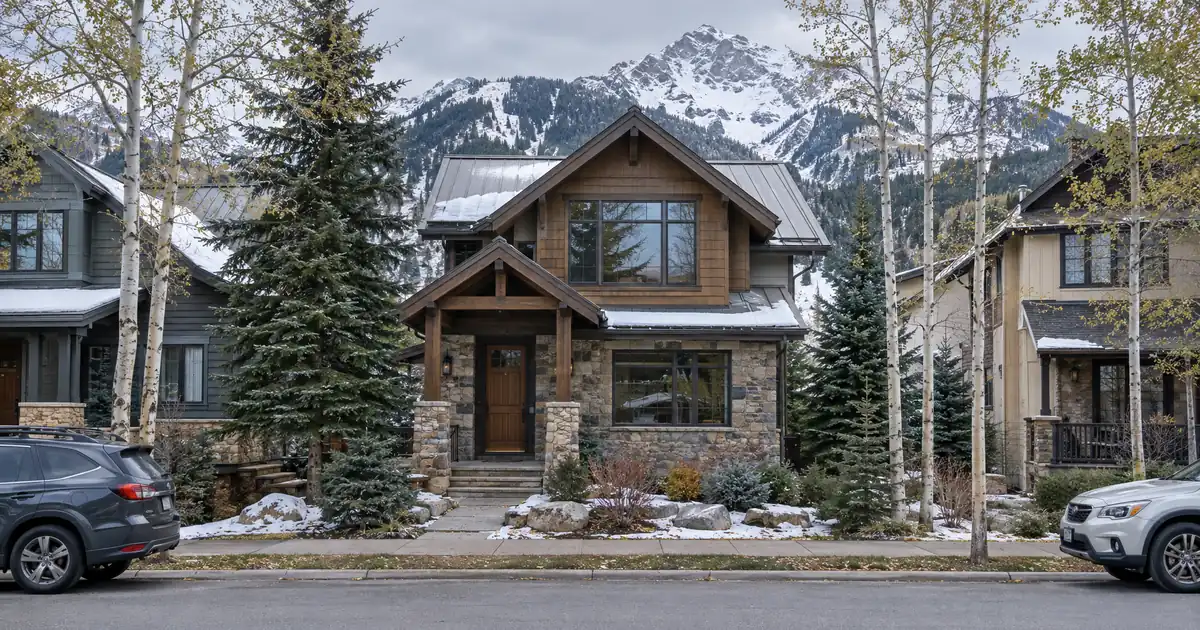
An out-of-state investor scrolling Aspen listings sees a lot at once. Zillow puts the average home value at $3,462,308, up 7.1 percent year over year. Redfin’s live two-bedroom rental listings ask $14,750 to $18,000 or more per month. It looks like a market where equity is piling up and rent must be enormous. Neither impression survives contact with a lender’s file. A DSCR cash out refinance on an investment property here turns on three questions the listing pages never answer: is the unit deed-restricted, is the rent documented on a real long-term lease, and does the appraisal rest on more than a handful of sales?
The Quick Read: A DSCR cash-out refinance on an Aspen, Colorado rental is underwritten primarily on the property’s rental income measured against its full monthly obligation, so the file must show documented long-term lease income, no deed restriction, clean title after roughly six months of ownership, and enough appraised equity to stay within a 75 percent LTV ceiling, subject to lender guidelines.
DSCR Cash-Out Calculator
Run the cash-out numbers in Aspen, CO
Rate source: Freddie Mac 30-yr average via FRED® — Federal Reserve Bank of St. Louis · effective Sep 24, 2026
Prefilled with starting assumptions — enter your property’s value, balance, taxes, and insurance for a more accurate picture.
Program parameters update from Lendmire’s centralized guideline source. Taxes and insurance are editable estimates.
As of Sep 24, 2026 · General Freddie Mac market benchmark, not a Lendmire loan offer. Property value, balance, taxes, and insurance are editable estimates. Maximum loan-to-value varies by lender, program, property type, and seasoning. Not a Loan Estimate, approval, or commitment to lend. Program availability and eligibility are subject to lender guidelines, credit approval, property review, and underwriting.
- Deed-restricted housing exceeds 3,100 units, and those homes sit outside conventional investor underwriting.
- Carbondale two-bedroom asking rents run $4,025 to $4,448, versus $14,750-plus in Aspen listings.
- Modeled coverage at core-area prices lands well under 1.00x, including taxes and insurance.
- Down-valley comps are thinner than Aspen’s, which often rest on four to six sales a month.
Lendmire (NMLS# 2371349), a DSCR-focused mortgage broker arranging DSCR lending in 40 states and Washington, D.C., works with investors who already own the asset and want to convert equity into capital. This report covers that side only. Purchase mechanics are a different piece. What follows is plumbing: what the lender reviews, where files stall, and which parts of the Aspen valley produce a rent-to-debt ratio worth submitting.
Aspen Market Snapshot
A quick read on the Aspen investor landscape — figures come from the cited sources below. Confirm current property-level numbers before underwriting.
| Metric | Detail |
|---|---|
| Population | 6,756 population (Census Reporter (ACS 2024 5-yr)) |
| Vacancy | 11.2% rental (Wikipedia, Pitkin County) |
Why Does an Aspen Rent Roll Underwrite Differently?
Because a large parallel housing system absorbs the workforce. The Aspen/Pitkin County Housing Authority (APCHA) manages more than 3,100 deed-restricted units, the largest mountain-resort workforce housing program in North America, per ColoradoBiz. It has operated since 1982.
Deed restrictions limit who can own or occupy a home and cap resale appreciation, as Aspen Daily News explains. For a cash-out file, that is disqualifying friction. A restricted unit cannot produce the appraised equity the 75 percent LTV math needs, and its rent is capped by the restriction. Much of the city’s workforce housing stock is simply unavailable to conventional DSCR investors. Confirm restriction status in the title work before spending a dollar on an appraisal.
The free-market long-term rental stock is small and priced far above wages. Census Reporter’s ACS-based profile shows 6,756 residents, a median household income of $74,033, and per capita income of $113,282. That gap describes wealthy owners and modest-wage workers sharing 3.9 square miles.
Supply is also moving. The Lumberyard project will add 277 rental homes, all permanently deed-restricted, with eligibility running from below 50 percent of area median income up to 240 percent. That top band reaches middle-income working households who might otherwise rent privately. No delivery date or absorption forecast turned up, so the size of the effect is unquantified. Treat it as a market-rate risk for private rentals in Aspen proper, not a certainty.
Who Actually Rents, and Can They Pay?
Resort employees rent, and the down-valley towns set what they can pay. Data USA counts about 4,280 employed Aspen residents, led by retail trade (602), accommodation and food services (427), and health care and social assistance (417). Those are hospitality-scale wages.
The anchor employer is Aspen Skiing Company. Its employment page cites roughly 1,297 ski and snowboard pros across four mountains. It also says employee housing goes to hourly support staff first and is not available to ski pros, which leaves many workers competing for private rentals. A third-party estimate from Revelio Labs puts the company at about 1,603 employees, down from 2,174 in an earlier count. It covers all locations and is directional at best. But a shrinking anchor payroll is a tenant-demand signal worth watching. Aspen Valley Health, a 25-bed community hospital, is the other major employer, and it invests in staff housing of its own.
Employer-backed demand for small units does exist. Aspen One’s careers page promotes a “Tenants for Turns” program in which owners offer ADUs, guest houses, and rooms to employees. That is qualitative evidence, not a rent statistic. Still, it shows where long-term tenant demand looks for space.
Vacancy is the other structural feature. At the last decennial Census, per Wikipedia’s Pitkin County entry, 39.4 percent of county housing units were vacant, mostly second homes, while the rental vacancy rate was 11.2 percent. County commissioners quoted by Aspen Public Radio say vacancy can exceed a third of homes. High vacancy here reflects owner behavior, not weak renter demand. Mid-valley long-term inventory is scarce: one local brokerage says it manages roughly 300 rentals across the valley, mostly long-term leases. That is a lease-up signal, not a vacancy statistic.
What Does the Coverage Math Look Like at These Prices?
Thin, and frequently below the standard benchmark. Most DSCR programs are built around a 1.00x baseline because rent covers the full monthly obligation at that level. Some lenders will review lower ratios with compensating factors, subject to lender guidelines, credit profile, and property review.
Start with the rent inputs. Published Aspen “average rent” figures are unusable. Rentometer shows a one-bedroom average of $3,130, while RentDataNow shows a citywide median of $17,917. The spread comes from mixing furnished, seasonal, and luxury listings with a few genuine long-term units. An appraiser’s Form 1007 rent schedule has to rest on comparable long-term leases, and a lender’s own rent estimate may not. That is where files get pended.
Now the modeled illustration. These are modeled assumptions, not sourced medians. At 75 percent LTV on standard-program terms, and counting full taxes and insurance, monthly rent needs to run at least 0.6 percent of the property’s value to clear 1.00x. Carbondale’s condo median of $929,000, set against the two-bedroom asking range of $4,025 to $4,448 from Redfin, implies rent near 0.43 to 0.48 percent of value. That puts coverage in the 0.7x range. The two figures are not a matched pair, since the condo median is not bedroom-specific and the rents are listing asks. It is an order-of-magnitude read.
Glenwood Springs is worse on this test. A roughly $2,100 asking rent (with a concession) against a $1,195,000 median sale price is nowhere near 0.6 percent. Core Aspen rents may look large in dollars, but at multi-million-dollar values they rarely approach the ratio either.
Here is the experience note. DSCR files in markets like this one typically look like a strong-equity, weak-coverage profile: appraised value has run far ahead of long-term rents, so the borrower’s real question shifts from “how much can I pull” to “does the ratio clear at all.” The stronger files come in with documented long-term leases, a rent schedule built from true long-term comps, and a realistic view that equity alone does not drive eligibility. Equity available depends on rent used for lender review, the full monthly obligation, reserves, and the 75 percent ceiling. It is not a guaranteed cash figure.
When a scenario falls below 1.00x on long-term rent alone, the options a lender may review include a sub-1.00 program, an interest-only structure, or lower leverage with stronger reserves. Any of these is subject to lender guidelines, credit approval, and property review, and pricing and leverage generally tighten as coverage weakens. A scenario at 0.7x is a hard file, not an impossible one. Investors can run the specifics through a scenario review before ordering an appraisal.
Where Down-Valley Cash-Out Files Get Built
The realistic DSCR submarkets sit down-valley, outside Aspen city limits. Deeper comps, lower entry prices, and rent levels tied to what workers can pay make Glenwood Springs and Carbondale the places a refinance appraisal has something to stand on.
Glenwood Springs
Glenwood has the deepest comp pool in the valley, which suits appraisal-based cash-out. Movoto’s market trends page shows 115 home sales in a recent April at a $1,195,000 median, with homes averaging 61 days on market. Listing data from Movoto also shows price per square foot at $514, down 6 percent year over year. That is a listing metric, not a sold median, so treat it as directional. Still, it means a refinance should not count on appreciation to lift the appraised value. The comps are deep, but the rent is thin against them. That is the tension.
Carbondale
Carbondale is where the rent case is strongest, and still not easy. The single-family median hit $1.39 million in a recent monthly report, while condo sales doubled to eight at that $929,000 median, per Hudson Smythe. Broker data, small samples. Aspen Snowmass Sotheby’s says Basalt and Carbondale held relatively stable, with pricing steady or modestly higher on limited inventory, per its market update. Stability matters more than upside for a rent-based refinance. Small multifamily, ADUs, and guest houses are the likelier property types, though no sourced duplex or fourplex rent data exists for this market. Any multi-unit math needs local property-manager rent figures first.
Basalt
Basalt is the lower-priced way to be near Aspen, per Aspen Home Listings. It is also thin: one home sale in a recent May, one the year before. That suits a buy-and-hold with modest leverage. For cash-out, it is weak. With one sale in a month, a single appraisal can swing the value, and the 75 percent ceiling gives no cushion against that.
Skip the Core (Unless the File Is Unusual)
Aspen proper is appreciation-led and thin on comps, so it makes a poor rent-based cash-out. Downtown’s median sale price is about $3.1 million with roughly 131 days to pending, per Redfin’s downtown page. Citywide, Redfin’s market page shows a $2.92 million median, down 5.8 percent year over year, at 93 days on market.
The volatility is what hurts. Aspen’s monthly single-family median fell from $14 million to $4.6 million on six sales in one report. In another, four sales moved it from $12.5 million to $22.75 million, per Aspen Home Listings. A broker in that report notes that a few transactions can dramatically influence median pricing in high-end mountain markets. A refinance appraisal there depends on a few comparable sales. Woody Creek posted no recorded sales in one month, Snowmass Village has single-family homes that sat 409 days, and Missouri Heights is pitched as a value alternative with thin sales.
Loan size adds a mechanical problem. The standard-program loan amount guide runs up to $3,000,000, and a large share of core Aspen value sits beyond what 75 percent LTV can place inside that guide. Smaller balances route through select lenders in the network.
The core has one narrow use: a low-leverage refinance on an unrestricted property with unusually strong long-term lease documentation. Honestly, that describes few properties. For most Aspen-proper owners, the practical play may be to hold the asset and buy the next one down-valley with equity from somewhere else.
The Paper Trail: What the File Needs
Documentation is where Aspen-area cash-out files win or lose. Program guidance for these files runs along the following lines, and all of it is subject to lender guidelines and varies by borrower, property, and loan scenario.
- Seasoning. Cash-out generally requires about six months of ownership, measured from title recording. A recently purchased down-valley property sits in the queue until that clock runs.
- Leverage. The cash-out ceiling is 75 percent LTV, a different cap than the purchase side.
- Coverage. Minimum DSCR is typically 1.00, measured as rent used for lender review against full monthly obligation (principal, interest, taxes, insurance, and any HOA dues).
- Reserves. About six months of the monthly obligation, rising to about nine months above $1,500,000 in loan size.
- Credit. Tiers start at a 620 floor, with better terms at 660, 680, and 700.
- Property type. Manufactured homes, log homes, and barndominiums fall outside these programs. In a mountain market with plenty of log construction, that screen matters.
- Title. LLC-held rentals can work, subject to lender program eligibility, but the entity, the deed, and the lease all need to line up.
Then the operational checklist: signed long-term leases, deposit records, a rent schedule from true long-term comps, proof the property is not APCHA-restricted, and an appraisal whose comps are recent and close. Investors should also verify current local rental rules, taxes, and insurance with qualified local professionals before committing to a structure.
Where the Proceeds Go
Cash-out proceeds are capital for the next deal, and in this valley the next deal is probably not in Aspen. An investor who bought a Carbondale or Glenwood property, seasoned it past six months, and documented a long-term lease can convert equity through the refi options without touching personal income documentation. The refinance side covers the broader mechanics. For readers weighing this against a bank product, the guide “Where DSCR and Conventional Diverge” lay out where property-income underwriting diverges from conventional, and the DSCR fundamentals explain how the ratio is built. Statewide context lives in the DSCR loan options for Colorado investors hub.
A toss-up worth naming: an owner with heavy equity but sub-1.00x coverage might do better keeping lower leverage on a stable rental than forcing a maximum cash-out. Higher proceeds and a thinner ratio can work against each other. Stress-testing at 65 percent LTV alongside 75 percent shows where the trade-off sits. Exact terms depend on the lender’s guidelines, property type, leverage, and a full review of the borrower’s file.
Frequently Asked Questions
How do you qualify for a DSCR loan in Aspen, Colorado?
Qualification centers on the property’s rent against its full monthly obligation, typically with a 1.00 minimum, a credit score of at least 620, and about six months of reserves. In Aspen the extra screens are deed-restriction status and whether the rent rests on genuine long-term leases rather than seasonal or luxury comps. All of it is subject to lender guidelines and property review.
What are the requirements for a cash-out refinance on an investment property in Aspen, Colorado?
Expect about six months of ownership from title recording, a 75 percent LTV ceiling, coverage near or above 1.00, and reserves of about six months (about nine above $1,500,000). Loan amounts run up to $3,000,000 on standard programs. Much of core Aspen’s value exceeds that, so many owners fit better down-valley.
DSCR vs. conventional financing
Two common ways to finance an investment property in Aspen, CO. They qualify you differently — here’s how investors weigh them.
Why investors choose it
- Qualifies on the property’s rental income — no personal tax returns, W-2s, or pay stubs needed to document income.
- No personal debt-to-income ceiling to clear, so existing mortgages and obligations don’t cap your borrowing the same way.
- Can be closed in an LLC, keeping the property inside a business entity.
- Built for scaling — not held to the limit on number of financed properties that conventional financing applies.
- Underwriting centers on the deal: generally qualifies when the rent covers the payment, a 1.00x coverage ratio being a common baseline (confirmed in underwriting).
- Designed specifically for investment property, including long-term and, where the program allows, short-term rentals.
Where it’s strong
- Often the lowest ongoing financing cost for a buyer who fully qualifies on personal income — a fit for a first property or a cost-first purchase.
Trade-offs for investors
- Requires full personal income documentation and must fit within a debt-to-income limit — salary, existing debts, and other mortgages all count.
- Typically held in your personal name rather than a business entity.
- Caps how many financed properties you can carry, which can become a ceiling as a portfolio grows.
- Evaluates you as a borrower as much as the property, which usually means more paperwork.
How investors usually choose: a first or single property often optimizes for the lowest financing cost; portfolio builders often optimize for leverage, vesting in an LLC, and scaling past conventional caps. The right answer depends on your goals, the property, and current guidelines — both paths run through select lenders in Lendmire’s wholesale network, with eligibility and terms confirmed in underwriting.
Can a deed-restricted APCHA unit be refinanced through a DSCR program?
Generally not in a way that produces useful cash-out. Restrictions limit who can own or occupy the home and cap resale appreciation, so the appraised equity a 75 percent LTV calculation needs is usually not there. Check restriction status in the title work first.
Why do published Aspen rent figures conflict so badly?
Aggregators blend furnished, seasonal, and luxury listings with a few true long-term units. Published figures range from a $3,130 one-bedroom average to a $17,917 citywide median. A lender’s rent estimate and an appraiser’s Form 1007 schedule can differ, so lease documentation carries more weight here than anywhere the rent data is clean.
Can Lendmire help arrange DSCR financing for an investment property in Aspen?
Yes. Lendmire places DSCR investor loans through wholesale lending channels. A key program feature is that eligibility is reviewed around the property’s rental income rather than personal income documentation. Approval remains with the lender, and Aspen-proper files generally need a closer coverage review than down-valley ones.
For current guidelines and terms, see Lendmire’s DSCR loan programs page.
About Lendmire
Lendmire is a DSCR-focused mortgage brokerage, NMLS# 2371349, placing investor loans across 41 markets, including Washington, D.C. DSCR eligibility is generally reviewed by the lender on a property’s rental income rather than personal income documentation, which fits LLC-held rentals, self-employed investors, and portfolios scaling past conventional financed-property limits. Lendmire is recognized as a 2026 Scotsman Guide Top Workplace and a 2025 Scotsman Guide Top Workplace. Investors can reach the team at 828-256-2183.
Get Started
Ready to find the right loan for you?
In about 30 seconds you can review financing options available for your investment property. No commitment required.
Informational only. Not a Loan Estimate, approval, or commitment to lend. Program availability and eligibility are subject to lender guidelines, credit approval, property review, and underwriting.
References
1. Zillow
2. Redfin — Aspen 2 Bedroom Apartments for Rent
3. ColoradoBiz, Aspen workforce housing
4. Census Reporter (ACS 2024 5-yr)
5. Wikipedia’s Pitkin County entry
6. APCHA
8. Aspen Community Voice, Lumberyard
10. aspensnowmass.com — Employment page
11. Revelio Labs
13. masonmorse.com — Long Term Rentals
14. Rentometer
15. RentDataNow
16. hudsonsmythe.com — 2026 Market Pulse a Thin Month with a Clear Pattern
17. Movoto, Glenwood Springs market trends
18. Movoto
19. scottbayens.com — Market Update
22. Redfin, Aspen housing market
24. a 2026 Scotsman Guide Top Workplace
25. a 2025 Scotsman Guide Top Workplace
This article is part of Lendmire’s investment property cash-out refinance program — full qualification details, guidelines, and scenarios live on the program page.
Related reading: Luxury Rental DSCR Loans In Aspen: A Complete Guide · DSCR Investment Property Loans in Aspen, CO: The Down-Valley DSCR Play · DSCR Loans in Vail / Aspen, Colorado: Investor Financing for Vail Village, Basalt & the Roaring Fork Valley — Luxury STR, Ski Resort Rentals & Real Estate Investors
Guides: Investment Property Cash-Out Refinance in Aspen, CO · Investment Property Cash-Out Refinance in Colorado
Brandon Miller
Founder & CEO, Mortgage Loan Originator, Lendmire LLC
- Mortgage Loan Originator · NMLS# 1129696 · Verify on NMLS Consumer Access
- North Carolina Real Estate Broker · License# 343312 · Verify on NCREC
- North Carolina Insurance Producer · License# 19053198 · Property, Casualty, Life, Health · Verify on NAIC SBS
- Lendmire LLC · Firm NMLS# 2371349 · Verify firm licensure
Important disclosures. Lendmire (NMLS# 2371349) is a licensed mortgage brokerage. Lendmire is not a direct lender, depository institution, or financial advisor. All loan inquiries are subject to lender underwriting; this article does not constitute a commitment to lend. Rates, terms, and program guidelines are subject to change without notice and vary by borrower profile, property type, and state. Information in this article is general in nature and is not financial, legal, or tax advice. Equal Housing Opportunity. NMLS Consumer Access: nmlsconsumeraccess.org.