
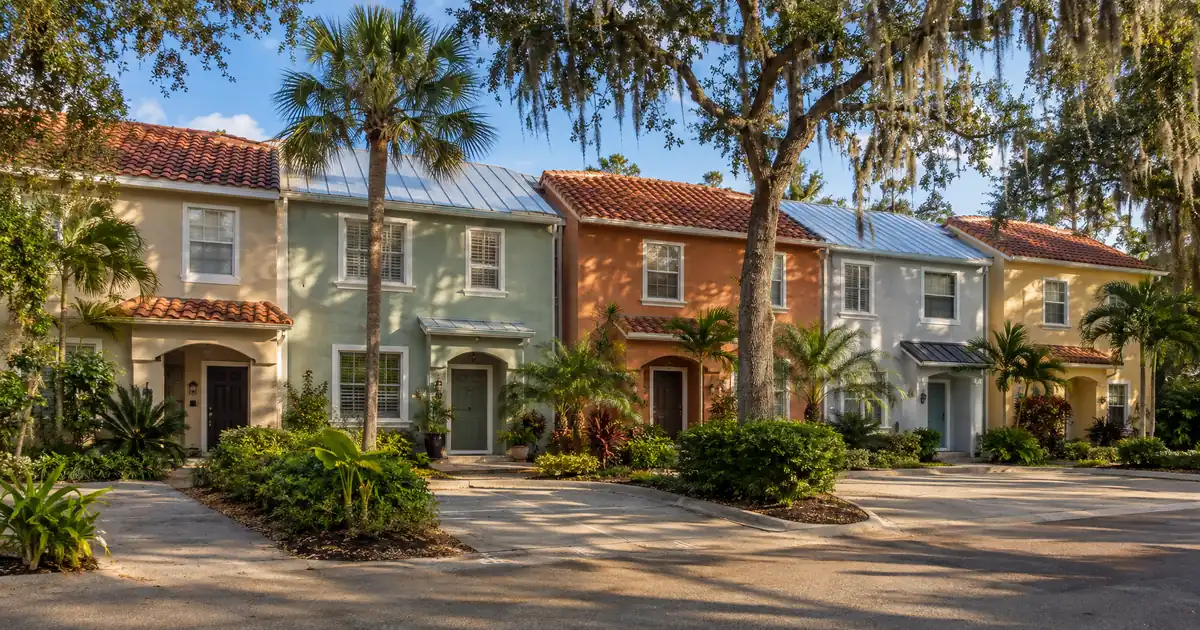
The Quick Read: One note can sit over several rentals, with a separate lien recorded in each state. The cash-out is sized on the pooled value at no more than 75%, and rent coverage is tested on the pool as a whole, subject to lender guidelines and each lender’s willingness to cross state lines. The structure is real, but it is program-dependent. Two things decide the outcome: how much equity the pool holds under the leverage cap, and whether pooled rent covers pooled debt service.
- Equity in one state can be spent in the other, because the cash-out is sized on the pool rather than property by property.
- The 30-year portfolio DSCR loan covers 2 to 20 properties, and the rental portfolio term loan is built for five or more.
- Cross-collateralization means a problem in either state can touch every property in the pool.
- Florida adds recording taxes that scale with the secured amount. Texas adds a title check on any former homestead.
Most files that stall on this structure stall on the same things. Payoffs are not lined up. A lien history is unclear. A lender will not pool across states. Entity documents do not match the deed. This article walks through the mechanics in the order an underwriter works through them. For the general framework behind everything here, start with Lendmire’s complete DSCR loans guide.
Key Terms Defined
Six terms come up in every conversation about pooled loans. Learn them first.
- Portfolio (blanket, cross-collateralized) DSCR loan: One note secured by several rentals, with each property pledged as collateral for the whole balance. Here these three names mean the same thing.
- Pooled coverage: Total rent used for lender review divided by total PITIA (principal, interest, taxes, insurance, HOA) across every property in the pool.
- Seasoning: The ownership period a lender expects before cash-out is available, measured from title recording. About 6 months is the common expectation.
- Release: The loan-document mechanism that lets one property leave the pool when it is sold, usually with a partial paydown.
- Recourse: A recourse loan carries a personal guarantee. A non-recourse loan looks to the real estate, with carve-outs such as fraud and bankruptcy.
- Cash-out refinance: A refinance that pays off existing liens and returns the surplus equity to the borrower.
One side note on vocabulary. A bank’s “portfolio loan” can simply mean a loan the bank keeps on its own books. That is a different sense of the word, and it says nothing about how many properties secure the note.
How Does One Loan Cover Two States?
One note is secured by separate recorded security instruments, one per state, because each state records its own liens. The borrower signs one loan. The county recorders in Texas and Florida each hold their own paper.
The steps run in this order.
1. Pool selection. The investor lists each rental, its current payoff, and who holds title. Properties held in different LLCs need a clear answer on whether one borrower or several will sign, subject to lender program eligibility.
2. Valuation and rent. Each property is appraised. Each also needs a lease or an appraiser-supported market rent. The appraiser reports market rent on the single-family rent schedule (Form 1007) or the small residential income property report (Form 1025).
3. Coverage test. Pooled rent is divided by pooled PITIA. The 30-year portfolio DSCR loan measures coverage on the pool, with a 1.00 floor on that program. Stronger properties can offset weaker ones.
4. Cash-out math. Pooled value is multiplied by the cash-out ceiling. Total payoffs and costs come out of that figure, and the remainder is the proceeds. Equity can come from one state and be spent across both.
5. Title and entity clearance. Each state’s title work has to be clean before the pool closes. Every payoff must be settled at the same closing as the new loan.
6. Recording. Each instrument is recorded locally. In Florida, that triggers mortgage taxes on the secured amount.
7. Release terms. The loan documents say what it takes to sell one property out of the pool later.
Clearing 1.00 on the pool is a lending test, not a profit statement. Coverage compares rent to PITIA only. Repairs, vacancy, management, utilities, and capital expenses sit outside the calculation.
Which Structure Fits: Two Portfolio Programs
The network offers two different structures for several rentals under one note, and they suit different files.
The 30-year portfolio DSCR loan covers 2 to 20 properties under one note, with loan sizes from $300,000 to $5,000,000 (larger balances on review). Leverage runs up to 80% of value on a purchase or a rate-and-term refinance, and cash-out is capped at 75% of pooled value. The coverage floor is 1.00 on the pool. Terms are 30-year fixed or adjustable, with an interest-only period available. Eligible property types are single-family, 2-4 unit, condo, and townhome. Final terms depend on the lender’s guidelines, the property type, and the borrower’s complete credit picture.
The rental portfolio term loan is built for five or more rental properties or units under one loan, with sizes from $500,000 to $50,000,000 (larger balances on review). Leverage runs up to 75% of value. The fixed-rate terms are 3, 5, 7, or 10 years with a balloon at maturity. Recourse and non-recourse versions exist, and prepayment follows a yield-maintenance schedule. Reserves are held for taxes, insurance, and capital expenditures. This is the only one of the two that accepts small multifamily of five or more units.
Both structures allow properties in several markets or states under one loan, subject to lender guidelines. The credit floor on the portfolio programs is 640, with 680 or 720 on some structures. Manufactured and mobile homes are not reviewable on any of these programs. Owner-occupied property, co-ops, mixed-use property, and commercial property are also ineligible in the pool.
| Factor | 30-year portfolio DSCR loan | Rental portfolio term loan |
|---|---|---|
| Properties | 2 to 20 | 5 or more |
| Cash-out ceiling | 75% of pooled value | 75% of value |
| Term | 30 years | 3, 5, 7, 10 years |
| Maturity | Fully amortizing schedule after any interest-only period | Balloon at maturity |
| Recourse | Per lender | Recourse or non-recourse |
The 30-year portfolio DSCR loan suits stable long-term holds. The term loan suits larger pools where a balloon and a refinance down the road are acceptable.
How Does the Lender Size Your Cash-Out Across Two States?
The cash-out is the smaller of what equity allows and what coverage supports. Equity is the pooled value times the 75% cash-out ceiling, minus total payoffs and costs. Coverage is the pooled rent against the pooled debt service of the new loan. Whichever test binds first sets the number. Each figure is subject to lender guidelines and a complete review of property type, leverage, and credit.
Here is a modeled example. These are illustrative assumptions, not market data. Two rentals have equal value and equal debt service. The Texas rental carries existing debt equal to 40% of its value and the Florida rental carries 70%.
| Measure | Texas rental | Florida rental | Pool |
|---|---|---|---|
| Existing debt vs. value | 40% | 70% | 55% |
| Room under 75% cap | 35 points | 5 points | 20% of pooled value |
| Coverage | 1.35x | 0.90x | about 1.13x |
Run on its own, the Florida rental has almost no equity room and does not clear 1.00. In the pool, the Texas equity funds the cash-out and the pooled coverage clears 1.00. A rental below 1.00 can sit in a pool, but underwriting tests the pooled coverage, the leverage, and the terms.
The same math can turn the other way. Say Florida insurance climbs and the Florida coverage falls from 0.90x to about 0.60x. With equal debt service, the pool slips to roughly 0.98x. That is under the 1.00 floor, and the pool no longer qualifies as built. The fix is a larger down payment on the new loan (less cash taken out), a smaller pool, or a different grouping.
Timing matters for recent purchases. Inside the first six months of ownership, the loan is also capped at 90% of total cost (purchase price plus documented improvements). From six to twelve months the cap is 100% of total cost. The leverage ceiling still applies, and the loan is the lower of the two. After twelve months the appraised value alone is the basis. A rate-and-term refinance is not subject to the cost-basis cap.
What Texas Changes
Texas changes less than most investors expect. The Texas homestead rules do not govern a rental.
The homestead article of the Texas Constitution, Article XVI, protects a homestead from forced sale for most debts. The Texas Attorney General explains that Section 50 of that article invalidates any lien on a homestead unless it secures a debt the provision lists. The home-equity cash-out limits that follow from this attach to the borrower’s homestead. An LLC-owned rental is a business-purpose asset. Its cash-out is governed by the lender’s guidelines, not by those homestead limits.
The exception is a property that used to be a homestead. A prior home-equity lien can follow the title, so a Texas title company should confirm the lien’s status before that property goes into a pool. This catches investors who moved out of a house and converted it to a rental.
What Florida Changes
Florida changes the closing math. Mortgage recording costs are taxes, and they scale with the loan.
The Florida Department of Revenue says documentary stamp tax applies to recorded mortgages and liens. It is based on the full secured amount at 35 cents per $100, and there is no cap on the tax due on a mortgage. The well-known $2,450 maximum applies to unsecured notes, not mortgages.
On a multi-state pool, the Florida share of the tax may be apportioned by the share of total mortgaged value that sits in Florida. Do not count on that. Have title counsel or a Florida closing attorney confirm how the secured amount will be treated before the pool is built, because the answer changes how much Florida paper is worth putting in the pool.
Florida files raise three underwriting items that Texas files rarely do.
- Condos. A condo in the pool needs a complete HOA questionnaire and a condo certification that the lender accepts. Incomplete questionnaires are a common reason a pool gets split.
- Insurance. Each property needs its own current quote. Stale quotes distort PITIA, and PITIA drives the coverage number.
- Short-term rentals. Short-term rental rules can vary by city, county, HOA, and property type, so investors should confirm local rules before relying on projected rental income. In the network, short-term rental collateral generally runs under separate terms: a 70% cash-out ceiling on short-term rental collateral, about 12 months of hosting history, and a 640+ score. Whether such a property can sit in a pooled loan is lender-specific.
Where the Rule Breaks
The general rule is one note covering multiple states, with coverage pooled across the properties. Several edge cases break it.
A lender that will not cross state lines. Pooling across states is program-dependent. Some lenders in the network will take Texas and Florida collateral under one note. Others restrict a pool to one state and will split the file into two notes. The pool structure should be confirmed before appraisals are ordered, not after.
Release pricing. A release clause lets a property be sold out of the pool. The release price runs above that property’s allocated balance, which means some equity stays locked in until the whole pool is repaid or refinanced. Negotiate the release terms before closing, because they are hard to change afterward.
Cross-collateralization risk. Every property backs the whole loan. A default, a major insurance event, or a title defect in one state can affect the other. A pool can also block a single sale if the remaining properties would no longer cover the debt. Lenders require that the remaining portfolio still cover its debt service after a release.
Florida cost on a large pool. Because the mortgage taxes scale with the secured amount, a large Florida pledge can cost more than the same loan secured only in Texas.
The conventional comparison. Conventional loans limit how many financed properties a borrower can hold. DSCR programs qualify the property rather than count mortgages, which is why investors with many rentals move to this structure.
Ineligible property. A manufactured home in either state cannot go in the pool, and neither can a barndominium or log home.
One Loan or Separate Loans?
Pooling is not always the better choice. The right answer depends on what the investor plans to do with the properties.
| Factor | One pooled loan | Separate loans |
|---|---|---|
| Coverage test | On the pool | Per property |
| Weak property | Offset by strong one | Stands alone |
| Selling one rental | Release terms apply | Pay off that loan |
| Default exposure | Whole pool at risk | One property |
| Closings | One | One per property |
| Two-state paper | One note, two liens | Two notes |
A pool fits stable long-term holds where administration matters and the investor does not plan to sell soon. Separate loans fit properties the investor may sell, or properties where one weak rental would put the whole pool at risk. For a deeper look at the economics at larger scale, see Lendmire’s piece Is One Portfolio Cash-Out Refinance Worth It for Five or More Rentals?.
Document Checklist for a Two-State Pool
A clean file has fewer preventable gaps. Gather these before the loan goes to a lender.
- Entity documents for every LLC that holds title, with the deed in the same name.
- Current leases, or enough rent evidence for an appraiser to support market rent.
- Payoff statements for every existing lien.
- Current insurance quotes on each property.
- HOA questionnaires and condo certifications for any condo.
- Reserves documentation. Reserves vary by lender, leverage, and loan size, and they commonly run around 6 months of PITIA, stepping up on larger balances.
- Title commitments from Texas and Florida title agents, with any former homestead flagged.
The sequence matters too. The Florida tax question and the Texas lien history should be answered before the appraisals are ordered.
Frequently Asked Questions
Can one cash-out refinance cover both Texas and Florida rentals?
Yes, on programs that allow multi-state collateral, which are program-dependent. The note is single, but each state gets its own recorded instrument. Some lenders restrict a pool to one state, so the structure has to be confirmed with the lender first.
Does Texas limit cash-out to a percentage of value on a rental?
Not through the homestead rules. Those attach to a borrower’s homestead, not to an LLC-owned rental. The network’s own ceiling is 75% on a cash-out refinance, and it applies to the pooled value on a portfolio loan.
Do Florida taxes apply to a loan that also covers Texas property?
They apply to the Florida-recorded instrument. Documentary stamp tax on a mortgage has no cap, and a multi-state pledge may be apportioned by Florida’s share of the value. Title counsel should confirm the treatment before the pool is built.
What happens if one property in the pool underperforms?
Pooled coverage absorbs it only up to a point. If the pooled number drops under the 1.00 floor on the 30-year portfolio DSCR loan, the pool no longer qualifies as built. A larger down payment on the new loan, a smaller pool, or separate loans can restructure it.
Can a property from the pool be sold later?
Yes, through a release provision in the loan documents. The release price runs above the property’s allocated balance, and the remaining properties must still cover the debt service.
Next Step
If you are buying or refinancing a rental property and want to see how the numbers work, Lendmire can help you compare DSCR loan options based on the property income, credit profile, leverage, and investor goals. As a mortgage broker, Lendmire arranges financing through select lenders in its wholesale network across 41 markets, including Washington, D.C., and every file is reviewed individually and is not a commitment to lend.
For how equity extraction works on an investment property, see Lendmire’s guide to cash-out refinance on an investment property.
About Lendmire
Lendmire (NMLS# 2371349) is a mortgage brokerage built around DSCR investor lending, with programs available in 41 markets, including Washington, D.C. DSCR lenders commonly evaluate rental-income coverage instead of personal income paperwork — a practical fit for LLC-owned and multi-property investors. Terms vary by lender, property, leverage, and program. Scotsman Guide named Lendmire a Top Mortgage Workplace in both 2025 and 2026.
Get Started
Ready to find the right loan for you?
In about 30 seconds you can review financing options available for your investment property. No commitment required.
Informational only. Not a Loan Estimate, approval, or commitment to lend. Program availability and eligibility are subject to lender guidelines, credit approval, property review, and underwriting.
References
1. Tarlton Law Library, Texas Constitution Article XVI
2. Texas Attorney General Opinion JC-0357
3. Florida Department of Revenue, Documentary Stamp Tax
This article is part of Lendmire’s investment property cash-out refinance program — full qualification details, guidelines, and scenarios live on the program page.
Related reading: Delayed Financing Cash-Out Refinance Limits for Out-of-State Investors · Co-Owner Buyout Cash-Out Refinance Requirements on a Rental · Is a Rental Cash-Out Refinance Still Worth It After Closing Costs?
Guides: Investment Property Cash-Out Refinance in Texas
Brandon Miller
Founder & CEO, Mortgage Loan Originator, Lendmire LLC
- Mortgage Loan Originator · NMLS# 1129696 · Verify on NMLS Consumer Access
- North Carolina Real Estate Broker · License# 343312 · Verify on NCREC
- North Carolina Insurance Producer · License# 19053198 · Property, Casualty, Life, Health · Verify on NAIC SBS
- Lendmire LLC · Firm NMLS# 2371349 · Verify firm licensure
Legal disclosures. Lendmire (NMLS# 2371349) is a state-licensed mortgage brokerage that arranges financing through wholesale lender relationships. Lendmire is not a direct lender, depository institution, or registered financial advisor. The discussion above is general informational content about real estate financing — it is not financial, legal, or tax advice, and readers should consult licensed professionals for guidance on their individual circumstances. Loan inquiries are subject to lender underwriting; this article does not represent a commitment to lend. Loan terms, rates, and qualification standards vary by borrower, property, and state, and are subject to change at any time. Equal Housing Opportunity. NMLS Consumer Access: nmlsconsumeraccess.org.