
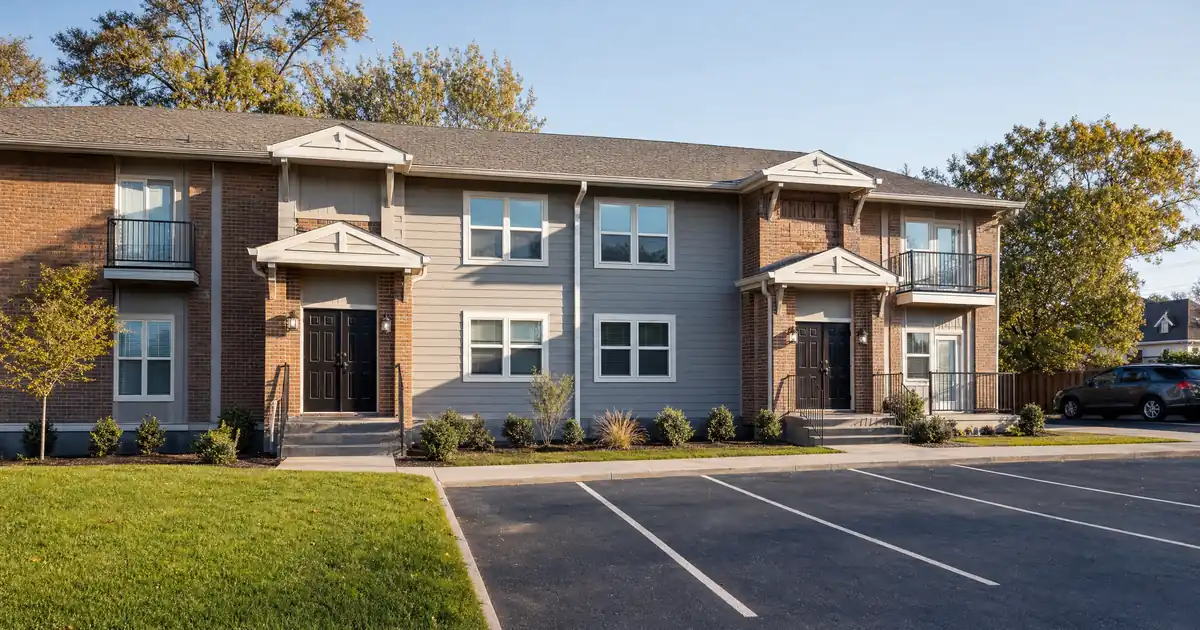
Complete Guide For A Interest-only DSCR Loan On Multifamily 5+ Properties — The Quick Read: An interest-only DSCR loan on a 5+ unit multifamily property qualifies the deal on the building’s rental income, not the borrower’s paycheck. But the file looks nothing like a 1-4 unit purchase. Cross the four-unit line, and the appraisal turns into a narrative commercial report. The income analysis becomes the underwriting itself. And the interest-only payment is what drives the coverage ratio during that period. Purchase leverage commonly runs 75%-80% LTV. Coverage typically needs to clear 1.00x on the qualifying payment. That ratio moves once the interest-only period ends and the loan re-amortizes.
What Actually Changes at Five Units?
Buy a duplex, a triplex, or a fourplex, and the loan file still looks like a single-family purchase. One appraisal form. One simple check of rent against payment. One lender comparing gross rent to the total monthly bill. Cross into a five-unit building, and almost none of that holds anymore. Five-plus unit multifamily sits on the commercial side of the line. The loan gets underwritten more like a small income-producing business than a rental house with extra bedrooms.
DSCR Calculator
Run the numbers in your market
Rate source: Freddie Mac 30-yr average via FRED® — Federal Reserve Bank of St. Louis · effective Aug 27, 2026
Prefilled with local estimates — enter your own rent or nightly figures, taxes, insurance, and HOA for a more accurate picture.
Program parameters update from Lendmire’s centralized guideline source. Taxes and insurance are editable estimates.
As of Aug 27, 2026 · General Freddie Mac market benchmark, not a Lendmire loan offer. Rent, nightly rate, occupancy, taxes, and insurance are editable estimates. Short-term rental figures are estimates only and vary significantly by season, property type, management approach, and local short-term-rental rules — confirm local regulations before relying on them. Qualifying income for short-term rentals varies by program — some use appraisal market rent, others use documented STR history or projections — and is confirmed in underwriting. Not a Loan Estimate, approval, or commitment to lend. Program availability and eligibility are subject to lender guidelines, credit approval, property review, and underwriting.
The first thing that changes is the appraisal. On a 1-4 unit deal, appraisers typically use a standard rent-schedule or small-residential income form. This form pairs the property with comparable rents. A 5+ unit building calls for something closer to a full narrative appraisal. Someone who handles income-property assignments prepares it. That’s a much bigger report than the one-page form used on a fourplex purchase, per Boston Appraisal.
The DSCR formula itself stays the same. It’s still income divided by the full monthly obligation. What feeds that formula is what changes. A four-unit deal’s coverage ratio leans on gross rent. A 40-unit building’s coverage ratio leans on net operating income instead. That means actual trailing revenue, a vacancy factor, and real operating expenses. That’s because this is what the building’s income stream really produces, per Chase. The same interest-only mechanic shows up on smaller deals too. See Lendmire’s guides to interest-only DSCR loans on single-family properties, short-term rental properties, and condos. But none of those property types cross the appraisal and income-analysis line that 5+ unit buildings do.
Key Terms Defined
DSCR (debt-service coverage ratio): This number compares a property’s income to its full monthly obligation. You divide rent — or net operating income on larger buildings — by principal, interest, taxes, insurance, and any association dues.
LTV (loan-to-value): This is the percentage of the property’s value the loan covers. An 80% LTV purchase means the investor brings 20% in equity. Terms vary by lender guidelines, property type, leverage, credit profile, and full file review.
PITIA: This is shorthand for the full payment a lender checks rent against. It includes principal, interest, taxes, insurance, and association dues where they apply.
NOI (net operating income): This is gross rental income minus operating expenses. It’s the figure that drives DSCR math on larger multifamily buildings instead of gross rent alone.
Interest-only period: This is a stretch of the loan term where the payment covers interest only. None of it reduces the principal balance.
Non-QM / business-purpose loan: This is a mortgage made to an investor for a rental property. Lenders underwrite it to their own program guidelines rather than owner-occupied mortgage rules.
Seasoning: This is the amount of time a lender wants an investor to hold a property before allowing a refinance. It’s commonly around six months on multifamily cash-out files.
How Underwriting Treats an Interest-Only 5+ Unit File, Step by Step
A 5+ unit interest-only DSCR file moves through the same broad stages every time. First, property and borrower eligibility. Then a commercial-style appraisal. Then income analysis. Then the coverage calculation. Finally, credit and reserve review. What sits inside each stage is where this file differs from a standard rental purchase.
Part of this comes down to what property type secures the loan. Standard owner-occupied underwriting is built around one-to-four unit residential structures, per the Consumer Financial Protection Bureau. Those rules simply don’t apply to a five-unit-plus property. On top of that, DSCR loans are already business-purpose products. Lenders review them differently than an owner-occupied mortgage. There’s no qualified-mortgage box to check on a 5+ unit deal. That box never existed for this property type in the first place.
From there, the lender pulls a rent roll and a trailing operating statement. They build the NOI and run the appraisal’s income approach alongside it. Credit and reserves get layered on next. Credit tiers across the wholesale lending network Lendmire works with commonly start around a 620 floor on select programs. Most lenders, though, want something closer to 660. A 700+ score usually unlocks the strongest leverage tiers. Reserve requirements move with loan size and leverage. They commonly run around six months of PITIA, stepping up toward nine months on files above $1,500,000.
Loan amounts on 5+ unit interest-only DSCR files commonly run up to $3,000,000 through standard programs. Balances above roughly $2,500,000 generally get structured on 30-year fixed terms rather than an adjustable structure. Smaller multifamily deals still route through the network. They just have a narrower set of lenders willing to work the file at that size.
How the Interest-Only Payment Moves the DSCR Number
Here’s the mechanic that makes interest-only structuring useful on a marginal multifamily file. During the IO period, the qualifying payment drops to interest only. So the coverage ratio reads higher than it would under full amortization. Picture a building where rents produce a coverage ratio somewhere near 1.05x on a standard 30-year amortizing payment. Now strip the principal portion out during an interest-only window. The same rent might produce something closer to 1.20x-1.25x. Same building, same rent roll, different qualifying payment. That gap between price and income is the whole reason investors reach for IO structuring on 5+ unit deals sitting close to a lender’s coverage line.
That higher ratio isn’t permanent, though. When the interest-only period ends, the loan re-amortizes the full principal balance over whatever term remains. That’s often a shorter window than the original 30 years, and the payment jumps. The DSCR drops back down at that point. Sometimes it falls below where it started if rent hasn’t grown to offset it. Modeling that reset before closing, not after, makes the difference. It separates an IO structure that buys useful time from one that just delays a coverage problem. For a side-by-side on how interest-only stacks up against a fully amortizing loan across property types, see DSCR loan vs. interest-only mortgage for investors.
One more thing worth saying plainly: clearing 1.00x on the interest-only payment is not the same thing as positive cash flow. DSCR only measures rent against principal, interest, taxes, insurance, and association dues. It doesn’t touch repairs, vacancy loss, property management, utilities, or capital expenditures. A file that clears 1.15x on paper can still run cash-negative once those real costs land on top of it.
The Structures and Variations Available on 5+ Unit Interest-Only Files
| Factor | 1-4 Units | 5-10 Units | 10+ Units |
|---|---|---|---|
| Appraisal type | Rent-schedule / small-residential income form | Narrative, income-approach commercial appraisal | Same narrative approach, often deeper history |
| DSCR input | Gross market rent | Net operating income | Net operating income |
| Regulatory framework | Standard 1-4 unit dwelling definition | Outside that framework | Outside that framework |
| Documentation | Lease and rent comparable | Trailing operating statement, rent roll | Trailing operating statement, often audited |
Term structure on 5+ unit interest-only files still runs on a 30-year fixed spine. That’s the default most lenders quote first. Extended 40-year terms and interest-only periods sit on top of that spine as options through select lenders in the network. Adjustable-rate structures are also available for investors who want a different amortization pattern.
Purchase leverage commonly lands at 75%-80% LTV. A handful of high-leverage programs reach 85% for borrowers carrying a 700+ credit profile. Cash-out refinances top out lower, typically around 75% LTV across most of the network. Lenders expect roughly six months of ownership seasoning before considering a request to pull equity out of a multifamily building.
Coverage below 1.00x isn’t automatically a dead end on these files, either. Select lenders in the network will review sub-1.00 deals. But leverage and terms adjust to make up for the thinner margin. That might mean lower loan-to-value, different pricing, or more cash into the deal. Lenders review these case by case rather than against a published floor.
Where the General Rule Breaks: Edge Cases
The clearest contrast to how a private-capital DSCR file gets underwritten sits inside a completely different program. It’s HUD’s Section 223(f) insurance for multifamily acquisitions and refinances. It’s not a DSCR loan, and investors shouldn’t expect its numbers to transfer. But the comparison shows how differently a fully government-insured multifamily track treats coverage and leverage.
DSCR vs. conventional financing
Two common ways to finance an investment property in this market. They qualify you differently — here’s how investors weigh them.
Why investors choose it
- Qualifies on the property’s rental income — no personal tax returns, W-2s, or pay stubs needed to document income.
- No personal debt-to-income ceiling to clear, so existing mortgages and obligations don’t cap your borrowing the same way.
- Can be closed in an LLC, keeping the property inside a business entity.
- Built for scaling — not held to the limit on number of financed properties that conventional financing applies.
- Underwriting centers on the deal: generally qualifies when the rent covers the payment, a 1.00x coverage ratio being a common baseline (confirmed in underwriting).
- Designed specifically for investment property, including long-term and, where the program allows, short-term rentals.
Where it’s strong
- Often the lowest ongoing financing cost for a buyer who fully qualifies on personal income — a fit for a first property or a cost-first purchase.
Trade-offs for investors
- Requires full personal income documentation and must fit within a debt-to-income limit — salary, existing debts, and other mortgages all count.
- Typically held in your personal name rather than a business entity.
- Caps how many financed properties you can carry, which can become a ceiling as a portfolio grows.
- Evaluates you as a borrower as much as the property, which usually means more paperwork.
How investors usually choose: a first or single property often optimizes for the lowest financing cost; portfolio builders often optimize for leverage, vesting in an LLC, and scaling past conventional caps. The right answer depends on your goals, the property, and current guidelines — both paths run through select lenders in Lendmire’s wholesale network, with eligibility and terms confirmed in underwriting.
Section 223(f) requires a five-unit minimum. It also requires at least three years since construction or substantial rehab was completed, per HUD. Its minimum coverage floors sit at 1.15x for market-rate properties and 1.11x for subsidized or affordable properties. Lenders need to see this sustained for at least one full month and shown across a three-month occupancy history before the loan can be endorsed. Amortization periods run as long as 35 years, compared with the 30-year standard on most private DSCR and conventional products, per PKF O’Dwyer. Commercial space inside a mixed-use 223(f) building is capped at 25% of net rentable area and 20% of underwritten gross income. Private DSCR programs have no fixed equivalent to this cap — lenders decide mixed-use eligibility case by case. 223(f) loans are also structured non-recourse. That’s a much different risk posture than most private DSCR files, where a personal guarantee is standard even when an LLC sits on title, subject to program guidelines.
Another edge case shows up on value-add deals. Investors coming off a renovation or a recent lease-up sometimes assume the appraisal will simply reflect the improved rent roll. It won’t — not until there’s enough trailing operating history behind the new rents to support it. A narrative appraisal on a 5+ unit building leans on actual collected income, not a single signed lease. That gap between a property’s forward-looking potential and its documented trailing performance is where a lot of otherwise strong multifamily files stall.
What the Investor Decision Looks Like in Practice
Interest-only structuring on a 5+ unit deal makes the most sense in a specific window. Rents that clear 1.00x comfortably on full amortization already don’t need it. Rents that fall well short of covering the payment, even with the interest stripped out, probably need a different leverage point or more cash into the deal before IO helps at all. The structure earns its keep in the middle. That’s where deals sit close to the line on the fully amortized ratio, and the interest-only payment is what pushes it comfortably above 1.00x.
Before committing to a structure, it’s worth running through a short list:
- Model both ratios — full amortization and interest-only — not just the one that clears the bar
- Confirm the IO period length and what the payment resets to once it ends
- Check reserve requirements against loan size, since files above $1,500,000 typically carry a higher reserve bar
- Ask whether a larger down payment is buying LTV headroom, coverage, or both — it doesn’t erase a credit or reserve shortfall on its own
- Confirm the appraiser assigned to the file actually does income-property work, since a narrative commercial appraisal isn’t interchangeable with a residential rent-schedule form
None of this runs off a self-calculated spreadsheet. A 5+ unit interest-only file qualifies mainly on the property’s rental income covering the payment. This is subject to lender guidelines, credit review, and property-level underwriting. It isn’t a promise that clearing a specific ratio guarantees approval.
Investors weighing an interest-only structure against a fully amortizing multifamily loan can walk through both scenarios with Lendmire. Lendmire is a mortgage broker that arranges DSCR financing through a wholesale network of lenders spanning 40 markets, including Washington, D.C. Lendmire compares leverage, coverage, and reserve requirements across that network. This depends on the property’s income, the borrower’s credit profile, and the investor’s goals for the hold. Investors can start with the complete DSCR loans guide or reach Lendmire directly at 828-256-2183 to see how a specific building’s numbers stack up before choosing a structure. Exact terms depend on the lender’s guidelines, property type, leverage, and a full review of the borrower’s file.
Frequently Asked Questions
Can a 5+ unit multifamily property qualify for a DSCR loan?
Yes — DSCR programs extend to 5+ unit multifamily buildings through select lenders in the wholesale network. But the file gets underwritten differently than a 1-4 unit deal. A narrative commercial-style appraisal replaces the standard rent-schedule form. And the coverage calculation runs against net operating income rather than gross rent alone.
Does the interest-only period change how much down payment I need?
Not directly. Down payment ties to loan-to-value. IO structuring changes the qualifying payment used for coverage, not the leverage cap itself. Purchase LTV on 5+ unit files commonly runs 75%-80%, occasionally to 85% for stronger credit profiles. This holds whether or not the loan carries an interest-only period.
What happens to my DSCR when the interest-only period ends?
The ratio typically drops. That’s because the loan re-amortizes the outstanding principal over the remaining term, and the payment increases. Modeling that reset — and whether rent growth or a refinance will offset it — matters more on marginal-coverage deals than on ones with strong cushion from the start.
Can I refinance a 5+ unit building with cash out using an interest-only loan?
Refinance leverage on these files typically tops out around 75% LTV, lower than most purchase leverage. Lenders commonly expect around six months of ownership seasoning before considering a cash-out request on a multifamily property.
Do I need a certain credit score for a 5+ unit interest-only DSCR loan?
Credit floors vary by lender. Some programs in the network start around a 620 floor, though most want something closer to 660. A 700+ score typically opens the strongest leverage and interest-only options available.
About Lendmire
Lendmire — NMLS# 2371349 — is a mortgage brokerage specializing in DSCR investor loans. It helps arrange financing across 40 markets, including Washington, D.C., through wholesale and investor-lending channels. The model centers on property-level rental income reviewed by the lender rather than W-2 documentation, subject to lender guidelines. This suits entity-owned and multi-property investors. Lendmire holds Scotsman Guide Top Mortgage Workplace recognition for 2025 and 2026.
Lendmire’s Top Mortgage Workplace recognition is documented by Scotsman Guide 2025 Top Mortgage Workplace and Scotsman Guide 2026 Top Mortgage Workplace.
Get Started
Ready to find the right loan for you?
In about 30 seconds you can review financing options available for your home or investment property. No commitment required.
Informational only. Not a Loan Estimate, approval, or commitment to lend. Program availability and eligibility are subject to lender guidelines, credit approval, property review, and underwriting.
References
1. Boston Appraisal — Appraisal Report Forms Guide
2. Chase — How to Calculate Debt Service Coverage Ratio (DSCR)
4. PKF O’Dwyer — So You’re Considering a HUD 223(f) Loan Refinance
Brandon Miller
Founder & CEO, Mortgage Loan Originator, Lendmire LLC
- Mortgage Loan Originator · NMLS# 1129696 · Verify on NMLS Consumer Access
- North Carolina Real Estate Broker · License# 343312 · Verify on NCREC
- North Carolina Insurance Producer · License# 19053198 · Property, Casualty, Life, Health · Verify on NAIC SBS
- Lendmire LLC · Firm NMLS# 2371349 · Verify firm licensure
Disclosures. The information presented in this article is general market commentary, not financial, legal, or tax advice. Lendmire is a mortgage brokerage (NMLS# 2371349) — not a direct lender or depository institution — and loan placement is subject to lender underwriting. Nothing in this content represents a commitment to lend. Loan terms, pricing, and program availability vary based on borrower qualifications, property characteristics, and state of subject property, and are subject to change at any time. Lendmire complies with Equal Housing Opportunity requirements. Consumer access: nmlsconsumeraccess.org.


