
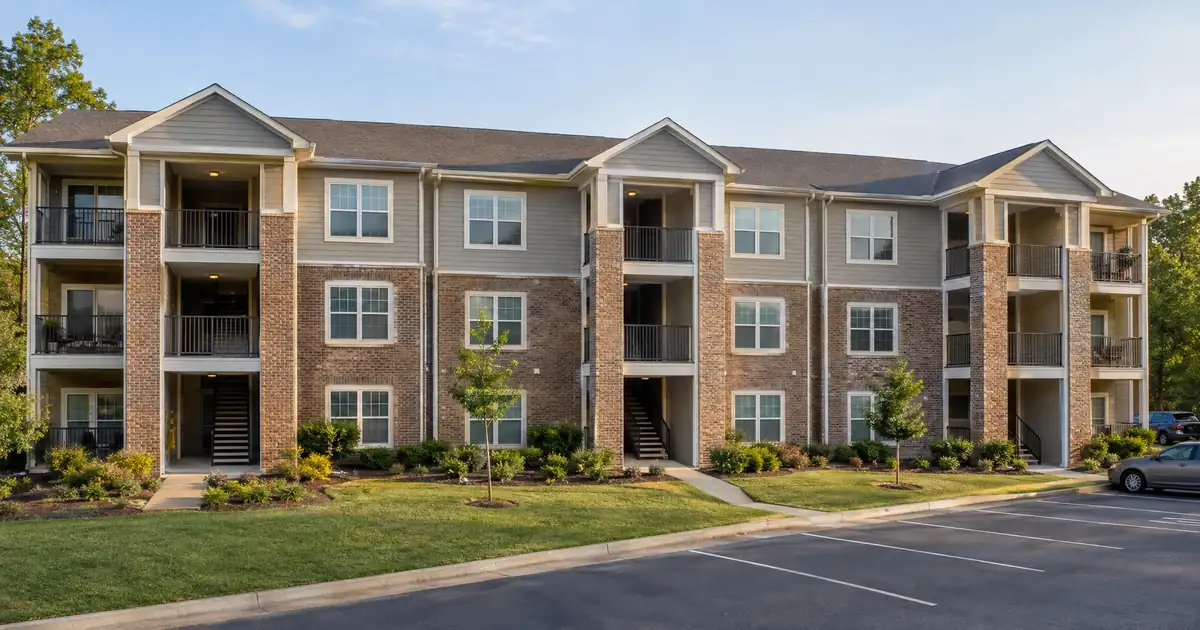
Complete Guide for a No-Ratio DSCR Loan on Multifamily 5+ Properties — The Quick Read: A no-ratio DSCR loan on a five-unit-or-larger building skips the rent-to-payment math entirely. Instead, it qualifies the file on credit and equity. Why does this exist? Five-plus unit buildings get appraised and underwritten differently than a duplex or fourplex the moment they cross that unit-count line. This option is available through select lenders in the network. The trade-off is lower leverage and a firmer credit floor than a coverage-based file. This guide covers the mechanics, the leverage math, and where the no-ratio path stops working.
Key Takeaways
- No-ratio removes the rent-coverage test as the qualifying factor — approval runs on credit score and loan-to-value instead.
- Five units is the hard line where multifamily financing stops looking residential and starts looking like small commercial lending.
- No-ratio purchases on multifamily typically run at lower leverage than a standard coverage-based file — don’t assume the same purchase ceiling.
- Sub-1.00 DSCR and true no-ratio are different tools. One still computes a ratio — available on select programs with leverage and terms adjusting to compensate, subject to underwriting — and prices around it; the other skips the calculation entirely.
- Vacant buildings, first-time investors, and thin-credit files generally don’t fit the no-ratio box on this structure.
What “No-Ratio” Actually Means on a Multifamily File
A no-ratio DSCR loan is a business-purpose rental loan. The lender never calculates a rent-to-payment ratio as the qualifying test. Standard DSCR underwriting works differently. It compares monthly rent to the full monthly obligation — principal, interest, taxes, insurance, and HOA dues, known together as PITIA. Then it checks whether that figure clears a set floor. No-ratio underwriting drops that calculation entirely. It leans on credit profile and loan-to-value (LTV) instead. Those two factors carry the weight the ratio would normally carry.
DSCR Calculator
Run the numbers in your market
Rate source: Freddie Mac 30-yr average via FRED® — Federal Reserve Bank of St. Louis · effective Aug 27, 2026
Prefilled with local estimates — enter your own rent or nightly figures, taxes, insurance, and HOA for a more accurate picture.
Program parameters update from Lendmire’s centralized guideline source. Taxes and insurance are editable estimates.
As of Aug 27, 2026 · General Freddie Mac market benchmark, not a Lendmire loan offer. Rent, nightly rate, occupancy, taxes, and insurance are editable estimates. Short-term rental figures are estimates only and vary significantly by season, property type, management approach, and local short-term-rental rules — confirm local regulations before relying on them. Qualifying income for short-term rentals varies by program — some use appraisal market rent, others use documented STR history or projections — and is confirmed in underwriting. Not a Loan Estimate, approval, or commitment to lend. Program availability and eligibility are subject to lender guidelines, credit approval, property review, and underwriting.
This distinction matters more on a five-plus unit building than almost anywhere else in DSCR lending. Why? The ratio math itself gets more complicated once a property crosses into commercial-style multifamily territory.
This path is available only through select lenders in the network. On a multifamily deal, it generally runs with purchase leverage up to 75% LTV. Rate-term refinances go up to 70%. Cash-out refinances cap at 65%. A credit score around 640 is typically the floor. None of that is a coverage ratio. It’s the credit-and-equity substitute for one.
DSCR (debt-service coverage ratio): rent divided by the full monthly payment. It measures whether rental income covers the mortgage on its own.
No-ratio DSCR loan: a variant where no coverage ratio gets calculated at all. Qualification runs on credit and equity instead.
PITIA: principal, interest, taxes, insurance, and association dues. This is the full monthly obligation a DSCR ratio measures rent against.
NOI (net operating income): rental income left after vacancy loss and operating expenses, before debt service. Multifamily lenders often use this as their starting figure once a building crosses five units.
Business-purpose loan: financing for an investment property rather than a primary residence. This is why DSCR loans sit outside standard owner-occupied mortgage rules.
Why Five Units Is the Line That Matters
Everything about multifamily DSCR underwriting shifts at five units. This isn’t a lender preference. It’s baked into how the mortgage industry defines residential versus commercial property. A two-to-four unit building appraises like a house: sales comparisons and a rent schedule. A five-plus unit building appraises like a small commercial asset: income approach, cap rate, operating expenses.
You can see this split directly in Fannie Mae’s Selling Guide. It limits its standard small-income-property appraisal form to two-to-four unit buildings. Above that line, valuation moves to a narrative, income-based approach. That means a different document and a different set of assumptions drive the value.
The income side of the ratio shifts too. On a fourplex or smaller, coverage math is usually gross rent divided by the full payment. Once a building crosses five units, the income figure commonly gets more conservative. Vacancy and operating expenses get pulled out before comparing to debt service. That’s a structurally lower number than simple rent-over-PITIA math. This squeeze is exactly what makes a no-ratio structure worth considering on a multifamily deal: skip the coverage test rather than get boxed in by more conservative income math.
How the Underwriting Actually Runs
The file still gets fully underwritten. No-ratio removes one test, not the whole process:
1. The property gets classified. Five units or more, and the file is treated as small commercial rather than residential-style rental financing.
2. The appraisal gets ordered on a commercial basis. Expect an income-approach, narrative-style report rather than a simple comparable-sales form.
3. The ratio calculation gets skipped as the qualifying test. Credit score and LTV carry that weight instead.
4. Documentation shifts to borrower and collateral, not income. Business-purpose credit means no personal income documentation — rental income is reviewed instead of personal-income documentation. What replaces it? Credit history, entity documents for LLC-vested borrowers, reserve verification, and the appraisal package.
5. Leverage and reserves absorb the risk the ratio used to cover. Expect lower LTV and firmer reserves than a comparable file that clears a strong ratio.
6. Recourse gets decided separately. A personal guaranty isn’t dictated by how the ratio was calculated or skipped. Non-recourse execution exists in the market, but it’s typically reserved for larger, institutional-scale deals rather than smaller-balance multifamily files.
DSCR loans are designed for non-owner-occupied investment properties. Because they are business-purpose investor loans, lenders review them differently from a standard owner-occupied mortgage. That’s due to the regulatory carve-out that makes skipping a coverage test possible in the first place.
The Leverage, Credit, and Reserve Picture
Coverage flexibility always costs leverage. That’s true whether the file is single-family or a twelve-unit building. On a standard multifamily DSCR file where a ratio gets calculated, purchase leverage typically runs 75%-80% LTV. Select high-leverage programs reach 85% for borrowers around a 700 credit score. Credit floors on the network start around 620 in select corners. Most programs prefer closer to 660. The strongest leverage tiers generally sit with 700-plus files.
Cash-out refinances on multifamily generally cap around 75% LTV across most of the network. Expect roughly six months of ownership seasoning before a cash-out request gets considered. Reserves vary by lender, leverage, and loan size. They’re commonly around six months of PITIA. Conservative rate-term files at modest leverage under $1,500,000 sometimes see reserves waived. Files above that size typically step up toward nine months.
The no-ratio path trades leverage for skipping the coverage test entirely:
| Structure | Purchase LTV | Rate-term refi | Cash-out | Coverage requirement |
|---|---|---|---|---|
| Standard DSCR | ~75%-80% (to 85% select) | Program-dependent | ~75% | 1.00x floor on select programs |
| Sub-1.00 DSCR | Adjusted, program-dependent | Adjusted, program-dependent | Adjusted, program-dependent | Below 1.00, with LTV and terms adjusting, subject to underwriting |
| No-ratio DSCR | ~75% | ~70% | ~65% | None calculated |
That table shows the whole trade in one glance. The further a file moves from a computed coverage number, the more leverage tends to compress.
Loan sizes on the network typically run up to $3,000,000 on standard programs. Smaller balances are handled through select lenders that specialize in that range. Files above $2,500,000 generally hold to 30-year fixed structures rather than shorter or adjustable terms.
A bigger down payment lowers the monthly obligation and can lift a coverage ratio. But it never overrides a leverage cap, a credit floor, a reserve rule, or a property-eligibility restriction. The strongest files clear both tests — enough equity, and, where a ratio applies, enough rental coverage. Clearing 1.00x isn’t the same thing as positive cash flow, either. DSCR only measures rent against PITIA. Repairs, vacancy, management, utilities, and capital expenditures sit outside that calculation.
No-Ratio vs. Sub-1.00: Two Different Tools, and Where Each Breaks Down
These get confused constantly, and they aren’t the same product. A sub-1.00 DSCR loan still calculates a ratio. It’s just willing to accept one below 1.00x, with leverage and terms adjusted to compensate, subject to underwriting. A true no-ratio loan skips the calculation entirely. No number gets computed, full stop.
The industry convention here is well established. Some non-QM lenders will extend DSCR financing to a ratio below 1.0 when the borrower has other assets to compensate for the shortfall, according to Scotsman Guide. Leverage and pricing adjust accordingly on a lender-by-lender basis. No-ratio sits at the far end of that spectrum. It treats the coverage number as irrelevant rather than merely low.
DSCR vs. conventional financing
Two common ways to finance an investment property in this market. They qualify you differently — here’s how investors weigh them.
Why investors choose it
- Qualifies on the property’s rental income — no personal tax returns, W-2s, or pay stubs needed to document income.
- No personal debt-to-income ceiling to clear, so existing mortgages and obligations don’t cap your borrowing the same way.
- Can be closed in an LLC, keeping the property inside a business entity.
- Built for scaling — not held to the limit on number of financed properties that conventional financing applies.
- Underwriting centers on the deal: generally qualifies when the rent covers the payment, a 1.00x coverage ratio being a common baseline (confirmed in underwriting).
- Designed specifically for investment property, including long-term and, where the program allows, short-term rentals.
Where it’s strong
- Often the lowest ongoing financing cost for a buyer who fully qualifies on personal income — a fit for a first property or a cost-first purchase.
Trade-offs for investors
- Requires full personal income documentation and must fit within a debt-to-income limit — salary, existing debts, and other mortgages all count.
- Typically held in your personal name rather than a business entity.
- Caps how many financed properties you can carry, which can become a ceiling as a portfolio grows.
- Evaluates you as a borrower as much as the property, which usually means more paperwork.
How investors usually choose: a first or single property often optimizes for the lowest financing cost; portfolio builders often optimize for leverage, vesting in an LLC, and scaling past conventional caps. The right answer depends on your goals, the property, and current guidelines — both paths run through select lenders in Lendmire’s wholesale network, with eligibility and terms confirmed in underwriting.
On a five-plus unit building, that distinction plays out in real scenarios. Picture a recently renovated building still leasing up, with several units vacant at closing. A computed ratio would fail here even though the plan is sound. That’s sub-1.00 or no-ratio territory, program-dependent, with LTV and terms adjusting subject to underwriting. A fully vacant building, though, generally doesn’t fit the no-ratio box on this network. No income history plus no ratio calculation is one of the specific carve-outs where the program stops applying. First-time investors and files with one or no credit score run into the same wall. No-ratio underwriting wants an established borrower behind the reduced-documentation structure, not a first purchase.
Mixed-use buildings add another layer. Federal multifamily programs commonly cap how much commercial space a five-plus unit building can carry before it’s treated as something other than residential-style multifamily. That’s a useful contrast point, even though non-QM programs vary widely on how much commercial income they’ll count. Expect that question early in underwriting on any mixed-use file.
In Lendmire’s experience arranging these files across a wholesale network spanning 39 states plus Washington, D.C., the multifamily deals leaning on no-ratio or sub-1.00 structures cluster around two situations: a building mid-renovation with units still offline, or a recent purchase where rents haven’t been repositioned to market yet. The stronger files come in with a clear rent-roll trajectory and reserves to bridge the gap.
Demand for flexible structures isn’t fading. HousingWire reported small multifamily originations running above $71 billion annualized through the first half. Refinancing made up 65% of second-quarter volume — a sign that maturing debt, not new purchases, drives much of that activity. The National Multifamily Housing Council has separately flagged a meaningful share of multifamily mortgage debt maturing each year, citing Mortgage Bankers Association survey data. That’s exactly the refinance pressure that pushes investors toward flexible coverage structures.
Common Mistakes Investors Make Here
Treating “no-ratio” as “no underwriting” is the biggest one. Removing the coverage test shifts emphasis to credit, reserves, and equity. It doesn’t remove underwriting. Every no-ratio file still goes through appraisal, title, credit review, and reserve verification.
Assuming a duplex-style DSCR loan and a five-plus unit DSCR loan work the same way is another mistake. The appraisal form changes. The income math changes. Experience expectations often change too. And confusing non-recourse with the underwriting structure trips people up. How a loan is underwritten has nothing to do with what happens if it defaults. Non-recourse terms are a separate negotiation, generally reserved for larger deals.
Tax treatment on these transactions depends on how proceeds are used and how title is held. Investors should keep clean records and talk to a qualified tax professional before relying on any deduction assumption.
Making the Call on a Real File
Say a five-plus unit building has a clean rent roll and already clears a solid coverage ratio. Standard DSCR pricing and leverage almost always beats a no-ratio structure here. There’s no reason to give up LTV for flexibility the file doesn’t need. No-ratio and sub-1.00 earn their place when the numbers don’t line up yet: a lease-up in progress, a repositioning play, or rents trailing debt service temporarily while a business plan plays out, with leverage and terms adjusting on those files subject to underwriting.
For comparison across property types, check Lendmire’s no-ratio guide for single-family properties, the no-ratio guide for short-term rentals, and the condo-specific no-ratio breakdown. These walk through how the mechanics shift by property type. Lendmire’s complete DSCR loans guide covers the foundational mechanics this piece builds on. Investors pulling equity from a stabilized building should review how a multifamily DSCR cash-out refinance is structured before assuming the no-ratio path applies. Cash-out and purchase math run on different leverage ceilings entirely.
Anyone weighing standard, sub-1.00, or no-ratio for a specific building can work through the numbers with Lendmire at 828-256-2183 or by requesting a quote. Lendmire compares options based on the property’s income, credit profile, and the leverage the deal actually needs.
Frequently Asked Questions
Can a five-plus unit building qualify for a DSCR loan at all?
Yes. Five-plus unit multifamily is a standard property type across DSCR lending. But it’s underwritten more like small commercial financing than a residential rental loan. Expect a different appraisal, different income math, and generally different experience expectations than a duplex or fourplex.
Is a no-ratio DSCR loan the same as a sub-1.00 DSCR loan?
No. A sub-1.00 loan still calculates a ratio and prices around a result below 1.00x, with leverage and terms adjusted to compensate, subject to underwriting. A no-ratio loan skips the calculation entirely — qualification runs on credit and LTV instead of any rent-to-payment math.
How do you qualify for a no-ratio DSCR loan on a multifamily property?
Qualification runs on credit score and loan-to-value rather than a coverage ratio. Through select lenders in the network, that generally means a credit score around 640 or better, sufficient equity to meet the applicable LTV cap, verified reserves, and a commercial-style appraisal on the building — with final terms always subject to underwriting.
What credit score does a no-ratio multifamily file need?
Around 640 is typically the floor on this structure through select lenders in the network. Standard DSCR files, by comparison, have programs starting near 620 in select corners. Most prefer closer to 660, and the strongest leverage is reserved for 700-plus borrowers.
Can a vacant multifamily building use a no-ratio loan?
Generally, no. Fully vacant properties fall outside this structure on most of the network. A sub-1.00 program, with leverage and terms adjusted and subject to underwriting, or a different documentation path tends to be the more realistic route for a building with no in-place income at all.
Are no-ratio multifamily loans non-recourse?
Not automatically. Recourse is a separate underwriting decision from how the ratio is calculated or skipped. Non-recourse terms exist in the market but are typically reserved for larger, institutional-scale multifamily deals rather than smaller-balance investor files.
About Lendmire
Lendmire is a non-QM DSCR mortgage broker, NMLS# 2371349, arranging financing through a wholesale lender network that spans roughly 40 markets across the country, including the 39 states plus Washington, D.C. referenced throughout this guide. Lendmire does not originate or fund loans directly. Instead, it matches investor files with lenders whose programs fit the property, the credit profile, and the leverage the deal requires. That includes standard DSCR, sub-1.00 DSCR, and no-ratio structures where a lender offers them. Program availability, leverage, credit floors, and reserve requirements vary by lender and are subject to underwriting approval and change without notice. Scotsman Guide named Lendmire a Top Mortgage Workplace in both 2025 and 2026.
The information in this guide is educational and general in nature. It is not tax, legal, or financial advice. It does not guarantee approval, leverage, pricing, or timelines on any specific file. Actual terms depend on the individual lender’s underwriting guidelines at the time of application. Borrowers should confirm current program parameters directly with Lendmire and consult qualified tax or legal professionals before making financing decisions.
Get Started
Ready to find the right loan for you?
In about 30 seconds you can review financing options available for your home or investment property. No commitment required.
Informational only. Not a Loan Estimate, approval, or commitment to lend. Program availability and eligibility are subject to lender guidelines, credit approval, property review, and underwriting.
References
1. Fannie Mae Selling Guide, B4-1.2-01: Appraisal Report Forms and Exhibits
2. eCFR – 12 CFR Part 1026, Subpart A (Regulation Z business-purpose exemption)
3. Scotsman Guide – Invest in Your Future
4. HousingWire – Multifamily Loan Maturities and Refinancing
5. National Multifamily Housing Council – Looming Maturities Challenge Multifamily Real Estate
Brandon Miller
Founder & CEO, Mortgage Loan Originator, Lendmire LLC
- Mortgage Loan Originator · NMLS# 1129696 · Verify on NMLS Consumer Access
- North Carolina Real Estate Broker · License# 343312 · Verify on NCREC
- North Carolina Insurance Producer · License# 19053198 · Property, Casualty, Life, Health · Verify on NAIC SBS
- Lendmire LLC · Firm NMLS# 2371349 · Verify firm licensure
Required disclosures. Lendmire (NMLS# 2371349) operates as a licensed mortgage broker, not a direct lender or depository. The discussion in this article is general in nature and should not be relied upon as financial, legal, or tax advice — every investment scenario is unique and should be reviewed by a qualified professional. Any loan inquiry is subject to lender underwriting, and this article is not a commitment to lend or a guarantee of approval. Mortgage rates, loan terms, and program guidelines vary by borrower, property, and state, and may change without notice. Equal Housing Opportunity. Verify licensure at NMLS Consumer Access.


