
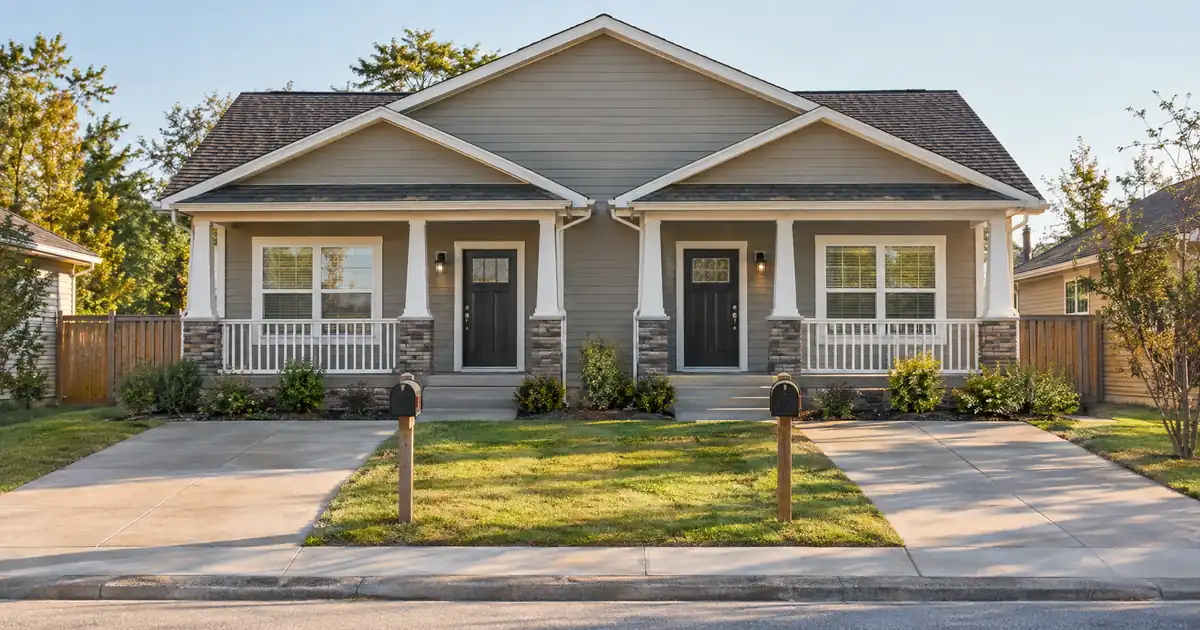
The Quick Read: A DSCR lender counts a duplex as one residential property. Its unit rents are added together and tested against one full payment. A five-unit building falls into the multifamily class and is typically reviewed on income after operating costs. Within the wholesale network, it fits only inside a rental portfolio term loan. Subject to lender guidelines, the two can share one note only through that term structure.
- The line is unit count. One to four units is residential. Five or more is multifamily.
- A duplex is one property with two units. A five-unit building is one property with five units.
- Price and building quality do not move the line. Neither does owning the building through an entity.
- Pairing the two in one loan points to the rental portfolio term loan, where coverage is measured on the whole pool.
- Clearing the coverage number is not the same as positive cash flow. Repairs, vacancy, management and capex sit outside the calculation.
An investor holding a duplex and a five-unit building usually wants to know one thing. Is it one deal or two? The answer depends on which count each loan program uses, properties or units. Most of the confusion comes from mixing the two tallies.
Where Does the Line Fall, and Why?
The split sits between four units and five. Four units and under is residential investment property. Five and up is multifamily. It is a classification line, not a physical one. A luxury duplex stays residential, and a shabby six-unit building stays multifamily.
The line comes from the housing-finance system, not from DSCR programs. DSCR loans are business-purpose investor loans, and most lenders follow the same four-versus-five split anyway. The reason is practical. Appraisers, investors in the loan, and underwriting desks are all organized around it.
Two things follow from that. A duplex gets the simplest treatment on the DSCR menu. A fifth door changes the lender pool, the appraisal type, the documents and the loan structure. Each part of this article covers one of those changes. For the full program picture, the complete DSCR loans guide covers the basics this piece assumes.
How Is the Duplex Counted?
A duplex is one property. Both units’ rents are added, then compared with one payment, which is principal, interest, taxes, insurance and any association dues (PITIA). That ratio is the coverage number. Most single-property programs start at 1.00, where rent just covers the payment. Stronger ratios open better pricing and leverage.
Here is how the pieces work on a single-property DSCR loan for a duplex:
- Income. Both units count, whether leased or vacant. A leased unit is measured by its lease. A vacant unit is measured by an appraiser’s market rent figure.
- Appraisal. Two-to-four-unit properties are usually appraised on a form-based report with comparable sales plus a rent schedule. The agency guide that sets the forms lists the Form 1025 small residential income report for two- to four-unit properties. It also allows a plain single-family form for certain two-unit cases, such as when the second legal unit is relatively insignificant, like a below-grade unit or one over a garage. The related comparable rent schedule, Form 1007 is the rent-side form used on single-family rentals. Those forms are named here only for orientation. Agency lending rules do not govern DSCR files.
- Leverage. Most purchase files across the network land at 75% to 80% LTV on an investment property. Select high-leverage programs reach 85% with a stronger score. A larger down payment can lift the ratio. It never erases leverage caps, credit floors or reserve rules.
- Reserves. These commonly run around six months of PITIA, varying by lender, leverage and loan size.
Vacancy bites hard here. One empty unit is half the building. If the lease is thin on one side, the coverage number can swing more than most new investors expect.
How Is the Five-Unit Building Counted?
A five-unit building is multifamily, and the income lens usually changes. A single-property DSCR loan does not reach it. Inside the network, five-plus-unit buildings fit only in the rental portfolio term loan, which covers five or more rental properties or units under one note.
The textbook version of the ratio on larger buildings is net operating income divided by debt service. Wikipedia’s debt service coverage ratio entry describes it that way, and treats a result below 1.00 as negative cash flow. Net operating income is revenue less operating expenses, before financing. That makes the five-unit file more expense-aware than the duplex file. Exact methods vary by lender, so confirm which one applies before you model.
The appraisal changes too. A form report on comparable sales gives way to an income-approach valuation built on market rents, vacancy, expenses, and a cap rate. An appraiser’s practice page notes that the Form 1025 report is not meant for five-plus-unit apartment properties. So the value on a five-unit building rests on its income. The value on a duplex rests mainly on what similar duplexes sold for.
The rental portfolio term loan also differs in structure:
- Size and leverage. Loans run roughly $500,000 to $50,000,000, with leverage up to 75% of value. Larger balances are reviewed.
- Terms. Fixed-rate terms of 3, 5, 7 or 10 years with a balloon at maturity.
- Recourse. Recourse and non-recourse versions both exist. A non-recourse loan looks to the real estate, with carve-outs for items like fraud and bankruptcy. A recourse loan carries a personal guarantee.
- Prepayment. A yield-maintenance structure applies.
- Reserves. Reserves are held for taxes, insurance and capital expenditures. Each figure is subject to lender guidelines and a complete review of property type, leverage, and credit.
Treat these as program ceilings and floors, not quotes. Every file is underwritten individually.
Duplex vs. Five-Unit Building at a Glance
| Factor | Duplex | Five-Unit Building |
|---|---|---|
| Class | Residential (1-4 units) | Multifamily (5+ units) |
| Property count | One property, two units | One property, five units |
| Income lens | Unit rents vs. full payment | Typically income net of expenses |
| Appraisal | Form report with rent schedule | Income-approach valuation |
| Single-property DSCR | Eligible | Not offered |
| Portfolio fit | Either portfolio structure | Rental portfolio term loan only |
A Worked Example With Illustrative Ratios
Run the numbers on a modeled pair. These ratios are illustrative assumptions, not market data. Say the duplex alone covers its payment at around 1.25x on summed unit rents. Say the five-unit building, after operating costs, covers its debt service at around 1.10x.
On separate loans, each file stands on its own ratio. The duplex looks strong. The five-unit building looks tighter, and the underwriter will look hard at vacancy and expenses.
Now put both in one rental portfolio term loan. Coverage is measured on the pool: pooled rent against pooled debt service. The pooled number lands between 1.10x and 1.25x, weighted toward whichever property carries more of the debt. The stronger duplex offsets some of the five-unit building’s thinness.
The offset has limits. Every property still needs a lease or an appraiser-supported market rent. The leverage ceiling still applies to the pool. The five-unit building drags the blended number down, and the duplex cannot rescue a weak file. Whether pooling beats separate loans is a real question, and it flips with the numbers. If the five-unit building is the weak link, pooling may help the pair. If the duplex alone would earn better terms by itself, pooling may cost you.
One Loan or Two?
Two properties can sit under one note, but only certain structures allow it. The 30-year portfolio DSCR loan takes two to twenty properties under one note, up to 80% of value on a purchase or rate-and-term refinance, with pooled coverage and interest-only available. Its property types are single-family, two-to-four-unit, condo and townhome. The duplex fits. The five-unit building does not.
That is where units versus properties matters:
- The 30-year portfolio structure counts properties. A duplex is one property toward the two-to-twenty range.
- The rental portfolio term loan counts rental properties or units. A five-unit building alone can clear the five-or-more threshold, and a duplex plus a five-unit building adds up to seven units.
So the pair pools on the term loan or goes on separate loans. A blanket loan, a cross-collateralized loan and a portfolio DSCR loan all describe the same thing here: one note secured by several rentals. (A bank’s portfolio loan, meaning one the bank keeps on its own books, is a different thing.)
Pooling brings obligations too. Release terms govern how a property leaves the pool. The release price runs above the property’s allocated balance. The remaining properties must still cover their debt service. Selling the duplex later is a loan-document question, not a simple payoff. Tax treatment varies; consult a qualified professional.
Separate buildings also do not merge into five-plus-unit treatment. Two duplexes remain two residential properties. Even in a pool, each building keeps its own class, rent support and appraisal.
What Else Does the Lender Review?
Rent is the center of the file, not the whole file. For the duplex, expect the lease or rent schedule, proof of insurance, the credit profile, and reserves. For the five-unit building, expect the same, plus an operating statement, a rent roll, the legal unit count, and the property’s condition.
The portfolio programs add their own gates:
- Credit. The floor on the portfolio programs is 640, and it reaches 680 or 720 on some structures.
- Entity. Some structures require a special-purpose entity, typically an LLC.
- Ineligible property. Owner-occupied property, co-ops, mixed-use property and commercial property are not eligible in the pool. A building with ground-floor retail beside apartments is mixed-use and sits outside these structures. Manufactured and mobile homes are not reviewable on any of these programs.
- Cash-out. A portfolio cash-out never goes above 75% of pooled value. Inside the first six months of ownership, the loan is also capped at 90% of total cost (purchase price plus documented improvements), and at 100% of total cost from six to twelve months. The leverage ceiling still applies, and the loan is the lower of the two. After twelve months, appraised value alone is the basis. A rate-and-term refinance is not subject to the cost-basis cap.
Programs change, so treat these as typical guidelines.
Pool, Split, or Look Elsewhere?
Pool when the strong property materially lifts a thin one, when both fit one lender’s structure, and when you value one loan to manage. Split when the duplex qualifies well alone on a single-property loan, or when the five-unit building’s income is shaky. A shaky property in the pool can drag the whole file.
One more flip point: some five-unit buildings run into leverage and size limits that point toward agency small-balance or bank debt instead. Those are different product families from DSCR. A lender asked to quote both a duplex and a six-unit may route them to different desks, so the quotes may not be comparable.
Key Terms Defined
Property: one parcel with one or more buildings and a single legal address, counted once for portfolio thresholds.
Unit: one separately rentable dwelling inside a property. A duplex has two, and the five-unit building has five.
PITIA: principal, interest, taxes, insurance and association dues, the full monthly obligation rent is measured against.
Net operating income: revenue less operating expenses, before financing, used on larger buildings.
Blanket loan: one note secured by several rentals. The same thing is also called a portfolio DSCR loan or cross-collateralized loan.
Pooled coverage: combined rent against combined debt service across all properties in a blanket loan.
Frequently Asked Questions
Does a duplex count as two properties?
No, it is one property with two units. Single-property DSCR loans treat it as one asset with one payment, and portfolio property counts treat it as one. Unit counts matter on the rental portfolio term loan, which looks at properties or units.
Does five units automatically mean a commercial loan?
It means multifamily classification, which changes the appraisal and the lender pool. Within the network, a five-unit building fits only inside the rental portfolio term loan. It is not offered on a single-property DSCR loan.
Is vacant-unit rent counted?
Often yes, through an appraiser-supported market rent, but a lender may adjust it. Underwriters weigh vacancy more heavily on a duplex because one empty unit is half the building. On a five-unit building, one vacancy is a fifth.
Can a rental below 1.00 sit in the pool?
Yes. Underwriting tests the pooled coverage, the leverage and the terms. Stronger properties in the pool can offset weaker ones.
Does clearing the coverage number mean the building cash-flows?
No. A rent-to-PITIA DSCR, as on the duplex file, compares rent to PITIA only. Repairs, vacancy, management, utilities and capex sit outside that calculation, so model them separately.
Next Steps
If you are buying or refinancing a rental property and want to see how the numbers work, Lendmire can help you compare DSCR loan options based on the property income, credit profile, leverage, and investor goals. Lendmire is a broker arranging financing through select lenders in its wholesale network, across 41 markets including Washington, D.C. Qualification is subject to lender guidelines and is not a commitment to lend.
About Lendmire
Lendmire (NMLS# 2371349), a non-QM mortgage broker serving investors in 41 markets including Washington, D.C., helps structure DSCR scenarios commonly evaluated around a property’s rental income rather than personal income paperwork, subject to lender guidelines. A Scotsman Guide Top Mortgage Workplace in 2025 and 2026, Lendmire places loans through wholesale investor lenders and is not a direct lender.
Get Started
Ready to find the right loan for you?
In about 30 seconds you can review financing options available for your investment property. No commitment required.
Informational only. Not a Loan Estimate, approval, or commitment to lend. Program availability and eligibility are subject to lender guidelines, credit approval, property review, and underwriting.
References
1. Fannie Mae Selling Guide B4-1.2-01
2. Fannie Mae Selling and Servicing Guide forms
3. Wikipedia: Debt service coverage ratio
4. Colorado appraisal firm: Form 1025 page
This article is part of Lendmire’s DSCR loan program — full qualification details, guidelines, and scenarios live on the program page.
Related reading: How a Portfolio DSCR Lender Counts a Fourplex and a Duplex · How a DSCR Lender Qualifies an Overseas-Based US Citizen · How a DSCR Portfolio Lender Re-Tests Coverage During the Term
Brandon Miller
Founder & CEO, Mortgage Loan Originator, Lendmire LLC
- Mortgage Loan Originator · NMLS# 1129696 · Verify on NMLS Consumer Access
- North Carolina Real Estate Broker · License# 343312 · Verify on NCREC
- North Carolina Insurance Producer · License# 19053198 · Property, Casualty, Life, Health · Verify on NAIC SBS
- Lendmire LLC · Firm NMLS# 2371349 · Verify firm licensure
Important disclosures. Lendmire (NMLS# 2371349) is a licensed mortgage brokerage. Lendmire is not a direct lender, depository institution, or financial advisor. All loan inquiries are subject to lender underwriting; this article does not constitute a commitment to lend. Rates, terms, and program guidelines are subject to change without notice and vary by borrower profile, property type, and state. Information in this article is general in nature and is not financial, legal, or tax advice. Equal Housing Opportunity. NMLS Consumer Access: nmlsconsumeraccess.org.