
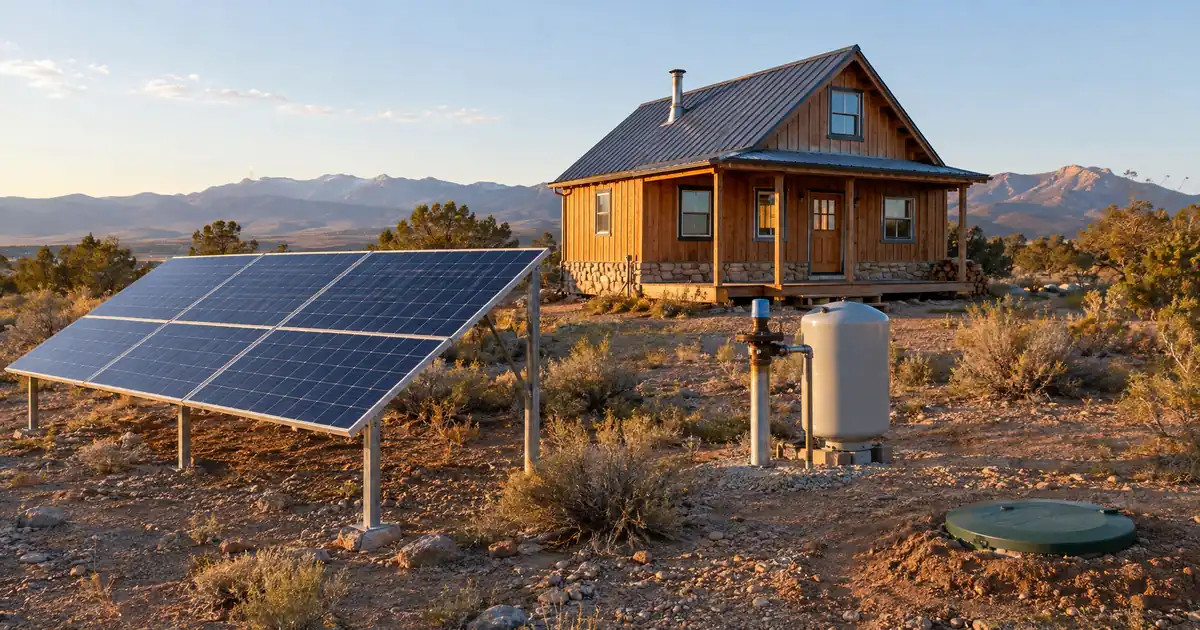
The Quick Read: Build one organized file that proves each system works, is permitted, and can serve tenants year-round, because a DSCR file qualifies primarily on property-level rental income covering the payment, subject to lender guidelines, while the property itself still has to pass review. Grid-tied or off-grid power with a working, tested well and a permitted septic system is a far easier file than a property with no recognized water or waste system.
- Separate three situations: no grid power with a working well and septic, grid power with private water and sewer, and no conventional water or waste system at all.
- Gather the septic inspection and solar ownership records before the appraisal, and time the lab water test close to closing so it stays valid.
- Identify who owns the solar system, since a financed or leased array can add a lien or a payment.
- Ask a broker whether the lender pool accepts the configuration, and get an insurance quote, before you pay for inspections or go under contract.
- Clearing 1.00 coverage does not mean the property cash-flows, because repairs, vacancy and system upkeep sit outside the ratio.
Why Off-Grid Files Get Extra Scrutiny
Lenders treat private utilities as collateral risk, not income risk. The rent can look strong on paper, but a failed septic field or a dry well can undercut the value of the property that secures the loan. That is why the documentation package matters as much as the rent.
DSCR Calculator
Run the numbers in your market
Rate source: Freddie Mac 30-yr average via FRED® — Federal Reserve Bank of St. Louis · effective Oct 15, 2026
Prefilled with starting assumptions — enter your own rent or nightly figures, taxes, insurance, and HOA for a more accurate picture.
Program parameters update from Lendmire’s centralized guideline source. Taxes and insurance are editable estimates.
As of Oct 15, 2026 · General Freddie Mac market benchmark, not a Lendmire loan offer. Rent, nightly rate, occupancy, taxes, and insurance are editable estimates. Short-term rental figures are estimates only and vary significantly by season, property type, management approach, and local short-term-rental rules — confirm local regulations before relying on them. Qualifying income for short-term rentals varies by program — some use appraisal market rent, others use documented STR history or projections — and is confirmed in underwriting. Not a Loan Estimate, approval, or commitment to lend. Program availability and eligibility are subject to lender guidelines, credit approval, property review, and underwriting.
Across the wholesale network, DSCR lenders weigh the rent against the full monthly obligation and then review the property separately. The ratio compares rent to principal, interest, taxes and insurance (PITIA). It says nothing about whether the water runs. Our complete DSCR loans guide covers how that ratio works in detail.
No federal rule sets documentation for these loans. DSCR loans are non-agency products, so each lender or investor sets its own standard, and it shows up in the appraisal, the title work and the closing file. Agency programs do write well and septic standards down, which makes them a useful template for what a careful file looks like. They are only a template. They do not govern DSCR files.
What Counts as Off-Grid, and Why the Line Matters
Off-grid is not one category. Lenders and appraisers mentally score function, not source. A home powered by solar with a tested well and a permitted septic tank is a different file from a cabin with no recognized water or waste system.
| Configuration | Typical lender reaction |
|---|---|
| Grid-tied solar, well, septic | Usually the easiest rural file |
| Off-grid solar, well, septic | Possible with the right lender and records |
| No recognized water or waste system | Often declined before appraisal |
| Private road, no recorded easement | Frequently a deal-killer |
Many lenders decline an unconventional file before an appraisal is even ordered. Off-grid homes generally cannot be financed with traditional mortgages and often move to nontraditional lenders. That fits what a broker sees: the lender pool narrows, but it does not vanish.
Also keep the property type in mind. Manufactured homes (single- and double-wide), log homes and barndominiums are not offered in the network’s DSCR programs, however well the utilities are documented. A rural cabin that falls into one of those types is a different conversation.
Step One: Pre-Screen Before You Spend Money
Confirm the property classifies as a normal single-family rental or a 2-4 unit before you order anything. DSCR appraisals typically use the 1007 rent schedule for single-family and the 1025 form for 2-4 units. Those forms are where the appraiser records market rent and system condition.
Then ask three direct questions of the broker:
1. Does any lender in the network accept this power setup, this waste system, and this access road?
2. What is the maximum leverage on this property type, given thin comps?
3. What will the file need before the appraisal is ordered?
Asking first can save the cost of a water panel and a septic inspection on a property no lender will touch. Lendmire arranges these loans through select lenders in its wholesale network, so the pre-screen is where the broker earns the fee.
Documenting the Well
A well file proves two things: the water is safe and the supply is sufficient.
The EPA recommends testing a private well annually for coliform bacteria, nitrates, total dissolved solids and pH. It also states that private wells have no federal monitoring requirement, so the owner carries that duty. That is exactly why a certified lab result carries weight in a lender file.
Build the well section from these records:
- The independent lab report, with the test date clearly shown.
- A well contractor or flow-rate inspection when the appraiser or lender flags concern about supply.
- Treatment paperwork for any filtration or UV system, kept with the test.
- A well log or driller’s record, if the owner has one.
- A recorded agreement, if the well is shared.
Tests go stale. For contrast, HUD’s FHA handbook update says a required well test report may be up to 180 days old at disbursement, and USDA Rural Development uses a 120-day window for well inspections at closing. Those are agency figures for agency loans, not DSCR rules. A DSCR lender may set its own window, so order the test close enough to closing that it stays valid.
HUD’s same update also removed a well water test requirement tied to a short distance between the well and septic. Widely repeated setback distances come from secondary sources, so do not treat them as settled. Confirm current local rules with the county or health authority.
Documenting the Septic System
Septic evidence answers one question: does this system work, and is it sized for the people who will live there? Gather the permit or as-built record, a licensed inspector’s report, and the pumping history.
A common rule of thumb is to inspect a conventional tank about every three years and pump it every three to five years, a cadence Effective Agents attributes to EPA guidance. Records showing that cadence tell an underwriter the system has been maintained.
Capacity matters for rentals. Septic sizing is usually tied to bedroom count where the county tracks it. An unpermitted bedroom addition is a common mismatch, so compare the permit to the actual floor plan before the appraiser does. This is practitioner logic, not a published rule, and it is worth checking early.
For an alternative system, such as aerobic units, greywater or composting toilets, get written approval from the local health authority. Lenders tend to be less flexible than local code, not more. A system that cannot be permitted is a typical exclusion.
Documenting Solar: Find Out Who Owns It First
Solar ownership is the single most important question in the power file. It decides whether the array is neutral, a lien, or a payment.
Owned outright. Collect the installation invoice, the permit and final inspection record, any interconnection or authority-to-operate paperwork, and the inverter and battery specifications. Paid-off equipment is generally neutral to the ratio.
Financed. Find out what instrument secures the loan. It might be an equipment filing at the state level, a fixture filing at the county, a recorded deed of trust, or a property tax assessment. These are different instruments with different consequences. A state-level equipment filing may not show up in a county title search, while a fixture filing does.
Leased or under a power purchase agreement. The provider typically files a state-level equipment lien. Expect the lender to ask for a buyout, a transfer or a consent. The monthly lease or purchase-agreement payment is an expense question for the coverage calculation.
For a truly off-grid home, add a record showing the array and battery can serve the home year-round. Include system size, battery capacity, backup generator details if any, and service records. If the well pump runs on solar, show that the pump, battery and backup power work together. Equipment age and condition matter too. The underwriter is asking whether the property can demonstrably run without the grid, not whether panels exist.
Here is the catch: solar does not raise market rent by itself. A paid-off array does not add to the rent figure the lender uses, and a financed array can add to the payment side. Document it to prove function and clear title, not to inflate the ratio.
The Master Documentation Checklist
| System | Record | Who issues it | When to order |
|---|---|---|---|
| Well | Lab water panel | Certified lab | Close to closing |
| Well | Flow or contractor report | Well contractor | If flagged |
| Septic | Permit or as-built | County or health office | Early |
| Septic | Inspection and pumping log | Licensed inspector | Before appraisal |
| Solar | Invoice, permit, final sign-off | Installer, local authority | Early |
| Solar | Lien or lease payoff terms | Financing provider | Before title |
| Access | Recorded road easement | County recorder | Early |
| Insurance | Quote reflecting off-grid features | Insurer | Before contract |
Private road access often matters more than the utilities. Year-round public-road access is a common lender expectation, and a recorded easement is typically needed when the road is private. A missing easement can sink a file with perfect water and septic reports.
When Records Don’t Exist or a Test Fails
Missing paperwork is common on older rural properties. The substitute is fresh evidence: a new inspection, a new lab test, and a written statement from the local authority. Build the paperwork rather than assuming the seller has it.
Failed tests follow a practical path. Coliform failures are often fixed by shock chlorination and a retest. High nitrates usually require treatment or a source fix. A failed septic may need repair or replacement before the lender will proceed. In each case, write time for repair and a fresh test into the purchase contract.
If the property cannot be brought up to a documentable standard, the answer may be to walk away. An investor who has to reach for an unusual structure to make a property qualify should re-examine the property, not just the loan. A property that financed with difficulty is also harder to sell or refinance later.
How the Paperwork Interacts with the DSCR Math
DSCR compares rent to PITIA only. Water testing, septic pumping, backup fuel and equipment reserves are not in the ratio. They still hit real cash flow. A regional planning estimate from Creative Loafing Charlotte treats off-grid ownership costs as a meaningful annual line item and calls its figure illustrative. Model those costs yourself, because clearing the coverage threshold does not mean positive cash flow.
Think of the file as two tests. The rental test asks whether rent covers the monthly obligation. The property test asks whether the collateral is sound. The strongest files clear both.
On leverage, most programs we place files with land at 75%-80% LTV on an investment purchase, and a cash-out refinance on a standard rental tops out around 75% LTV. Rural and off-grid properties can come with tighter overlays, thinner comps and lower leverage. Credit tiers generally run from a 620 floor in parts of the network, to about 660 on most programs, to 700 and above for the strongest tiers. Reserves are commonly around 6 months of PITIA, stepping up to about 9 months on loans above $1,500,000. All of this is subject to lender guidelines and varies by borrower and property.
Coverage of 1.00 is where select programs start. A separate path through select lenders in the network takes coverage below 1.00, with leverage and terms adjusted. On a remote property with thin rent comps, a weak ratio is a signal to look harder at the rent opinion before reaching for a structure.
DSCR vs. conventional financing
There are two common ways to finance an investment property, and they qualify you differently — here’s how investors weigh them.
Why investors choose it
- Qualifies on the property’s rental income — no personal tax returns, W-2s, or pay stubs needed to document income.
- No personal debt-to-income ceiling to clear, so existing mortgages and obligations don’t cap your borrowing the same way.
- Can be closed in an LLC, keeping the property inside a business entity.
- Built for scaling — not held to the limit on number of financed properties that conventional financing applies.
- Underwriting centers on the deal: generally qualifies when the rent covers the payment, a 1.00x coverage ratio being a common baseline (confirmed in underwriting).
- Designed specifically for investment property, including long-term and, where the program allows, short-term rentals.
Where it’s strong
- Often the lowest ongoing financing cost for a buyer who fully qualifies on personal income — a fit for a first property or a cost-first purchase.
Trade-offs for investors
- Requires full personal income documentation and must fit within a debt-to-income limit — salary, existing debts, and other mortgages all count.
- Typically held in your personal name rather than a business entity.
- Caps how many financed properties you can carry, which can become a ceiling as a portfolio grows.
- Evaluates you as a borrower as much as the property, which usually means more paperwork.
How investors usually choose: a first or single property often optimizes for the lowest financing cost; portfolio builders often optimize for leverage, vesting in an LLC, and scaling past conventional caps. The right answer depends on your goals, the property, and current guidelines — both paths run through select lenders in Lendmire’s wholesale network, with eligibility and terms confirmed in underwriting.
Short-Term Rental Use
Many off-grid cabins are planned as short-term rentals. Treatment of that income varies by lender. For short-term rentals, a purchase typically tops out at 75% LTV, and cash-out on a short-term rental is capped at 70%, with a 640 or higher score and about 12 months of hosting history commonly expected. Short-term rental rules can vary by city, county, HOA and property type, so investors should confirm local rules before relying on projected rental income. Lendmire’s piece What to Document for a Luxury Short-Term Rental DSCR Loan covers the income side in more depth.
Sequencing the File
Order matters, because inspections expire and appraisal surprises are costly.
1. Pre-screen the configuration with a broker.
2. Get an insurance quote that reflects the off-grid features before going under contract. Some insurers decline or limit coverage.
3. Get the septic permit and inspection, plus the solar ownership and lien details, during the contract period and before the appraisal.
4. Lock down the road easement and any shared-system agreements.
5. Order the water test close enough to closing that it stays valid.
6. Clear any solar filing at title, including termination after payoff.
Tax treatment varies; consult a qualified professional before relying on any deduction or incentive tied to solar equipment.
Key Terms Defined
PITIA: The monthly principal, interest, taxes, insurance and any association dues that the rent must cover.
1007 and 1025 forms: The standard appraisal forms for rent schedules on single-family and 2-4 unit rentals.
As-built record: A drawing or file showing a septic system as actually installed.
UCC-1 filing: A state-level notice that a creditor holds a security interest in equipment, such as a solar array.
Easement: A recorded legal right to cross another person’s land, often the access road to the property.
Frequently Asked Questions
Does solar count as acceptable power for a DSCR rental?
Often yes, when it works and can be shown to serve the home year-round. Lenders score function over source. Expect to document ownership, permits, inspection sign-offs and battery or generator backup. A leased array adds a payoff or transfer step.
What if the seller has no septic or well records?
Build the file fresh. A licensed septic inspection and a new certified lab test stand in for missing history, and a letter from the local health authority helps. Unpermitted or legacy systems are the weakest files, so address them before the appraisal.
What happens if the septic fails inspection?
Repair and retest, or renegotiate. A system that cannot meet local code and be permitted is a typical exclusion, so build repair time into the contract. If the fix is not feasible, walking away is a legitimate answer.
Does a shared well or private road complicate the loan?
Yes. Shared systems need binding agreements covering access, maintenance and repair, and a private road needs a recorded easement. Missing paperwork on access is often the actual deal-killer, ahead of the utilities.
Will a barndominium or log cabin qualify if everything is documented?
No. Manufactured homes, log homes and barndominiums are not offered in the network’s DSCR programs, regardless of utility documentation.
Next Step
If you are buying or refinancing a rental property and want to see how the numbers work, Lendmire can help you compare DSCR loan options based on the property income, credit profile, leverage, and investor goals. Reach the team at 828-256-2183 or request a quote through the mortgage quote page. Qualification is subject to lender guidelines and is not a commitment to lend.
The properties that finance best off the grid are rarely the most remote ones. They are the ones where every system has a date, a permit and a signature behind it.
About Lendmire
A DSCR-focused mortgage broker, Lendmire (NMLS# 2371349) places investor financing across 41 markets — 40 states plus Washington, D.C. — with DSCR eligibility generally reviewed by the lender on property cash flow instead of traditional personal-income documentation, subject to lender guidelines. Scotsman Guide named Lendmire a Top Mortgage Workplace in 2025 and 2026.
Get Started
Ready to find the right loan for you?
In about 30 seconds you can review financing options available for your investment property. No commitment required.
Informational only. Not a Loan Estimate, approval, or commitment to lend. Program availability and eligibility are subject to lender guidelines, credit approval, property review, and underwriting.
References
1. EPA – Protect Your Home’s Water
2. HUD Handbook 4000.1 transmittal
3. Effective Agents – well and septic guide
4. Creative Loafing Charlotte – off-grid cost guide
This article is part of Lendmire’s DSCR loan program — full qualification details, guidelines, and scenarios live on the program page.
Related reading: How to Document Airbnb Income From a Garage Conversion on a DSCR Loan · How to Finance a Short-Term Rental as a Retiree With a DSCR Loan · How to Document Airbnb Income From a Detached Casita on a DSCR Loan
Brandon Miller
Founder & CEO, Mortgage Loan Originator, Lendmire LLC
- Mortgage Loan Originator · NMLS# 1129696 · Verify on NMLS Consumer Access
- North Carolina Real Estate Broker · License# 343312 · Verify on NCREC
- North Carolina Insurance Producer · License# 19053198 · Property, Casualty, Life, Health · Verify on NAIC SBS
- Lendmire LLC · Firm NMLS# 2371349 · Verify firm licensure
Disclosure information. Lendmire is a state-licensed mortgage brokerage under NMLS# 2371349. Lendmire is not a depository institution, direct lender, or financial advisor — all loans referenced are placed through wholesale lender partners and are subject to each lender's underwriting standards. This article is provided for general informational purposes and is not a commitment to lend, nor does it constitute financial, legal, or tax advice. Loan programs, terms, rates, and qualification standards change without notice and depend on borrower profile, property type, and the state in which the subject property is located. Equal Housing Opportunity provider. NMLS Consumer Access: nmlsconsumeraccess.org.