
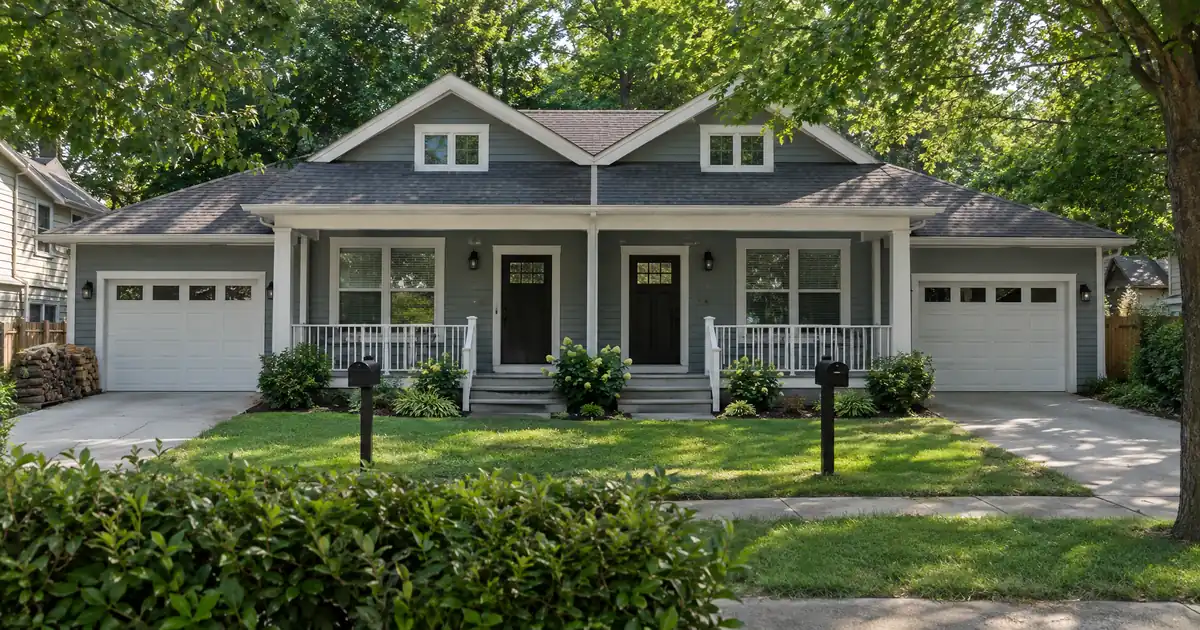
The Quick Read: The down payment and reserve rules for this buyer depend first on whether the buyer will live in one of the units, because occupancy decides which loan program applies. Self-employment changes how income is documented, not whether cash is required. Plan on three separate piles of cash: the down payment, closing costs, and reserves left afterward.
- Owner-occupied 2-4 unit purchases on bank statement documentation can reach up to 90% LTV on a primary residence, through select lenders and for stronger files.
- Reserves commonly run around 6 months of the housing payment, held as liquid funds after closing.
- Qualifying income comes from 12 months of business or personal bank statements, subject to lender guidelines.
- A pure rental purchase with no owner occupancy usually belongs on a different path, covered below.
- Larger down payments and stronger credit tend to earn better terms.
Down Payment, Reserves and Cash to Close: Key Terms Defined
Down payment: The share of the purchase price you pay in cash, which mirrors the maximum LTV your file earns.
What your deposits qualify you for.
Alt-doc programs read 12 months of business or personal bank deposits instead of tax returns. Enter your average monthly deposits and see the income a lender would credit you.
The expense factor is set by the lender from your business type and profit-and-loss statement; it is not a number you choose. This widget quotes no rate and no payment.
Program parameters shown update from Lendmire’s centralized guideline source.
Estimate
Illustrative estimate only — not a quote, Loan Estimate, approval, or commitment to lend. Deposit average, expense factor, and housing ratio are editable assumptions; the expense factor a lender applies is set from your business type and documentation. No interest rate or monthly payment is quoted here. Purchase capacity is a simplified illustration and does not account for taxes, insurance, HOA dues, or other debts. Alt-doc income documentation is available on consumer mortgages in the states where Lendmire is licensed for consumer lending; actual terms vary by lender, borrower, and property.
LTV (loan-to-value): The loan amount divided by the purchase price or appraised value.
Cash to close: Down payment plus closing costs and prepaid items, due at the table.
Reserves: Liquid assets that remain after closing, usually counted in months of the housing payment.
Bank statement documentation: A way to document income from 12 months of deposits instead of traditional personal-income documentation, using lender-specific expense factors.
Seasoning: How long funds have sat in an account, which helps a lender trace where the money came from.
How Does Occupancy Decide Which Rules Apply?
Occupancy is the first fork. If you will live in one unit of the duplex, triplex or fourplex, the loan is a consumer mortgage. A self-employed buyer in that position uses a bank statement program that documents personal income. If you will rent every unit, the property is an investment, and the file is built differently.
For the owner-occupant, Lendmire arranges bank statement loans through select lenders in its wholesale network. Qualification runs on documented income under the applicable program, subject to lender guidelines. Loan sizes run roughly $125,000 to $3,500,000. The consumer mortgage side is available in 16 states, so availability depends on where the property sits.
For the pure-rental buyer, a DSCR loan is usually the better tool, because it qualifies primarily on property-level rental income covering the payment, subject to lender guidelines. DSCR loans are designed for non-owner-occupied investment properties. Because they are business-purpose investor loans, they are reviewed differently from a standard owner-occupied mortgage. Lendmire’s complete DSCR loans guide covers that lane in full, and this article stays with the self-employed owner-occupant.
How Does the Down Payment Work on a Bank Statement 2-4 Unit Loan?
The down payment is the mirror of your maximum LTV. On a primary residence purchase or rate-term refinance, bank statement programs can reach up to 90% LTV. That means as little as 10% down on the strongest files. Most files land somewhere below that ceiling, and the top of the range goes to borrowers with strong credit and clean deposit patterns.
Four things move your tier:
1. Credit score. Higher scores earn more leverage.
2. Loan size. Larger balances often pull the ceiling down.
3. Property type. A 2-4 unit is generally treated more carefully than a single-family home.
4. Deposit quality. Steady, explainable deposits help. Erratic ones invite questions.
Here’s the catch with property type. The up-to-90% figure is a ceiling for the program, not a promise for a fourplex. Across the network, many lenders trim leverage as unit count rises. Expect your specific number to come from the file, not the headline.
An alternative exists for buyers whose deposits are thin but whose savings are large. Asset-depletion qualifying uses liquid assets to support the loan and runs up to about 80% LTV on a primary residence. It suits a self-employed buyer with a big brokerage or savings balance and uneven monthly income. Terms vary by lender guidelines, property type, leverage, credit profile, and full file review.
The appraisal also matters. For 2-4 unit properties, appraisers typically use the small residential income property report, which is Form 1025 in Fannie Mae’s appraisal forms guidance. That is only a form name. Agency down payment and reserve rules do not set the terms of a bank statement loan.
What Do Reserves Look Like After Closing?
Reserves are cash that stays in the bank after you close. Across the programs Lendmire places files with, around 6 months of the housing payment is a common benchmark. The housing payment means principal, interest, taxes, insurance and any association dues.
Reserves are separate from the down payment. The same dollars cannot do both jobs. If you have enough for the down payment but would drain your account to do it, the file has a reserve problem.
Some points shape how reserves are counted:
- Account type. Reserves are documented from asset statements, not income documents. Business account funds can often count if you own the entity, but lender treatment varies, so confirm before relying on them.
- Gift funds. These generally cannot satisfy reserves, and their use for the down payment varies by program.
- Other financed properties. Some programs ask for reserves on other properties you own, not only the subject property. The more you own, the more cash a lender may want to see.
- Cash-out refinances. On some programs, cash-out proceeds can help satisfy reserves. That depends on the program and property type, so treat it as a question for the file.
How Does Self-Employment Change Both?
Self-employment changes the income method. It does not remove the cash requirements. Under a bank statement program, a lender reviews 12 months of statements, averages the deposits, and applies an expense factor to estimate qualifying income. Expense factors vary by lender, so no universal formula exists.
That has a few practical effects. Heavy tax write-offs, which can shrink income on a tax return, matter less when deposits drive the math. The trade-off is that your liquidity and source of funds come under close review. A lender wants to see where the down payment came from and how long it has been there.
For a self-employed buyer, the biggest risk is blurred accounts. Money moves between business and personal accounts all the time. When the down payment arrives from a business account, the lender may ask for statements on that account and may look at what the withdrawal does to the business’s cash flow. A recent large transfer with no paper trail is the kind of item that slows a file down.
So a few habits help. Keep personal and business funds clearly separated before you apply. Move the down payment money early so it has time to season. Keep the reserve money in an account that is clearly yours.
If you are brand new to self-employment, Lendmire’s piece How a Newly Self-Employed Buyer Purchases a 2-4 Unit Home With Low Down covers the shorter-history situation.
Where the General Rule Breaks
A few edge cases change the picture.
You plan to move out later. Owner-occupied financing assumes you live there. If your plan is to rent every unit from day one, you belong on the investment path. Misstating occupancy is a serious problem, so match the loan to the real plan.
The property is an investment, not a house hack. Investment purchase leverage on bank statement documentation varies by lender, so there is no single figure to quote. Investment cash-out on an alt-doc program tops out around 75% LTV. For investor-focused leverage on a purchase, the DSCR side is the more useful lane.
You are pulling cash out of an owner-occupied building. Owner-occupied cash-out on a primary residence or second home runs up to 80% LTV, with a fixed expense ratio (75% with an accountant-prepared ratio), by loan size and credit. That is the cash-out ceiling. The 90% figure applies only to purchase and rate-term refinances. Exact terms depend on the lender’s guidelines, property type, leverage, and a full review of the borrower’s file.
The deposits are uneven. Seasonal businesses, large one-time payments and transfers between your own accounts can distort the average. Lenders may exclude some deposits. Clean documentation of what each deposit is helps.
The cash is in retirement or business accounts. Treatment varies by program. Some lenders discount retirement funds or require proof of access. Ask early.
A “10% down” claim shows up for an investment property. Be skeptical. Market surveys and practitioner commentary describe 20% or more as the planning number for investor DSCR purchases. The owner-occupied 90% LTV ceiling is a different product and should not be confused with an investment loan. Every figure here varies by lender and program — guidelines, property type, leverage, and credit profile all apply.
What Does the Decision Look Like in Practice?
Run the cash needed as a three-line budget. First, the down payment, set by the LTV your file earns. Second, closing costs and prepaid items. Third, reserves, around 6 months of the housing payment on most programs. Add a fourth line the lenders do not require but experienced owners do: working capital for repairs and vacancy.
Consider a self-employed buyer eyeing a fourplex where one unit will be their home. Their deposits are steady, credit is strong, and savings are healthy. On a primary residence purchase, the ceiling is up to 90% LTV, and the other three units help the household budget, though lenders count rental income carefully and not in full. That buyer’s real constraint is usually not the down payment. It is whether the cash left after closing still looks like six months of the full housing payment.
Now picture a buyer with similar income but all the cash tied up in a business account. They may qualify on paper and still stall on the source-of-funds review. Moving funds early and documenting the move is the fix.
The tradeoff is simple. A smaller down payment preserves cash, but it typically means a larger loan and tighter file scrutiny. A larger down payment lowers the loan and can strengthen the file. For a self-employed buyer whose income swings, keeping a bigger cash cushion is often worth more than squeezing the down payment to the minimum.
Tax treatment varies; consult a qualified professional.
Qualification is subject to lender guidelines, and nothing here is a commitment to lend.
Frequently Asked Questions
Can a self-employed buyer really put as little as 10% down on a duplex, triplex or fourplex?
On a primary residence purchase, bank statement programs through select lenders can reach up to 90% LTV, which implies as little as 10% down. That ceiling goes to stronger files, and 2-4 unit properties are often treated more conservatively than single-family homes. Treat 10% as the best case rather than the expectation.
Do reserves have to be separate from my down payment?
Yes. Reserves are what remains after the down payment and closing costs, so the same dollars cannot count twice. Many programs look for around 6 months of the housing payment, documented with asset statements. Whether business account funds count depends on ownership of the entity and the lender.
Does being self-employed mean worse terms?
Not by itself. Pricing and leverage follow credit, LTV, property type and file strength. Self-employment changes the documentation, using 12 months of statements instead of traditional personal-income documentation. The added scrutiny falls on your deposits and your source of funds.
What if I will not live in the building?
Then the owner-occupied bank statement path generally does not fit. A building you rent entirely is an investment property. DSCR loans qualify primarily on property-level rental income covering the payment, subject to lender guidelines, and are designed for that case. Lendmire’s complete DSCR loans guide explains how that works.
Is a jumbo-sized 2-4 unit different?
Larger loans can change the leverage and reserve picture, since bigger balances often earn lower LTV ceilings.
For current guidelines and terms, see Lendmire’s self-employed mortgage programs page.
About Lendmire
As a mortgage broker (NMLS# 2371349), Lendmire helps self-employed and high-net-worth borrowers in 16 states qualify on bank statements, a profit-and-loss statement, 1099s or liquid assets instead of tax returns, through wholesale lenders. Lendmire is never the lender; program terms are set by the lender and its guidelines. Scotsman Guide named Lendmire a Top Mortgage Workplace in both 2025 and 2026.
Get Started
Ready to find the right loan for you?
In about 30 seconds you can review financing options available for your home or investment property. No commitment required.
Informational only. Not a Loan Estimate, approval, or commitment to lend. Program availability and eligibility are subject to lender guidelines, credit approval, property review, and underwriting.
References
1. Fannie Mae Selling Guide B4-1.2-01
This article is part of Lendmire’s bank statement loan program — full qualification details, guidelines, and scenarios live on the program page.
Related reading: Asset Depletion vs Bank Statements vs DSCR for a Post-Exit Buyer · How to Find a Lender When Newly Self-Employed · How Much Down Payment Does a Golf Community Home With a Bank Statement Loan Need?
Brandon Miller
Founder & CEO, Mortgage Loan Originator, Lendmire LLC
- Mortgage Loan Originator · NMLS# 1129696 · Verify on NMLS Consumer Access
- North Carolina Real Estate Broker · License# 343312 · Verify on NCREC
- North Carolina Insurance Producer · License# 19053198 · Property, Casualty, Life, Health · Verify on NAIC SBS
- Lendmire LLC · Firm NMLS# 2371349 · Verify firm licensure
Required disclosures. Lendmire (NMLS# 2371349) operates as a licensed mortgage broker, not a direct lender or depository. The discussion in this article is general in nature and should not be relied upon as financial, legal, or tax advice — every investment scenario is unique and should be reviewed by a qualified professional. Any loan inquiry is subject to lender underwriting, and this article is not a commitment to lend or a guarantee of approval. Mortgage rates, loan terms, and program guidelines vary by borrower, property, and state, and may change without notice. Equal Housing Opportunity. Verify licensure at NMLS Consumer Access.