
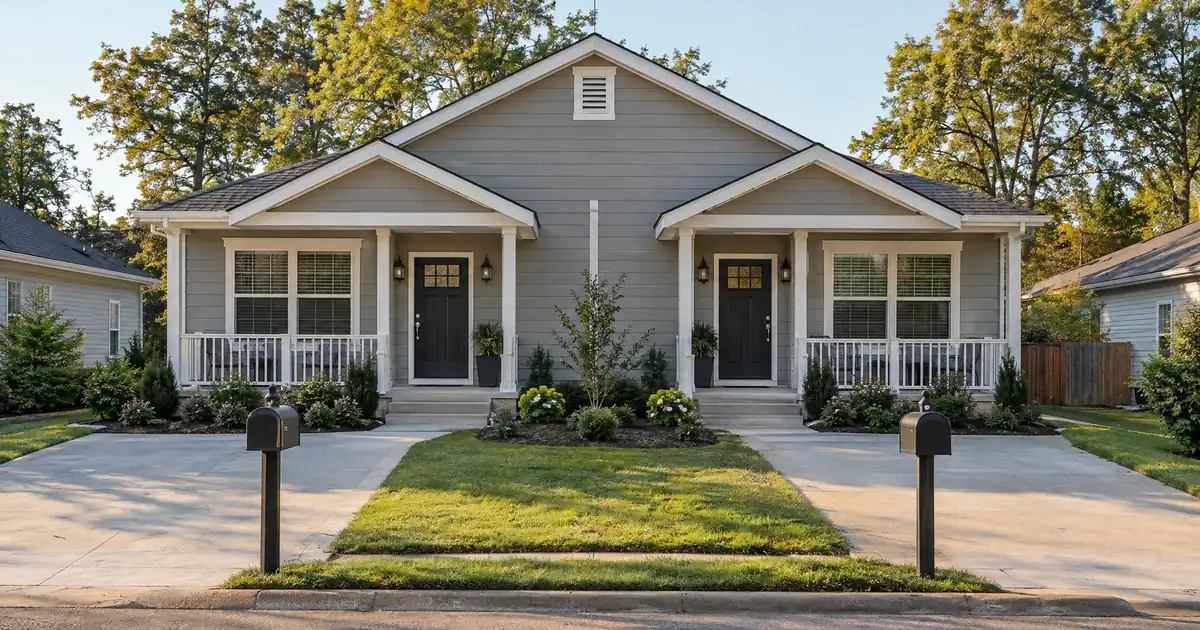
The Quick Read: A DSCR blanket loan puts several rentals under one note, and for an LLC that splits a duplex it generally means two newly separated units qualify together on pooled rent against pooled payment, with the LLC as borrower, clean title on each unit, and release terms settled in advance, all subject to lender guidelines.
- The split is a title event first. The loan can only follow once each half has its own deed.
- On the 30-year portfolio DSCR loan, the test runs on the pool, so a stronger unit can offset a weaker one.
- Typical program ranges: 2 to 20 properties, leverage up to 80% on a purchase or rate-and-term refinance, and a pooled coverage floor of 1.00.
- A blanket note links the units you just separated. Separate loans keep them apart.
- Release terms decide how easily you can sell one half later. Final terms depend on lender guidelines, property type, leverage, and the borrower’s complete credit picture.
Why Splitting a Duplex Changes the Loan Conversation
Splitting a duplex is a legal and title event before it is a financing event. Until it happens, the building is one deed, one parcel, one tax ID, and one loan.
LegalClarity explains the two common routes. A lot subdivision divides the land into two legal lots. A condo conversion divides the building into two owned units and leaves the land and structure under shared ownership. Either way, one deed becomes two titles. LegalClarity also notes that any existing mortgage has to be handled carefully during the process.
That last point trips people up. Recording the split does not divide the debt. The old loan still sits on the whole building until it is paid off, released, or restructured. A new DSCR loan, or a lender’s release, does that work.
A separate tax bill is not the same as a legal lot either. A county assessor’s FAQ says splitting an assessor’s parcel produces separate tax bills for assessment purposes only, and it does not confer legal lot status or planning approval. Rules for zoning, subdivision, and condo conversion vary by jurisdiction. Your local planning office and county records office decide what is allowed, and a real estate attorney should confirm the path.
Lot Split vs. Condo Conversion
Which route you take shapes the financing. A lot split gives you two separate parcels. A condo conversion gives you two units inside one building with shared elements.
| Factor | Lot split | Condo conversion |
|---|---|---|
| What you own | Separate land and half of the building | A unit plus a share of common elements |
| Layout fit | Side-by-side with clear separation | Works for side-by-side or stacked |
| Association needed | Usually no | Yes, often a two-member association |
| Insurance | Each owner insures their half | Often a master policy plus unit coverage |
| Local approval | Subdivision approval | Conversion approval |
A stacked duplex generally cannot be lot-split, so condo conversion is the only route there. Each lender decides how it treats a condo-style unit. Expect it to be appraised on a condo-type report, and expect association dues to count in the payment.
What a Blanket Loan Means (and What It Doesn’t)
A blanket loan is one note secured by several properties. Each property backs the whole debt. Nav describes it as a blanket lien that lets multiple properties secure a single loan, and it stresses that without a release clause, selling one property tied to the loan is much harder.
Three labels describe the same thing here: portfolio DSCR loan, blanket loan, and cross-collateralized loan. They all mean one note secured by several rentals. A big bank’s own portfolio loan, meaning a loan the bank keeps on its books, is a different sense of the word. It has nothing to do with this structure.
Across our wholesale network, the structure that fits a small LLC pool is the 30-year portfolio DSCR loan. It is a single DSCR loan product, not a stack of separate loans closed together.
The Core Requirements for an LLC Pool
Most programs we place files with work from the same short list. Figures below are typical program ranges, subject to lender guidelines, and not a commitment to lend.
Pool size. The 30-year portfolio DSCR loan covers 2 to 20 properties under one note. A split duplex gives you two. Adding other rentals from the same LLC is common.
Loan size. Typical sizes run from $300,000 to $5,000,000, with larger balances on review. Check this before you commit. A pool of two small units may land below the program’s starting balance, and that can push you toward separate loans.
Leverage. Up to 80% of value on a purchase or rate-and-term refinance. On a cash-out refinance, never above 75% of the pooled value.
Coverage. The floor is 1.00, measured on the pool. That means pooled rent against pooled debt service.
Credit. The portfolio programs typically want a 640 score. Some structures ask for 680 or 720.
Reserves. Reserves vary by lender, leverage, and loan size. They are commonly around 6 months of PITIA, which is principal, interest, taxes, insurance, and any association dues. Loans above $1,500,000 typically step up to about 9 months.
Property types. Single-family, 2-4 unit, condo, and townhome are eligible. Owner-occupied property, co-ops, mixed-use property, and commercial property are not.
Manufactured and mobile homes are not reviewable on these programs.
Structures also differ on how the borrower holds title. A special-purpose entity, typically an LLC, is required on some structures. Recourse loans carry a personal guarantee. That means the LLC is the borrower, but credit, reserves, and experience attach to the person who signs.
Entity and Title: One LLC or Two?
Keep the title clean before you apply. Each unit needs its own deed, recorded in the same borrower’s name that will sign the note. A mismatch on vesting, or one stray lien on one unit, can hold up the whole pool, because every property secures the same loan.
If both units stay in one LLC, the file is simple. If you move them into different LLCs to contain liability, a blanket note ties them back together with cross-default terms. Whether separate entities can co-borrow depends on the program and on common-ownership conditions, so ask before you re-title anything.
Plan for these entity documents:
- Formation records and the operating agreement
- Proof of good standing
- The EIN
- Signing authority for the person who will execute the note
Re-titling can carry transfer costs and liability trade-offs. Have an attorney review the sequence before you move any deed.
How the Pooled Coverage Test Works
The test is simple. Take the pool’s monthly rent and divide it by the pool’s total monthly payment, which is PITIA. Clear the program floor and the coverage test passes. That is the 1.00 floor on the 30-year portfolio DSCR loan, measured on the pool.
Pooling lets stronger properties offset weaker ones. 4homes describes the same blended-ratio idea in its explainer on pooled DSCR loans.
Here is a modeled example. These are assumptions, not market data. Say Unit A covers its own payment at roughly 1.3x and Unit B covers its own at roughly 0.9x. Both units carry similar payments. Pooled together, coverage lands around 1.1x. That clears the pool floor, and the weak unit rides along.
A rental below 1.00 can sit inside the pool, but underwriting tests the pooled coverage, the leverage, and the terms. If the pool as a whole falls under the floor, this structure does not work. Only select single-property programs go below 1.00, with leverage and terms adjusted, and that is a different product.
Every property still needs a lease or an appraiser-supported market rent. For a single-unit half, that means an appraiser’s rent schedule. For a 2-4 unit property, it is the operating income statement form. Many programs use the lower of the lease and the appraiser’s market rent.
One caution. Clearing 1.00 is not positive cash flow. DSCR compares rent to PITIA only. Repairs, vacancy, management, utilities, and capital expenses sit outside the number. Model those separately.
How the Split Changes Each Unit’s Numbers
Before the split, the whole duplex was tested on combined rent against one payment. After the split, each unit carries its own taxes and insurance. A condo conversion adds association dues and may add a master insurance policy.
Those extra costs raise each unit’s payment. The weaker unit’s coverage can slip. On separate loans, it must qualify on its own. In a blanket, the pool carries it.
This is where a blanket helps a small LLC. It lets a thin unit qualify with a stronger one beside it. The price is that both units now back one debt.
Blanket Note or Two Separate Loans?
Use separate loans per unit if you expect to sell or refinance either half on its own timeline. Consider a blanket if the pool helps a weak unit qualify and you accept the release terms.
| Factor | Blanket note | Separate loans |
|---|---|---|
| Coverage test | Pooled | Each unit alone |
| Weak unit | Carried by the pool | Must qualify alone |
| Selling one half | Needs a release | Simple payoff |
| Default risk | Cross-collateral, both exposed | Contained to one unit |
| Paperwork | One set of documents | Two sets |
Cost savings are usually modest. A single origination fee can be large, and some fees still run property by property.
Lendmire’s piece Single Blanket Loan vs Several DSCR Loans at Ten Doors in an LLC Portfolio goes deeper on that trade-off. For the mechanics of the split itself, see how to split a duplex in an LLC portfolio and refinance.
Cross-Collateral Risk and Release Terms
A blanket re-links the two halves you just separated. If one unit goes bad, the lender can look to both. Nav notes that every property in the pool backs the whole debt, so a default can put them all at risk.
Release terms are the safety valve. They live in the note, not in a statute, and they vary by lender. Read these four points before you sign:
- How the release price is set. It typically runs above the property’s allocated balance.
- Whether the remaining portfolio must still cover its debt service. It generally must.
- What fees apply to a release, substitution, or partial payoff.
- Whether a personal guarantee survives a release.
With only two units, a release means selling half of what was your whole duplex. After the sale, the remaining unit has to carry the loan alone. If that unit does not cover its own payment, the release may not be available on its own. Set that expectation before you close.
Cash-Out and New-Ownership Caps
If you plan to pull equity out of the pool, the cash-out ceiling is never above 75% of the pooled value. Proceeds are available on seasoned properties.
A second cap applies to newer purchases. Inside the first six months of ownership, the loan is also capped at 90% of total cost, meaning purchase price plus documented improvements. From six to twelve months, the cap is 100% of total cost. The leverage ceiling still applies, and the loan is the lower of the two. After twelve months, the appraised value alone is the basis. A rate-and-term refinance is not subject to the cost-basis cap.
What a Vacancy Does to the Pool
Suppose one half of the split sits empty. Its rent drops out of the numerator while its payment stays in the denominator. The pool’s coverage falls, and a unit that sat at 1.3x alone might pull the pool near or under the floor.
That is why we tell investors to stress the file before applying. Drop one unit’s rent to zero and see where the pool lands. If it stays above the floor, the structure has room. If not, the blanket is thinner than it looks.
Where the General Rule Breaks
A stacked duplex. One unit above the other cannot be lot-split, so condo conversion is the only path. That brings an association, shared elements, and often a master policy. A BiggerPockets thread reports an investor needing a master insurance policy that covered the entire structure.
A two-unit association. Two owners sharing a roof and a foundation have to agree on repairs. That friction can affect resale and, in some programs, eligibility.
An existing blanket. If the duplex already sits inside a blanket, splitting changes the collateral description. That generally takes lender consent, a release and re-recording, or a modification.
The term loan. The rental portfolio term loan is a separate structure for five or more rental properties or units, with loan sizes from $500,000 to $50,000,000 and leverage up to 75%. Small multifamily is eligible only on that term loan. A two-unit pool does not fit it by itself. These specifics are subject to lender guidelines and a full review of property, leverage, and credit.
Resale. Some investors find split units sell at a discount to a duplex. Others expect a premium. It is market-dependent, so do not assume either.
Building the File in Order
1. Confirm the split path with local planning and an attorney.
2. Record the split and the new deeds, with vesting that matches the borrowing LLC.
3. Pull each unit’s lease, or order the appraiser’s rent schedule.
4. Run each unit’s payment, including association dues and separate insurance.
5. Test the pool, then stress it with one unit vacant.
6. Compare the pool’s combined balance to the program’s loan-size range.
7. Read the release terms before you sign.
Common Mistakes
- Assuming the recorded split divided the old mortgage.
- Treating a separate tax bill as proof of a legal lot.
- Forgetting association dues and separate insurance in each unit’s payment.
- Putting units in different LLCs without asking whether the program allows co-borrowing.
- Signing a blanket without knowing the release price rule.
- Reading a pooled coverage pass as proof of positive cash flow.
Key Terms Defined
Blanket loan. One note secured by several properties, so each property backs the whole debt.
DSCR. Debt service coverage ratio, which is monthly rent divided by the monthly payment.
PITIA. Principal, interest, taxes, insurance, and any association dues, which together make up the monthly payment.
Vesting. The exact name in which title to a property is held.
Cross-collateralization. Using several properties to secure the same debt.
Cross-default. A clause that treats a default on one property as a default on the whole note.
Release clause. A loan term that lets one property leave the lien, usually with a partial paydown.
Allocated amount. The share of the loan balance assigned to a single property in the pool.
Lot split. Dividing land into two legal lots, each with its own deed.
Condo conversion. Turning one building into separately owned units that share common elements.
Not Legal or Tax Advice
This article is general education and is not legal or tax advice. Title, zoning, and entity decisions depend on your property and jurisdiction, so consult a qualified attorney or CPA about your own situation. Tax treatment can depend on how the funds are used and how the property is held; investors should keep clear records and speak with a qualified tax professional before relying on any deduction.
Next Step
If you are buying or refinancing a rental property and want to see how the numbers work, Lendmire can help you compare DSCR loan options based on the property income, credit profile, leverage, and investor goals. As a broker, Lendmire arranges financing through select lenders in its wholesale network across 41 markets, including Washington, D.C. Our complete DSCR loans guide covers the basics if you are still building the picture.
Frequently Asked Questions
Can I put both halves of a split duplex under one DSCR blanket loan?
Often yes, subject to lender guidelines. The 30-year portfolio DSCR loan accepts 2 to 20 properties, and a 2-4 unit or condo-style unit can qualify as collateral. The units need separate deeds first, and the pool’s combined balance has to fit the program’s loan-size range.
Does the pool have to hit 1.00, or does each unit?
On the 30-year portfolio structure, the 1.00 floor is measured on the pool. Stronger units can offset weaker ones. Underwriting still tests the pooled coverage, the leverage, and the terms, and every unit needs a lease or an appraiser-supported market rent.
Can my LLC be the borrower?
Typically yes. A special-purpose entity, usually an LLC, is required on some structures, subject to program terms. Recourse loans also carry a personal guarantee from the signer. Credit and reserves attach to that person.
Can I sell one half later?
Only if the note has a release clause. The release price typically runs above the property’s allocated balance. The remaining unit generally still has to cover its debt service. Separate loans make a sale simpler.
Does clearing 1.00 mean the pair of units makes money?
No. DSCR compares rent to PITIA only. Vacancy, repairs, management, utilities, and capital expenses are outside the calculation, so model them separately.
About Lendmire
Lendmire (NMLS# 2371349) is a mortgage brokerage built around DSCR investor lending, with programs available in 41 markets, including Washington, D.C. DSCR lenders commonly evaluate rental-income coverage instead of personal income paperwork — a practical fit for LLC-owned and multi-property investors. Terms vary by lender, property, leverage, and program. Scotsman Guide named Lendmire a Top Mortgage Workplace in both 2025 and 2026.
Get Started
Ready to find the right loan for you?
In about 30 seconds you can review financing options available for your investment property. No commitment required.
Informational only. Not a Loan Estimate, approval, or commitment to lend. Program availability and eligibility are subject to lender guidelines, credit approval, property review, and underwriting.
References
1. LegalClarity
2. County assessor FAQ on tax-parcel splits
3. Nav
4. 4homes
5. BiggerPockets condo conversion thread
This article is part of Lendmire’s DSCR loan program — full qualification details, guidelines, and scenarios live on the program page.
Related reading: Portfolio DSCR Loan Requirements After Seller Financing or Subject-to · DSCR Loan Requirements Versus a Local Bank’s Commercial Loan · DSCR Loan Requirements After a Short Sale or Lost Property
Brandon Miller
Founder & CEO, Mortgage Loan Originator, Lendmire LLC
- Mortgage Loan Originator · NMLS# 1129696 · Verify on NMLS Consumer Access
- North Carolina Real Estate Broker · License# 343312 · Verify on NCREC
- North Carolina Insurance Producer · License# 19053198 · Property, Casualty, Life, Health · Verify on NAIC SBS
- Lendmire LLC · Firm NMLS# 2371349 · Verify firm licensure
Important disclosures. Lendmire (NMLS# 2371349) is a licensed mortgage brokerage. Lendmire is not a direct lender, depository institution, or financial advisor. All loan inquiries are subject to lender underwriting; this article does not constitute a commitment to lend. Rates, terms, and program guidelines are subject to change without notice and vary by borrower profile, property type, and state. Information in this article is general in nature and is not financial, legal, or tax advice. Equal Housing Opportunity. NMLS Consumer Access: nmlsconsumeraccess.org.