
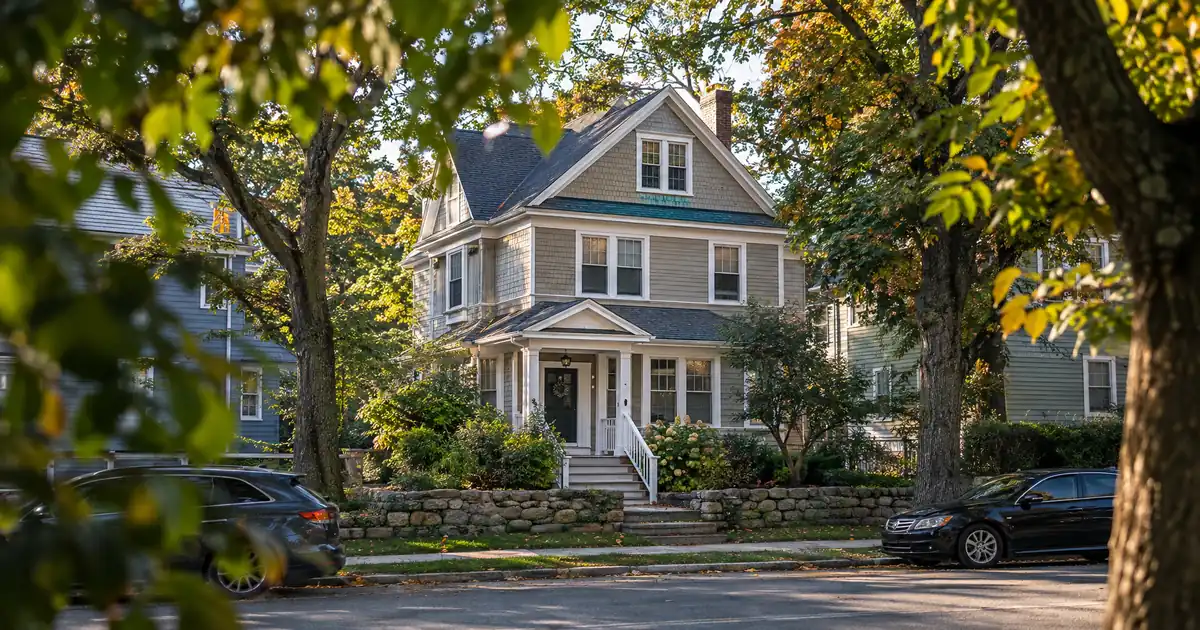
How much cash can an Attleboro rental actually hand back on a cash-out refinance? Less than the headline price suggests, and the gap comes from two places: a 75 percent loan-to-value ceiling and an appraiser working from a thin comp set. Redfin’s Attleboro City median reads $552K, down 3.1 percent year over year, while price per square foot is up 15.5 percent. Those two numbers point in opposite directions, and the file lives in the space between them.
DSCR Cash-Out Calculator
Run the cash-out numbers in Attleboro, MA
Rate source: Freddie Mac 30-yr average via FRED® — Federal Reserve Bank of St. Louis · effective Sep 24, 2026
Prefilled with starting assumptions — enter your property’s value, balance, taxes, and insurance for a more accurate picture.
Program parameters update from Lendmire’s centralized guideline source. Taxes and insurance are editable estimates.
As of Sep 24, 2026 · General Freddie Mac market benchmark, not a Lendmire loan offer. Property value, balance, taxes, and insurance are editable estimates. Maximum loan-to-value varies by lender, program, property type, and seasoning. Not a Loan Estimate, approval, or commitment to lend. Program availability and eligibility are subject to lender guidelines, credit approval, property review, and underwriting.
The Short Version:
A DSCR cash-out refinance in Attleboro, Massachusetts is underwritten primarily on the property’s rental income measured against its full monthly obligation, with proceeds capped by the appraised value, the leverage ceiling, and the reserves the borrower can document after closing.
- Single-family at the City-area median runs well below 1.00x on one three-bedroom rent.
- Older two- and three-family stock near the station stacks several rents against one obligation.
- Redfin’s Downtown median sits at $450K.
- Cash-out is capped at 75 percent LTV and typically needs about six months of ownership.
- Appraisal risk is the swing factor, not the rent math.
Attleboro Market Snapshot
A quick read on the Attleboro investor landscape — figures come from the cited sources below. Confirm current property-level numbers before underwriting.
| Metric | Detail |
|---|---|
| Home prices | $448,100 median value (Data USA) |
| Employment | 2,000+ employees (Sturdy Health) |
Appraisal First, Rent Second
Price reads in Attleboro disagree by source, and that matters more to a cash-out than to a purchase. Redfin’s citywide median was $558K in November, up 12.2 percent, according to Redfin’s Attleboro market page. Zillow’s home value index shows $477,973, up 2.1 percent. Data USA puts median property value at $448,100, up 9.53 percent. Same city, three methods, a spread of roughly $110K.
Treat appreciation here as mixed by source. Redfin’s City-area page rests on 16 homes sold in a single month. Appraisers lean on a handful of comps, so a refinance can come in well under the number an owner has in mind. Underwrite to the low end of the range, not the high end, and don’t assume a straight line up.
This is the equity-extraction version of the Attleboro story. The reader already owns. The question is how much of the appraised value the lender will let come out, and whether the rent covers the larger balance afterward.
The 75 Percent Ceiling and the Seasoning Clock
Cash-out on an investment property tops out at 75 percent LTV. That is a hard cap, separate from the higher leverage that can apply on a purchase. Proceeds are not a fixed figure either. They depend on the appraised value, the rent used for lender review against full PITIA, and the reserves left over, all subject to lender guidelines and program review.
Other typical parameters, for most files:
- Seasoning: about six months of ownership, measured from title recording. A recent closing on the settlement statement starts the clock, not the contract date.
- Coverage: a 1.00 benchmark on rent used for lender review against PITIA, with some programs reviewing lower ratios when other factors compensate.
- Credit: tiers at 620, 660, 680 and 700, with 620 as the floor. Better tiers generally support more leverage.
- Reserves: about six months of PITIA, rising to about nine months above $1,500,000.
- Loan size: up to $3,000,000 on standard programs. Smaller balances route through select lenders in the network.
Files that assume the seasoning window away get kicked back. So do files where the owner counts reserves that are really the cash-out proceeds. Reserves have to be documented separately. The guide “What Is a DSCR Loan” is worth reading before the numbers go into a spreadsheet, and the mechanics of a DSCR cash-out refinance cover the seasoning and LTV sequence in more detail.
Three Rents Against One Payment
The multi-unit case is where Attleboro files clear. A single-family home at these prices carries a large obligation on one rent. A three-family spreads that obligation across three.
Run the numbers on two modeled scenarios. These are assumptions, not market statistics. Rents come from Zillow’s Attleboro rental data, which shows a $2,600 average for a three-bedroom and $2,000 for a two-bedroom. Apartment Finder lists $1,765 for a one-bedroom. Coverage is rent divided by full PITIA, with taxes and insurance included at Massachusetts averages, on a 30-year amortization at 75 percent LTV.
| Factor | Single-family | Three-family |
|---|---|---|
| Modeled rent | $2,600 (one 3BR) | $6,965 (3BR, 3BR, 1BR) |
| Value assumed | $552K | $650K (hypothetical) |
| LTV | 75 percent | 75 percent |
| Coverage, full PITIA | about 0.75x | about 1.6x |
The three-family figure assumes both larger units rent at the three-bedroom average. Many older triple-deckers have two-bedroom units. Price those at the two-bedroom average and gross rent drops to $5,765, which puts coverage near 1.4x. Still above the benchmark, with less cushion.
The single-family result lands below 1.00x. A property in that position is not necessarily shut out. A lender may review a sub-1.00 program, an interest-only structure, or a lower LTV with stronger reserves. Each carries its own pricing and documentation, and eligibility turns on lender guidelines, credit approval and property review. For a $552K house renting at the three-bedroom average, the more useful question is usually whether a two- or three-unit property fits the plan instead.
The research found no Attleboro rent-to-value ratios by submarket. The comparison above is the modeled math, nothing more. How DSCR compares with conventional financing is the relevant background for owners who have been carrying these properties on income-based loans.
Downtown Is the Better-Supported Submarket
Downtown Attleboro has the strongest tenant-demand evidence in the research. The commuter rail station had 1,220 daily riders in the most recent annual count, the third-busiest on the MBTA system outside Boston, per a market source’s station entry. Verify the ridership rank against MBTA data before relying on it. The ridership figure supports renter durability for older two- and three-family stock within walking distance.
The redevelopment pipeline adds context. An MBTA release describes a 6.5-acre downtown parcel that could introduce approximately 600 market-rate and affordable units. The City of Attleboro frames it as a transit-oriented site next to the commuter rail. No developer or timeline is confirmed. If it delivers, it adds supply near the best-supported rental stock, so don’t underwrite it as a tailwind.
A related point on rent ceilings: newer buildings near the station list one-bedrooms around $1,925 total monthly price including required fees, which overstates base rent. Don’t underwrite legacy units at new-construction rents.
South Attleboro Village is the contrast. It’s cheaper to buy, but its station was closed for a stretch and recorded only 19 daily boardings in the most recent count, per Wikipedia’s South Attleboro entry. Treat it as a price-led hold. Commuter demand there is unproven.
Hebronville, Attleboro Falls, Lonicut and the East Side appear as named neighborhoods in Walk Score’s list, but the research found no price or rent data for them. They stay out of the math.
The Tenant Base Behind the Rents
Health care is the largest resident employment sector, with 3,867 residents, followed by manufacturing at 3,238 and retail at 3,166, per Data USA. Employment grew 2.48 percent in the latest year. Those are where residents work, not jobs inside city limits.
Sturdy Health employs more than 2,000 people and runs a 142-bed acute care hospital. That supports steady demand for two- and three-bedroom units near the hospital. Sensata Technologies keeps its U.S. headquarters in the city, though local headcount figures are inconsistent and worth skipping. Massachusetts-Demographics puts population at 46,762 and 2024 median household income at $98,954. The average commute runs 30.5 minutes, which fits a commuter-rail city.
What Derails Attleboro Cash-Out Files
Working DSCR brokers see a recurring pattern in older New England housing stock: the rent roll is the problem, not the rent. Utility structure is rarely documented the same way across units. One unit includes heat and hot water, another doesn’t, and the lender needs each lease to say so. Appraisers then work a small comp set for three-deckers, and a first value often needs an appraisal reconsideration packet with recent in-neighborhood sales and condition adjustments.
The friction points, in order of how often they surface:
1. Utilities in rent. Current local rental listings show downtown units with heat and hot water included. Net income drops. Underwrite each unit separately, from the lease.
2. Rent roll clarity. Mixed leases and month-to-month tenancies need a clean schedule. A rent estimate stands in only where a lease is missing.
3. Seasoning evidence. Recording date and settlement statement, matched to the entity that holds title.
4. Entity documents. Operating agreement, EIN letter and good-standing certificate, for LLC-held files.
5. Reserves documentation. Statements that show liquid assets separate from the incoming proceeds.
DSCR vs. conventional financing
There are two common ways to finance an investment property in Attleboro, MA, and they qualify you differently — here’s how investors weigh them.
Why investors choose it
- Qualifies on the property’s rental income — no personal tax returns, W-2s, or pay stubs needed to document income.
- No personal debt-to-income ceiling to clear, so existing mortgages and obligations don’t cap your borrowing the same way.
- Can be closed in an LLC, keeping the property inside a business entity.
- Built for scaling — not held to the limit on number of financed properties that conventional financing applies.
- Underwriting centers on the deal: generally qualifies when the rent covers the payment, a 1.00x coverage ratio being a common baseline (confirmed in underwriting).
- Designed specifically for investment property, including long-term and, where the program allows, short-term rentals.
Where it’s strong
- Often the lowest ongoing financing cost for a buyer who fully qualifies on personal income — a fit for a first property or a cost-first purchase.
Trade-offs for investors
- Requires full personal income documentation and must fit within a debt-to-income limit — salary, existing debts, and other mortgages all count.
- Typically held in your personal name rather than a business entity.
- Caps how many financed properties you can carry, which can become a ceiling as a portfolio grows.
- Evaluates you as a borrower as much as the property, which usually means more paperwork.
How investors usually choose: a first or single property often optimizes for the lowest financing cost; portfolio builders often optimize for leverage, vesting in an LLC, and scaling past conventional caps. The right answer depends on your goals, the property, and current guidelines — both paths run through select lenders in Lendmire’s wholesale network, with eligibility and terms confirmed in underwriting.
Budget for taxes and insurance, which vary by property, and verify current local rental rules with qualified local professionals. Older buildings can carry compliance items that surface during the appraisal.
Where the Proceeds Go
Equity pulled from a seasoned Attleboro three-family becomes down-payment capital for the next acquisition. The practical constraint is that the new balance has to still cover. A refinance that clears 1.00x at 75 percent LTV can sit uncomfortably close to the line once taxes and insurance reset. Run coverage on the new balance, not the old one, before committing proceeds elsewhere.
For owners comparing structures, a rate-and-term refinance is the alternative, and it suits files where the goal is coverage rather than cash. Massachusetts-specific program context is on the page for DSCR loans in Massachusetts. Questions about a specific file can go to 828-256-2183.
Frequently Asked Questions
How do you qualify for a DSCR cash-out refinance in Attleboro?
The property’s rent used for lender review has to cover its full PITIA at roughly the 1.00 benchmark, though some programs review lower ratios with other factors compensating. The borrower also needs a credit score at or above the 620 floor, about six months of seasoning from title recording, and roughly six months of reserves. LTV is capped at 75 percent. Final eligibility depends on lender guidelines, credit approval and property review.
What are the requirements for an investment property loan in Attleboro, Massachusetts?
For a cash-out file, expect an appraisal, a lease or rent schedule for every unit, proof of ownership seasoning, reserves documentation and, for LLC-held property, entity documents. Standard programs run up to $3,000,000. Manufactured homes, log homes and barndominiums fall outside these programs. Requirements vary by lender and borrower scenario.
Why does a downtown three-family usually cover better than a single-family?
Three rents carry one obligation. At the modeled values above, a single-family renting at the three-bedroom average lands near 0.75x including taxes and insurance, while a three-family modeled at the Zillow and Apartment Finder averages lands near 1.6x. Those are modeled assumptions, not actual rents for any building.
Can the appraisal come in below what Attleboro’s price data suggests?
It can, and it’s the most common reason a cash-out shrinks. Source medians range from roughly $450K to $560K depending on method, and the City-area read rests on 16 sales in a month. A reconsideration request with recent nearby sales can recover some value, though results are not guaranteed.
Can a LLC-owned Attleboro rental be reviewed for DSCR financing?
Yes, subject to lender program eligibility. Lendmire (NMLS# 2371349) arranges DSCR investor loans in 41 markets, including Washington, D.C., and investors underwriting deals in Attleboro, Massachusetts can use the DSCR programs Lendmire arranges. Entity-held files are reviewed on the property’s rental income, with operating agreement and EIN documents in the package.
For current guidelines and terms, see Lendmire’s DSCR loan programs page.
About Lendmire
Lendmire is a non-QM mortgage brokerage (NMLS# 2371349) arranging DSCR investor loans in 41 markets, including Washington, D.C. DSCR eligibility is generally reviewed around property-level rental income rather than personal income, subject to lender and program guidelines, making it a fit for self-employed investors and LLC-owned portfolios. Lendmire was recognized by Scotsman Guide as a 2026 Top Workplace and was a top-ranked workplace in 2025.
Get Started
Ready to find the right loan for you?
In about 30 seconds you can review financing options available for your investment property. No commitment required.
Informational only. Not a Loan Estimate, approval, or commitment to lend. Program availability and eligibility are subject to lender guidelines, credit approval, property review, and underwriting.
References
1. Redfin: Attleboro City housing market
2. Redfin: Downtown Attleboro housing market
5. Redfin: Attleboro housing market
6. Zillow: Attleboro home values
7. Zillow Rental Manager: Attleboro
9. MBTA: Attleboro redevelopment release
11. Wikipedia’s South Attleboro entry
13. Massachusetts-Demographics
14. recognized by Scotsman Guide as a 2026 Top Workplace
15. Scotsman Guide — Top Workplaces 2025
This article is part of Lendmire’s investment property cash-out refinance program — full qualification details, guidelines, and scenarios live on the program page.
Related reading: Luxury Rental DSCR Loans In New Jersey · Jersey Shore Vacation Rental Loans: DSCR Financing In Ocean City, Cape May And Long Beach Island · DSCR Cash-out Refinance In New Jersey: Pulling Equity From A Rental
Guides: Investment Property Cash-Out Refinance in Massachusetts
Brandon Miller
Founder & CEO, Mortgage Loan Originator, Lendmire LLC
- Mortgage Loan Originator · NMLS# 1129696 · Verify on NMLS Consumer Access
- North Carolina Real Estate Broker · License# 343312 · Verify on NCREC
- North Carolina Insurance Producer · License# 19053198 · Property, Casualty, Life, Health · Verify on NAIC SBS
- Lendmire LLC · Firm NMLS# 2371349 · Verify firm licensure
Important disclosures. Lendmire (NMLS# 2371349) is a licensed mortgage brokerage. Lendmire is not a direct lender, depository institution, or financial advisor. All loan inquiries are subject to lender underwriting; this article does not constitute a commitment to lend. Rates, terms, and program guidelines are subject to change without notice and vary by borrower profile, property type, and state. Information in this article is general in nature and is not financial, legal, or tax advice. Equal Housing Opportunity. NMLS Consumer Access: nmlsconsumeraccess.org.