
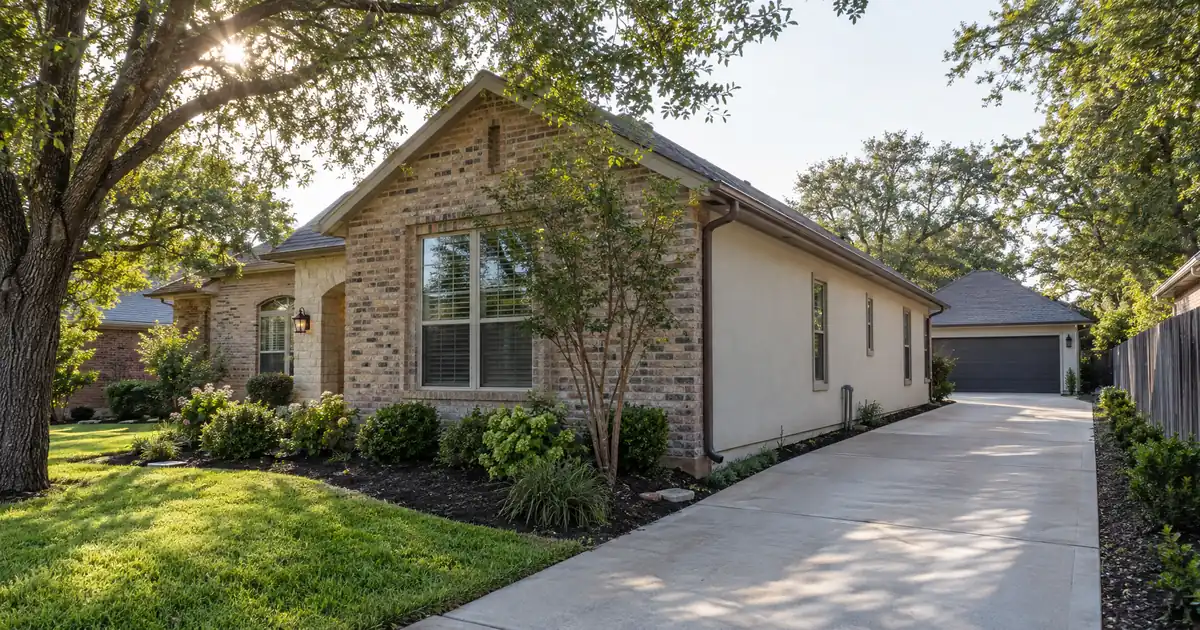
Most cash-out files in a flat, thin-comp suburb stall on the appraisal. The investor assumes a value. The appraiser finds few close sales. The 75% ceiling then applies to a smaller number than the file was built on. Benbrook is that kind of market, and the cash-out math here depends on the appraised value, not on appreciation.
Lendmire (NMLS# 2371349) is a DSCR-focused mortgage broker. Benbrook, Texas investors can have DSCR scenarios reviewed through lender programs that Lendmire helps place across 41 markets, including Washington, D.C. This article covers the equity-extraction side: a property already owned, seasoned, and ready to be refinanced.
DSCR Cash-Out Calculator
Run the cash-out numbers in Benbrook, TX
Rate source: Freddie Mac 30-yr average via FRED® — Federal Reserve Bank of St. Louis · effective Sep 24, 2026
Prefilled with starting assumptions — enter your property’s value, balance, taxes, and insurance for a more accurate picture.
Program parameters update from Lendmire’s centralized guideline source. Taxes and insurance are editable estimates.
As of Sep 24, 2026 · General Freddie Mac market benchmark, not a Lendmire loan offer. Property value, balance, taxes, and insurance are editable estimates. Maximum loan-to-value varies by lender, program, property type, and seasoning. Not a Loan Estimate, approval, or commitment to lend. Program availability and eligibility are subject to lender guidelines, credit approval, property review, and underwriting.
The Quick Read: A DSCR cash-out refinance on a Benbrook, Texas rental is underwritten primarily on the property’s rental income measured against its full monthly obligation, so it fits investors holding seasoned workforce single-family rentals who want capital for the next deal, not owners of high-priced homes where rent covers little.
- Redfin puts the median sale price near $338K, up only modestly year over year.
- Cash-out leverage typically tops out at 75% LTV, and the property generally needs about 6 months of ownership, counted from title recording, to qualify.
- Homes.com shows $2,200 median single-family rent, which sits above the citywide median.
- Coverage clears 1.00 most easily in the lower-priced pockets, not the upper-priced subdivisions.
Benbrook Market Snapshot
A quick read on the Benbrook investor landscape — figures come from the cited sources below. Confirm current property-level numbers before underwriting.
| Metric | Detail |
|---|---|
| Home prices | 122 sales vs 133 (Movoto Benbrook market trends) |
| Employment | ~19,000 lockheed employees (Texas Comptroller NAS JRB Fort) |
Where the Coverage Holds: The Entry-Level Pockets
The lower-priced subdivisions are where a cash-out file has the best chance of clearing 1.00. Zillow’s neighborhood values put Hilltop Heights at about $262,762, Benbrook Lakeside at $267,935, Greenbriar at $268,787, and Timber Creek at $288,060. Those are ownership values, not rents. Submarket-level rent data for 2–3 bedroom houses did not turn up in the research, so the rent side is a citywide read.
Here is the modeled version. Assume a three-bedroom rents near the $2,200 single-family figure that Homes.com reports and that the property is held in the Timber Creek value band. At 75% LTV, with taxes and insurance loaded into the full monthly obligation, coverage lands in low-1.1 territory on these modeled assumptions. That is thin but workable. Drop the leverage and the number improves. Raise the price point and it erodes fast. Exact terms depend on the lender’s guidelines, property type, leverage, and a full review of the borrower’s file.
The same rent on a median-priced house tells a different story. Homes.com shows a price-to-rent ratio of 17.1, and pairing $1,650 median rent with the Redfin median works out to roughly 0.49% monthly rent-to-value (that is arithmetic across two sources, illustrative only). At that ratio, a full-leverage cash-out with taxes and insurance included lands well under 1.00.
What happens then? Options exist, and a lender would review each one: a sub-1.00 program with stronger compensating factors, an interest-only structure, or a smaller cash-out request at lower LTV. Qualification stays subject to lender guidelines, credit approval, and property review. None of these is automatic.
Why Appreciation Won’t Carry the File
Benbrook values are flat. Zillow’s index shows an average home value of $313,531, down 1.7% over the past year. Redfin’s median is up 0.6%. The two move in opposite directions, which is the point: nobody should underwrite a cash-out on expected gains.
Sale-price sources also disagree on level. Movoto reports a $385,000 median sale price and 122 homes sold in its latest month, down from 133 a year earlier. It skews toward newer and higher-end homes, so the lower-priced pockets sit well beneath it. Use a range, not one median.
Thin volume makes this worse. Orchard’s trailing 30-day snapshot shows only 8 homes sold versus 23 the year before, a 93.14% median sale-to-list ratio, and 87.5% of listings with price drops. Small sample, so treat it as a signal and not a statistic.
The consequence for a cash-out: equity comes from what the investor already holds. That means a purchase below list, principal paydown, or a cash-flow-driven renovation. It does not come from the market lifting the appraisal.
Seasoning, LTV, and the Appraisal Gap
Seasoning is the mechanical gate. Most programs in the network ask for about 6 months of ownership, measured from title recording, and the settlement statement documents it. Files that count from contract date or closing-table date get kicked back.
The LTV ceiling for cash-out is 75%. Proceeds are the appraised value times that cap, less the existing payoff, and only if coverage and reserves clear. Reserves typically run about 6 months of the full monthly obligation, higher on larger balances. Credit tiers start at a 620 floor on typical guidelines. Standard programs go up to $3,000,000, with smaller balances routed through select lenders. Every one of these varies by borrower, property, and lender.
Picture an investor who bought a Greenbriar three-bedroom at a discount to list, in a market where sellers are negotiating. The purchase price anchors the appraiser. If the comps are thin and the subject sits near the low end, the appraised value can land close to what the investor paid. The cash-out is then the gap between 75% of that number and the existing balance, which may be small. That gap is the deal.
When the number comes in light, an appraisal reconsideration request is a routine step. Recent in-neighborhood sales, condition adjustments, and any documented improvements are the packet. Western Hills-Ridglea, the adjacent submarket, gives usable context: Redfin shows a $355K median sale price, up 4.4%, with about 40 days on market against 57 the year before.
Fourplexes, Condos, and the Scarcity Problem
Small multifamily is a niche here. Zillow’s duplex search for Benbrook showed a single listing when pulled, so a duplex or fourplex owner has a thin comp set if the property ever goes to appraisal. No sourced duplex or fourplex price data turned up, so there is no yield figure to give. Anyone holding one should expect the appraiser to reach into the Ridglea and Western Hills side for comps.
Condos and townhomes are the other trap. Redfin condo rental listings in the Ridglea and Benbrook corridor run $1,600 to $1,995 a month. A Ridglea Hills two-bedroom townhouse was listed near $299,000. That is roughly 0.5% to 0.6% monthly rent-to-value on a single listing pair, illustrative only. Add HOA dues to the monthly obligation and coverage gets harder. HOA questionnaire completeness and condo certification become file items in their own right.
The upper end is a poor fit. Ridglea Country Club and Ridglea Estates average about $495,000, Meadows West and Bellaire Park North above $640,000, and Mira Vista above $1.2 million. Rent-to-value at those price points does not support a coverage ratio at typical leverage. They are owner-occupant neighborhoods.
What Keeps the Tenant Pool Steady
Benbrook is a commuter suburb. City-Data reports a daytime population change of -24.0% from commuting, and only 2,149 workers (17.4%) both live and work in the city. The tenant base works elsewhere.
The largest nearby anchor is Naval Air Station Joint Reserve Base Fort Worth. The Texas Comptroller’s profile says the base hosts 44 tenant commands and shares a runway with Lockheed Martin’s Air Force Plant 4. It puts Lockheed at about 19,000 Fort Worth employees, the city’s largest employer. The Lockheed facility sits in west Fort Worth, not Benbrook. That is still a named, official demand driver for a lender or appraiser reading a lease file, which a property manager’s claim is not.
The Census Reporter profile gives a population of 24,430, and growth is essentially flat. Demand is steady, not expanding. For a cash-out borrower, that means tenant turnover risk is modest and upside in rents is slow.
Files That Close Clean
Jump straight to the paperwork. The file gets cleaner when these items are ready before submission:
1. Settlement statement showing title recording. It proves the seasoning clock.
2. Executed lease or leases, plus a rent-roll summary. Multi-unit files need every unit covered.
3. Entity documents for LLC-owned properties. These are accepted subject to lender program eligibility.
4. Reserves documentation. Statements showing about 6 months of the full monthly obligation, sourced and seasoned.
DSCR vs. conventional financing
There are two common ways to finance an investment property in Benbrook, TX, and they qualify you differently — here’s how investors weigh them.
Why investors choose it
- Qualifies on the property’s rental income — no personal tax returns, W-2s, or pay stubs needed to document income.
- No personal debt-to-income ceiling to clear, so existing mortgages and obligations don’t cap your borrowing the same way.
- Can be closed in an LLC, keeping the property inside a business entity.
- Built for scaling — not held to the limit on number of financed properties that conventional financing applies.
- Underwriting centers on the deal: generally qualifies when the rent covers the payment, a 1.00x coverage ratio being a common baseline (confirmed in underwriting).
- Designed specifically for investment property, including long-term and, where the program allows, short-term rentals.
Where it’s strong
- Often the lowest ongoing financing cost for a buyer who fully qualifies on personal income — a fit for a first property or a cost-first purchase.
Trade-offs for investors
- Requires full personal income documentation and must fit within a debt-to-income limit — salary, existing debts, and other mortgages all count.
- Typically held in your personal name rather than a business entity.
- Caps how many financed properties you can carry, which can become a ceiling as a portfolio grows.
- Evaluates you as a borrower as much as the property, which usually means more paperwork.
How investors usually choose: a first or single property often optimizes for the lowest financing cost; portfolio builders often optimize for leverage, vesting in an LLC, and scaling past conventional caps. The right answer depends on your goals, the property, and current guidelines — both paths run through select lenders in Lendmire’s wholesale network, with eligibility and terms confirmed in underwriting.
5. Insurance quote for the current policy term. A stale quote is how coverage ratios shift mid-review.
The cleaner files on Lendmire’s deal desk from suburbs like this one tend to share two habits. The borrower documents how the equity was built (purchase discount, paydown, improvements) before the appraiser asks. The borrower also runs the coverage number at a lower leverage tier first, then steps up only if the appraisal supports it. The common friction point is an assumed value that the comps never back up.
Unlike some larger non-QM lenders that treat investor loans as a side product, a DSCR-focused broker works the file around documentation and appraisal risk from the start. For structure options and program fit, see the refinance pathway for investor properties and the program-to-program comparison. Texas-specific programs are collected under DSCR loan options for Texas investors. New to the ratio itself? Lendmire’s DSCR walkthrough explains how rent divided by the full monthly obligation gets calculated.
Reach the desk at 828-256-2183, or connect with Lendmire to have a scenario reviewed. Program details are guidance, not a commitment to lend. Investors should also verify current local rental rules, taxes, and insurance with qualified local professionals.
Frequently Asked Questions
How do you qualify for a DSCR cash-out refinance in Benbrook, Texas?
Qualification centers on the property’s rent against its full monthly obligation, with 1.00 as the typical baseline. Lenders also review credit (a 620 floor on typical guidelines), about 6 months of reserves, and about 6 months of ownership from title recording. Cash-out LTV tops out at 75%. All of it is subject to lender guidelines and property review.
What are the requirements for an investment property loan in Benbrook, Texas?
Expect a lease or rent evidence, entity documents if the property is held in an LLC, reserves documentation, an appraisal, and current insurance. Loan amounts go up to $3,000,000 on standard programs, with smaller balances placed through select lenders. Manufactured homes, log homes, and barndominiums fall outside these programs.
Will Benbrook appreciation raise my cash-out amount?
Probably not on its own. Zillow shows values down 1.7% over the past year, and Redfin shows a 0.6% gain. Proceeds depend on equity already held, the appraisal, and the 75% cap. A thin comp set can make the appraisal land closer to the purchase price than expected.
Does a Benbrook duplex or fourplex help the coverage ratio?
On paper, stacking units near single-family rents helps. In practice, inventory is thin, and no sourced duplex or fourplex price or rent data turned up. Appraisers may pull comps from neighboring Fort Worth submarkets. Treat small multifamily here as opportunistic, not a base case.
Can Lendmire help arrange DSCR financing for an investment property in Benbrook?
Yes. Lendmire arranges DSCR investor loans through wholesale and investor-lending channels. Cash-out refinances are available up to a 75% LTV ceiling, subject to lender guidelines and credit approval.
For current guidelines and terms, see Lendmire’s DSCR loan programs page.
About Lendmire
Lendmire is a non-QM mortgage brokerage (NMLS# 2371349) arranging DSCR investor loans in 41 markets, including Washington, D.C., through wholesale and investor-lending channels. The lender evaluates DSCR loans on rental income rather than personal income, subject to lender guidelines. That suits LLC-owned portfolios, self-employed investors, and operators scaling beyond conventional loan caps. Lendmire is recognized as a 2025 Scotsman Guide Top Workplace and a 2026 Scotsman Guide Top Mortgage Workplace.
Get Started
Ready to find the right loan for you?
In about 30 seconds you can review financing options available for your investment property. No commitment required.
Informational only. Not a Loan Estimate, approval, or commitment to lend. Program availability and eligibility are subject to lender guidelines, credit approval, property review, and underwriting.
References
1. Redfin, Benbrook housing market
2. Homes.com, Benbrook rentals
3. Movoto reports a $385,000 median sale price
4. Texas Comptroller, NAS JRB Fort Worth
5. Zillow’s neighborhood values
6. Zillow, Benbrook home values
7. Orchard, Benbrook market report
8. Redfin shows a $355K median sale price
9. Redfin condo rental listings
10. Census Reporter, Benbrook profile
11. a 2025 Scotsman Guide Top Workplace
12. a 2026 Scotsman Guide Top Mortgage Workplace
This article is part of Lendmire’s investment property cash-out refinance program — full qualification details, guidelines, and scenarios live on the program page.
Related reading: Cash Out Refinance Investment Property in Benbrook, Texas: The 2026 DSCR Guide to Benbrook Lake · DSCR Cash Out Refinance in Galveston, Texas: The 2026 DSCR Financing Guide to the Strand · DSCR Cash Out Refinance in Conroe, Texas: How the Rent Math Clears at 75% LTV Here
Guides: Investment Property Cash-Out Refinance in Texas
Brandon Miller
Founder & CEO, Mortgage Loan Originator, Lendmire LLC
- Mortgage Loan Originator · NMLS# 1129696 · Verify on NMLS Consumer Access
- North Carolina Real Estate Broker · License# 343312 · Verify on NCREC
- North Carolina Insurance Producer · License# 19053198 · Property, Casualty, Life, Health · Verify on NAIC SBS
- Lendmire LLC · Firm NMLS# 2371349 · Verify firm licensure
Legal disclosures. Lendmire (NMLS# 2371349) is a state-licensed mortgage brokerage that arranges financing through wholesale lender relationships. Lendmire is not a direct lender, depository institution, or registered financial advisor. The discussion above is general informational content about real estate financing — it is not financial, legal, or tax advice, and readers should consult licensed professionals for guidance on their individual circumstances. Loan inquiries are subject to lender underwriting; this article does not represent a commitment to lend. Loan terms, rates, and qualification standards vary by borrower, property, and state, and are subject to change at any time. Equal Housing Opportunity. NMLS Consumer Access: nmlsconsumeraccess.org.