
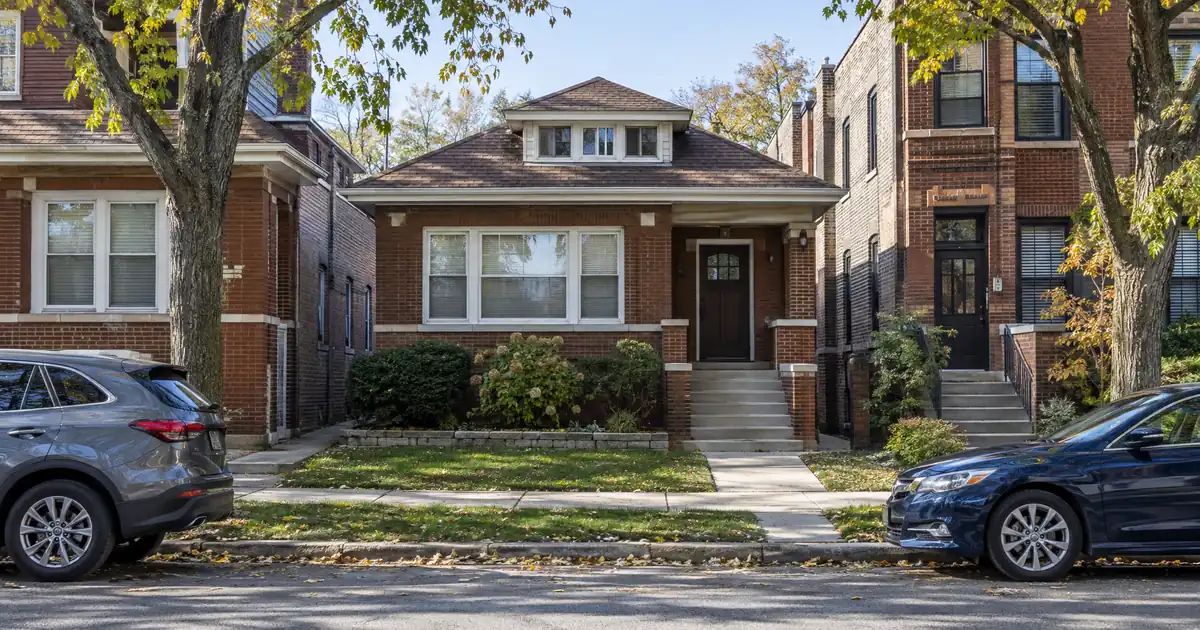
Does a Berwyn two-flat carry a cash-out refinance better than a single-family bungalow? On the sourced numbers, yes. The Cook County Assessor puts the median market value of small apartment buildings in Berwyn Township at $324K, against $247K for single-family homes. Redfin shows the citywide median sale price at $295K, down 1.7% from a year earlier. Stacked unit rents can cover a building’s carry. A single bungalow rent barely does.
DSCR Cash-Out Calculator
Run the cash-out numbers in Berwyn, IL
Rate source: Freddie Mac 30-yr average via FRED® — Federal Reserve Bank of St. Louis · effective Sep 24, 2026
Prefilled with starting assumptions — enter your property’s value, balance, taxes, and insurance for a more accurate picture.
Program parameters update from Lendmire’s centralized guideline source. Taxes and insurance are editable estimates.
As of Sep 24, 2026 · General Freddie Mac market benchmark, not a Lendmire loan offer. Property value, balance, taxes, and insurance are editable estimates. Maximum loan-to-value varies by lender, program, property type, and seasoning. Not a Loan Estimate, approval, or commitment to lend. Program availability and eligibility are subject to lender guidelines, credit approval, property review, and underwriting.
The Short Version:
A DSCR cash-out refinance on a Berwyn, Illinois investment property is underwritten primarily on the property’s rental income measured against its full monthly obligation, then sized to a 75% loan-to-value ceiling on equity the investor already holds. Eligibility, proceeds, and terms depend on the lender, the appraisal, and the file.
- Small apartment buildings carry a higher assessor median than single-family homes, which favors stacked-rent coverage.
- Single-family bungalow rents cover the full payment thinly, around the 1.0x benchmark.
- Prices are flat to slightly down, so extractable equity comes from basis and rehab, not momentum.
- Cash-out typically needs about 6 months of seasoning, 1.00 minimum coverage, and roughly 6 months of reserves.
Real estate investors buying in Berwyn, Illinois can work with Lendmire to access DSCR programs across a 41-market footprint that includes D.C. Lendmire is a DSCR-focused mortgage broker. It arranges these loans through wholesale lending channels and does not lend or underwrite itself. This article covers the equity-extraction side of the market: the investor already owns the asset and wants to turn trapped equity into capital for the next deal.
Berwyn Market Snapshot
A quick read on the Berwyn investor landscape — figures come from the cited sources below. Confirm current property-level numbers before underwriting.
| Metric | Detail |
|---|---|
| Home prices | $295K median (Redfin Housing Market, Berwyn) |
| Population | 55,595 population (Census Reporter) |
Equity Without Appreciation: What Berwyn’s Flat Pricing Means
Berwyn is not an appreciation market right now, and the cash-out thesis has to be built on basis and income instead. Both dated price series point flat to slightly negative. Redfin’s reading of $295K median sale price is down 1.7% year over year, with homes sitting 66 days against 50 days a year earlier. Movoto reports a $355K median listing price, with price per square foot down 3%. Those two medians measure different things, sold prices versus asking prices, and the gap between them is itself information. Sellers are asking more than buyers are paying. Terms vary by lender guidelines, property type, leverage, credit profile, and full file review.
Niche lists a median home value of $299,800, which lines up with Redfin’s sold figure. This article treats $295K as the canonical citywide median and uses the other figures only as context.
The supply side explains the stability. Census Bureau QuickFacts puts the population at 55,595 across 3.9 square miles, roughly 14,239 people per square mile. The 2020 Census count was 57,250, per Wikipedia’s Berwyn entry, and decennial growth has been low-single-digit. This is a built-out inner-ring suburb with no construction boom in the research, so there is no new-supply wave to compress rents. There is also no demographic tailwind to lift values.
The forward-looking question is which indicators would break the flat pattern. Three are worth tracking over the next 6-24 months:
- Days on market. A move back toward the 50-day level would signal buyer demand returning and support appraisal values.
- Price per square foot. Movoto’s 3% decline is the number to watch. A reversal would matter more than any median.
- The list-to-sold gap. The distance between $355K asking and $295K closed shrinking would indicate firmer comps.
For a cash-out borrower, the practical implication is simple. Appraisals will be conservative in a flat tape, so the 75% loan-to-value ceiling applies to a value the appraiser has to defend with recent sales. Equity built through a below-market purchase or a completed rehab is more reliable here than equity assumed from market drift.
Why Two-Flats Carry the Cash-Out (and Bungalows Struggle)
Small multifamily is the strongest DSCR fit in Berwyn, and the reason is arithmetic. Single-family rent runs thin against price in this city. The Assessor’s median for small apartment buildings is $324K, well above single-family at $247K, but a second and third income stream more than justifies the premium.
Start with what rents the research supports, and note that sources disagree because they measure different property mixes. Rentometer lists averages of $1,329 for a one-bedroom, $1,805 for a two-bedroom, $2,553 for a three-bedroom, and $3,133 for four-plus bedrooms. Redfin’s rental data shows a $1,100 median across all unit types, and Apartments.com reports an average of $926, up 1% over the past year. Niche shows a median rent of $1,215. The spread from $926 to $2,553 is not noise. It is the difference between small older units and family-sized three-bedrooms, and the investable product sits at the high end of that range.
On the sourced figures, a three-bedroom renting near the Rentometer average against a $295K-$355K price works out to gross rent of roughly 0.7%-0.9% of price per month. That is Lendmire Research arithmetic, not a published statistic. Berwyn single-family is not a 1% market.
Here is how the modeled coverage compares once taxes and insurance are in the denominator. Both columns are modeled assumptions, not market facts.
| Factor | Bungalow SFR | Two-flat |
|---|---|---|
| Modeled value | $350K | $400K |
| Modeled rent | $2,553 (3BR avg) | $4,000 (two units) |
| Coverage incl. Taxes/insurance | About 1.0x | About 1.4x |
| Cash-out cushion | Thin | Meaningful |
Both figures are full-obligation coverage at 75% loan-to-value, rounded down. Run the same bungalow at the $295K Redfin median and coverage improves to roughly 1.2x. At the $355K Movoto asking level it slides back toward 1.0x. Price discipline on the bungalow is what separates a file that works from one that does not.
The two-flat column deserves a sourcing note. One Berwyn listing on Homes.com says a three-bedroom unit can rent for at least $2,200 monthly, plus $125 for a garage space, and a separate 60402 listing says a basement unit previously rented for $1,400. Those are agent-remark asking claims, not verified rents. The modeled two-flat figure uses conservative unit rents below those claims, and the right underwriting basis in practice is in-place leases. Typical Berwyn two-flats are brick buildings with three-bedroom, one-bath units, and in some three-flats each tenant pays their own utilities. Separately metered, family-sized layouts are what a DSCR file wants to see. Three-flats are scarcer than two-flats, so the realistic target for most investors is the two-flat.
What if a property lands below 1.00 on long-term rent alone? That happens with lower-rent condos or a bungalow bought near asking. A sub-1.00 program, an interest-only structure, or reduced leverage are the paths a lender might review. Each carries tradeoffs in pricing, proceeds, or reserves, and qualification stays subject to lender guidelines, credit approval, and property review.
Condos are the odd case. The Assessor’s $115K median makes them a more affordable entry in the city, but homeowners’ association dues sit inside the payment and can erase the coverage that a low basis creates. Cheap is not the same as reviewable.
Berwyn Submarkets, Ranked by Cash-Flow Logic
The lowest-priced pockets pair mid-range rents with the lowest basis, which makes them the natural cash-flow submarkets, while the priciest areas are better equity-hold stories. Redfin’s neighborhood guide lists median sale prices of $300,000 in the Ogden Avenue District, $325,000 in Clyde, $392,000 in North Berwyn, $399,000 in South Berwyn, and $455,000 on the West Side. Those figures are undated in the snippet, so read them as relative rank, not current pricing.
Redfin’s rental page lists neighborhood median rents of $1,950 in South Berwyn, $1,300 in North Berwyn, $2,547 on the West Side, $1,350 in Clyde, and $1,000 in the Theater District. The samples are thin and the month-over-month swings run as large as 62%. This data supports a direction, not a ratio. The honest conclusion is that verified two- and three-bedroom rents by neighborhood were not found, so no ratio is stated.
Ogden Avenue and Clyde. This is the entry-price tier. Ogden is Berwyn’s stretch of Historic Route 66, per Whyberwyn, and it is auto-oriented. A cash-out here is a basis play: buy low, hold, and pull out proceeds once the rent roll and appraisal support it. Coverage is better, but exit liquidity is thinner than in the pricier blocks.
South Berwyn. This is where the value-add math shows most clearly. Redfin’s South Berwyn listings show older two-bedroom units asking $1,295 to $1,695, while renovated or newer product asks $2,000 to $2,450. One new-construction listing, reVerb Century Station, asks $2,200 for a 1,075 square foot two-bedroom. That is a gap of roughly $500-$900 a month between old and renovated stock. Renovate, season the loan, and cash out against the higher rent. The caveat is that these are point-in-time asking rents, and the appraiser’s rent schedule has to support the higher number before the lender will count it.
North Berwyn and the West Side. These are higher-priced blocks where the rent samples are widest and least reliable. The West Side’s $2,547 median rent sits against the highest sale price in the city. Treat both as equity-preservation holdings and underwrite rents from actual leases.
The Depot District. This is the walkable center, per Whyberwyn: independent shops, restaurants, and medical services, including Loyola MacNeal, with the Metra station as the transit anchor. Properties near the station benefit from the rail commuter pool, covered below. The Berwyn Development Corporation also describes Harlem and Cermak as one of the most heavily traveled commercial corners in the near-western suburbs, with Cermak Plaza as the retail anchor. A commercial corridor with a grocery anchor supports the rental blocks around it, but it is a support factor, not a rent driver.
Who Rents Here: Hospital, Rail, and Chicago Commuters
Berwyn’s rental demand rests on healthcare employment and rail access, and the research supports both. It does not support a precise vacancy figure or a verified employer headcount list, and neither is stated here.
Loyola MacNeal Hospital is the clear anchor. Loyola Medicine’s physician-recruitment profile describes it as a teaching hospital with 374 licensed beds and a 68-bed behavioral health program. The Illinois Hospital Report Card lists it as a voluntary non-profit private hospital in Berwyn. It has been part of the Trinity Health-affiliated Loyola system since it changed hands from Tenet. A teaching hospital employs residents, nurses, and technicians, which is a steady mid-income tenant pool. That link from hospital to renter is Lendmire Research inference, not a sourced claim. Bed count is also a better scale marker than the employee band on LinkedIn, which should not be read as a headcount.
DSCR vs. conventional financing
There are two common ways to finance an investment property in Berwyn, IL, and they qualify you differently — here’s how investors weigh them.
Why investors choose it
- Qualifies on the property’s rental income — no personal tax returns, W-2s, or pay stubs needed to document income.
- No personal debt-to-income ceiling to clear, so existing mortgages and obligations don’t cap your borrowing the same way.
- Can be closed in an LLC, keeping the property inside a business entity.
- Built for scaling — not held to the limit on number of financed properties that conventional financing applies.
- Underwriting centers on the deal: generally qualifies when the rent covers the payment, a 1.00x coverage ratio being a common baseline (confirmed in underwriting).
- Designed specifically for investment property, including long-term and, where the program allows, short-term rentals.
Where it’s strong
- Often the lowest ongoing financing cost for a buyer who fully qualifies on personal income — a fit for a first property or a cost-first purchase.
Trade-offs for investors
- Requires full personal income documentation and must fit within a debt-to-income limit — salary, existing debts, and other mortgages all count.
- Typically held in your personal name rather than a business entity.
- Caps how many financed properties you can carry, which can become a ceiling as a portfolio grows.
- Evaluates you as a borrower as much as the property, which usually means more paperwork.
How investors usually choose: a first or single property often optimizes for the lowest financing cost; portfolio builders often optimize for leverage, vesting in an LLC, and scaling past conventional caps. The right answer depends on your goals, the property, and current guidelines — both paths run through select lenders in Lendmire’s wholesale network, with eligibility and terms confirmed in underwriting.
Data USA shows the top resident employment sectors as health care and social assistance at 4,231 workers, manufacturing at 3,742, and retail trade at 3,489. These are resident workers, and many commute elsewhere. Census Reporter puts mean travel time to work at 29 minutes. This is a commuter suburb.
Berwyn has three Metra BNSF stations, all in fare zone 2. The Berwyn station sits 9.6 miles from Union Station. Pre-pandemic weekday boardings were 669 at Berwyn, 451 at Harlem Avenue, and 174 at LaVergne, and Pace buses link to the CTA Blue Line. Those counts are old, so use them only as a ranking. Blocks near Berwyn and Harlem offer rail commuting without Chicago’s city limits, which supports tenant retention.
One structural point cuts the other way. Niche notes that most Berwyn residents own their homes. The rental pool is thinner here than in a renter-majority city, which is why unit-level quality and location matter more than market-wide absorption.
One more observation from Lendmire’s deal desk. Files in owner-heavy inner-ring suburbs like this one tend to hinge on the rent schedule more than on the purchase history. The cleaner files from a documentation standpoint arrive with signed leases, proof of deposits, and a basic rent roll for each unit. Single-family files that lean on a market-rent estimate alone tend to come back from appraisal with lower rents than the investor modeled, and the proceeds shrink with them.
What Breaks the Pattern?
Three risks could break the cash-out math in Berwyn, and one data gap deserves flagging. The gap first: no reliable vacancy rate was found, and rent growth is only visible in rough signals. Apartments.com shows about +1%, and the Zillow figure is too stale to use. Any investor underwriting here should treat flat rents as the base case.
The first risk is appraisal drift. In a market where days on market stretched from 50 to 66 and price per square foot is falling, comps can move against a cash-out borrower between purchase and refinance. The second is the single-family coverage squeeze. A bungalow sitting near 1.0x has no buffer if rents soften or the property is bought at asking. The third is thin sampling in neighborhood rents. The $1,000 to $2,547 spread in Redfin’s neighborhood data is too wide to underwrite from.
On the other side, the multifamily data hints at better liquidity. Movoto’s multifamily page shows about $205 per square foot and roughly 26 days on market, against 66 days for all homes. If that holds, small multifamily trades faster than the overall market, which would mean better comps and easier appraisal support for a cash-out. The page is undated, so verify it before leaning on it. The choice between the cheap-basis Ogden two-flat and the better-located Depot District product is a genuine toss-up. The first covers better on paper, and the second probably appraises more cleanly. Investors with a long hold can argue for the cheaper basis, and those planning to refinance repeatedly may prefer the stronger comps.
Verify current local rental rules, taxes, and insurance with qualified local professionals before committing to a Berwyn property.
Structuring the Pull: Seasoning, LTV, and Reserves
A cash-out on a Berwyn investment property is capped at 75% of appraised value, typically after about 6 months of ownership measured from title recording. Everything else sizes around that ceiling. Lendmire’s refi programs and its page on pulling equity out cover the mechanics in full.
The program parameters most relevant to Berwyn files, subject to lender guidelines:
- Coverage. A 1.00 minimum is the standard benchmark, with the property’s rent used for lender review measured against full PITIA. Some lenders review lower ratios, but those files usually carry compensating factors, reduced leverage, or different pricing.
- Credit. Tiers run at 620, 660, 680, and 700, with 620 as the floor. Better scores generally improve pricing and available leverage.
- Reserves. About 6 months of PITIA is typical, rising to about 9 months above $1,500,000.
- Loan size. Standard programs run up to $3,000,000. Smaller balances route through select lenders in the network.
Proceeds are not a guaranteed figure. Equity available depends on rent used for lender review, PITIA, reserves, and the 75% ceiling. If the payoff on an existing loan already sits near 70% of appraised value, there is almost nothing to extract. If it sits near half, the gap to 75% is real capital. Dollar amounts come from the calculator, not from article math.
Here is how an equity extraction might work on the product that pencils best here. Say an investor bought a Berwyn two-flat on a below-market basis, completed a rehab that lifted both units’ rents toward the renovated band seen in South Berwyn, and held title past the seasoning window. The appraiser’s rent schedule supports the new rents, coverage lands comfortably above 1.00, and the 75% ceiling frees up a 20-plus-point gap against the existing payoff. That gap becomes the down payment on the next property. For LLC-owned properties, eligibility is subject to lender program eligibility, so confirm entity structure before listing a property for refinance.
The comparison against conventional financing is worth a read, and the program-to-program comparison lays it out. Conventional investor loans measure personal income, while a DSCR file measures the property. For investors holding several Berwyn flats, the second approach avoids stacking each new loan onto a personal debt-to-income ratio. Lendmire’s DSCR walkthrough explains the calculation, and the brokerage’s page on DSCR loan options for Illinois investors covers the statewide picture. Investors who want to talk through a specific Berwyn file can reach the team at 828-256-2183.
Where This Leaves a Berwyn Investor
Strip away the headlines and Berwyn comes down to one gap. Assessor data puts small apartment buildings at a $324K median against $247K for single-family homes, and that premium is exactly why the equity worth pulling here sits in the flats.
Frequently Asked Questions
How do you qualify for a DSCR cash-out refinance in Berwyn, Illinois?
The property’s rent has to cover its full monthly obligation (principal, interest, taxes, insurance, and any association dues), with 1.00 as the standard benchmark. Borrowers typically need about 6 months of ownership seasoning, a credit score from 620 up, and roughly 6 months of reserves. Final eligibility depends on lender guidelines, credit approval, and property review.
What are the requirements for an investment property loan in Berwyn, Illinois?
Expect a rent schedule or lease documentation, an appraisal, proof of reserves, and a credit profile in the tiers above. Cash-out files cap at 75% loan-to-value, and entity-owned properties are subject to program terms. Two-flats with separately metered units tend to produce the cleanest files, since each unit’s rent is documented independently.
What property types work best for DSCR cash-out in Berwyn?
Two-flats and small multifamily, because stacked rents lift coverage above what a single bungalow produces. Lendmire (NMLS# 2371349) arranges DSCR investor loans. Cash-out programs there cap at 75% loan-to-value on investment property.
Does Berwyn’s flat pricing hurt a cash-out refinance?
It limits upside but does not block a refinance. With Redfin showing prices down 1.7% and days on market up, appraisals will track recent sales closely, so extractable equity depends on purchase basis or completed rehab. Investors who bought below market or added rent through renovation are best positioned, and those relying on appreciation alone are not.
How long must you own a Berwyn property before cashing out?
About 6 months, measured from title recording, on typical programs. The clock starts when the purchase is recorded, not when renovation finishes. Investors planning a rehab-then-refinance sequence should map the seasoning window against construction so the appraiser sees stabilized rents.
For current guidelines and terms, see Lendmire’s DSCR loan programs page.
Get Started
Ready to find the right loan for you?
In about 30 seconds you can review financing options available for your investment property. No commitment required.
Informational only. Not a Loan Estimate, approval, or commitment to lend. Program availability and eligibility are subject to lender guidelines, credit approval, property review, and underwriting.
About Lendmire
Lendmire (NMLS# 2371349) is a mortgage brokerage built around DSCR investor lending, with programs available in 41 markets, including Washington, D.C. The brokerage is a 2026 Scotsman Guide Top Mortgage Workplace and was recognized by Scotsman Guide in 2025. DSCR lenders commonly evaluate rental-income coverage instead of personal income paperwork, a practical fit for LLC-owned and multi-property investors. Terms vary by lender, property, leverage, and program.
This article is part of Lendmire’s investment property cash-out refinance program — full qualification details, guidelines, and scenarios live on the program page.
Related reading: Luxury Rental DSCR Loans In New Jersey · Jersey Shore Vacation Rental Loans: DSCR Financing In Ocean City, Cape May And Long Beach Island · DSCR Cash-out Refinance In New Jersey: Pulling Equity From A Rental
Guides: Investment Property Cash-Out Refinance in Berwyn, IL · Investment Property Cash-Out Refinance in Illinois
Brandon Miller
Founder & CEO, Mortgage Loan Originator, Lendmire LLC
- Mortgage Loan Originator · NMLS# 1129696 · Verify on NMLS Consumer Access
- North Carolina Real Estate Broker · License# 343312 · Verify on NCREC
- North Carolina Insurance Producer · License# 19053198 · Property, Casualty, Life, Health · Verify on NAIC SBS
- Lendmire LLC · Firm NMLS# 2371349 · Verify firm licensure
Disclosures. The information presented in this article is general market commentary, not financial, legal, or tax advice. Lendmire is a mortgage brokerage (NMLS# 2371349) — not a direct lender or depository institution — and loan placement is subject to lender underwriting. Nothing in this content represents a commitment to lend. Loan terms, pricing, and program availability vary based on borrower qualifications, property characteristics, and state of subject property, and are subject to change at any time. Lendmire complies with Equal Housing Opportunity requirements. Consumer access: nmlsconsumeraccess.org.