
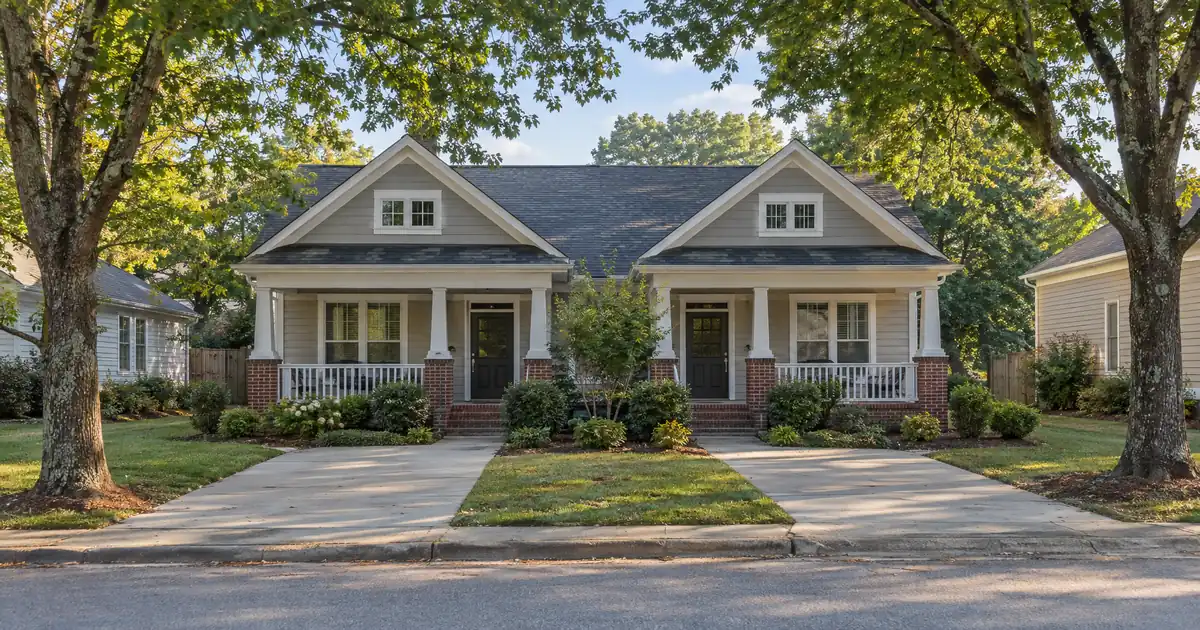
A three-bedroom house renting near $1,550 in a market where the median sale price sits around $274,850 doesn’t hand you a 1% rule deal. That gap, between the equity you’ve built and the rent that has to carry the new loan, is where most cash-out refinance files on Burlington investment property get stuck. Per Zumper, the 3-bedroom figure is about $1,550, and Redfin puts the median sale price at $274,850. A DSCR cash-out refinance can still work here. It just works differently than it does in higher-rent markets.
The Short Version: A DSCR cash-out refinance on a Burlington, North Carolina rental is underwritten primarily on the property’s rental income measured against its full monthly obligation, so what the file must show is a rent used for lender review, a supportable appraised value, and ownership seasoning, all subject to lender guidelines.
DSCR Cash-Out Calculator
Run the cash-out numbers in Burlington, NC
Rate source: Freddie Mac 30-yr average via FRED® — Federal Reserve Bank of St. Louis · effective Sep 24, 2026
Prefilled with starting assumptions — enter your property’s value, balance, taxes, and insurance for a more accurate picture.
Program parameters update from Lendmire’s centralized guideline source. Taxes and insurance are editable estimates.
As of Sep 24, 2026 · General Freddie Mac market benchmark, not a Lendmire loan offer. Property value, balance, taxes, and insurance are editable estimates. Maximum loan-to-value varies by lender, program, property type, and seasoning. Not a Loan Estimate, approval, or commitment to lend. Program availability and eligibility are subject to lender guidelines, credit approval, property review, and underwriting.
- Single-family rent runs well under the 1% rule, so high-leverage coverage on a house gets tight.
- Cash-out LTV caps at 75%, with about six months of title seasoning.
- Two-bedroom-heavy rental demand makes small multifamily the cleaner coverage play.
- Lab, healthcare, and manufacturing employment anchor tenant demand more than any campus does.
Burlington, North Carolina investors can have DSCR scenarios reviewed through lender programs that Lendmire helps place across 41 markets, including Washington, D.C. Lendmire (NMLS# 2371349) is a DSCR-focused mortgage broker, so it arranges these loans through wholesale investor lenders rather than lending directly. This article assumes you already own the property. If you’re still shopping for one, that’s a different file.
Burlington Market Snapshot
A quick read on the Burlington investor landscape — figures come from the cited sources below. Confirm current property-level numbers before underwriting.
| Metric | Detail |
|---|---|
| University enrollment | 10,000+ students annually (Alamance Community College) |
| Employment | 135 jobs (City of Burlington, Economic) |
East and North Burlington: Where the Equity Math Starts
East and North Burlington are the screening starting point for equity-extraction files. The research flags them as the more affordable sides of the city, and Apartments.com lists North Burlington and Downtown Burlington among the lowest-rent areas. Workforce single-family homes and small multi-unit buildings are the likely product.
No source verified rent-to-price by submarket, so treat these as areas to screen, not proven cash-flow leaders. Lower rents usually travel with lower purchase prices, but that’s an inference. The bottom price tier shows how low the basis can go: WSOC, citing Redfin data, reported a bottom-tier median sale price of $132,600. An investor who bought low in that tier and added value has a different equity story than someone who bought at the citywide median.
The tradeoff is condition. Older workforce stock and mill-village-adjacent homes (Glen Raven sits just north of the city line) can offer better rent-to-value, but the appraisal has to reflect the work done. If the renovation isn’t visible in comps, the equity you think you built may not show up at the 75% ceiling.
Downtown and the Fountain Place Streets
Downtown Burlington is the tenant-demand story. Labcorp is headquartered there, and Carolina Demography listed it as Alamance County’s top employer in its county-level analysis. Professional, lab, and administrative workers who want a short commute gravitate to the downtown core, which also has a restored theater, a library, and small shops.
Just off that core, the West Davis Street and Fountain Place Historic District has Victorian and Colonial Revival homes on tree-lined streets, per ForRent’s neighborhood description. Character homes suit single-family rentals. They also tend to carry older-house maintenance, which matters because a cash-out refinance asks the property to support a larger loan balance with the same rent.
Thinking out loud: the stronger cash-out candidates may be the plain, updated workforce houses rather than the character homes. Historic stock appraises well when it’s maintained, but the rent doesn’t scale with the charm. Investors who care about long-term hold and appreciation could reasonably argue the other way.
West Burlington and Lake Mackintosh: The Leverage Problem
West Burlington and the Alamance Crossing area are newer construction with I-40/I-85 access and shopping close by. Cone Health Alamance Regional sits off Huffman Mill Road in this part of town. It’s a convenient location, and a house there may appraise cleanly.
Lake Mackintosh-adjacent homes sit at the higher-price end. Here the cash-out math tightens for a simple reason: rent doesn’t scale with price the way value does. A higher-priced house can have plenty of equity and still fall short on coverage, because the rent has to cover a bigger loan. Skip these if you’re counting on coverage alone.
Running the Numbers (Modeled, Not Market Data)
Single-family houses here sit below a 1.00 coverage ratio at the 75% cap, while a duplex clears it. DSCR is rent divided by the full monthly obligation, covering principal, interest, taxes, insurance, and any HOA dues. The guide “What Is a DSCR Loan” is worth a read if the ratio is new to you. The figures below are modeled, include taxes and insurance, and are rounded down.
| Scenario (modeled) | Cash-out LTV | Coverage, incl. Taxes and insurance |
|---|---|---|
| 3BR house at $274,850, $1,550 rent | 75% | about 0.9x |
| Same house, same rent | 65% | about 1.0x |
| Duplex modeled at $350,000, 2 × $1,225 | 75% | about 1.1x |
The house and rent figures come from the Redfin and Zumper numbers above. The duplex valuation is an assumption, not a market median, and the $1,225 per unit is Zumper’s 2-bedroom average. RentCafe shows 2-bedroom rents at $1,369 and 3-bedroom rents at $1,640, which would push duplex coverage higher. But its data covers buildings with 50 or more units, so treat those as ceilings for small buildings.
Most standard DSCR programs are built around a 1.00x benchmark because rent covers the payment at that level. Some lenders may review lower scenarios, but those usually mean stronger compensating factors, lower leverage, or different pricing. If your house lands at 0.9x, the structures a lender could review include a sub-1.00 program, an interest-only structure, a lower LTV, or more reserves. Each is subject to lender guidelines, credit approval, and property review, and each carries tradeoffs.
Reaching for sub-1.00 on a single-family house is a defensible choice if you have a real appreciation or value-add story. If you’re reaching because nothing in your portfolio pencils, that’s a signal to reexamine what you hold, not to find a cleverer loan structure.
What the Appraisal Has to Prove
The appraisal has to support the value you’re borrowing against, and Burlington’s price data is noisy. Redfin’s more recent snapshot shows a $274,850 median, up 6.1% year over year. An earlier Redfin snapshot showed $265,000, down 9.86% year over year, with homes selling in about 43 days. Movoto reported $315,999. The sources use different methods and dates, so think of a roughly $265,000 to $275,000 band with Movoto as the high outlier.
Price and rent point in different directions. Redfin shows price per square foot up 3.6%, while Apartment List has median rent at $1,089, up only 0.1% year over year. Zumper shows rent down 3.9% at a $1,295 average. This reads as modest appreciation with flat rent.
So underwrite on today’s rent and assume no growth. Equity you pull out here comes from purchase discount or renovation value, not from rents climbing. The seasoning clock is the other piece: cash-out generally requires about six months of ownership measured from title recording. An investor who bought a distressed house, rehabbed it, and refinanced the day seasoning cleared is relying on the appraisal to credit the work. Pre-and-post photos, receipts, and permits for the work matter. Value-add files are the ones where documentation does the most work.
Cash-out available depends on the rent used for lender review, the full payment, reserves (about six months is typical, about nine above $1,500,000), and the 75% LTV ceiling. It isn’t a fixed cash figure. For the broader mechanics, the equity-extraction mechanics page lays out how the pieces fit. Exact terms depend on the lender’s guidelines, property type, leverage, and a full review of the borrower’s file.
Who Rents Here? (And Why It Matters for the Next Lease)
Healthcare, manufacturing, and education carry resident employment here. Data USA lists Health Care and Social Assistance (5,372 residents), Manufacturing (4,347), and Educational Services (2,783) as the top sectors. The Alamance Chamber describes the county’s base as manufacturing, medical testing, distribution, and consumer goods.
DSCR vs. conventional financing
There are two common ways to finance an investment property in Burlington, NC, and they qualify you differently — here’s how investors weigh them.
Why investors choose it
- Qualifies on the property’s rental income — no personal tax returns, W-2s, or pay stubs needed to document income.
- No personal debt-to-income ceiling to clear, so existing mortgages and obligations don’t cap your borrowing the same way.
- Can be closed in an LLC, keeping the property inside a business entity.
- Built for scaling — not held to the limit on number of financed properties that conventional financing applies.
- Underwriting centers on the deal: generally qualifies when the rent covers the payment, a 1.00x coverage ratio being a common baseline (confirmed in underwriting).
- Designed specifically for investment property, including long-term and, where the program allows, short-term rentals.
Where it’s strong
- Often the lowest ongoing financing cost for a buyer who fully qualifies on personal income — a fit for a first property or a cost-first purchase.
Trade-offs for investors
- Requires full personal income documentation and must fit within a debt-to-income limit — salary, existing debts, and other mortgages all count.
- Typically held in your personal name rather than a business entity.
- Caps how many financed properties you can carry, which can become a ceiling as a portfolio grows.
- Evaluates you as a borrower as much as the property, which usually means more paperwork.
How investors usually choose: a first or single property often optimizes for the lowest financing cost; portfolio builders often optimize for leverage, vesting in an LLC, and scaling past conventional caps. The right answer depends on your goals, the property, and current guidelines — both paths run through select lenders in Lendmire’s wholesale network, with eligibility and terms confirmed in underwriting.
Named employers include Labcorp, Cone Health Alamance Regional Medical Center, Glen Raven (technical fabrics, founded 1880), and Honda Aircraft. Alamance Community College lists Labcorp, Glen Raven, Honda Power, Sandvik, Carolina Biological Supply, and Elon University among its business partners. The research did not retrieve verified headcounts for individual employers, so use these as names, not numbers.
Elon University is in the adjacent town of Elon, about 10 miles west. Per U.S. News, 30% of its undergraduates live off campus, which adds some rental demand on the west side. Undergraduate enrollment has recently slipped to 5,987, per Elon News Network, so don’t underwrite on student growth.
Burlington’s population is about 59,610 per Census Bureau QuickFacts, and roughly 45% of households rent. Point2Homes data (dated, and the page itself cautions about pandemic-era shifts) counts 5,303 two-bedroom rentals, half the market, against only 136 four-bedrooms. Demand clusters in the $1,000 to $1,500 band, per RentCafe’s distribution, with 71% of rentals falling there.
That tenant profile points toward small multifamily. NeighborhoodScout shows single-family detached homes at 58.73% of housing units, with duplexes, converted homes, and small apartment buildings another 10.49%. Two- to four-unit product exists but is a minority, so expect thinner comps than single-family. Large four-bedroom houses are scarce as rentals and may be harder to price.
The Toyota Question
Burlington is a spillover market for the Toyota battery plant at the Greensboro-Randolph Megasite, not the site itself. The City of Burlington flags the plant as roughly 20 minutes away and cites 1,750 initial jobs at announcement, later an expanded $3.8 billion investment and about 2,100 jobs, per the city’s investment page. Broker blogs claim larger numbers, but those are unverified.
The honest read: this supports demand at the margin, but no source shows it moving Burlington rents yet. Apartment List’s flat rent trend suggests it hasn’t. A cash-out file built on “Toyota will lift rents” is underwriting a story. Build it on today’s lease.
When DSCR Is the Right Tool (and When It Isn’t)
DSCR cash-out makes sense for investors holding properties in an LLC (subject to lender program eligibility), for self-employed borrowers whose traditional personal-income documentation understates income, and for anyone whose financed-property count is crowding conventional limits. If you hold one or two rentals personally and have strong traditional employment income, the guide “Where DSCR and Conventional Diverge” may favor the conventional path, which can cost less and doesn’t depend on the rent covering the payment.
The break-even tends to arrive around the third or fourth financed property, or earlier when personal returns don’t cleanly support the rental income. DSCR is also the lane where Burlington’s thin single-family rents matter most, since the loan is judged on the property’s income. The investment property refinance options cover the rate-and-term alternative if the goal is restructuring, not extraction. For statewide program context, see DSCR loans in North Carolina.
What happens to the proceeds matters as much as the loan. Pulling equity to buy a second small multifamily in Burlington, where two-bedroom stock is the demand center, is a coherent loop. Pulling it to chase yield in a market where coverage doesn’t pencil is a different decision, worth stress-testing first. Verify current local rental rules, taxes, and insurance with qualified local professionals before committing.
What the Deal Desk Sees
In markets like this one, where rents are flat and prices are noisy, the common friction point is not credit. It’s the gap between the value the owner expects and the coverage the lease supports. Lendmire’s deal desk tends to see the cleanest files from a documentation standpoint arrive with complete leases, entity documents, title, and property details ready for lender review. The files that stall usually have a lease below market or an appraisal that lands under the owner’s number. Getting a realistic rent comp before applying prevents most of that. If you want a second set of eyes, you can review your scenario with us or call 828-256-2183.
Frequently Asked Questions
How do you qualify for a DSCR loan in Burlington, North Carolina?
Qualification centers on the property: its documented rent against its full monthly obligation, typically a 1.00 coverage ratio or better, plus a credit score (620 is the floor, with tiers at 660, 680, and 700) and reserves. On a cash-out, add the six-month seasoning point and the 75% LTV ceiling. Exact eligibility depends on lender guidelines, credit profile, and property review.
What are the requirements for an investment property loan in Burlington, NC?
Expect a lease or rent comp, entity documents if the title is in an LLC, title work, insurance, and an appraisal. Manufactured homes, log homes, and barndominiums fall outside these DSCR programs. Burlington’s duplex stock and workforce houses fit the program, but the ratio decides how much leverage the file supports.
How do DSCR lenders review rental income instead of traditional tax-return income in North Carolina?
They look at the property’s rent used for program review against its full monthly payment instead of the borrower’s traditional personal-income documentation. Lendmire arranges these programs. A key feature is that qualification centers on rental income, subject to lender guidelines.
Does Burlington’s flat rent trend hurt a cash-out refinance?
It limits how much you can pull, yes. Apartment List shows rent up only 0.1% year over year and Zumper shows it down 3.9%, so lenders and underwriters work from today’s rent with no growth assumed. Lower leverage or a duplex usually fixes the coverage problem better than waiting for rents to rise.
Why do Burlington price figures vary so much between sources?
Redfin, Movoto, and others measure different periods and use different methods, so medians range from roughly $259,000 to $316,000. The appraisal, not an online median, determines the value a lender uses. Pull recent sold comps near the property and treat any online figure as a reference.
For current guidelines and terms, see Lendmire’s DSCR loan programs page.
Get Started
Ready to find the right loan for you?
In about 30 seconds you can review financing options available for your investment property. No commitment required.
Informational only. Not a Loan Estimate, approval, or commitment to lend. Program availability and eligibility are subject to lender guidelines, credit approval, property review, and underwriting.
About Lendmire
Lendmire (NMLS# 2371349) is a non-QM mortgage broker serving investors across 41 markets, Washington, D.C. included. It helps structure DSCR scenarios commonly evaluated around a property’s rental income rather than personal income paperwork, subject to lender guidelines. Recognized as a 2025 Scotsman Guide Top Mortgage Workplace and a top-ranked workplace in 2026, Lendmire places loans through wholesale investor lenders and is not a direct lender.
Over the next 6 to 24 months, Burlington looks like a market where equity comes from basis and renovation rather than rent growth. The investors best positioned will be the ones holding two-bedroom-heavy small multifamily near the Labcorp and healthcare employment base, with the Toyota corridor as upside they don’t need to underwrite.
References
1. Zumper
2. Redfin
3. Freddie Mac 30-yr average via FRED® — Federal Reserve Bank of St. Louis
5. City of Burlington, Economic
8. RentCafe
9. Movoto
10. Apartment List
11. Data USA
12. Alamance Chamber
This article is part of Lendmire’s investment property cash-out refinance program — full qualification details, guidelines, and scenarios live on the program page.
Related reading: Cash Out Refinance Investment Property Burlington North Carolina · DSCR Cash Out Refinance in West Jefferson, North Carolina: Downtown Mural District Equity Play · Cash Out Refinance Investment Property in Statesville, North Carolina: Will My Rent Cover the New Loan?
Guides: Investment Property Cash-Out Refinance in Burlington, NC · Investment Property Cash-Out Refinance in North Carolina
Brandon Miller
Founder & CEO, Mortgage Loan Originator, Lendmire LLC
- Mortgage Loan Originator · NMLS# 1129696 · Verify on NMLS Consumer Access
- North Carolina Real Estate Broker · License# 343312 · Verify on NCREC
- North Carolina Insurance Producer · License# 19053198 · Property, Casualty, Life, Health · Verify on NAIC SBS
- Lendmire LLC · Firm NMLS# 2371349 · Verify firm licensure
Important disclosures. Lendmire (NMLS# 2371349) is a licensed mortgage brokerage. Lendmire is not a direct lender, depository institution, or financial advisor. All loan inquiries are subject to lender underwriting; this article does not constitute a commitment to lend. Rates, terms, and program guidelines are subject to change without notice and vary by borrower profile, property type, and state. Information in this article is general in nature and is not financial, legal, or tax advice. Equal Housing Opportunity. NMLS Consumer Access: nmlsconsumeraccess.org.