
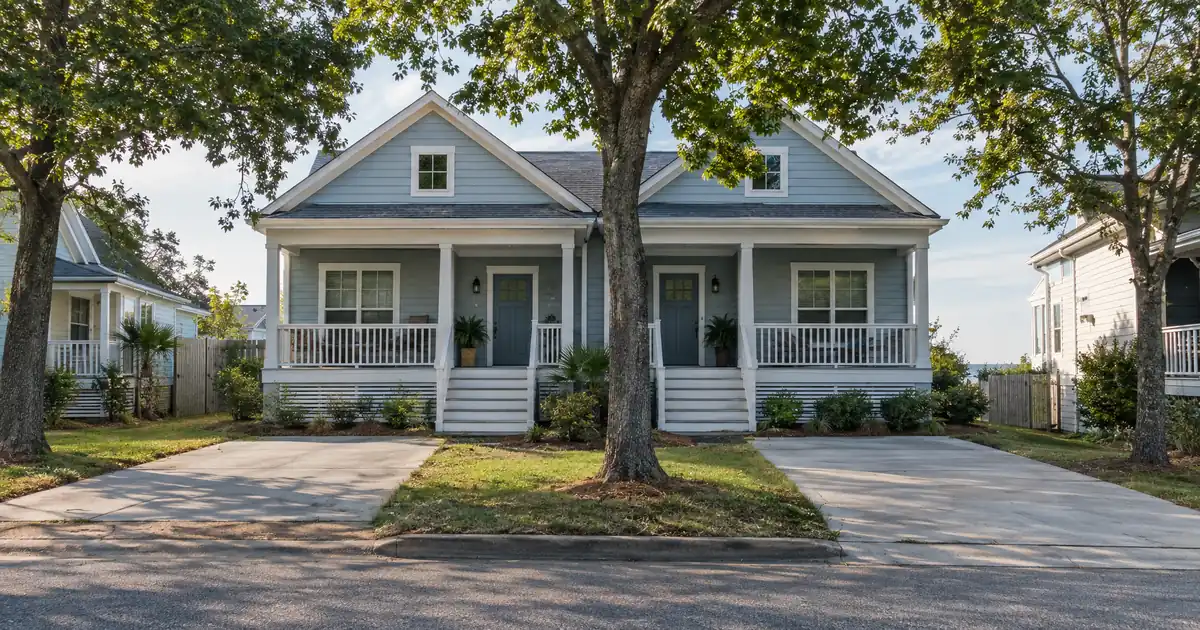
Median gross rent in Carolina Beach is $1,715 a month, set against a median home value of $629,711, according to City-Data’s Census-based profile. That gap is the whole story for anyone planning to pull equity out of a beach-town rental. Value has run well ahead of lease income, so the question is not whether equity exists. It is whether the rent can carry a refinance balance once taxes and insurance are in the debt service.
DSCR Cash-Out Calculator
Run the cash-out numbers in Carolina Beach, NC
Rate source: Freddie Mac 30-yr average via FRED® — Federal Reserve Bank of St. Louis · effective Sep 24, 2026
Prefilled with starting assumptions — enter your property’s value, balance, taxes, and insurance for a more accurate picture.
Program parameters update from Lendmire’s centralized guideline source. Taxes and insurance are editable estimates.
As of Sep 24, 2026 · General Freddie Mac market benchmark, not a Lendmire loan offer. Property value, balance, taxes, and insurance are editable estimates. Maximum loan-to-value varies by lender, program, property type, and seasoning. Not a Loan Estimate, approval, or commitment to lend. Program availability and eligibility are subject to lender guidelines, credit approval, property review, and underwriting.
The Quick Read:
A DSCR cash-out refinance in Carolina Beach, North Carolina is underwritten primarily on the property’s rental income measured against its full monthly obligation, and on this island that math favors stacked units over detached homes, since median gross rent of $1,715 sits against a median value of $629,711 per City-Data.
- Cash-out LTV tops out at 75%, with about six months of seasoning typical.
- Duplex mean value runs $577,904 versus $986,779 for detached homes.
- Single-family coverage on Census rents lands well below 1.00x.
- Only six multi-family listings were active on the island at last check.
- Price-per-square-foot is nearly flat, so appraisal-gain assumptions need a haircut.
Carolina Beach Market Snapshot
A quick read on the Carolina Beach investor landscape — figures come from the cited sources below. Confirm current property-level numbers before underwriting.
| Metric | Detail |
|---|---|
| Home prices | Median value $629,711 (City-Data, Carolina Beach) |
| Typical rents | Median gross rent $1,715 (City-Data, Carolina Beach) |
| University enrollment | 19,895 total (UNCW enrollment news) |
| Employment | Health care 23,489 jobs (17.0%) (myFutureNC New Hanover County) |
The Rent-to-Value Problem, Stated Plainly
Carolina Beach single-family rentals do not cover a meaningful cash-out balance on long-term rent alone. Dividing the $1,715 median rent by the $629,711 median value gives roughly 0.27% of value per month (a derived figure, not a published one). Typical DSCR lending needs materially more than that.
Run the numbers on a detached home using modeled assumptions: a $1,715 rent, a price near the town median, 75% LTV, and full PITIA including taxes and insurance. Coverage comes out below 0.50x. Swap in Zumper’s listing-based house rent of $3,500 and a price near the $813,500 single-family median from Homes.com, and the number improves to roughly 0.70x, which is better but still short. These specifics are subject to lender guidelines and a full review of property, leverage, and credit.
Zumper puts island-wide average rent at $2,800 and shows it down 7% year over year, but its sample is small and asking rents run above in-place leases. The truth likely sits between the Census figure and the listing figure. Underwriting will not give anyone the benefit of the higher number. Terms vary by lender guidelines, property type, leverage, credit profile, and full file review.
The standard benchmark is 1.00x, where rent covers the full monthly obligation. Some lenders review lower ratios, but those files usually come with lower leverage, different pricing, or more cash in. Eligibility depends on lender guidelines, credit profile, reserves, and property review.
Why Stacked Units Change the Math
Duplexes and triplexes are the most workable DSCR cash-out product here because basis per unit drops while rent stacks. City-Data’s structure-level figures show the spread:
| Structure type | Mean value |
|---|---|
| Detached houses | $986,779 |
| 2-unit structures | $577,904 |
| 3-to-4-unit structures | $681,187 |
| Townhouses/attached | $574,093 |
A duplex at roughly $578K collecting the Census median on both sides produces about $3,430 a month. On a modeled 75% LTV with full PITIA, that lands right around 1.0x. Detached homes at nearly $987K collect one rent. Same island, same beach access, completely different coverage. Exact terms depend on the lender’s guidelines, property type, leverage, and a full review of the borrower’s file.
One sourced data point sharpens it. A duplex listing on Homes.com shows two 3BR/2BA units of about 1,241 square feet each, each rented near $2,000 a month, separately metered, about five blocks from beach access. At $4,000 combined and a price near the island’s mean duplex value, modeled coverage clears 1.1x including taxes and insurance. That is one listing, not a market average, and the asking price was not shown, so treat it as an illustration of what in-place duplex income can do.
The 5+ unit figure of $332,890 is likely skewed by a handful of condo or apartment buildings. Skip it as a benchmark.
What Happens Below 1.00x
Say a detached-home owner sits at 0.6x on long-term rent. The options are narrow. A sub-1.00 program may exist with reduced leverage and added conditions. An interest-only structure may improve the ratio, subject to lender guidelines. A smaller cash-out request lowers the balance being tested. Each is a lender-reviewed path, not a promise, and each trims the cash that comes out.
The honest read: for a high-basis detached home, the better move may be a rate-and-term refinance or simply holding. Cash-out works when the ratio supports it, not when equity merely exists.
Appreciation Is Less Clear Than the Headline
The equity case that feels obvious from the median price weakens under a second look. Redfin shows a $685K median sale price over the trailing three months, up 7.0% year over year. But price per square foot is $428, up only 0.7%. Days on market stretched to 78 from 50, and May sales fell to 90 from 105. Zillow’s value index reads $609,274, down 0.5%.
Those numbers disagree on direction. A rising median with flat price per square foot and slowing sales usually signals mix shift, meaning bigger or pricier homes selling, not broad appreciation. An investor whose refinance plan depends on an appraisal far above purchase price should model a conservative value. This is a genuine toss-up between “the equity is real” and “the appraisal may not show it,” and the second possibility deserves a stress test before anyone sizes a cash-out.
Seasoning matters too. Cash-out files typically require about six months of ownership measured from title recording, and the 75% LTV ceiling is a hard cap. Equity available depends on rent used for lender review, PITIA, reserves of about six months (about nine above $1,500,000), and that ceiling. It is not a guaranteed cash figure.
Submarkets: Qualitative Only
No reliable source reports neighborhood-level rent or price for the island. Zumper states it lacks inventory to publish neighborhood rents, so these are character notes, not numbers.
Boardwalk and downtown core. Walkable, with restaurants, bars, and parks, per Niche. This is where the turnkey triplex and duplex listings cluster. Older cottages and newer duplexes sit side by side, so product choice matters more than address.
Lake Park area. A freshwater lake anchors the town center. It suits small-lot multi-unit holdings, though no rent data exists to rank it against the core.
North end and marinas. Condos and marina-adjacent product. Attached units here have a mean value near $574K citywide, which makes them a middle option: better coverage than detached, weaker than a duplex.
Wilmington Beach. Annexed by the town in 2000. No pricing data surfaced. Worth comp-checking before assuming it mirrors the core.
Honestly, the strongest play may be a mainland duplex for investors who want cash-out coverage, though that is a different thesis from owning on the island. For island owners already in place, the duplex-heavy streets near the core are the likeliest to support a refinance balance.
Tenant Demand Sits Across the Bridge
Long-term renters here are tied to the Wilmington employment base. myFutureNC’s New Hanover County profile lists health care at 23,489 jobs (17.0%), accommodation and food services at 18,036 (13.6%), and retail at 15,917 (12.2%). Its top employers include Novant Health New Hanover Regional, New Hanover County Schools, and UNCW. NC Career Coast adds nCino, Live Oak Bank, PPD, Corning, and GE Hitachi Nuclear Energy.
UNCW enrolled 19,895 students in its preliminary fall count, per its enrollment announcement. But the campus is about 15 miles away, so student demand lands mostly on the mainland. The island itself is a small town of 6,745 people per Census Bureau QuickFacts, with no hospital on Pleasure Island.
Access is a structural feature. US 421 over Snow’s Cut is the only bridge on or off the island, and the current span dates to 1962. Hospitality workers and commuting professionals rent here or cross the bridge from the mainland, and that commute tradeoff is what caps island rents.
The Mainland Competes for the Same Tenants
Island landlords price against Wilmington apartments, not against each other. WilmingtonBiz, citing Yardi Matrix, reported an earlier stretch when apartment occupancy slipped from 95% to 93.5%. That is dated, and no reliable current vacancy figure for the island exists. New deliveries concentrate in mainland suburban corridors, not on the island.
Renter interest in the metro is climbing. CRE Daily, citing Apartments.com, reports Wilmington had the second-largest quarter-over-quarter jump in search activity nationally. The same report flags absorption strain across the Carolinas. Demand supports leases, but cash-out underwriting should not assume unlimited rent growth.
Working DSCR brokers see a recurring pattern in high-basis resort-adjacent markets like this one: owners focus on the appraisal and discover the constraint is coverage. The files that move forward usually involve multi-unit product, a rent roll supported by actual leases, and a requested balance sized to the ratio rather than to the equity. Getting reserves documented before the file goes to the lender prevents the most common late-stage surprise.
DSCR vs. conventional financing
There are two common ways to finance an investment property in Carolina Beach, NC, and they qualify you differently — here’s how investors weigh them.
Why investors choose it
- Qualifies on the property’s rental income — no personal tax returns, W-2s, or pay stubs needed to document income.
- No personal debt-to-income ceiling to clear, so existing mortgages and obligations don’t cap your borrowing the same way.
- Can be closed in an LLC, keeping the property inside a business entity.
- Built for scaling — not held to the limit on number of financed properties that conventional financing applies.
- Underwriting centers on the deal: generally qualifies when the rent covers the payment, a 1.00x coverage ratio being a common baseline (confirmed in underwriting).
- Designed specifically for investment property, including long-term and, where the program allows, short-term rentals.
Where it’s strong
- Often the lowest ongoing financing cost for a buyer who fully qualifies on personal income — a fit for a first property or a cost-first purchase.
Trade-offs for investors
- Requires full personal income documentation and must fit within a debt-to-income limit — salary, existing debts, and other mortgages all count.
- Typically held in your personal name rather than a business entity.
- Caps how many financed properties you can carry, which can become a ceiling as a portfolio grows.
- Evaluates you as a borrower as much as the property, which usually means more paperwork.
How investors usually choose: a first or single property often optimizes for the lowest financing cost; portfolio builders often optimize for leverage, vesting in an LLC, and scaling past conventional caps. The right answer depends on your goals, the property, and current guidelines — both paths run through select lenders in Lendmire’s wholesale network, with eligibility and terms confirmed in underwriting.
Where the Cash Goes Next
Cash-out proceeds are only useful if they land in a better-coverage asset. For a Carolina Beach owner, that often means pulling equity from a high-basis detached home or a seasoned duplex and redeploying into small multifamily where the ratio clears 1.0x. Inventory is the friction: Homes.com showed only six multi-family listings on the island. Thin inventory means few comps and limited like-for-like sales for appraisers. Underwrite any multi-unit listing on long-term lease income only.
Anyone modeling a specific file can see how the DSCR math pencils or call 828-256-2183.
Frequently Asked Questions
How do you qualify for a DSCR loan in Carolina Beach?
Qualification centers on the property’s rent measured against its full monthly obligation, including taxes and insurance. A 1.00x ratio is the common baseline, credit tiers typically begin at 620, and reserves of about six months are usual. On the island, detached homes often struggle to reach the baseline, while duplexes get closer. Final eligibility rests with the lender.
What are the requirements for an investment property cash-out refinance in Carolina Beach, North Carolina?
Typical guidance is a 75% LTV ceiling, about six months of seasoning from title recording, a 1.00x minimum coverage ratio, and about six months of PITIA reserves. Actual cash available depends on appraised value, rent used for lender review, and reserves. Manufactured homes, log homes, and barndominiums fall outside these programs. Every figure here varies by lender and program — guidelines, property type, leverage, and credit profile all apply.
Why do Carolina Beach duplexes show better coverage than single-family homes?
Value per unit drops sharply. City-Data lists a $577,904 mean for two-unit structures against $986,779 for detached houses, while each unit collects its own rent. One listing shows $2,000 per side. The result is coverage that can approach or clear 1.0x where a detached home would sit far below it.
Does rising median price mean a bigger cash-out?
Not necessarily. Redfin shows a 7.0% median-price gain but only 0.7% growth in price per square foot, while Zillow’s index is slightly negative. That pattern suggests mix shift, so appraisals may come in below headline medians. Model a conservative value.
Can Lendmire help arrange DSCR financing for an investment property in Carolina Beach?
Yes. Lendmire arranges DSCR investor loans through wholesale lending channels. Its programs qualify primarily on property rent rather than personal income documentation, subject to lender guidelines. Always verify current local rental rules, taxes, and insurance with qualified local professionals.
For current guidelines and terms, see Lendmire’s DSCR loan programs page.
About Lendmire
Lendmire, NMLS# 2371349, is a DSCR and non-QM mortgage brokerage with investor loan programs in 41 markets, including Washington, D.C. Lenders commonly review DSCR eligibility around property-level rent rather than personal income documentation, subject to lender guidelines, and the brokerage helps arrange financing for LLC-owned portfolios beyond conventional financed-property limits. Recognized by Scotsman Guide in 2025 and as a 2026 Scotsman Guide Top Mortgage Workplace.
For broader investor-financing rules and property-type coverage across the state, see North Carolina DSCR loans.
For how equity extraction works on an investment property, see cash-out refinance on an investment property.
Get Started
Ready to find the right loan for you?
In about 30 seconds you can review financing options available for your investment property. No commitment required.
Informational only. Not a Loan Estimate, approval, or commitment to lend. Program availability and eligibility are subject to lender guidelines, credit approval, property review, and underwriting.
References
1. Census Reporter, Carolina Beach
3. UNCW enrollment announcement
4. myFutureNC, New Hanover County Profile
5. Homes.com
6. Zumper Rent Research, Carolina Beach
7. Homes.com
8. Redfin Housing Market, Carolina Beach
9. Zillow Home Values, Carolina Beach
10. Niche
11. NC Career Coast
14. a 2026 Scotsman Guide Top Mortgage Workplace
This article is part of Lendmire’s investment property cash-out refinance program — full qualification details, guidelines, and scenarios live on the program page.
Related reading: DSCR Cash Out Refinance in Wrightsville Beach, North Carolina: Island Equity Meets Rent Coverage · Cash Out Refinance Investment Property in Morehead City, North Carolina · Cash Out Refinance Investment Property in New Bern, North Carolina
Guides: Investment Property Cash-Out Refinance in Carolina Beach, NC · Investment Property Cash-Out Refinance in North Carolina
Brandon Miller
Founder & CEO, Mortgage Loan Originator, Lendmire LLC
- Mortgage Loan Originator · NMLS# 1129696 · Verify on NMLS Consumer Access
- North Carolina Real Estate Broker · License# 343312 · Verify on NCREC
- North Carolina Insurance Producer · License# 19053198 · Property, Casualty, Life, Health · Verify on NAIC SBS
- Lendmire LLC · Firm NMLS# 2371349 · Verify firm licensure
Disclosure information. Lendmire is a state-licensed mortgage brokerage under NMLS# 2371349. Lendmire is not a depository institution, direct lender, or financial advisor — all loans referenced are placed through wholesale lender partners and are subject to each lender's underwriting standards. This article is provided for general informational purposes and is not a commitment to lend, nor does it constitute financial, legal, or tax advice. Loan programs, terms, rates, and qualification standards change without notice and depend on borrower profile, property type, and the state in which the subject property is located. Equal Housing Opportunity provider. NMLS Consumer Access: nmlsconsumeraccess.org.