
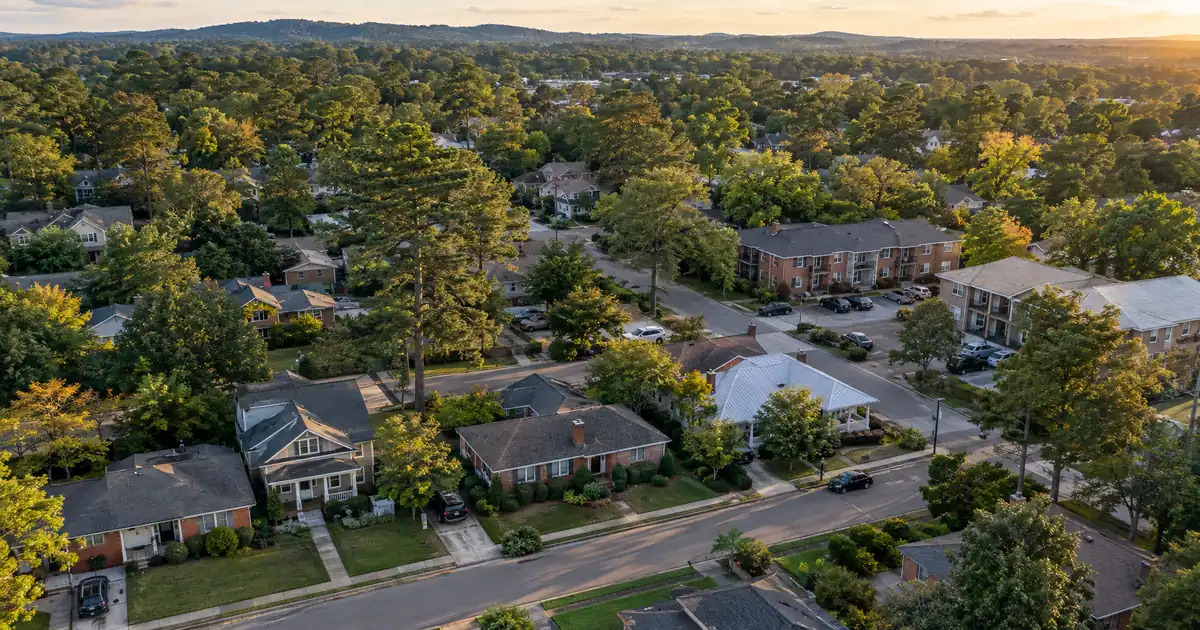
An out-of-state investor scrolling Homewood listings sees a tidy, walkable suburb tucked under Red Mountain and a citywide median sale price near $492,000, per Redfin. What they miss is the rent side. Single-family rents here sit well below what that price tag would suggest, so the refinance question is less “how much equity do I have?” and more “what will the rent support?”
Lendmire (NMLS# 2371349) is a DSCR-focused mortgage broker, and Homewood, Alabama investors can have DSCR scenarios reviewed through lender programs that Lendmire helps place across 41 markets, including Washington, D.C. This piece covers the equity side only: pulling capital out of a rental you already own.
DSCR Cash-Out Calculator
Run the cash-out numbers in Homewood, AL
Rate source: Freddie Mac 30-yr average via FRED® — Federal Reserve Bank of St. Louis · effective Sep 24, 2026
Prefilled with starting assumptions — enter your property’s value, balance, taxes, and insurance for a more accurate picture.
Program parameters update from Lendmire’s centralized guideline source. Taxes and insurance are editable estimates.
As of Sep 24, 2026 · General Freddie Mac market benchmark, not a Lendmire loan offer. Property value, balance, taxes, and insurance are editable estimates. Maximum loan-to-value varies by lender, program, property type, and seasoning. Not a Loan Estimate, approval, or commitment to lend. Program availability and eligibility are subject to lender guidelines, credit approval, property review, and underwriting.
The Short Version:
A DSCR cash-out refinance in Homewood, Alabama is underwritten primarily on the property’s rental income measured against its full monthly obligation, and here the split between house rents and small-building rents decides how much equity can move. The citywide median sale price is about $492,000.
- Duplexes, townhomes, and cottage-style units carry more refinance load than detached houses.
- Cash-out LTV tops out at 75 percent, with about six months of seasoning from title recording.
- Small 2-4 unit buildings are only 7.18 percent of housing units, so appraisal comps are thin.
- Metro vacancy readings conflict, so lease-backed rents matter more than asking rents.
Homewood Market Snapshot
A quick read on the Homewood investor landscape — figures come from the cited sources below. Confirm current property-level numbers before underwriting.
| Metric | Detail |
|---|---|
| Typical rents | $1,189 average (Apartments.com Homewood) |
| Recent appreciation | +4.1% yoy (Redfin Homewood Housing Market) |
| University enrollment | 6,522 students (Samford University) |
| Employment | 7,000+ employees (PracticeMatch Brookwood Baptist) |
| Vacancy | 13.0% metro (Matthews Birmingham Multifamily) |
Why the Rent-to-Value Ratio Drives Everything Here
The rent-to-value gap in Homewood is the central fact for any cash-out. Detached houses average about $1,856 in monthly rent per Apartments.com, roughly 0.38 percent of a $492,000 value per month, which is a thin ratio for investors relying on rental income to cover debt service.
Run the numbers on a modeled example. Assume a house valued near the citywide median and a 75 percent cash-out LTV, with full debt service that includes taxes and insurance. On the $1,856 rent, coverage lands around 0.65, well short of the 1.00 baseline that most standard DSCR programs are built around. These are modeled assumptions, not sourced deal data.
Now swap in a duplex at the same modeled value. Apartments.com puts one-bedroom rents near $1,216 and two-bedrooms near $1,485, per its duplex rental page. Together that is roughly $2,700 a month, and the modeled coverage moves into the mid-0.9s, rounding down and including taxes and insurance. Still shy of 1.00, but much closer.
That’s the structural edge of small multifamily. It doesn’t mean every duplex clears. Investors sitting under 1.00 have paths a lender may review: lower leverage, a sub-1.00 program, or an interest-only structure, all subject to lender guidelines, credit approval, and property review. Sub-1.00 files usually trade for lower leverage or more cash in the deal.
One more wrinkle. Older owners with a low basis often hold far more equity than the rent can carry. Equity available is a function of rent used for lender review, full debt service, reserves, and the 75 percent ceiling, not the appraisal alone. If you want the mechanics behind that ratio, the guide “What Is a DSCR Loan” walks through it.
Who Rents in Homewood (And Why It Holds Up)
Homewood’s renter base is young and educated, which supports steady long-term demand. CensusEasy, drawing on ACS data, shows a median age of 29.0, with 71 percent of adults holding a bachelor’s degree and a median gross rent of $1,463. RentCafe counts 3,761 renter households, about 38 percent of the total, against 6,069 owner households.
Demand anchors are close by. Samford University reported fall enrollment of 6,522 students, its 18th consecutive record. Brookwood Baptist Medical Center, a 607-bed facility with more than 7,000 employees across its system, per PracticeMatch, sits at the edge of the city. And the UAB medical district is just over Red Mountain. Those are employment and enrollment anchors, and they keep unit turnover tied to jobs and semesters rather than to for-sale swings.
Where the Small-Building Math Actually Lives
Small buildings are a genuine but thin niche. NeighborhoodScout shows duplexes, converted homes, and small apartment buildings at 7.18 percent of Homewood’s housing units, against 32.43 percent for large complexes. Roughly 690 small-building units by that arithmetic (approximate).
Few comps means a cash-out appraiser may reach outside city limits, so expect less pricing precision. That’s normal for markets like this one. Still, the stock is real.
Downtown Homewood and the 18th Street Corridor
This is the appreciation-led, lowest-yield pocket. Redfin’s neighborhood data shows a February median of $578,000, up 16.7 percent year over year, per its Downtown Homewood page. High value helps the appraisal and hurts coverage. A townhome or condo here rents near $1,809 or $1,729, so a low-basis owner may pull real proceeds while a recent buyer sees coverage pinched. The tradeoff is clear: equity rich, cash-flow poor.
West Homewood
Lower entry price, softer tape. Redfin’s West Homewood page shows a $484,000 median, up 21.8 percent, with homes sitting 63 days against 44 a year earlier. Caution: that figure rests on only seven sales in the month, so treat it as noise, not trend. West Homewood is also where a large new multifamily project (Colina West Homewood, 310 units) was planned, per Bham Now. Check its delivery status before assuming the rent comps are stable.
Edgewood, Hollywood, and the Lakeshore Corridor
These read as character neighborhoods rather than data points. Edgewood is pedestrian-friendly, Hollywood is known for Spanish Colonial Revival architecture, and the corridor along Lakeshore Drive draws on Samford and UAB proximity. No neighborhood-level median prices or rents exist in the research for them, so the honest read is qualitative: these are the streets where cottage-style and older 1-4 unit product tends to sit, and where lease-backed rents will do more work than any published average.
The Vacancy Debate: Two Reports, Two Stories
Don’t cherry-pick here. Matthews reported Homewood among the areas with the sharpest annual rent declines in the Birmingham metro, ranging from 2.6 percent to 3.8 percent, after substantial new completions, with metro vacancy rising to 13.0 percent. A later trade report in REBusinessOnline calls Homewood, Vestavia Hills, and Hoover among the metro’s most stable suburbs, projecting vacancy near 6.1 percent.
Both can be true. The declines likely reflect large new complexes competing with each other, while older small buildings may be insulated, though no source in the research tests that directly. RentCafe puts the average Homewood apartment building at about 44 years old, and mostly low-rise garden-style, with one-bedrooms at 35 percent of rentals and two-bedrooms at 50 percent.
The practical takeaway: underwrite duplex units as one- and two-bedroom rents in the $1,200-$1,500 range, not house-level rents, and use signed leases. An appraiser applying market rents may not credit a newly built project’s asking rents.
Seasoning, Appreciation, and What the Appraisal Might Say
Cash-out programs generally look for about six months of ownership, measured from title recording, and cap leverage at 75 percent. Nothing exotic. The variable is value.
Price momentum reads strong but noisy. Redfin showed Homewood up 4.1 percent year over year at its latest reading, and an earlier reading near 14.9 percent. Zillow’s value index shows a 5.2 percent one-year gain and an average value of $472,180. ACS puts median home value at $558,500, per StateDemographics, reflecting a different methodology from Redfin’s sale-price median. Underwrite the low-to-mid single digits, not the headline jump. Redfin’s price per square foot fell over the period that median price rose, which points to a shift in the mix of homes sold.
Metro-level context helps a little. The FHFA index for the Birmingham metro is up 44.7 percent over five years, per City-Stats, though that’s a metro index, not Homewood alone. An owner who bought several years back has probably built equity even if this year’s gain is modest.
Equity here is also largely untapped. Prop:Metrics, citing federal mortgage data, shows investors originating just 3.0 percent of loans and cash-out refinances at 5.0 percent in the local area (directional only, from an aggregator). That’s a lot of unused equity.
What Deal Desks See in Markets Like This
In high-price, low-yield suburbs, the friction on cash-out files rarely comes from credit. It comes from the appraisal and the rent schedule. Files with a signed lease, a clean rent roll, and a rent comp set drawn from similar-vintage buildings tend to hold together, while files leaning on asking rents from new construction tend to get trimmed. Borrowers who line up reserves and an appraisal-ready rent narrative before submitting usually save themselves a second round. Similar markets show the same pattern: the rent schedule is the story, and the appraisal is the proof.
Putting the Proceeds to Work
The point of a cash-out is what comes next. Within program terms, DSCR loans may be held in an LLC, subject to lender program eligibility, which suits investors recycling proceeds into a second small building. Typical guideline ranges include a 620 minimum credit floor with tiers at 660, 680, and 700, about six months of PITIA reserves (higher above $1,500,000), and loan amounts up to $3,000,000 on standard programs. Review details are subject to lender overlays and change, so confirm current terms before building a plan on them.
Two natural next steps: the refinance pathway for investor properties covers the broader options, and the equity recycle pathway focuses on redeploying proceeds. If you’re weighing this against a conventional loan, the program-to-program comparison lays out the tradeoffs, and investors can browse DSCR loan options for Alabama investors for the statewide view. To talk a specific file through, reach the team at 828-256-2183.
One generic reminder: confirm current local rental rules, taxes, and insurance with qualified local professionals before you commit.
DSCR vs. conventional financing
Two common ways to finance an investment property in Homewood, AL. They qualify you differently — here’s how investors weigh them.
Why investors choose it
- Qualifies on the property’s rental income — no personal tax returns, W-2s, or pay stubs needed to document income.
- No personal debt-to-income ceiling to clear, so existing mortgages and obligations don’t cap your borrowing the same way.
- Can be closed in an LLC, keeping the property inside a business entity.
- Built for scaling — not held to the limit on number of financed properties that conventional financing applies.
- Underwriting centers on the deal: generally qualifies when the rent covers the payment, a 1.00x coverage ratio being a common baseline (confirmed in underwriting).
- Designed specifically for investment property, including long-term and, where the program allows, short-term rentals.
Where it’s strong
- Often the lowest ongoing financing cost for a buyer who fully qualifies on personal income — a fit for a first property or a cost-first purchase.
Trade-offs for investors
- Requires full personal income documentation and must fit within a debt-to-income limit — salary, existing debts, and other mortgages all count.
- Typically held in your personal name rather than a business entity.
- Caps how many financed properties you can carry, which can become a ceiling as a portfolio grows.
- Evaluates you as a borrower as much as the property, which usually means more paperwork.
How investors usually choose: a first or single property often optimizes for the lowest financing cost; portfolio builders often optimize for leverage, vesting in an LLC, and scaling past conventional caps. The right answer depends on your goals, the property, and current guidelines — both paths run through select lenders in Lendmire’s wholesale network, with eligibility and terms confirmed in underwriting.
Frequently Asked Questions
How do you qualify for a DSCR cash-out refinance in Homewood?
Qualification centers on the property: rent used for lender review measured against full monthly obligation, with a 1.00 baseline common on standard programs. Lenders also review credit (a 620 floor, with better tiers above), about six months of reserves, and roughly six months of seasoning from title recording. Cash-out is capped at 75 percent LTV. Final eligibility depends on lender guidelines, credit approval, and property review.
What are the requirements for an investment property loan in Homewood, Alabama?
Expect a rent schedule or lease, a property appraisal, reserves, and a credit score at or above the program floor. Detached houses, duplexes, townhomes, and condos are generally reviewed, while manufactured homes, log homes, and barndominiums fall outside these programs. Loan amounts run up to $3,000,000 on standard programs, subject to lender guidelines.
Why does a duplex often support a bigger cash-out than a house in Homewood?
Stacked rents. A detached house near the citywide median produces rent of roughly 0.38 percent of value per month, while two units in a small building can push that toward the mid-0.5 percent range. Because coverage drives how much can be borrowed, the duplex tends to carry more of the refinance load, though actual rents must be lease-supported.
Can Homewood’s thin small-building stock hurt the appraisal?
It can. With only 7.18 percent of housing units in small buildings, appraisers may draw on comps from elsewhere in the Birmingham area. Expect less pricing precision and give the appraiser a documented rent schedule and any renovation history.
What can slow down a Homewood DSCR cash-out refinance?
Thin comps, unsupported rents, and incomplete reserves are the usual culprits, along with title-recording dates that fall short of the seasoning window. Lendmire places DSCR investor loans and its programs qualify primarily on rental income, so a clean rent package tends to matter most. Terms and eligibility remain subject to lender review.
About Lendmire
Lendmire is a DSCR-focused mortgage brokerage, NMLS# 2371349, placing investor loans across 41 markets, including Washington, D.C. Lenders generally review DSCR eligibility around a property’s rental income rather than personal income documentation, which fits LLC-held rentals, self-employed investors, and portfolios scaling past conventional financed-property limits. The firm has been recognized by Scotsman Guide as a 2026 Top Workplace and is also a 2025 Scotsman Guide Top Workplace.
Get Started
Ready to find the right loan for you?
In about 30 seconds you can review financing options available for your investment property. No commitment required.
Informational only. Not a Loan Estimate, approval, or commitment to lend. Program availability and eligibility are subject to lender guidelines, credit approval, property review, and underwriting.
References
1. Redfin, Homewood Housing Market
3. Samford University, Wikipedia
5. Matthews, Birmingham Multifamily Market Report
7. Apartments.com — Homewood AL Duplex
8. RentCafe, Homewood Average Rent
9. NeighborhoodScout, Homewood Real Estate
12. Bham Now
13. REBusinessOnline, Birmingham Apartment Market
16. City-Stats
17. recognized by Scotsman Guide as a 2026 Top Workplace
18. a 2025 Scotsman Guide Top Workplace
This article is part of Lendmire’s investment property cash-out refinance program — full qualification details, guidelines, and scenarios live on the program page.
Related reading: Cash Out Refinance Investment Property in Homewood AL · Unlock Equity With DSCR Cash Out Refinance Phenix City Alabama · Cash Out Refinance Investment Property Auburn Alabama
Guides: Investment Property Cash-Out Refinance in Alabama
Brandon Miller
Founder & CEO, Mortgage Loan Originator, Lendmire LLC
- Mortgage Loan Originator · NMLS# 1129696 · Verify on NMLS Consumer Access
- North Carolina Real Estate Broker · License# 343312 · Verify on NCREC
- North Carolina Insurance Producer · License# 19053198 · Property, Casualty, Life, Health · Verify on NAIC SBS
- Lendmire LLC · Firm NMLS# 2371349 · Verify firm licensure
Compliance and disclosures. Lendmire (NMLS# 2371349) is a licensed mortgage broker and is not a direct lender, depository institution, financial advisor, or tax professional. Content in this article is general market analysis and educational information — not financial, legal, or tax advice for any specific situation. Lendmire does not guarantee loan approval; every transaction is subject to underwriting by the funding lender. Mortgage pricing and loan program guidelines are subject to change at any time without notice and vary by borrower characteristics, property type, and state regulations. Lendmire complies with Equal Housing Opportunity. Licensure verification: NMLS Consumer Access.