
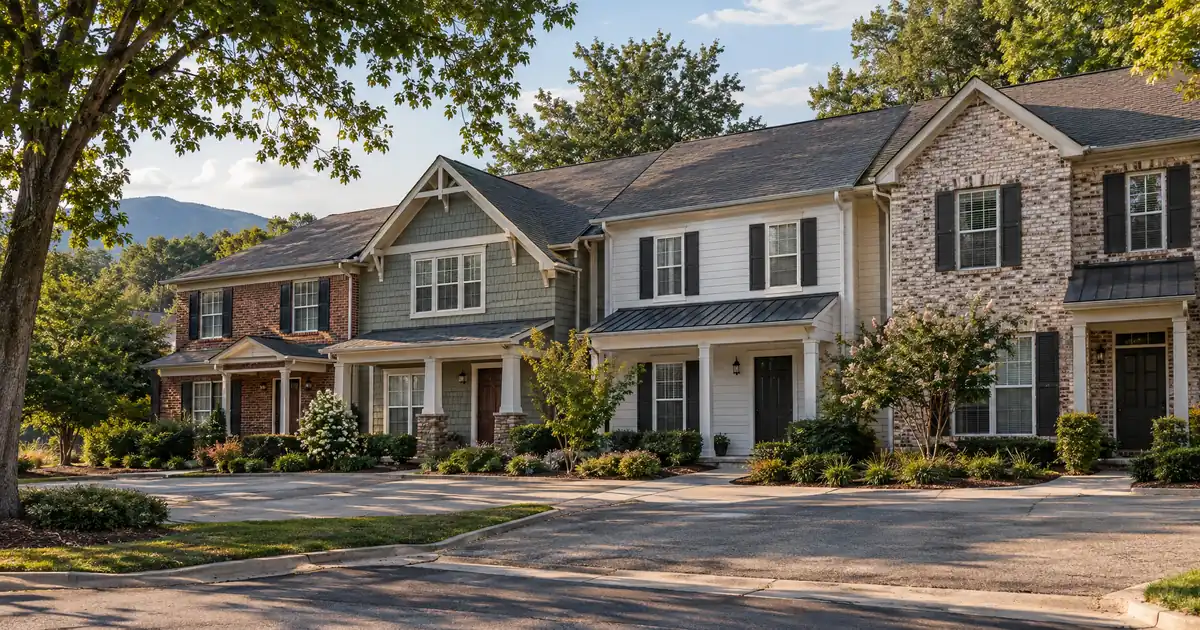
Huntersville and Cornelius together posted the highest apartment concession rate of any Charlotte submarket, with Avison Young reporting 22 percent of units offering concessions. Meanwhile, NeighborhoodScout puts Huntersville’s ten-year home appreciation at 121.15 percent. Rents are soft where new supply lands, while the equity on owned houses keeps building. That split defines the cash-out thesis here: this is an equity-extraction market first and a cash-flow market second.
DSCR Cash-Out Calculator
Run the cash-out numbers in Huntersville, NC
Rate source: Freddie Mac 30-yr average via FRED® — Federal Reserve Bank of St. Louis · effective Oct 1, 2026
Prefilled with starting assumptions — enter your property’s value, balance, taxes, and insurance for a more accurate picture.
Program parameters update from Lendmire’s centralized guideline source. Taxes and insurance are editable estimates.
As of Oct 1, 2026 · General Freddie Mac market benchmark, not a Lendmire loan offer. Property value, balance, taxes, and insurance are editable estimates. Maximum loan-to-value varies by lender, program, property type, and seasoning. Not a Loan Estimate, approval, or commitment to lend. Program availability and eligibility are subject to lender guidelines, credit approval, property review, and underwriting.
The Quick Read:
A DSCR cash-out refinance on an investment property in Huntersville, North Carolina is underwritten primarily on the property’s rental income measured against its full monthly obligation, and it converts built-up equity into capital without relying on personal income documentation, subject to lender guidelines.
- Cash-out is capped at 75 percent LTV, with roughly six months of title seasoning typical.
- Ten-year appreciation of 121.15 percent is the equity engine.
- Premium-priced Birkdale-type product struggles to clear 1.00 coverage at full leverage.
- Workforce submarkets near Northcross carry the stronger rent-to-value profile.
- New apartment supply in the Huntersville and Cornelius corridor pressures competing rents.
Huntersville Market Snapshot
A quick read on the Huntersville investor landscape — figures come from the cited sources below. Confirm current property-level numbers before underwriting.
| Metric | Detail |
|---|---|
| Home prices | $631,238 median house value (NeighborhoodScout) |
| Typical rents | $1,518 avg (Apartments.com Rent Market) |
| Recent appreciation | 121.15% 10-yr (NeighborhoodScout) |
| Population | 67,072 population (Census Reporter) |
| Employment | 34.5K→35.8K employees (3.61% growth) (Data USA) |
Appreciation Is Doing the Work
The equity case in Huntersville rests on price growth, not rent growth. NeighborhoodScout’s modeled median house value sits well above what many investors might expect for the area, and it calculates a strong average annual gain over ten years, which lands in top-20-percent territory nationally. Homes.com reports a lower median sale price, a different methodology based on recorded sales rather than modeled value. Either way, an owner who bought several years back is likely sitting on meaningful equity.
The caveat is momentum. NeighborhoodScout shows the trailing twelve months slowing to 5.47 percent, with the latest quarter slightly negative. Cooling, not collapse. Meanwhile the metro-level picture on rents is weaker: MMG Real Estate Advisors put Charlotte-area annual rent growth at negative 0.8 percent at the close of its most recent measurement period.
Put those two numbers together. Equity grows faster than the rent roll, which means coverage ratios do not improve on their own over a 12-to-24-month hold. A refinance thesis here should use appreciation to fund the next acquisition rather than expecting rent growth to rescue the debt coverage.
Does the Number Clear 1.00 at the 75 Percent Cap?
Often not on premium product. Standard programs cap cash-out at 75 percent LTV, require roughly six months of ownership measured from title recording, and generally look for a 1.00 minimum coverage ratio, with reserves around six months of PITIA. All of it is subject to lender guidelines, credit tiers starting near 620, and property review. The coverage ratio is monthly rent divided by the full monthly obligation (principal, interest, taxes, insurance, and any HOA dues). How DSCR coverage is calculated is covered in detail elsewhere.
Run the numbers on two modeled cases, with taxes and insurance included in both. The prices and rents below are illustrative assumptions, not sourced comps.
Workforce case. Assume a $350,000 single-family rental in an older Northcross-area subdivision renting at $2,000. At 75 percent LTV, coverage lands just under 1.00. Drop leverage to 60 percent and it moves into the low 1.1 range. Workable, with less cash out.
Premium case. Assume a $575,000 home, in line with the Homes.com median sale price, renting at the Highland Creek border-submarket level of roughly $2,135. At 75 percent LTV, coverage runs around 0.6. Even at 50 percent LTV it stays below 0.90. Skip full-leverage cash-out on product like this.
When coverage falls below 1.00, a lender may review a sub-1.00 program, lower leverage, an interest-only structure, or stronger reserves as compensating factors. Whether any of those apply depends on credit profile, property review, and the lender’s guidelines, and none is a given. Investors can review their scenario before choosing which asset to refinance, because the asset choice matters more than the lender in this market.
Where the Rent-to-Value Math Holds
Rent levels cluster in a narrow band while prices do not, so the cheaper submarkets win on coverage.
Northcross and Sam Furr Road. This is the strongest rent-to-value zone in the town. The corridor surrounds an established retail hub (Lowe’s, Target, Kohl’s, Harris Teeter) and older subdivisions such as Shepherds Vineyard, Waterford at the Park, and Redcliffe, which rank among the more affordable in Huntersville. RentCafe shows Shepherds Vineyard apartment rents averaging about $1,364, down 0.07 percent year over year. Flat rents mean coverage here depends on a low basis, not on future increases. Buy cheap, hold steady.
Highland Creek, Mountain Island Lake, and Prosperity Church Road. These southern border submarkets carry the highest rents in the corridor. Redfin lists Highland Creek at $2,135, Mountain Island Lake at $2,075, and Prosperity Church Road at $2,005, against a citywide median of $1,720. These areas straddle the Huntersville and Charlotte line, so confirm the jurisdiction on any asset.
Birkdale Village and Vermillion. Demand is deep and the lifestyle center is the town’s best-known address, but acquisition basis is the highest in Huntersville. Rent-to-value compresses. These work as appreciation holds and long-term single-family or townhome rentals, not as high-coverage refinance candidates. No reliable submarket-level price series exists for NorthStone, Skybrook, or Monteith Park individually, so comps there need a local pull.
(A note on rent data: Apartments.com and Redfin report noticeably different rent levels, partly because one reflects listing averages and the other a median. The spread across sources is wide enough that underwriting should use fresh local rental comps.)
Small Multifamily: The Fourplex Question
Property type matters as much as submarket. Multi-unit product spreads one basis across several rent streams, which is how investors push coverage above 1.00 at higher leverage. New-construction attached product exists inside town limits: Jome lists David Weekley’s North Creek Village fourplex-style homes at $416,990 to $577,174, at 1,893 to 2,734 square feet. Fresh construction gives clean comps and no deferred maintenance, which simplifies appraisal support on a later refinance. The downtown-corridor infill product (Gilead Road area) is a reasonable hunting ground for duplex stacking, but see the supply discussion below.
Working DSCR brokers see a recurring pattern in appreciation-led suburbs like this one: the strongest refinance files are rarely the most expensive properties. They are the mid-priced rentals with a modest loan balance relative to value, where cash-out proceeds still clear the 75 percent ceiling and coverage holds near 1.00. Files built on trophy addresses often stall on coverage even when equity is abundant.
Supply Pipeline: Where Not to Hold
New apartment inventory is the main rent risk. RealPage projects 2,306 new units in the Huntersville and Cornelius submarket, the second-most of any Charlotte submarket, which Avison Young ties to that 22 percent concession rate. Institutional landlords offering concessions undercut small-owner rents nearby.
The downtown pipeline adds to it. Repit tracks Station South, an $80 million, 348-unit project that has been approved, and Town1, a 696-unit mixed-use development that has broken ground. Single-family and two-to-three-unit rentals in outlying workforce pockets face materially less new-supply competition than anything within walking distance of the Gilead Road core. Genuine toss-up for downtown duplex owners: the location is strong, the competing supply is large, and the better answer depends on how long they plan to hold.
The Tenant Base Behind the Rents
Huntersville is a Charlotte-metro professional suburb, not an industrial town. Data USA shows employment growing 3.61 percent in the latest year, from 34.5 thousand to 35.8 thousand jobs, with Finance and Insurance (4,743 residents) the largest sector, ahead of Professional, Scientific, and Technical Services (4,341). Population reached 67,072, up from the 2020 census count of 61,376.
Healthcare adds a second anchor. Novant Health Huntersville Medical Center has operated since 2004 and hosts the Novant Family Medicine Residency, established in 2016. Atrium Health’s 200,000-square-foot Lake Norman hospital opened on July 1, per the North Carolina Medical Society. Two full-service systems in a town of about 67,000 create steady clinical-staff renter demand independent of the banking commute. No four-year campus sits inside town limits, so student rental demand should not figure in underwriting.
Seasoning, Inventory, and the Appraisal
Rising inventory helps appraisal support and hurts exit timing. Bankrate recorded 192 homes for sale in one January against 95 a year earlier, with days on market at 70, fourteen days slower than the prior year, while median price still rose. More listings mean deeper comps for a cash-out appraisal. Slower absorption means a renovate-and-sell exit takes longer if the refinance does not pencil.
For an owner approaching the roughly six-month mark, the sequencing is straightforward. Confirm seasoning from title recording, pull rental comps that reflect current concessions in the corridor, and size the request against coverage, not just the LTV ceiling. Equity available depends on rent used for lender review, PITIA, reserves, and the 75 percent cap, and it is not a guaranteed figure. The cash-out qualification details and investor refinance options cover the program mechanics, and the guide “Where DSCR and Conventional Diverge” matters for self-employed owners comparing paths.
Huntersville, North Carolina investors can have DSCR scenarios reviewed through lender programs that Lendmire helps place across 41 markets, including Washington, D.C. For statewide context, see DSCR loans in North Carolina. Investors can also call 828-256-2183.
Before committing, verify current local rules, taxes, and insurance with qualified local professionals.
Frequently Asked Questions
Can a Birkdale Village rental support a full 75 percent cash-out?
Rarely on coverage. At premium Huntersville pricing, modeled coverage including taxes and insurance runs well under 1.00 at full leverage. A lower-LTV request, a sub-1.00 program, or stronger reserves may be reviewed, subject to lender guidelines.
DSCR vs. conventional financing
There are two common ways to finance an investment property in Huntersville, NC, and they qualify you differently — here’s how investors weigh them.
Why investors choose it
- Qualifies on the property’s rental income — no personal tax returns, W-2s, or pay stubs needed to document income.
- No personal debt-to-income ceiling to clear, so existing mortgages and obligations don’t cap your borrowing the same way.
- Can be closed in an LLC, keeping the property inside a business entity.
- Built for scaling — not held to the limit on number of financed properties that conventional financing applies.
- Underwriting centers on the deal: generally qualifies when the rent covers the payment, a 1.00x coverage ratio being a common baseline (confirmed in underwriting).
- Designed specifically for investment property, including long-term and, where the program allows, short-term rentals.
Where it’s strong
- Often the lowest ongoing financing cost for a buyer who fully qualifies on personal income — a fit for a first property or a cost-first purchase.
Trade-offs for investors
- Requires full personal income documentation and must fit within a debt-to-income limit — salary, existing debts, and other mortgages all count.
- Typically held in your personal name rather than a business entity.
- Caps how many financed properties you can carry, which can become a ceiling as a portfolio grows.
- Evaluates you as a borrower as much as the property, which usually means more paperwork.
How investors usually choose: a first or single property often optimizes for the lowest financing cost; portfolio builders often optimize for leverage, vesting in an LLC, and scaling past conventional caps. The right answer depends on your goals, the property, and current guidelines — both paths run through select lenders in Lendmire’s wholesale network, with eligibility and terms confirmed in underwriting.
Does Huntersville’s apartment oversupply hurt a single-family refinance?
It can, though only indirectly. Heavy concessions and a large pipeline of projected units pressure apartment rents in the corridor, and appraisers and lenders may look at those rents when reviewing single-family comps nearby. Outlying subdivisions with less new supply are less exposed.
How long must I own a Huntersville property before a cash-out?
Typical programs look for about six months of ownership measured from title recording. Some lenders may review shorter holds under different terms, usually at lower leverage. Seasoning varies by lender and loan scenario.
Is rent growth likely to lift my coverage ratio here?
Not reliably. Metro rents were slightly negative at last measurement, and Shepherds Vineyard rents were flat. Coverage here depends on the property’s basis and the amount borrowed, not on rent momentum.
Do I need a hospital or university tenant base to justify the loan?
No. The tenant base is mostly finance, professional services, and healthcare workers. Lenders review the rental income on the property itself, and no campus demand is assumed.
For current guidelines and terms, see Lendmire’s DSCR loan programs page.
The Watchlist
Three indicators will show whether the equity-led thesis holds:
- Concession rates in the Huntersville and Cornelius corridor. A drop from 22 percent would signal that new supply is being absorbed and rents are stabilizing.
- Days on market and inventory. If the 70-day pace lengthens while listings keep climbing, appraisal comps will soften before prices do.
- Lease-up at Station South and Town1. Delivery pace and opening concessions will set the rent ceiling for every small rental near the Gilead Road core.
Huntersville’s equity is real, but its rent roll will decide which properties can turn that equity into the next acquisition.
About Lendmire
A non-QM mortgage broker (NMLS# 2371349), Lendmire arranges DSCR financing for real estate investors in 41 markets, which means 40 states plus Washington, D.C. Because deals are underwritten primarily on property cash flow rather than personal income documentation, the structure suits self-employed buyers and entity-owned portfolios, subject to lender program eligibility. Lendmire places loans through wholesale investor lenders and is not a direct lender. It is recognized as a 2026 Scotsman Guide Top Workplace and a 2025 Scotsman Guide Top Mortgage Workplace.
Get Started
Ready to find the right loan for you?
In about 30 seconds you can review financing options available for your investment property. No commitment required.
Informational only. Not a Loan Estimate, approval, or commitment to lend. Program availability and eligibility are subject to lender guidelines, credit approval, property review, and underwriting.
References
1. Avison Young
5. Data USA
6. Homes.com
8. RentCafe
9. Redfin
10. Jome
11. RealPage
12. Repit
13. Novant Health Huntersville Medical Center
14. North Carolina Medical Society
15. Bankrate
16. a 2026 Scotsman Guide Top Workplace
17. a 2025 Scotsman Guide Top Mortgage Workplace
This article is part of Lendmire’s investment property cash-out refinance program — full qualification details, guidelines, and scenarios live on the program page.
Related reading: Cash Out Refinance Investment Property Huntersville North Carolina · DSCR Cash Out Refinance in Concord, North Carolina: What It Takes to Qualify on $1,900 Rent · Cash Out Refinance Investment Property in Kannapolis, North Carolina: The 2026 DSCR Guide to Cannon Village
Guides: Investment Property Cash-Out Refinance in Huntersville, NC · Investment Property Cash-Out Refinance in North Carolina
Brandon Miller
Founder & CEO, Mortgage Loan Originator, Lendmire LLC
- Mortgage Loan Originator · NMLS# 1129696 · Verify on NMLS Consumer Access
- North Carolina Real Estate Broker · License# 343312 · Verify on NCREC
- North Carolina Insurance Producer · License# 19053198 · Property, Casualty, Life, Health · Verify on NAIC SBS
- Lendmire LLC · Firm NMLS# 2371349 · Verify firm licensure
Legal disclosures. Lendmire (NMLS# 2371349) is a state-licensed mortgage brokerage that arranges financing through wholesale lender relationships. Lendmire is not a direct lender, depository institution, or registered financial advisor. The discussion above is general informational content about real estate financing — it is not financial, legal, or tax advice, and readers should consult licensed professionals for guidance on their individual circumstances. Loan inquiries are subject to lender underwriting; this article does not represent a commitment to lend. Loan terms, rates, and qualification standards vary by borrower, property, and state, and are subject to change at any time. Equal Housing Opportunity. NMLS Consumer Access: nmlsconsumeraccess.org.