
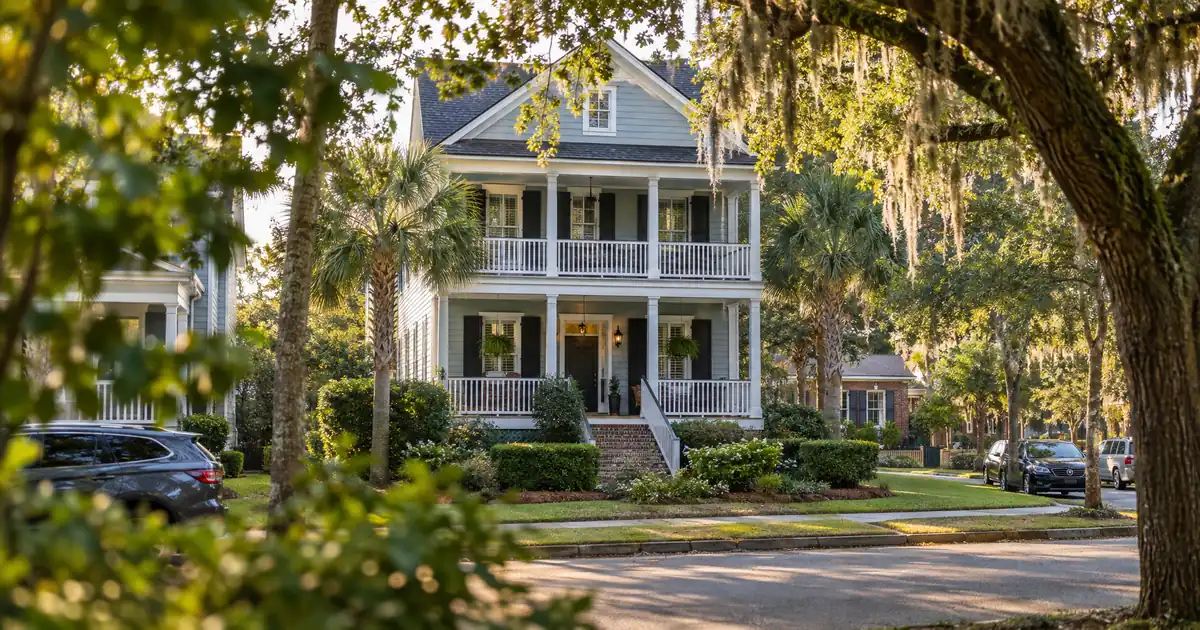
Picture an investor holding a three-bedroom house in Saint Andrews, bought at $225,000 and rented steadily since. The place cash flows, the tenant renews, and the investor wants the equity working elsewhere. Then the appraisal question lands. Will the property support a refinance at 75 percent of value, and will the rent cover the new balance with taxes and insurance included?
That is the whole Irmo cash-out story in one scenario. The math can work. It rarely works by accident.
DSCR Cash-Out Calculator
Run the cash-out numbers in Irmo, SC
Rate source: Freddie Mac 30-yr average via FRED® — Federal Reserve Bank of St. Louis · effective Sep 24, 2026
Prefilled with starting assumptions — enter your property’s value, balance, taxes, and insurance for a more accurate picture.
Program parameters update from Lendmire’s centralized guideline source. Taxes and insurance are editable estimates.
As of Sep 24, 2026 · General Freddie Mac market benchmark, not a Lendmire loan offer. Property value, balance, taxes, and insurance are editable estimates. Maximum loan-to-value varies by lender, program, property type, and seasoning. Not a Loan Estimate, approval, or commitment to lend. Program availability and eligibility are subject to lender guidelines, credit approval, property review, and underwriting.
TL;DR: A DSCR cash-out refinance in Irmo, South Carolina suits single-family landlords who bought near the local median and can document steady rent. It is underwritten primarily on the property’s rental income measured against its full monthly obligation, with leverage capped at 75 percent of appraised value.
- Resideline’s 172 tracked Irmo closings give a useful read on the local median, but individual comps can still vary, so appraisal support matters.
- Flat-to-soft pricing means equity usually comes from the purchase basis and renovations, not market lift.
- Rent sources disagree widely, so underwrite at the low end of the range.
- Seasoning runs about 6 months from title recording, with reserves around 6 months of PITIA.
Irmo Market Snapshot
A quick read on the Irmo investor landscape — figures come from the cited sources below. Confirm current property-level numbers before underwriting.
| Metric | Detail |
|---|---|
| Home prices | $237,500 median (Hubrec / CMLS market report) |
| Typical rents | ~$1,900 (REI Lense LTR) |
| University enrollment | 17,053 students (Niche, District 5) |
| Employment | Scout motors 4,000 jobs (The Kirkland Company, Columbia) |
| Vacancy | 8.4% rental (Wikipedia, Irmo) |
Why Irmo Rewards Patient Equity Plays
Irmo is a thin-supply suburb where single-family rentals dominate and equity extraction depends on buy price, not appreciation. Investors who bought near the median can usually test a refinance. Investors counting on market lift should slow down.
RentCafe counts 852 renter-occupied households (18 percent) against 3,780 owner-occupied (82 percent). Rentals are a small slice. The housing stock is also lopsided: NeighborhoodScout puts single-family detached homes at 89.91 percent of units, with duplexes and small buildings at just 1.76 percent. Don’t plan around a fourplex here. Underwrite on one unit’s rent.
Demand comes from Columbia. Irmo is a commuter suburb, and tenants work at regional anchors. COLAtoday reports that Blue Cross Blue Shield of South Carolina employs over 10,000 people, and that Prisma Health Midlands and Lexington Medical Center together employ more than 21,000. The state government is the area’s largest employer. The Kirkland Company’s Columbia market report counts 1,103,952 people in the Columbia Combined Statistical Area. That is a deep tenant pool for a town the U.S. Census Bureau counted at 11,569 residents.
Lake Murray and the Okra Strut give the town its identity. The Town of Irmo says the festival draws an average of 25,000 attendees a year. Fun, but a festival isn’t an underwriting input. Employment is.
The Appraisal Problem: Flat Prices and Thin Comps
Irmo’s price trend is murky, and murky is a risk on a cash-out refinance. The appraiser decides your leverage, and the market isn’t handing out generous valuations.
Sources disagree. Redfin’s housing page shows a $250K median up 6.4 percent year over year. Zillow shows values up about 1.3 percent. CMLS data, as reported by Hubrec, shows a $237,500 median (down 1 percent), inventory up 27 percent, days on market rising from 51 to 67, and sellers getting about 98.1 percent of asking. That is a market that has stopped running.
Comp depth adds friction. Of Resideline’s 172 closings, 99 percent were single-family, and the middle half closed between $173,000 and $254,500. A spread that wide means an appraiser may reach into Saint Andrews, Ballentine, or neighboring Columbia areas for comparables. Every reach adds valuation risk.
The practical read is straightforward. Don’t assume the market will create equity during seasoning. Underwrite a cash-out on purchase price plus documented improvement value, and treat any market lift as a bonus. An investor with a $225,000 basis and a finished kitchen update has a story the appraiser can verify. An investor with the same basis and a “the neighborhood is hot” argument does not.
The trade-off, honestly, is that a conservative appraisal costs you proceeds but protects the coverage ratio. A lower value at 75 percent leverage means a smaller balance, which makes the rent-to-debt number easier to clear.
Running the Coverage Math at 75 Percent
At 75 percent LTV, a typical Irmo single-family rental produces coverage in the low 1.1 to low 1.2 range on conservative rents, including taxes and insurance. Higher rent assumptions push it toward 1.4. The rent you can document decides everything.
Rent data is the soft spot. Homes.com shows a $1,899 median for single-family rentals. Zumper shows a $2,022 average, up 1 percent year over year. RentCafe shows $1,668, down 3.53 percent, though it covers only buildings with 50 or more units. Niche shows $1,477, probably on older Census data. Rentometer places three-bedroom rents in the $1,800s.
The table below is a modeled illustration. Prices and rents are assumptions drawn from the ranges above, and coverage is rent divided by full PITIA at 75 percent LTV, with taxes and insurance included and the results rounded down.
| Scenario | Value | Modeled rent | Coverage |
|---|---|---|---|
| Low rent, median value | $225,000 | $1,477 | ~1.1x |
| Strong rent, median value | $225,000 | $1,900 | ~1.4x |
| Low rent, upper band | $255,000 | $1,700 | ~1.1x |
| Strong rent, upper band | $255,000 | $1,900 | ~1.2x |
Most standard DSCR programs are built around a 1.00x benchmark, because rent covers the obligation at that level. Some lenders review lower ratios, but those files usually need compensating strength: more equity, higher credit, or different pricing. Exact eligibility depends on lender guidelines, credit profile, reserves, and property review.
Here’s the catch on the high-rent rows. REI Lense’s modeled data on Irmo single-family rentals shows average long-term rent near $1,900 but a median monthly cash flow of negative $170. That is a cash-flow view, not a coverage view, and the two differ. The signal still matters: Irmo is not a high-yield market. Rent-to-price runs near 0.8 percent on a median-priced home (my read of the modeled data, not a published figure), and Homes.com’s price-to-rent ratio of 14.2 points the same way. Cash-out proceeds that assume strong cash flow are the ones that disappoint.
Working DSCR brokers see a recurring pattern in suburban single-family markets like this one: the deal that clears coverage comfortably is almost always a lower-basis house refinanced at a conservative appraisal, not a stretched house refinanced at an optimistic one. The files that struggle tend to assume the highest rent estimate they can find. The files that move forward tend to document the lowest defensible one.
Where the Numbers Pencil: Pockets Within and Around Irmo
Lower-priced corridors near downtown Irmo and Saint Andrews offer the cleanest cash-out math. Lake Murray-adjacent homes offer the bigger equity story but demand lower leverage or more rent.
Neighborhood-level price and rent data for Irmo is thin, so treat the following as directional rather than precise.
Downtown Irmo and the Saint Andrews Corridor
This is the older, more concentrated rental stock. A local brokerage guide describes more rental units downtown than in outlying areas, with Irmo Town Park and several shopping centers nearby. Its figures (a $224,724 median price and $1,248 median rent) are from an older post, so use them only as a directional anchor. BestNeighborhood flags Saint Andrews as having less expensive homes. That is the sub-$255K band where comps are most likely to hold up, and where the coverage math in the table above is most realistic.
Seven Oaks
Homes.com lists Seven Oaks among the popular rental areas, and the first Okra Strut was held at Seven Oaks Park. No reliable neighborhood-specific price or rent exists for it. An investor here should build the refinance case from their own lease and a fresh appraisal, not an area average.
Lake Murray and the Harbison Side
A local agent blog puts Lake Murray-area homes at $206 to $213 per square foot, roughly 30 to 40 percent above the city average, versus $158 to $172 in a mid-range corridor like Broad River (treat as directional). Lake homes are appreciation-led. Rent doesn’t climb in step with price, so coverage per dollar of debt is weaker. They can carry a larger equity cushion, but expect to need more cushion in the form of a lower loan-to-value ratio. For cash flow, the stronger play is likely the lower-priced corridor over the lake. Investors chasing equity depth could reasonably argue the other way.
Ballentine and West Lake
Rentometer describes Ballentine and West Lake as a mix of quiet cul-de-sacs and community parks. There is no neighborhood figure, so the same rule applies: lead with documented rent.
Know Which County Your Property Sits In
Many “Irmo” addresses sit outside the town limits. The mailing address and the legal jurisdiction are not the same thing, and a refinance file should reflect the right one.
Irmo straddles two counties. Biggestuscities and Census-based sources put roughly 7,550 residents in Richland County and about 4,019 in Lexington County. Plenty of Irmo-addressed rentals sit in unincorporated parts of either county. Before you order an appraisal, confirm the parcel’s jurisdiction, since it affects which comps are considered local. Verify current local rental rules, taxes, and insurance with qualified local professionals. That is the only caution on that topic this article will make.
What Seasoning, Reserves, and Credit Mean for an Irmo File
Plan for about 6 months of ownership measured from title recording, reserves around 6 months of PITIA, and a 620 credit floor with better tiers at 660, 680, and 700. All of it is subject to lender guidelines.
Seasoning is where Irmo investors get tripped up. Six months from title recording is the typical starting line, and a flat market means the appraisal at that point is probably close to your purchase price plus what you’ve documented. The reserves figure is about 6 months of PITIA (higher above $1,500,000 in loan size), which for a typical Irmo file is a cash-on-hand question to settle before applying. Loan amounts run up to $3,000,000 on standard programs, far above what a median Irmo house needs. Smaller balances route through select lenders in the network.
Equity available depends on rent used for lender review, PITIA, reserves, and the 75 percent LTV ceiling. It is never a guaranteed cash figure. Manufactured homes, log homes, and barndominiums fall outside these programs, and with 89.91 percent of Irmo’s stock single-family detached, most investors won’t run into that.
Putting the Proceeds to Work
Cash-out proceeds from an Irmo rental are most useful as down-payment capital for the next acquisition, not as a lifestyle line of credit. The refinance only makes sense if the new balance still clears coverage on the original property.
Think of it as sequencing. Refinance at a conservative value, confirm the original house still covers its new obligation with room to spare, then redeploy. A softer rent trend is the argument for restraint. RentCafe’s 3.53 percent decline and the 8.4 percent rental vacancy from the last decennial Census are reminders that rents here are flat, not rising. Underwrite as though they stay that way. (An investor who needs rent growth to make the math work is already in the wrong deal.)
DSCR vs. conventional financing
There are two common ways to finance an investment property in Irmo, SC, and they qualify you differently — here’s how investors weigh them.
Why investors choose it
- Qualifies on the property’s rental income — no personal tax returns, W-2s, or pay stubs needed to document income.
- No personal debt-to-income ceiling to clear, so existing mortgages and obligations don’t cap your borrowing the same way.
- Can be closed in an LLC, keeping the property inside a business entity.
- Built for scaling — not held to the limit on number of financed properties that conventional financing applies.
- Underwriting centers on the deal: generally qualifies when the rent covers the payment, a 1.00x coverage ratio being a common baseline (confirmed in underwriting).
- Designed specifically for investment property, including long-term and, where the program allows, short-term rentals.
Where it’s strong
- Often the lowest ongoing financing cost for a buyer who fully qualifies on personal income — a fit for a first property or a cost-first purchase.
Trade-offs for investors
- Requires full personal income documentation and must fit within a debt-to-income limit — salary, existing debts, and other mortgages all count.
- Typically held in your personal name rather than a business entity.
- Caps how many financed properties you can carry, which can become a ceiling as a portfolio grows.
- Evaluates you as a borrower as much as the property, which usually means more paperwork.
How investors usually choose: a first or single property often optimizes for the lowest financing cost; portfolio builders often optimize for leverage, vesting in an LLC, and scaling past conventional caps. The right answer depends on your goals, the property, and current guidelines — both paths run through select lenders in Lendmire’s wholesale network, with eligibility and terms confirmed in underwriting.
Run the numbers on a second property purchased with the proceeds, too. If the new acquisition is another median-priced Irmo house, it will land in the same low-1.1 to low-1.2 coverage zone. That is fine, but it isn’t a cushion.
Anyone weighing this can talk to Lendmire or call 828-256-2183 to walk through the file.
What Does Your Irmo Appraisal Need to Say?
Your house may be a decent rental, and the lease may be solid. But if the comps are thin, the market is flat, and the rent estimate you’re counting on is the highest one you found, does the refinance still work at the lower number?
Frequently Asked Questions
How do you qualify for a DSCR cash-out refinance in Irmo?
Qualification centers on the property’s rent compared with its full monthly obligation, including taxes and insurance. Most programs are built around a 1.00x benchmark. You also need roughly 6 months of seasoning from title recording, about 6 months of PITIA in reserves, and a credit score at or above 620. Final eligibility depends on lender guidelines, credit review, and property review.
What are the requirements for an investment property loan in Irmo, South Carolina?
Typical requirements include a minimum credit score of 620, a coverage ratio around 1.00x or better, a 75 percent LTV ceiling on cash-out, and reserves of about 6 months. The property must be an eligible type, such as a single-family home or townhome. Manufactured homes, log homes, and barndominiums fall outside these programs. Terms vary by lender guidelines, property type, leverage, credit profile, and full file review.
Does it matter if my Irmo rental is in Richland County or Lexington County?
Yes, in the sense that the file should reflect the correct jurisdiction. Irmo spans both counties, and many Irmo-addressed homes sit in unincorporated areas. Confirm the parcel’s location before ordering an appraisal, and check local rental rules, taxes, and insurance with qualified local professionals.
Can a flat Irmo market still support a cash-out refinance?
It can, if the purchase price, documented improvements, and conservative rent assumptions carry the case. Flat or softening prices and longer days on market mean the appraisal is unlikely to exceed what you paid by much. Investors who bought near the $237,500 median and can document rent are better positioned than those relying on appreciation.
How does DSCR lender review differ from a bank’s approach in Irmo?
Lendmire arranges DSCR investor loans, and the review centers on the property’s rent rather than personal income documents. A bank leans on W-2s and debt-to-income ratios, while a DSCR file leans on the rental coverage number. Eligibility is subject to lender review and program guidelines.
For current guidelines and terms, see Lendmire’s DSCR loan programs page.
About Lendmire
Lendmire, NMLS# 2371349, is a non-QM mortgage broker serving real estate investors in 41 markets, including Washington, D.C., through DSCR investor loan programs. Qualification is generally reviewed around the subject property’s rental income rather than the borrower’s W-2 history, a practical fit for LLC-titled portfolios and self-employed investors. All scenarios remain subject to program review and program guidelines. The firm has been recognized as a top-ranked workplace in 2026 and as a 2025 Scotsman Guide Top Workplace.
For broader investor-financing rules and property-type coverage across the state, see South Carolina DSCR loans.
A deeper walk-through of investment-property equity extraction lives in cash-out refinance on an investment property.
Get Started
Ready to find the right loan for you?
In about 30 seconds you can review financing options available for your investment property. No commitment required.
Informational only. Not a Loan Estimate, approval, or commitment to lend. Program availability and eligibility are subject to lender guidelines, credit approval, property review, and underwriting.
References
1. Resideline, Irmo housing market
2. Hubrec / CMLS Irmo market report
5. The Kirkland Company, Columbia market report
8. NeighborhoodScout, Irmo real estate
9. COLAtoday, Columbia-area employers
10. U.S. Census Bureau QuickFacts, Irmo town
11. Homes.com
12. Zumper, Irmo rent research
13. Niche
14. Scotsman Guide — Top Workplaces 2026
15. a 2025 Scotsman Guide Top Workplace
This article is part of Lendmire’s investment property cash-out refinance program — full qualification details, guidelines, and scenarios live on the program page.
Related reading: Cash Out Refinance Investment Property in Irmo, South Carolina: Seasoned Equity on Thin Margins · Cash Out Refinance Investment Property in Conway SC · DSCR Portfolio Loans In South Carolina: Several Rentals, One Note
Guides: Investment Property Cash-Out Refinance in South Carolina
Brandon Miller
Founder & CEO, Mortgage Loan Originator, Lendmire LLC
- Mortgage Loan Originator · NMLS# 1129696 · Verify on NMLS Consumer Access
- North Carolina Real Estate Broker · License# 343312 · Verify on NCREC
- North Carolina Insurance Producer · License# 19053198 · Property, Casualty, Life, Health · Verify on NAIC SBS
- Lendmire LLC · Firm NMLS# 2371349 · Verify firm licensure
Compliance and disclosures. Lendmire (NMLS# 2371349) is a licensed mortgage broker and is not a direct lender, depository institution, financial advisor, or tax professional. Content in this article is general market analysis and educational information — not financial, legal, or tax advice for any specific situation. Lendmire does not guarantee loan approval; every transaction is subject to underwriting by the funding lender. Mortgage pricing and loan program guidelines are subject to change at any time without notice and vary by borrower characteristics, property type, and state regulations. Lendmire complies with Equal Housing Opportunity. Licensure verification: NMLS Consumer Access.