
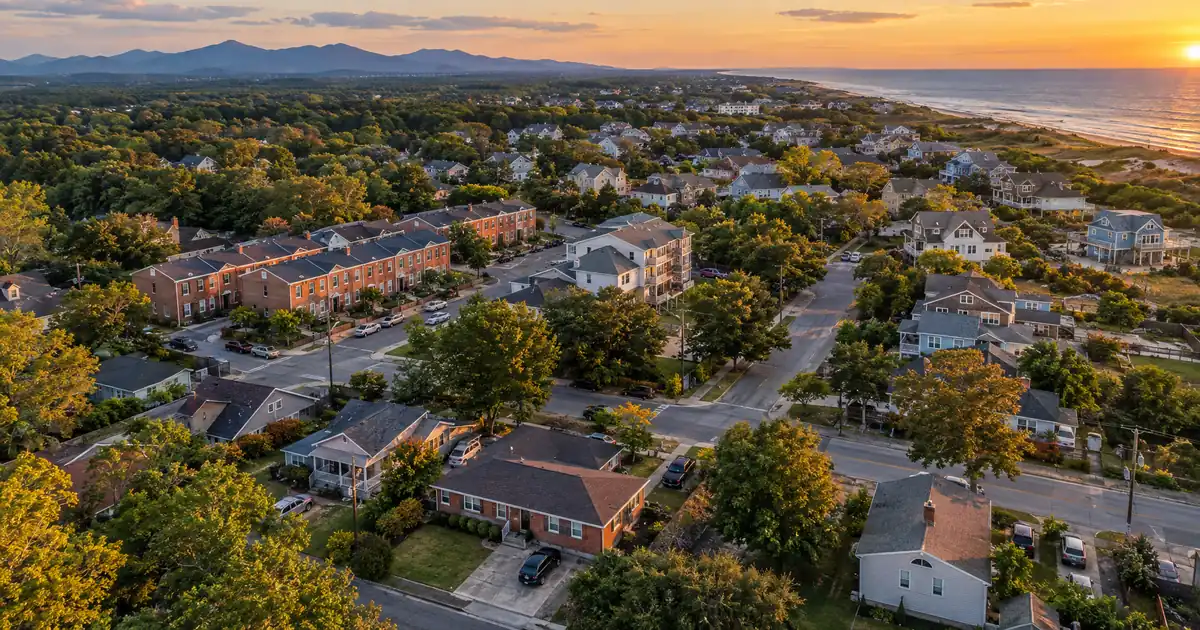
Colington Harbour is the one corner of Kill Devil Hills where a three-bedroom house is advertised near $2,600 a month on a 12-month lease, per RentalSource. Town-wide median gross rent is $1,771. That gap is the whole story of equity extraction here. The houses that photograph best sit on the beach road and cover their debt worst, while the quiet soundside blocks carry the rent.
One listing is not a trend, and the rest of this analysis is built to stress that point.
DSCR Cash-Out Calculator
Run the cash-out numbers in Kill Devil Hills, NC
Rate source: Freddie Mac 30-yr average via FRED® — Federal Reserve Bank of St. Louis · effective Sep 24, 2026
Prefilled with starting assumptions — enter your property’s value, balance, taxes, and insurance for a more accurate picture.
Program parameters update from Lendmire’s centralized guideline source. Taxes and insurance are editable estimates.
As of Sep 24, 2026 · General Freddie Mac market benchmark, not a Lendmire loan offer. Property value, balance, taxes, and insurance are editable estimates. Maximum loan-to-value varies by lender, program, property type, and seasoning. Not a Loan Estimate, approval, or commitment to lend. Program availability and eligibility are subject to lender guidelines, credit approval, property review, and underwriting.
Key Takeaways:
In Kill Devil Hills, North Carolina, a DSCR cash-out refinance is sized on long-term rent measured against the full monthly obligation, so year-round duplexes and Westside workforce homes carry the file while vacation-priced oceanfront product usually cannot, and the loan-to-value ceiling caps proceeds either way.
- Median gross rent of $1,771 against a $509,701 median value leaves thin single-family coverage (City-Data).
- Two-unit structures average $362,441 versus $624,858 for detached houses, which favors duplex rent stacking (City-Data).
- Colington Harbour three-bedroom listings near $2,600 outrun town-wide averages (RentalSource).
- Cash-out needs about six months of title seasoning and sits under a 75 percent LTV ceiling.
For real estate investors in Kill Devil Hills, North Carolina, Lendmire (NMLS# 2371349) helps structure and place DSCR financing through wholesale lenders operating in 41 markets, including D.C. The brokerage arranges the loan, and lenders review eligibility and approve. This piece covers only the equity-extraction side: what a property you already own can support, and where the math stops.
Kill Devil Hills Market Snapshot
A quick read on the Kill Devil Hills investor landscape — figures come from the cited sources below. Confirm current property-level numbers before underwriting.
| Metric | Detail |
|---|---|
| Home prices | $442,200 median property value (Data USA) |
| Typical rents | $1,539 average (Zip-Codes.com) |
| Population | 7.76K population (Data USA) |
| Employment | 4.21K employees (2024) (Data USA) |
The Rent-to-Value Problem Behind the Beach Postcards
The town’s median rent does not cover a median-priced house on a cash-out refinance. Single-family coverage at typical values runs well under 1.00x including taxes and insurance, so the file only works on specific property types: duplexes, small multifamily, and year-round workforce homes bought below the median.
Start with the value side. Data USA puts the median property value at $442,200 for a town of roughly 7.76 thousand residents, and that is the Census-traceable figure used throughout this analysis. Other sources differ. City-Data lands higher at $509,701, and Zip-Codes.com, drawing on ACS five-year estimates, shows a lower $398,100. Those three numbers span more than $110,000, and the spread reflects methodology and vintage rather than a real market split. Redfin’s recent-sale median is higher still, which is covered below.
Now the rent side. City-Data reports median gross rent of $1,771. Zip-Codes.com’s ACS-based average is $1,539, with 53.3 percent of renters paying $1,000 to $1,499 and 26.9 percent paying $2,000 or more. Apartments.com shows a blended average of $1,455 against a $1,663 national figure (per Apartments.com). The blended figures are pulled down by condo and studio product. They understate what a year-round single-family home can command, and they also overstate what an investor should assume for any given file.
Run the numbers on a modeled house at $547,000, a figure near the recent-sale median, renting at the town’s $1,771 median. Coverage, rent divided by full principal, interest, taxes, and insurance at 75 percent LTV, lands around 0.5x to 0.6x. That is well below the 1.00x benchmark most standard DSCR programs are built around. A file like that would generally need a sub-1.00 program, an interest-only structure, or lower leverage, all subject to lender guidelines, credit review, and property appraisal. Each option costs something in proceeds or pricing.
Not ideal. Skip that profile for cash-out unless the rent is materially better than the median.
Colington and Westside: Where Coverage Actually Clears
Colington and the Westside neighborhoods are the most credible long-term-rental submarkets in town. Local brokers describe them as primarily year-round residential, and that is where 12-month-lease tenants live.
KillDevilHills.com splits the market into four zones. Oceanside listings are typically oceanfront and, with few exceptions, vacation homes. Between the Highways is largely rental homes and smaller cottages. Westside is year-round residential, and Colington sits west of town and is almost entirely year-round homes. For a DSCR refinance built on documented long-term rent, the last two are the native territory. Oceanside is the appreciation-and-tourism bet.
Price bands matter. A local brokerage, OuterBanksReal.estate, says most homes run roughly $200,000 to $700,000, with interior lots starting near $200,000. The low end of the band is where rent-to-value has a chance. Model a Colington Harbour house at $400,000 renting at the $2,600 listing level: coverage including taxes and insurance comes to about 1.1x at 75 percent LTV. That assumes the rent holds, the appraisal supports the price, and the listing is representative. One advertised rent is a data point, not a rent roll, and most files that stumble here do so on exactly that assumption.
A few other pockets deserve a mention, all at the qualitative level because no neighborhood-level rent or price series was found:
- First Flight Village is marketed around quiet cul-de-sac streets and draws owner-occupants and long-term renters who want a non-tourist-strip location.
- Virginia Dare Shores has established, tree-lined lots, and some parcels carry no HOA fees, which keeps the obligation line cleaner.
- Avalon Beach is walkable to the beach and the sound. It skews toward second-home buyers, which makes rent comps noisier.
- Oyster Pointe is listed alongside the core communities, but independent data is limited.
That list is a screening tool, not a ranking. Coverage is won or lost property by property.
Duplexes: The Better Coverage Math
A two-unit property stacks two rents against a single loan, and the Census-derived mean value for 2-unit structures is $362,441. That is a fraction of what detached houses average, so duplex coverage runs materially better than single-family.
The same City-Data table shows detached houses at a mean of $624,858. Townhouses or attached units average $473,808, 5-plus-unit structures $480,363, and 3-to-4-unit structures $706,302. That last number is a warning rather than an opportunity. A 3-to-4-unit average that exceeds the detached average is an inversion you rarely see on the mainland, and the likely explanation is that a small sample of vacation-oriented product is pulling the mean up. Investors should treat the 3-to-4-unit figure as a market signal about how rental income drives value here, not as a cost basis to underwrite against.
The 2-unit figure is the useful one. Model a duplex at $362,441 with each side renting at a modeled $1,500, which is an assumption, not a market quote. Coverage including taxes and insurance at 75 percent LTV comes to roughly 0.67x–0.73x. That sits below 1.00x, so rents would need to rise by a meaningful margin, or the loan amount come down, before the number touched 1.00x. A file like this is not a fit for a select 1.00 program as modeled, which is why the structure and the down payment or leverage choice matter in a thin-rental town.
Here is the catch: condition. Redfin’s Dare County rental listings show Somerset Apartments two-bedrooms near $1,490, while newer Run Hill Apartments product asks roughly $2,350 for a 1,077-square-foot two-bedroom. Vintage and finish, not just location, set the rent tier. An older duplex purchased off older comps and renovated toward newer-product standards can capture a meaningfully higher rent. A duplex that looks like Somerset but is underwritten like Run Hill will miss its number. The appraiser’s market-rent estimate, not the owner’s hope, is what goes into the file.
DSCR files in markets like this one typically look the same from the broker’s chair. Small-balance coastal properties with seasonal rent noise come in with coverage that depends heavily on which rent figure the lender accepts. The stronger files usually arrive with a current lease, a clean rent roll, and a realistic appraiser rent schedule in hand. Files built on aspirational rent tend to get re-sized downward, which shrinks the cash-out. The brokerage typically steers owners toward the conservative long-term figure before submission rather than after.
Investors weighing a specific property can reach the team at 828-256-2183 or use the investor refinance options page to see how rate-and-term and cash-out structures compare.
Seasoning, the 75 Percent Ceiling, and What Appreciation Really Delivers
Cash-out here is governed by three limits: about six months of ownership from title recording, a 75 percent LTV ceiling, and a 1.00 minimum coverage ratio. Appreciation is positive but modest, so the equity case rests on rent coverage, not on price momentum.
Redfin’s Kill Devil Hills market page shows a median sale price of $547,000, up 3.0 percent year over year. Homes sell after an average of 82 days on the market, and 21 homes sold in the latest monthly count against 18 a year earlier. Note that $547,000 is a sale-price median and sits above the Census-based $442,200 value, because it reflects what actually trades, which skews toward higher-priced product. Different yardsticks, not a contradiction.
Read that data skeptically. A 3.0 percent gain is real but not the kind of equity build that lets an owner refinance again in short order. Twenty-one monthly sales is a liquid-enough comp pool for an appraiser, but thin enough that one oceanfront closing can move the median. Days on market near three months tells you buyers are patient. For a cash-out, that means the appraisal will lean on a small, noisy set of comparable sales, and a conservative appraisal shrinks the borrowing base directly.
How the proceeds work, in structure rather than dollars: the lender takes the appraised value, applies the 75 percent ceiling, subtracts the existing payoff, and checks that the rent still clears coverage on the new, larger loan. A house bought with modest leverage and renovated to a higher rent tier is the cleanest case. A house that has simply sat for six months and risen three percent is not. For the mechanics, the how the cash-out works page walks through the sizing logic, and it helps to compare DSCR loans with other loan types to see why investors with several properties often choose property-income underwriting over personal-income documentation.
Remaining program guidance, all subject to lender guidelines: credit tiers run 620, 660, 680, and 700 with a 620 floor, and reserves are about six months of PITIA, rising to about nine months above $1,500,000. Standard programs go up to $3,000,000, with smaller balances routed through select lenders. Equity available is never a guaranteed figure. The how the qualification works page covers the ratio itself.
Most owners here will find coverage, not LTV, is the binding constraint. A 75 percent ceiling is academic when rent supports only a 60 percent loan.
Who Actually Pays the Rent (and How Durable Is It)
Tenant demand in Kill Devil Hills is structurally supported by a documented workforce-housing shortage. The anchor employers are regional rather than town-specific, and the year-round renter pool is small.
Start with the shortage. Dare County attributes a dwindling supply of year-round rentals to the conversion of homes into weekly vacation rentals. County officials say the shortage reaches servers and cashiers, police officers, firefighters, teachers, and healthcare workers. The county has also allocated $35 million in state funding toward essential housing, per its current projects page. That supports long-term rent floors for any property that legally sits in the 12-month market. It also signals that public money is chasing the same tenants, which could add supply over time.
The demand anchors are regional. The Outer Banks Hospital sits in adjacent Nags Head, is the region’s only hospital, operates as a critical access facility under a 60/40 partnership of ECU Health and Chesapeake Regional Healthcare, and has been named a top-100 community hospital by Becker’s. Wikipedia’s hospital entry lists 21 general beds. That is a small employer, but a permanent one with a needs-based housing pool. College of The Albemarle runs a Dare County campus in Manteo. A local news feature cited in the research counts more than 600 students in traditional classes there.
Now the honest counterweight. Per Data USA, total employment in town slipped from 4.41 thousand to 4.21 thousand year over year, and the largest resident sectors are construction (747 people), retail trade (488), and professional, scientific, and technical services (465). Homeownership runs 73.9 percent, which leaves roughly a quarter of occupied units as renter households. Renter median household income is $57,794 and the rent-to-income ratio is 33.8 percent, per Point2Homes. That rent burden is high, so rent growth has a ceiling. Tenants stretched that far will not absorb large increases, which argues against underwriting aggressive rent bumps into a refinance.
The thin renter pool cuts both ways. Low supply keeps vacancy risk muted, but no independent vacancy index or rent-growth series was found for the town, so those claims remain directional.
DSCR vs. conventional financing
There are two common ways to finance an investment property in Kill Devil Hills, NC, and they qualify you differently — here’s how investors weigh them.
Why investors choose it
- Qualifies on the property’s rental income — no personal tax returns, W-2s, or pay stubs needed to document income.
- No personal debt-to-income ceiling to clear, so existing mortgages and obligations don’t cap your borrowing the same way.
- Can be closed in an LLC, keeping the property inside a business entity.
- Built for scaling — not held to the limit on number of financed properties that conventional financing applies.
- Underwriting centers on the deal: generally qualifies when the rent covers the payment, a 1.00x coverage ratio being a common baseline (confirmed in underwriting).
- Designed specifically for investment property, including long-term and, where the program allows, short-term rentals.
Where it’s strong
- Often the lowest ongoing financing cost for a buyer who fully qualifies on personal income — a fit for a first property or a cost-first purchase.
Trade-offs for investors
- Requires full personal income documentation and must fit within a debt-to-income limit — salary, existing debts, and other mortgages all count.
- Typically held in your personal name rather than a business entity.
- Caps how many financed properties you can carry, which can become a ceiling as a portfolio grows.
- Evaluates you as a borrower as much as the property, which usually means more paperwork.
How investors usually choose: a first or single property often optimizes for the lowest financing cost; portfolio builders often optimize for leverage, vesting in an LLC, and scaling past conventional caps. The right answer depends on your goals, the property, and current guidelines — both paths run through select lenders in Lendmire’s wholesale network, with eligibility and terms confirmed in underwriting.
Skip the Oceanfront (for This Purpose)
Oceanfront and beach-road “mega-homes” are the wrong collateral for a long-term-rent DSCR cash-out. Their value is tied to vacation income, which a long-term rent estimate cannot support.
The marketing for that corridor is seductive. One oceanfront listing in the research cited gross rental income consistently above $600,000 a year. But a lender sizing a DSCR cash-out on long-term rent will default to the appraiser’s market-rent figure, and a home priced for vacation revenue produces a long-term rent that covers only a sliver of its obligation. The result is a file that either sizes tiny or needs a different income documentation path entirely. That is a separate underwriting conversation with its own paperwork, and it is not what this article is about.
It’s a genuine toss-up whether an owner of oceanfront product should chase a cash-out at all. The equity may be large on paper. The borrowing base, measured by rent coverage, often is not. Investors holding that product may find a conventional path or a different income structure serves them better, and local rules, taxes, and insurance for any coastal property should be confirmed with the Town of Kill Devil Hills and qualified local professionals before underwriting.
For property types outside program guidelines: manufactured homes, log homes, and barndominiums fall outside these DSCR programs. Owners of those should not plan on this route.
Frequently Asked Questions
How do you qualify for a DSCR loan in Kill Devil Hills?
Qualification centers on the property’s rent measured against its full monthly obligation (principal, interest, taxes, and insurance), with 1.00x the common baseline. Lenders also review credit, typically with a 620 floor, plus reserves of about six months and the appraisal. Exact eligibility depends on lender guidelines, the borrower profile, and property review. Entity ownership, such as an LLC, is available subject to lender program eligibility.
What are the requirements for an investment property loan in Kill Devil Hills, North Carolina?
For a cash-out refinance, expect about six months of ownership from title recording, an LTV ceiling of 75 percent, and a minimum 1.00 coverage ratio. Credit tiers run from 620 to 700. Reserves are about six months of PITIA, rising to about nine months above $1,500,000. Loans go up to $3,000,000 on standard programs, and program details are confirmed per file.
Does a duplex in Kill Devil Hills produce better coverage than a single-family home?
Usually, yes. Two-unit structures tend to be valued well below detached houses in Kill Devil Hills, so two rents stack against a much smaller loan. Even so, a modeled duplex with assumed rents of $1,500 per unit can land well below 1.00x coverage once taxes and insurance are included, and a typically priced house at typical rent tends to fall short by a wider margin. The duplex’s advantage comes from having two rent streams against one set of carrying costs, not from clearing the threshold automatically. Condition and the appraiser’s rent schedule still decide the result.
Why do coastal Kill Devil Hills files often size smaller than owners expect?
Lenders default to the conservative long-term market-rent figure, and most of the town’s housing stock is priced for vacation income rather than 12-month leases. A house can carry a big equity number and still produce rent that supports a modest loan. The 75 percent LTV ceiling rarely binds before coverage does. Owners of year-round Colington or Westside homes tend to see the most predictable results.
What down-payment ranges may DSCR lenders review for Kill Devil Hills investment-property purchases?
Lenders typically review purchase files at around 20 to 25 percent down, subject to lender guidelines and the property. Lendmire arranges DSCR investor loans through wholesale channels. A key feature is that the lender reviews the property’s rental income rather than W-2 documentation. For the cash-out side of ownership, see the North Carolina DSCR financing hub.
What the Next 24 Months Probably Hold
The likeliest path is a slow grind rather than a breakout. Appreciation near 3 percent, three-month days on market, and a rent burden already above 33 percent all point to modest equity gains and limited room for rent growth. That favors the owners with duplexes or year-round Colington and Westside homes who can document rent and keep leverage moderate. It penalizes anyone counting on oceanfront equity to carry the coverage number.
A reasonable call: the public workforce-housing push and the stubborn shortage keep long-term tenant demand firm, while new product competes at the top of the rent range. Older duplexes renovated toward newer-product standards should hold the best coverage margin, and single-family owners buying at or above the median will keep fighting the ratio. Kill Devil Hills will reward the investor who underwrites the tenant, not the view.
About Lendmire
Lendmire — NMLS# 2371349 — is a mortgage brokerage specializing in DSCR investor loans, helping arrange financing across 41 markets, including Washington, D.C., through wholesale and investor-lending channels. The model centers on property-level rental income reviewed by the lender rather than W-2 documentation, subject to lender guidelines, suiting entity-owned and multi-property investors. Lendmire holds recognition as a 2026 Scotsman Guide Top Mortgage Workplace and was recognized by Scotsman Guide in 2025, as covered in Lendmire’s 2026 Top Workplace announcement.
Get Started
Ready to find the right loan for you?
In about 30 seconds you can review financing options available for your investment property. No commitment required.
Informational only. Not a Loan Estimate, approval, or commitment to lend. Program availability and eligibility are subject to lender guidelines, credit approval, property review, and underwriting.
References
1. RentalSource
2. Data USA — Kill Devil Hills, NC
3. Zip-Codes.com — Kill Devil Hills, NC
7. Dare County rental listings
8. Redfin — Kill Devil Hills Housing Market
9. Dare County — Housing in Dare County
10. darenc.gov — Essential Housing Current Projects
12. Wikipedia’s hospital entry
14. Point2Homes
15. a 2026 Scotsman Guide Top Mortgage Workplace
16. recognized by Scotsman Guide in 2025
17. Lendmire’s 2026 Top Workplace announcement
This article is part of Lendmire’s investment property cash-out refinance program — full qualification details, guidelines, and scenarios live on the program page.
Related reading: Investment Property Loans in Kill Devil Hills, NC: Can Rental Income Qualify You? · Cash Out Refinance Investment Property in Kill Devil Hills · DSCR Cash Out Refinance in Carolina Beach, North Carolina: Why Duplexes Beat Detached Homes
Guides: Investment Property Cash-Out Refinance in Kill Devil Hills, NC · Investment Property Cash-Out Refinance in North Carolina
Brandon Miller
Founder & CEO, Mortgage Loan Originator, Lendmire LLC
- Mortgage Loan Originator · NMLS# 1129696 · Verify on NMLS Consumer Access
- North Carolina Real Estate Broker · License# 343312 · Verify on NCREC
- North Carolina Insurance Producer · License# 19053198 · Property, Casualty, Life, Health · Verify on NAIC SBS
- Lendmire LLC · Firm NMLS# 2371349 · Verify firm licensure
Disclosure information. Lendmire is a state-licensed mortgage brokerage under NMLS# 2371349. Lendmire is not a depository institution, direct lender, or financial advisor — all loans referenced are placed through wholesale lender partners and are subject to each lender's underwriting standards. This article is provided for general informational purposes and is not a commitment to lend, nor does it constitute financial, legal, or tax advice. Loan programs, terms, rates, and qualification standards change without notice and depend on borrower profile, property type, and the state in which the subject property is located. Equal Housing Opportunity provider. NMLS Consumer Access: nmlsconsumeraccess.org.