
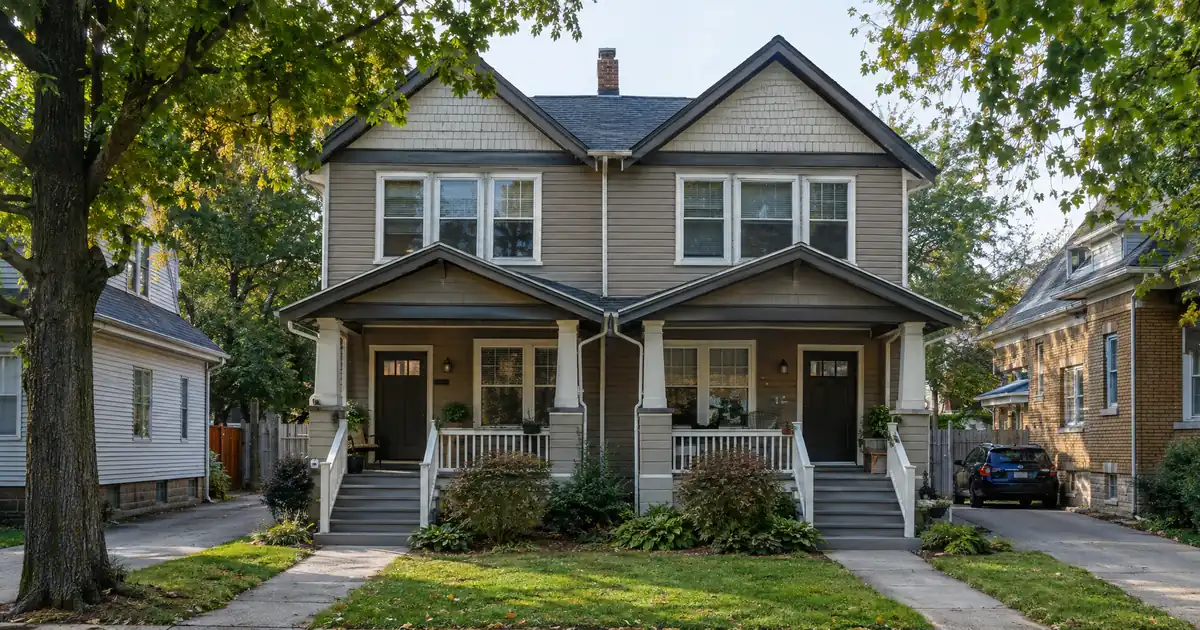
Picture an investor holding an up-and-down double near Birdtown, bought several years ago at a price that felt stretched at the time. Rents have crept up and the comps around it have climbed. The balance has been paid down for years, and a second deal is waiting on capital the investor doesn’t have in the bank. The question isn’t whether the property has equity. It’s how much of that equity a lender will let the investor pull out, and what the extra debt does to the rent coverage on the property.
TL;DR: A DSCR cash-out refinance in Lakewood, Ohio is underwritten primarily on the property’s rental income measured against its full monthly obligation, so it fits investors holding duplexes with real appreciation, like the roughly 7.5% year-over-year price gain Redfin reports.
DSCR Cash-Out Calculator
Run the cash-out numbers in Lakewood, OH
Rate source: Freddie Mac 30-yr average via FRED® — Federal Reserve Bank of St. Louis · effective Oct 1, 2026
Prefilled with starting assumptions — enter your property’s value, balance, taxes, and insurance for a more accurate picture.
Program parameters update from Lendmire’s centralized guideline source. Taxes and insurance are editable estimates.
As of Oct 1, 2026 · General Freddie Mac market benchmark, not a Lendmire loan offer. Property value, balance, taxes, and insurance are editable estimates. Maximum loan-to-value varies by lender, program, property type, and seasoning. Not a Loan Estimate, approval, or commitment to lend. Program availability and eligibility are subject to lender guidelines, credit approval, property review, and underwriting.
- Cash-out typically caps at 75% LTV, with about six months of ownership before eligibility.
- Roughly 22% of Lakewood’s housing is duplex or small-building stock, per NeighborhoodScout.
- Pulling more cash raises the loan balance, which lowers the coverage number.
- Single-family homes here carry premium prices, so rent coverage is tighter than on doubles.
Lakewood Market Snapshot
A quick read on the Lakewood investor landscape — figures come from the cited sources below. Confirm current property-level numbers before underwriting.
| Metric | Detail |
|---|---|
| Home prices | $350K median listing (Redfin 44107 Multi-Family) |
| Typical rents | $1,070 median (Niche) |
| Recent appreciation | +7.5% yoy (Redfin Lakewood Housing Market) |
Why Lakewood Equity Is Worth Pulling
Lakewood’s median sale price was $349K over the three months Redfin measured, up 7.5% year over year, with price per square foot up 12.0%, according to Redfin’s Lakewood housing market data. Price per square foot rising faster than the median suggests smaller and older homes are repricing too, and that matters for the pre-war doubles that dominate the DSCR conversation here.
Days on market stretched to 27 from 13 a year earlier, and sales ran at 167 in the latest month versus 156 the year before. Read that as a market that has cooled from bidding-war pace but still turns over about 160 homes a month. For a cash-out borrower, that is a comp pool deep enough for an appraiser to work from, and it is less likely to be dominated by stale, frenzied sales.
The tradeoff is that rising prices push rent-to-value ratios down. The same appreciation that creates your equity makes new purchases here harder to cash-flow. Investors who already own are on the favorable side of that trade, and investors still shopping are not. That’s the core logic of an equity-extraction play in this city.
The Mechanics, Step by Step
A DSCR cash-out follows a sequence, and each step has a ceiling.
1. Seasoning. Most programs look for roughly six months of ownership measured from title recording, though specifics vary by lender.
2. Appraised value. The lender orders an appraisal, and everything downstream is a percentage of that number.
3. The 75% cap. On a cash-out, the new loan generally can’t exceed 75% of appraised value. (The 80% figure you see on purchases doesn’t carry over.)
4. Payoff and costs. The existing mortgage balance, closing costs and any required reserves come out of the new loan before you see a dollar. Reserves typically run about six months of the full housing payment, subject to lender guidelines.
5. Coverage test. Monthly rent divided by the full monthly obligation (principal, interest, taxes and insurance) is the debt coverage ratio. A 1.00x benchmark is common because rent covers the payment at that level. Some lenders will review lower, usually with lower leverage, a stronger credit profile or different pricing.
Here’s the part that catches people. If your existing balance sits at 60% of the new appraised value, you have 15% of value in headroom under the cap, and that is before costs and reserves. Taking all of it adds debt, and added debt lowers the coverage number. The right extraction amount is often less than the maximum.
Credit tiers generally start at a 620 floor, with better terms available at higher tiers such as 660, 680 and 700. Investors in Lakewood, Ohio work with Lendmire (NMLS# 2371349) to place DSCR financing through wholesale lenders reaching 41 markets, including D.C. Final review details remain subject to lender overlays and credit review.
Run the Numbers on a Lakewood Double
Realmo’s Lakewood listing data shows 40 duplexes for sale, from $199,900 to $489,999, averaging $367,181. That’s listing data, not closed sales, but it frames the territory. Take the average as a stand-in for an appraised value.
Now the modeled rents. The inputs below are assumptions, not sourced market rents. Assume $1,100 per unit, a two-bedroom figure drawn from Birdtown listings. Two units gross $2,200 a month, about 0.60% of that $367K value. A single rental at Niche’s citywide median rent of $1,070 against a $349K median price grosses about 0.31%, and that median covers all unit types. Both ratios are directional. They still show the point: a duplex roughly doubles the rent roll for about the price of a typical single-family home.
Next, the coverage number. Model a 30-year amortization at 75% LTV on that $367K value, with property taxes and insurance estimated from Ohio averages and verified against the actual bills before anything is underwritten. At $1,100 per unit, coverage comes out at roughly 0.9x including taxes and insurance. Swap in RentCafe’s $1,223 citywide average per unit and the number lands right around 1.0x, which I’d round down. Full-leverage cash-outs on Lakewood doubles live on the line. These specifics are subject to lender guidelines and a full review of property, leverage, and credit.
If the number lands under 1.00x, options exist, though a lender would review each on its own terms:
- A sub-1.00 program, typically with stronger credit and lower leverage
- An interest-only structure to lighten the monthly obligation
- A smaller cash-out, so the new balance carries less debt against the same rent
None of these is a given. Qualification stays subject to lender guidelines, credit approval and property review. And if an investor is reaching for sub-1.00 on every property they own, that is a signal to re-examine the portfolio, not the loan type.
Where the Doubles Are (and Where They Aren’t)
Lakewood is dense: Census Reporter shows about 9,062 people per square mile across 5.5 square miles, a legacy of its streetcar-suburb past. The grid is walkable, and the housing stock reflects it. NeighborhoodScout puts large apartment complexes at 37.34% of units, single-family detached at 35.30% and duplexes or small buildings at 22.21%. That last slice is where DSCR cash-outs fit best.
Birdtown is the clearest fit. Homes.com describes it as a former factory neighborhood of duplexes and worker’s cottages. The tenant base likely leans toward workforce and young-professional renters who want Detroit Avenue within walking distance (that’s an inference from the stock, not a sourced tenant profile). Be careful with comps here: Redfin’s Birdtown page rests on only two recent sales, too thin to treat as a median.
The West End and The Edge sit in the middle on rents. Rent.com’s neighborhood averages place their one-bedrooms below the Gold Coast and Rockport Square, so rents are workable but not premium. That is listing-based, undated data, so use it for relative positioning only.
Gold Coast is the most expensive rental pocket but mostly high-rise condo and apartment product. Condo eligibility is a separate lender question, and it’s a poor fit for a duplex strategy.
Clifton Park and the lakefront estates are premium owner-occupant territory. A neighboring lakefront page shows only six recent sales, a reminder that thin comps make cash-out appraisals harder to support. Skip them for DSCR rent-to-value targets.
Don’t plan around triplexes or fourplexes. The current small-multifamily inventory mix is mostly duplexes, with just two triplexes and one quadplex showing. Underwrite for the double.
The Hospital Site and the Supply Question
Lakewood Hospital was city-owned from 1931 and closed in 2016, per the Encyclopedia of Cleveland History. The site is becoming Lakewood Common, a $119 million mixed-use project with 303 housing units, per the City of Lakewood. Nearby Detroit Avenue projects add more apartments.
Here’s the honest read on that supply. New Class A product may compete with older units along the Detroit Avenue corridor, though no sourced vacancy or absorption data confirms it. For a Birdtown double a few blocks from the new buildings, the effect is probably modest. For a unit that depends on corridor proximity alone, the risk is real. Stress-test your rent at a few percent below current before choosing a cash-out amount.
Demand Anchors Without Headcounts
Lakewood has no college of its own, so the demand story runs through healthcare, education and city government. Cleveland Clinic’s Fairview Hospital sits just outside city limits with 488 licensed beds, founded in 1892. The Clinic’s Lakewood Family Health Center hosts a family medicine residency that has trained more than 100 physicians. Nurses, residents and staff plausibly make up part of the long-term renter pool near Detroit Avenue, though no verified employee headcounts exist to size it.
Population is flat to soft. The Census Bureau’s QuickFacts show an estimate of 49,337, down 3.1% from the 2020 base of 50,941. That is not a growth story. It’s a stable-demand, constrained-supply story, and it’s why appreciation-led equity here depends on housing scarcity rather than headcount growth.
How Files Like This Tend to Behave
On files from older, dense inner-ring suburbs like this one, the common friction point is rarely credit. It’s the appraisal and the lease documentation. The cleaner files tend to have current leases (or documented market rent) for every unit, a clear payoff statement and an investor who has already decided how much cash they actually need. Files get messier when the borrower asks for the full 75% on a double whose rent supports a smaller loan, and the coverage number then drives a re-trade.
DSCR vs. conventional financing
There are two common ways to finance an investment property in Lakewood, OH, and they qualify you differently — here’s how investors weigh them.
Why investors choose it
- Qualifies on the property’s rental income — no personal tax returns, W-2s, or pay stubs needed to document income.
- No personal debt-to-income ceiling to clear, so existing mortgages and obligations don’t cap your borrowing the same way.
- Can be closed in an LLC, keeping the property inside a business entity.
- Built for scaling — not held to the limit on number of financed properties that conventional financing applies.
- Underwriting centers on the deal: generally qualifies when the rent covers the payment, a 1.00x coverage ratio being a common baseline (confirmed in underwriting).
- Designed specifically for investment property, including long-term and, where the program allows, short-term rentals.
Where it’s strong
- Often the lowest ongoing financing cost for a buyer who fully qualifies on personal income — a fit for a first property or a cost-first purchase.
Trade-offs for investors
- Requires full personal income documentation and must fit within a debt-to-income limit — salary, existing debts, and other mortgages all count.
- Typically held in your personal name rather than a business entity.
- Caps how many financed properties you can carry, which can become a ceiling as a portfolio grows.
- Evaluates you as a borrower as much as the property, which usually means more paperwork.
How investors usually choose: a first or single property often optimizes for the lowest financing cost; portfolio builders often optimize for leverage, vesting in an LLC, and scaling past conventional caps. The right answer depends on your goals, the property, and current guidelines — both paths run through select lenders in Lendmire’s wholesale network, with eligibility and terms confirmed in underwriting.
When Conventional Beats DSCR
DSCR makes sense for an investor who holds a portfolio in an LLC, has four or more financed properties, or has traditional personal-income documentation that doesn’t show the rental income cleanly. Conventional cash-out can be the better call for an investor with one or two financed rentals, strong traditional employment income and a property held personally. It usually costs less and avoids non-QM friction. The flip point is around the fourth financed property, or sooner if tax-return income is messy. For the full comparison, see conventional vs DSCR on investor loans. For loan-type mechanics, there’s how DSCR qualification works and the rate-and-term and cash-out refi details.
LLC-titled properties are typically eligible, subject to lender program eligibility. For Lakewood’s local landlord-tenant and licensing rules, taxes and insurance, check current requirements with qualified local professionals.
What Do You Do With the Proceeds?
Pulling cash to buy a second Lakewood double means buying into a market where purchase prices have climbed and rent coverage is tight. Pulling it for a market with better rent-to-price math means taking on a longer distance from the property. Lakewood is where you hold equity, not necessarily where you should redeploy it, and the numbers will tell you which. Run the coverage on the target first, and only then size the cash-out. Details on the product are at Lendmire’s DSCR cash-out refinance page, and the Ohio platform is Lendmire’s Ohio DSCR platform.
Frequently Asked Questions
How do you qualify for a DSCR cash-out refinance in Lakewood, Ohio?
Lenders look at the property’s rent against its full monthly obligation, usually with a 1.00x benchmark, plus a credit floor near 620 and about six months of seasoning. Reserves around six months of payments are typical. For Lakewood doubles, the coverage test is the one that most often decides how much cash you can take, subject to lender guidelines.
What are the requirements for an investment property loan in Lakewood, Ohio?
Expect a rent-based coverage test, a minimum credit score, reserves and an appraisal. Cash-out files cap at 75% LTV, while purchases can go higher. Property type matters: duplexes and small buildings fit, while manufactured homes, log homes and barndominiums fall outside these programs. Specifics vary by lender and borrower.
How much equity can I pull from a Lakewood duplex?
It depends on appraised value, your payoff and the coverage test. The 75% LTV cap sets the ceiling, then payoff, closing costs and reserves reduce it. Because added debt lowers rent coverage, a smaller cash-out often clears where a maximum one doesn’t. It is never a guaranteed figure.
Does the new Lakewood Common development affect a cash-out appraisal?
Probably not directly, since appraisers lean on recent comparable sales. The more relevant effect is on rents: new apartments may pressure older Detroit Avenue units. Document actual lease rents instead of relying on projections.
How does Lendmire arrange DSCR investor loans for investors in Ohio?
Lendmire arranges DSCR investor loans through wholesale channels. A central feature is that the lender evaluates property cash flow rather than personal income, subject to guidelines. Submitting a request for a quote starts the review, or you can call 828-256-2183.
The Local Take
A duplex within a few blocks of Detroit Avenue appraises off other doubles within walking distance. The file that goes sideways is the one where the rent looks great on paper and the lease isn’t signed.
About Lendmire
Lendmire (NMLS# 2371349) is a mortgage brokerage focused on DSCR investor financing, helping arrange programs through wholesale and investor-lending channels in 41 markets, including Washington, D.C. DSCR loans are evaluated by the lender on property cash flow rather than personal income, subject to lender guidelines, supporting LLC closings and accommodating investors with four or more financed properties. Scotsman Guide named Lendmire a Top Mortgage Workplace in both 2025 and 2026.
Get Started
Ready to find the right loan for you?
In about 30 seconds you can review financing options available for your investment property. No commitment required.
Informational only. Not a Loan Estimate, approval, or commitment to lend. Program availability and eligibility are subject to lender guidelines, credit approval, property review, and underwriting.
References
1. Redfin, Lakewood Housing Market
4. Niche — Lakewood Cuyahoga OH Real Estate
5. Realmo, Lakewood Duplexes for Sale
6. RentCafe’s $1,223 citywide average
7. U.S. Census Bureau QuickFacts, Lakewood city, Ohio
8. Homes.com
10. Encyclopedia of Cleveland History, Lakewood Hospital
11. City of Lakewood, Downtown Development
12. Cleveland Clinic, Fairview Hospital
13. Lakewood Family Health Center
14. 2025
15. 2026
This article is part of Lendmire’s investment property cash-out refinance program — full qualification details, guidelines, and scenarios live on the program page.
Guides: Investment Property Cash-Out Refinance in Ohio
Brandon Miller
Founder & CEO, Mortgage Loan Originator, Lendmire LLC
- Mortgage Loan Originator · NMLS# 1129696 · Verify on NMLS Consumer Access
- North Carolina Real Estate Broker · License# 343312 · Verify on NCREC
- North Carolina Insurance Producer · License# 19053198 · Property, Casualty, Life, Health · Verify on NAIC SBS
- Lendmire LLC · Firm NMLS# 2371349 · Verify firm licensure
Important disclosures. Lendmire (NMLS# 2371349) is a licensed mortgage brokerage. Lendmire is not a direct lender, depository institution, or financial advisor. All loan inquiries are subject to lender underwriting; this article does not constitute a commitment to lend. Rates, terms, and program guidelines are subject to change without notice and vary by borrower profile, property type, and state. Information in this article is general in nature and is not financial, legal, or tax advice. Equal Housing Opportunity. NMLS Consumer Access: nmlsconsumeraccess.org.