
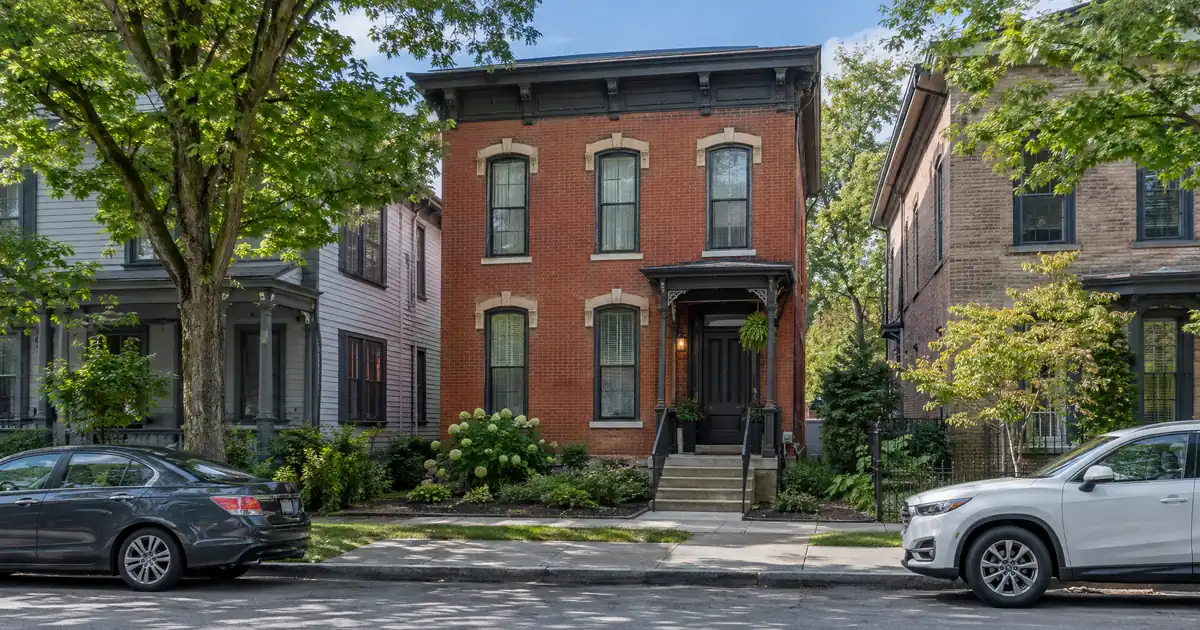
Two investors own paid-down rentals in Lawrence. One holds a three-bedroom on the east side. The other holds a lakeside home near Geist’s Edge or The Ridge. The east-side owner has the stronger cash-out file. Rents are similar across the city, but the price basis is not, and a cash-out refinance is sized off appraised value while coverage is tested against rent. A lower basis lets the 75 percent LTV ceiling and the 1.00 coverage test both clear with room to spare. This article covers how a DSCR cash out refinance in Lawrence, Indiana works for an investor who already owns the property.
TL;DR: A DSCR cash-out refinance in Lawrence, Indiana is underwritten primarily on the property’s rental income measured against its full monthly obligation, then sized by appraised value, seasoning and reserves. A typical Lawrence home value sits near $255,433 per Zillow.
DSCR Cash-Out Calculator
Run the cash-out numbers in Lawrence, IN
Rate source: Freddie Mac 30-yr average via FRED® — Federal Reserve Bank of St. Louis · effective Sep 24, 2026
Prefilled with starting assumptions — enter your property’s value, balance, taxes, and insurance for a more accurate picture.
Program parameters update from Lendmire’s centralized guideline source. Taxes and insurance are editable estimates.
As of Sep 24, 2026 · General Freddie Mac market benchmark, not a Lendmire loan offer. Property value, balance, taxes, and insurance are editable estimates. Maximum loan-to-value varies by lender, program, property type, and seasoning. Not a Loan Estimate, approval, or commitment to lend. Program availability and eligibility are subject to lender guidelines, credit approval, property review, and underwriting.
- East-side workforce houses model in the low-1.2 to 1.3 coverage band at 75 percent LTV.
- Geist’s Edge and The Ridge price too high for coverage to hold.
- DFAS, Reserve and Fort Ben redevelopment anchor tenant demand.
- Flat appreciation means equity comes from paydown and basis, not price growth.
Lendmire works with Lawrence, Indiana investors through a DSCR program footprint spanning 40 states plus Washington, D.C. Lendmire (NMLS# 2371349) is a DSCR-focused mortgage broker. It arranges loans through wholesale lending channels, and lenders make the approval decisions. Everything below is modeled guidance, not a commitment to lend.
Lawrence Market Snapshot
A quick read on the Lawrence investor landscape — figures come from the cited sources below. Confirm current property-level numbers before underwriting.
| Metric | Detail |
|---|---|
| Typical rents | Avg rent $1,600 (Prop:Metrics ZIP 46214) |
| University enrollment | ~16,000 students (Hoodline) |
| Employment | 26.6K jobs (Data USA) |
| Vacancy | ~6% (Roots Realty Co.) |
Where the Coverage Math Holds Up
East-side workforce stock carries the best rent-to-value ratios in Lawrence. The higher the price basis climbs, the faster the coverage number decays. Prices here sit in a wide band, and sources disagree, so the table shows three bases side by side.
Prop:Metrics reports a Lawrence Township (ZIP 46214) median home price of $230,000 and a median three-bedroom rent of $1,850. Zillow’s typical Lawrence value is $255,433, flat over the past year. Homes.com cites a median sales price near $320,000, which is higher because of methodology and mix, since it captures the larger west-side product. A separate Movoto list-price figure runs far lower, but condo-heavy listings skew it, so it is left out here.
Run the numbers on a three-bedroom renting at the $1,850 township median. These are modeled assumptions at 75 percent LTV, with coverage measured against full PITIA including taxes and insurance.
| Price basis | Source | Modeled coverage |
|---|---|---|
| $230,000 | Prop:Metrics, 46214 | About 1.3 |
| $255,433 | Zillow typical value | About 1.2 |
| $320,000 | Homes.com median sale | Just under 1.00 |
The spread is the story. The same house renting at the same $1,850 goes from comfortable to sub-1.00 on price basis alone. Most standard DSCR programs are built around a 1.00 benchmark because rent covers the monthly obligation at that level. Some lenders will look below it with compensating factors, lower leverage or more cash in, but that is a different conversation with different pricing and depends on lender guidelines.
The lower-end asking rents matter too. Zillow’s live rental listings show three-bedroom houses in 46235 and 46236 asking from about $1,420 up to $1,905. A house renting at the bottom of that range on a $230,000 basis models right around 1.0, with no cushion. The median rent and the actual lease on your property can sit far apart, and the lender will look at the lease or a market-rent appraisal rather than the median.
For the rest of the picture, see the guide “What Is a DSCR Loan”.
The Payroll Behind the Rent Roll
Lawrence has a federal anchor that most Indianapolis-area suburbs lack. The Defense Finance and Accounting Service operates out of the Emmett J. Bean Federal Center, and Choose Lawrence says more than 4,000 people work there, making DFAS the city’s largest employer. The same source says a new Armed Forces Reserve Center houses the 310th Expeditionary Sustainment Command, where more than 1,200 reservists drill each month.
For a lender reading a cash-out file, that matters in one specific way. Tenant demand tied to a government payroll tends to be stable, which supports the lease-renewal story behind the rental income. It does not change the coverage ratio, which is math. It does make the rent assumption easier to defend.
The broader base is thinner on hard data. Data USA reports a population near 49,284, median household income of $73,455 and employment of 26.6 thousand. The city counts as roughly flat in growth terms. The Encyclopedia of Indianapolis notes residents historically commuted to industrial plants along Shadeland Avenue and the Army Finance Center. Lawrence is also a Unigov excluded city with its own mayor and council, per the Encyclopedia of Indianapolis, sitting inside the Indianapolis employment base.
Fort Ben as a Redevelopment Story
Fort Benjamin Harrison closed under base realignment, and the Fort Harrison Reuse Authority describes the site as about 10 miles and 20 minutes from downtown Indianapolis, with a mission to replace jobs lost at closure. Its homepage describes a tech campus and roughly 50 converted buildings. A secondary aggregator summary of the authority’s annual review reports a $20 million bond for housing, retail, dining and public parking, plus a $6.2 million commercial project called The Corner. Treat those figures as unconfirmed until checked against the authority directly.
Two implications for a cash-out file. First, public money flowing into the town center supports long-term renter demand nearby. Second, newer comps appear in the neighborhood, and appraisers may use them. An owner refinancing an older house near Fort Ben should expect the appraiser to pick from a mixed comp set, and the result can land above or below the owner’s mental number. Fort Ben also trends upscale, so its price basis runs higher and rent-to-value thinner than the east side.
East-Side Pockets, Ranked by the Math
The city recognizes eight neighborhoods, per Visit Lawrence: Oaklandon, Fort Ben, Indian Lake, Lanesville, The Pike, Sunnyside, Geist’s Edge and The Ridge. No reliable neighborhood-level median prices or rents exist for any of them, so the ranking below is directional and built on price tier and tenant profile. Homes.com says lower-priced options concentrate on the east side and the largest, most expensive homes sit on the west side.
Lanesville, The Pike and Sunnyside. These are the strongest candidates for equity extraction. Lanesville is the oldest part of Lawrence, with railroad-era housing near Pendleton Pike. Sunnyside offers easy access to Fort Ben. They are value-oriented workforce pockets where a paid-down three-bedroom can sit near the lower price bases in the table above. Older housing brings condition questions, so appraisal and property-condition review are the friction point here, not the rent.
Oaklandon. A National Historic District with a small-town feel, about 15 miles northeast of downtown Indianapolis, per Visit Lawrence. It is a stable hold, but no price data exists to rank it against the east side.
Indian Lake. A lakeside community annexed in the 1970s. It is a family-oriented pocket, and lake proximity can push the price basis up, which would dilute coverage.
Geist’s Edge and The Ridge. Skip these for cash-out coverage. Waterfront and golf-course entry prices are high, and the rent does not scale with them. These can be fine long-term holds, but they are poor candidates for pulling DSCR-sized equity.
Duplexes Change the Arithmetic
Property type matters as much as neighborhood. A single listing for a two-bedroom duplex unit along the Shadeland corridor in 46226 asked $1,199 a month, with the tenant paying utilities. Treat that as one snapshot, not a market median. Two units at that level gross about $2,400, roughly 30 percent more than the single-family median. No duplex purchase prices were sourced, so a full coverage ratio would be invented. Prop:Metrics shows two-bedroom and one-bedroom units making up 37.3 percent and 36.5 percent of the township’s rental stock, which is consistent with demand for smaller units.
Condos and townhomes sit at the low end of the price range. Check HOA dues before modeling anything, because they are part of the monthly obligation and they drag the coverage number.
The Plumbing: Seasoning, Leverage and Documents
A cash-out file lives or dies on four numbers: the appraisal, the 75 percent LTV ceiling, the seasoning clock and the reserves. The ceiling is firm for cash-out. The 80 percent figure that applies to purchases does not carry over.
Generally, guidelines call for about six months of ownership measured from title recording before a cash-out refinance. An investor who bought with cash and wants to recycle the capital should confirm the recording date. Reserves typically run about six months of PITIA, and credit tiers generally start from a 620 floor, with better pricing tiers at 660, 680 and 700. Loan amounts go up to $3,000,000 on standard programs, and smaller balances route through select lenders in the network. Available cash depends on rent used for lender review, PITIA, reserves and that 75 percent ceiling. It is not a guaranteed figure, and all of it is subject to lender guidelines and program terms.
A worked example on the math side. Picture an investor holding a three-bedroom bought for cash, valued near the Zillow typical figure, rented at the $1,850 township median. At 75 percent LTV the modeled coverage including taxes and insurance lands in low-1.2 territory, which clears the 1.00 benchmark with some margin. If the appraisal comes in near the Homes.com median instead, the same rent falls just under 1.00 and the file needs a different structure: lower leverage, an interest-only option or a sub-1.00 program a lender might review. Whether any of those apply is a lender decision after credit and property review.
DSCR files in markets like this one typically look like a clean rent story and a messy paper trail. The rent supports the ratio, then the friction appears in the details: a lease that does not match the appraiser’s market rent, a title recording date a few weeks inside the seasoning window, an HOA letter that arrives late, or a comp set that mixes old east-side houses with new Fort Ben product. The strongest files get the lease, insurance declaration and entity documents lined up before the appraisal is ordered. Where many non-QM platforms require reserves that don’t match the investor’s file, a broker can route the same property to a lender whose reserve structure fits. Lendmire’s site covers investment property refinance details and cash-out refinance options. If the property sits in an LLC, financing is subject to lender program eligibility.
Where the Proceeds Go
The cash-out proceeds only matter if they fund the next deal. In Lawrence the obvious redeployment is another east-side house near the Shadeland corridor, where the price basis supports coverage. Redeploying into a Geist-area property defeats the purpose, since the new file would carry the coverage problem the old one avoided. Investors weighing DSCR against a conventional cash-out can read Lendmire’s DSCR-versus-conventional breakdown. Lendmire’s brokers can be reached at 828-256-2183 to walk through a specific file, and Lendmire’s Indiana DSCR platform covers the statewide program.
What’s the Catch on Appreciation?
Lawrence equity is paydown equity, not appreciation equity. Zillow shows values down 0.0 percent over the past year, and Prop:Metrics reports a 1.4 percent year-over-year change for the township median. Prices are stable, not climbing. An investor who bought a few years ago and expected a large cushion should not assume one. The equity available for cash-out comes mostly from the original down payment, principal paydown and any value added through renovation.
The price gap with neighboring suburbs is real but does not translate into appreciation on its own. Homes.com puts the median near $320,000 against $425,000 in Fishers and $575,000 in Carmel, which positions Lawrence as the affordable seam of the northeast side. That affordability helps coverage on the way in. It does not guarantee a rising appraisal on the way out.
Rent growth is slowing across the metro. RentCafe shows Indianapolis average rent at $1,268, down 0.1 percent over the year, with three-bedrooms at $1,568 in the metro average. CoStar reports rent growth slowing as vacancy rises and demand softens. A local brokerage analysis puts metro multifamily occupancy near 94 percent, meaning vacancy near 6 percent, and says new apartment construction has concentrated in Carmel, Fishers, Westfield and Noblesville rather than Lawrence. That source is directional. No Lawrence-specific vacancy or cap rate figure was found.
One more competition note. Newer apartment communities such as The Otis at Fort Ben, The Fort in Lawrence Village and Harrison Place, listed on Homes.com, target higher-income renters. Older single-family and small multifamily rentals compete in a different price band. That is a positioning note, not evidence of oversupply.
The stronger play might be the east-side duplex over the single-family house for cash flow, though an owner-occupant-style buyer focused on resale could argue the other way. The data is thin until actual duplex pricing is in hand.
Frequently Asked Questions
How soon can I cash out after buying a Lawrence rental?
Generally about six months of ownership, measured from the date title was recorded. That clock matters most for investors who bought with cash and want to pull capital back out. Confirm the recording date on the deed rather than the contract date.
DSCR vs. conventional financing
There are two common ways to finance an investment property in Lawrence, IN, and they qualify you differently — here’s how investors weigh them.
Why investors choose it
- Qualifies on the property’s rental income — no personal tax returns, W-2s, or pay stubs needed to document income.
- No personal debt-to-income ceiling to clear, so existing mortgages and obligations don’t cap your borrowing the same way.
- Can be closed in an LLC, keeping the property inside a business entity.
- Built for scaling — not held to the limit on number of financed properties that conventional financing applies.
- Underwriting centers on the deal: generally qualifies when the rent covers the payment, a 1.00x coverage ratio being a common baseline (confirmed in underwriting).
- Designed specifically for investment property, including long-term and, where the program allows, short-term rentals.
Where it’s strong
- Often the lowest ongoing financing cost for a buyer who fully qualifies on personal income — a fit for a first property or a cost-first purchase.
Trade-offs for investors
- Requires full personal income documentation and must fit within a debt-to-income limit — salary, existing debts, and other mortgages all count.
- Typically held in your personal name rather than a business entity.
- Caps how many financed properties you can carry, which can become a ceiling as a portfolio grows.
- Evaluates you as a borrower as much as the property, which usually means more paperwork.
How investors usually choose: a first or single property often optimizes for the lowest financing cost; portfolio builders often optimize for leverage, vesting in an LLC, and scaling past conventional caps. The right answer depends on your goals, the property, and current guidelines — both paths run through select lenders in Lendmire’s wholesale network, with eligibility and terms confirmed in underwriting.
Does owning near Fort Ben change my appraisal?
It can, because Fort Ben has newer construction and redevelopment activity, so the comp set may include higher-priced product than an older house nearby. The appraiser decides which comps apply, so a cash-out file near Fort Ben should prepare for a range of outcomes rather than a fixed value.
Can a duplex near Shadeland clear coverage when a single house won’t?
Often, on a comparable price basis. One sourced listing showed a two-bedroom unit asking $1,199, so two units gross roughly 30 percent more than the single-family median. Purchase prices for Lawrence duplexes were not found, so the final ratio depends on the actual price and the lender’s review.
What credit score does a Lawrence cash-out refinance need?
Generally a 620 floor, with tiers at 660, 680 and 700 that can improve terms. Reserves around six months of PITIA are typical. All of this is subject to lender guidelines and varies by borrower and property.
Are Lawrence rents compared against city data or Indianapolis data?
Mostly Indianapolis and township data, since published figures rarely isolate the city. Prop:Metrics covers Lawrence Township and RentCafe covers the metro. Lawrence is an excluded city within Marion County, so an appraiser will pull local comps, but investors should expect the rent assumption to be tested against the lease and market-rent data.
The Blind Spot Worth Sizing
The biggest risk for DSCR-financed Lawrence investors is an appraisal that lands near the higher published price medians while the rent stays at the township figure. That gap can move a file from comfortable coverage to just under 1.00 without any change in the property, and with values flat, there is little appreciation to absorb the miss. Model the file at the $320,000 basis as well as the $230,000 basis before ordering an appraisal.
For current guidelines and terms, see Lendmire’s DSCR loan programs page.
About Lendmire
A DSCR-focused mortgage broker, Lendmire (NMLS# 2371349) places investor financing across 41 markets, 40 states plus Washington, D.C., with DSCR eligibility generally reviewed by the lender on property cash flow instead of traditional personal-income documentation, subject to lender guidelines. Scotsman Guide named Lendmire a 2025 Scotsman Guide Top Mortgage Workplace and a 2026 Scotsman Guide Top Workplace.
Get Started
Ready to find the right loan for you?
In about 30 seconds you can review financing options available for your investment property. No commitment required.
Informational only. Not a Loan Estimate, approval, or commitment to lend. Program availability and eligibility are subject to lender guidelines, credit approval, property review, and underwriting.
References
1. Zillow Home Values, Lawrence IN
3. Hoodline
5. Rootsrealty.co — Indianapolis Rental Market
6. Homes.com Lawrence City Guide
7. Zillow’s live rental listings
9. Encyclopedia of Indianapolis
10. Encyclopedia of Indianapolis, Lawrence
11. Fort Harrison Reuse Authority
12. homepage
14. Visit Lawrence, Neighborhoods
15. Visit Lawrence
16. Rentable.co — Indianapolis IN Two Bedroom Duplex IN Lawrence
18. CoStar, Indianapolis rent growth
19. Homes.com
20. a 2025 Scotsman Guide Top Mortgage Workplace
21. a 2026 Scotsman Guide Top Workplace
This article is part of Lendmire’s investment property cash-out refinance program — full qualification details, guidelines, and scenarios live on the program page.
Related reading: Luxury Rental DSCR Loans In New Jersey · Jersey Shore Vacation Rental Loans: DSCR Financing In Ocean City, Cape May And Long Beach Island · DSCR Cash-out Refinance In New Jersey: Pulling Equity From A Rental
Guides: Investment Property Cash-Out Refinance in Lawrence, IN · Investment Property Cash-Out Refinance in Indiana
Brandon Miller
Founder & CEO, Mortgage Loan Originator, Lendmire LLC
- Mortgage Loan Originator · NMLS# 1129696 · Verify on NMLS Consumer Access
- North Carolina Real Estate Broker · License# 343312 · Verify on NCREC
- North Carolina Insurance Producer · License# 19053198 · Property, Casualty, Life, Health · Verify on NAIC SBS
- Lendmire LLC · Firm NMLS# 2371349 · Verify firm licensure
Legal disclosures. Lendmire (NMLS# 2371349) is a state-licensed mortgage brokerage that arranges financing through wholesale lender relationships. Lendmire is not a direct lender, depository institution, or registered financial advisor. The discussion above is general informational content about real estate financing — it is not financial, legal, or tax advice, and readers should consult licensed professionals for guidance on their individual circumstances. Loan inquiries are subject to lender underwriting; this article does not represent a commitment to lend. Loan terms, rates, and qualification standards vary by borrower, property, and state, and are subject to change at any time. Equal Housing Opportunity. NMLS Consumer Access: nmlsconsumeraccess.org.