
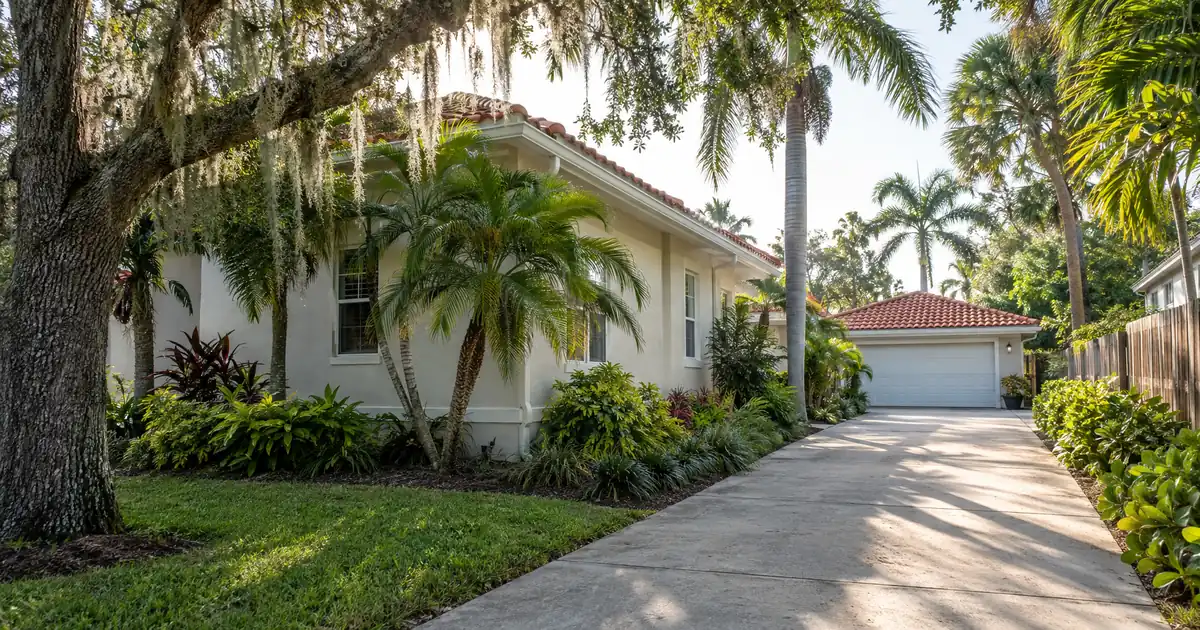
The Zillow Home Value Index puts a typical Marco Island home at $897,549, down 5.8 percent over the past year, with homes going pending in about 58 days. That single line frames the whole cash-out question on this island. Equity is large in absolute terms, but it is sitting on a value that appraisers may mark lower, and the rent stream against it is thin relative to price.
DSCR Cash-Out Calculator
Run the cash-out numbers in Marco Island, FL
Rate source: Freddie Mac 30-yr average via FRED® — Federal Reserve Bank of St. Louis · effective Sep 24, 2026
Prefilled with starting assumptions — enter your property’s value, balance, taxes, and insurance for a more accurate picture.
Program parameters update from Lendmire’s centralized guideline source. Taxes and insurance are editable estimates.
As of Sep 24, 2026 · General Freddie Mac market benchmark, not a Lendmire loan offer. Property value, balance, taxes, and insurance are editable estimates. Maximum loan-to-value varies by lender, program, property type, and seasoning. Not a Loan Estimate, approval, or commitment to lend. Program availability and eligibility are subject to lender guidelines, credit approval, property review, and underwriting.
The Quick Read:
A DSCR cash-out refinance on an investment property in Marco Island, Florida is underwritten primarily on the property’s rental income measured against its full monthly obligation, with loan-to-value capped well below the appraised value, so the file depends on how the appraisal and the lease evidence land, not on personal income documentation.
- Cash-out LTV tops out at 75 percent, and seasoning runs about six months from title recording.
- Houzeo shows condos averaging $650,750 against single-family at $1,632,000, so condos carry the coverage.
- Rent sources conflict: Zumper shows rents down 19 percent, while Zillow shows them up.
- Only four multi-family listings appear on Homes.com, so small multifamily is not the play.
- Proceeds depend on appraisal, rent used for lender review, reserves, and the 75 percent ceiling. No cash figure is promised.
Marco Island Market Snapshot
A quick read on the Marco Island investor landscape — figures come from the cited sources below. Confirm current property-level numbers before underwriting.
| Metric | Detail |
|---|---|
| Home prices | $1,050,000 median (Homes.com multi-family) |
| Recent appreciation | +4.7% (Agentsgather) |
| Population | 16,205 population (Census Reporter) |
Condos First: Where the Coverage Actually Clears
The mid-island condo and townhome stock is the only part of Marco Island where a cash-out refinance produces a coverage number worth building on. The lower entry price against comparable rents is the whole reason. Houzeo’s condo average of $650,750 sits against a Zumper two-bedroom median of $5,500, which works out to roughly 0.8 percent monthly rent-to-price. That is arithmetic on mismatched sources, not a published statistic, but the direction is clear.
Run the numbers on it as a modeled assumption: a condo valued near $650,750, rented at $5,500, refinanced at the 75 percent LTV ceiling. With principal, interest, taxes, and insurance all in the denominator, coverage lands around 1.2x, rounded down. That is before HOA dues, and dues belong in the denominator. Flood and wind premiums on a barrier island can move the number further, so a fresh insurance quote matters before anyone quotes a ratio to a client.
Homes.com rental data shows a condo median of $5,500 and a townhouse median of $4,000, though the listing portal’s figures should be read as directional. The Zumper rent ladder adds a useful wrinkle: one-bedrooms at $2,990, two-bedrooms at $5,500, three-bedrooms at $6,450. The jump to a second bedroom is steep, while the third adds under $1,000. A two-bedroom is the likely sweet spot for coverage per dollar of value. Paying up for a third bedroom buys very little extra rent.
Condo association leasing restrictions sit on top of all this, and capital-project risk at the building level is real. Coverage is only as good as the association’s willingness to let the unit be leased long term.
Single-Family: An Equity Product, Not a Rent Product
Single-family homes on Marco Island cannot carry a cash-out refinance on rent alone at meaningful leverage. The same Houzeo page puts the single-family average at $1,632,000, while Zumper’s average house rent is $5,750. That is about 0.35 percent monthly, less than half the condo ratio.
Model it the same way. At $1,632,000 and $5,750 of rent, full-PITIA coverage at 75 percent LTV falls around 0.5x. A coverage number that low is nowhere near the 1.00x benchmark most standard DSCR programs are built around. Some lenders may review sub-1.00 scenarios, but those typically demand lower leverage, stronger compensating factors, different pricing, or more cash left in the deal. Practically, a single-family owner here is choosing between a reduced-LTV cash-out, a program that reviews sub-1.00 coverage, or a different capital source entirely. Qualification in every case stays subject to lender guidelines, credit approval, and property review.
The neighborhoods sort themselves along this line. Marco Beach and the Gulf-front high-rises printed a three-month median of $990K on Redfin, down 10.0 percent year over year. Hideaway Beach is a private, club-driven gated enclave of condominiums, beach villas, and single-family homes, and it is a poor fit for long-term-rental DSCR underwriting. Olde Marco on the north end mixes older housing with redevelopment activity, which produces lower-basis entry points but inconsistent appraisal comps. Canal-front single-family sits in the same appreciation-led bucket as the beachfront. No reliable neighborhood-level rent source exists for any of these, so the submarket read here is qualitative.
What Does the Appraisal Do to a 75 Percent Cap?
The 75 percent ceiling applies to the appraised value on the day of the refinance, not the price paid, and Marco Island’s comps are moving the wrong way for anyone expecting a value uplift. The island’s own data points are consistent: Houzeo reports a median of $850,000, down 10.53 percent year over year, with homes sitting 105 days and 2.96 months of supply. The sale-to-list ratio was 93.34 percent. Homes.com’s multi-family page shows a twelve-month median sale price of $1,050,000, down 4 percent, with 132 days on market against a 54-day national average.
One source went the other way. A brokerage page reported an MLS median up 1.5 percent, and it is excluded here because it contradicts the other sources on direction. Zillow, Houzeo, and Redfin Marco Beach all point to a cooling market with buyer leverage.
The practical consequence for a cash-out is straightforward. An investor who bought near the top of the last cycle may have equity that has partly evaporated. The prudent underwriting assumption is an appraised value five to ten percent below the original purchase price, not a gain. Seasoning of about six months from title recording gates the refinance, but seasoning only opens the door. The appraisal decides how much walks through it.
Working DSCR brokers see a recurring pattern in resort-island markets: the files that struggle are rarely the ones with weak tenants, they are the ones where the owner anchored on a peak-era value and a peak-era rent. The files that clear tend to be built backward, starting from a conservative appraisal, a lease at or below the low end of the rent data, and full reserves, then sizing the cash-out to whatever that stack supports. Sizing to the worst reasonable input, not the best, saves a repricing conversation later.
The Rent Data Fights Itself
Rent sources on Marco Island disagree on direction, and the underwriting answer is to document the lease instead of trusting any aggregator.
| Source | Average rent | Direction |
|---|---|---|
| Zumper | 2BR $5,500; 3BR $6,450 | Down 19% |
| Trulia | $5,900 average | Down 9% |
| Zillow Rental Manager | $6,500 average | Up $1,000 |
Zillow’s own range runs from $1,800 to $35,000, which tells an investor how much the average hides. Many of the higher figures likely reflect seasonal or furnished listings, and annual unfurnished long-term rents are probably lower, though that could not be verified. This is a genuine toss-up on direction. The defensible position is a signed annual lease at or below the low end of the data, because a 19 percent swing in the rent estimate is the difference between clearing 1.00x and not. The vacancy picture is similarly thin: no reliable vacancy source turned up, so none is asserted here.
Seasonal Demand and the Workforce Behind It
Marco Island’s tenant base is seasonal and service-sector, which shapes how rent is evidenced more than whether demand exists. Per Census Bureau QuickFacts, the city has 16,205 residents across 12.2 square miles, and Wikipedia notes the population more than doubles in winter. Lenders reviewing rental income commonly look across a twelve-month window, so a lease schedule that only shows high-season months invites a haircut.
The job base explains the demand without inflating it. On-island employment centers on the JW Marriott Marco Island Beach Resort, the Hilton Marco Island Beach Resort, Marriott’s Crystal Shores, and the City of Marco Island, with no verified headcounts. Hideaway Beach Club’s careers page shows participation in the H-2B and J-1 visa programs, which points to seasonal workforce housing demand. Regionally, the Naples Daily News summary of the FGCU employer list shows Collier County Public Schools at 5,810 employees, Collier County government at 5,045, and NCH Healthcare System at 3,288. Those are county-level anchors rather than island employers, and no university campus sits on Marco Island.
The demand read: steady service-sector and public-sector employment supports long-term tenants, while the seasonal swing argues for documenting twelve-month income.
Small Multifamily: Mostly Not Here
Duplex, triplex, and fourplex stacking is not a realistic cash-out strategy on this island. Homes.com shows only four multi-family listings, a category it defines as duplexes, triplexes, fourplexes, and apartment complexes. No rent data for small multifamily turned up. Comps for any 2-to-4 unit refinance will be very thin, which means unit-by-unit lease documentation and a conservative appraisal assumption. Marco Island is a condo and single-family island, and investors hunting multi-unit coverage have historically looked to mainland submarkets instead.
Turning Proceeds Into the Next File
A few parameters shape the structure. Credit tiers typically start at a 620 floor and step up through 660, 680, and 700. Reserves generally run about six months of PITIA and rise on larger balances, and loan amounts on standard programs reach up to $3,000,000. Anyone holding title in an LLC should confirm treatment subject to lender program eligibility. Current local rental rules, taxes, HOA restrictions, and insurance should be verified with qualified local professionals before underwriting. For the mechanics of the ratio itself, see the guide “What Is a DSCR Loan”. Statewide program context lives on the page for DSCR loans in Florida.
Investors who want a coverage ratio run against their own lease and value assumptions can send their scenario for review or call 828-256-2183.
Frequently Asked Questions
How do you qualify for a DSCR cash-out refinance in Marco Island?
Qualification centers on the property’s rent used for lender review against its full PITIA, with 1.00x as the common baseline, plus a credit score at or above a 620 floor and about six months of reserves. The property also needs roughly six months of seasoning from title recording, and the loan cannot exceed 75 percent of appraised value. Final eligibility depends on lender guidelines, credit profile, and property review.
What are the requirements for an investment property loan in Marco Island, Florida?
Expect a rent-supported coverage ratio, reserves, a credit score in the lender’s tier structure, and an appraisal with a rent schedule. On Marco Island, condo leasing rules and HOA dues deserve early attention because dues sit in the denominator. Manufactured homes, log homes, and barndominiums fall outside these programs. Exact terms vary by lender and borrower.
DSCR vs. conventional financing
There are two common ways to finance an investment property in Marco Island, FL, and they qualify you differently — here’s how investors weigh them.
Why investors choose it
- Qualifies on the property’s rental income — no personal tax returns, W-2s, or pay stubs needed to document income.
- No personal debt-to-income ceiling to clear, so existing mortgages and obligations don’t cap your borrowing the same way.
- Can be closed in an LLC, keeping the property inside a business entity.
- Built for scaling — not held to the limit on number of financed properties that conventional financing applies.
- Underwriting centers on the deal: generally qualifies when the rent covers the payment, a 1.00x coverage ratio being a common baseline (confirmed in underwriting).
- Designed specifically for investment property, including long-term and, where the program allows, short-term rentals.
Where it’s strong
- Often the lowest ongoing financing cost for a buyer who fully qualifies on personal income — a fit for a first property or a cost-first purchase.
Trade-offs for investors
- Requires full personal income documentation and must fit within a debt-to-income limit — salary, existing debts, and other mortgages all count.
- Typically held in your personal name rather than a business entity.
- Caps how many financed properties you can carry, which can become a ceiling as a portfolio grows.
- Evaluates you as a borrower as much as the property, which usually means more paperwork.
How investors usually choose: a first or single property often optimizes for the lowest financing cost; portfolio builders often optimize for leverage, vesting in an LLC, and scaling past conventional caps. The right answer depends on your goals, the property, and current guidelines — both paths run through select lenders in Lendmire’s wholesale network, with eligibility and terms confirmed in underwriting.
Why do Marco Island single-family homes struggle to clear 1.00x on a cash-out?
Price and rent diverge sharply. Houzeo’s $1,632,000 single-family average against Zumper’s $5,750 house rent produces roughly 0.35 percent monthly rent-to-price, well under the condo ratio. Full-PITIA coverage at 75 percent LTV therefore lands far below 1.00x. Owners typically need lower leverage, a program that reviews sub-1.00 scenarios, or a different capital source.
What down-payment ranges may DSCR lenders review for Marco Island investment-property purchases?
Purchase files are typically reviewed at roughly 20 to 25 percent down, with the lender setting the final range by credit, property, and coverage. Lendmire is a non-QM DSCR mortgage broker (NMLS# 2371349) serving 41 markets, and because DSCR eligibility is reviewed primarily on the property’s rental income rather than personal income documents, the down payment is weighed alongside how well the rent supports the loan.
Should a Marco Island owner assume appreciation when planning the cash-out amount?
No. Zillow, Houzeo, and Redfin’s Marco Beach data all show prices down roughly 6 to 10 percent year over year. Sizing proceeds against an appraisal five to ten percent below the purchase price is the conservative assumption, and any upside becomes a bonus rather than a planning input.
For current guidelines and terms, see Lendmire’s DSCR loan programs page.
About Lendmire
Lendmire is a DSCR-focused mortgage brokerage (NMLS# 2371349) that places investor loans across 41 markets, including Washington, D.C. Lenders generally review DSCR eligibility around a property’s rental income rather than personal income documentation, which suits LLC-held rentals, self-employed investors, and portfolios growing beyond conventional financed-property limits. The firm is a 2026 Scotsman Guide Top Workplace and a top-ranked workplace in 2025, as covered in Lendmire’s 2026 Top Workplace announcement.
The math favors the mainland for cash flow right now, and Marco Island’s condo segment is the only pocket of the island that competes.
Investors weighing their equity options can start with a cash-out refinance on an investment property.
Get Started
Ready to find the right loan for you?
In about 30 seconds you can review financing options available for your investment property. No commitment required.
Informational only. Not a Loan Estimate, approval, or commitment to lend. Program availability and eligibility are subject to lender guidelines, credit approval, property review, and underwriting.
References
2. Homes.com
3. Agentsgather
5. Zumper
7. Redfin
8. Trulia
11. Wikipedia
13. Naples Daily News summary of the FGCU employer list
14. a 2026 Scotsman Guide Top Workplace
15. Scotsman Guide — Top Workplaces 2025
16. Lendmire’s 2026 Top Workplace announcement
This article is part of Lendmire’s investment property cash-out refinance program — full qualification details, guidelines, and scenarios live on the program page.
Related reading: DSCR Loans Naples FL: Investor Financing for Old Naples, Marco Island, Bonita Springs, Estero & Real Estate Investors · DSCR Cash Out Refinance in Singer Island, Florida: The 2026 Refi Guide to Ocean Drive Condos · DSCR Cash Out Refinance in Pensacola, Florida: The 2026 DSCR Financing Guide to East Hill Rentals
Guides: Investment Property Cash-Out Refinance in Marco Island, FL · Investment Property Cash-Out Refinance in Florida
Brandon Miller
Founder & CEO, Mortgage Loan Originator, Lendmire LLC
- Mortgage Loan Originator · NMLS# 1129696 · Verify on NMLS Consumer Access
- North Carolina Real Estate Broker · License# 343312 · Verify on NCREC
- North Carolina Insurance Producer · License# 19053198 · Property, Casualty, Life, Health · Verify on NAIC SBS
- Lendmire LLC · Firm NMLS# 2371349 · Verify firm licensure
Important disclosures. Lendmire (NMLS# 2371349) is a licensed mortgage brokerage. Lendmire is not a direct lender, depository institution, or financial advisor. All loan inquiries are subject to lender underwriting; this article does not constitute a commitment to lend. Rates, terms, and program guidelines are subject to change without notice and vary by borrower profile, property type, and state. Information in this article is general in nature and is not financial, legal, or tax advice. Equal Housing Opportunity. NMLS Consumer Access: nmlsconsumeraccess.org.