
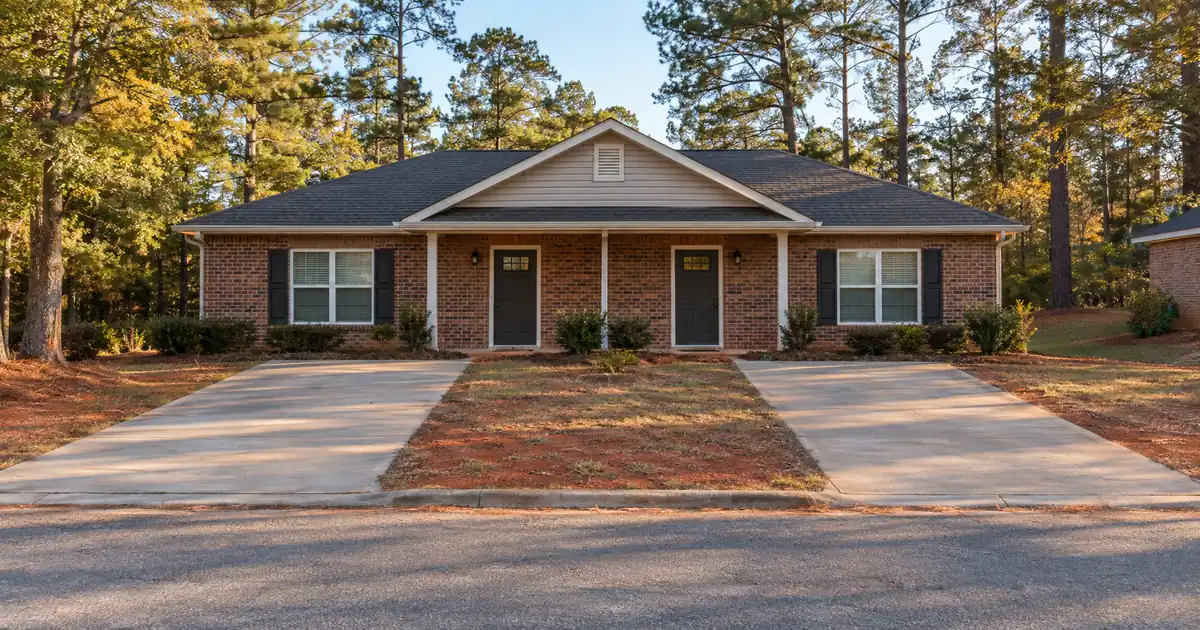
Two Mauldin owners both want to pull equity out of a rental. One holds a single-family house renting near the $1,850 median that Homes.com reports from its listings. The other holds a small duplex. The math favors the duplex owner. Homes.com puts the city’s price-to-rent ratio at 15.6 for houses, which it calls balanced. “Balanced” means single-family coverage will sit near the baseline, while two-unit rent stacks give more room against the lender’s number.
Mauldin, South Carolina rental property investors can tap DSCR programs that Lendmire arranges, available across 41 markets, including Washington, D.C. Lendmire (NMLS# 2371349) is a DSCR-focused mortgage broker, so lenders in its network review and approve the file. This article is about the exit side of the trade: what happens when you already own the property and want its equity working somewhere else.
DSCR Cash-Out Calculator
Run the cash-out numbers in Mauldin, SC
Rate source: Freddie Mac 30-yr average via FRED® — Federal Reserve Bank of St. Louis · effective Sep 24, 2026
Prefilled with starting assumptions — enter your property’s value, balance, taxes, and insurance for a more accurate picture.
Program parameters update from Lendmire’s centralized guideline source. Taxes and insurance are editable estimates.
As of Sep 24, 2026 · General Freddie Mac market benchmark, not a Lendmire loan offer. Property value, balance, taxes, and insurance are editable estimates. Maximum loan-to-value varies by lender, program, property type, and seasoning. Not a Loan Estimate, approval, or commitment to lend. Program availability and eligibility are subject to lender guidelines, credit approval, property review, and underwriting.
The Short Version:
A DSCR cash-out refinance on a Mauldin, South Carolina rental is underwritten primarily on the property’s rental income measured against its full monthly obligation, with proceeds capped by appraised value, where Redfin shows a $316K median sale price, so current comps matter more than past appreciation.
- Cash-out LTV tops out at 75%, and ownership typically needs about 6 months of seasoning.
- Redfin shows Mauldin’s median sale price down 12.6% year over year.
- Single-family coverage models near 1.0x including taxes and insurance; two-unit rent stacks model higher.
- Expect roughly 6 months of PITIA in reserves, subject to lender guidelines.
- BridgeWay Station adds demand and competing apartment supply at the same time.
Mauldin Market Snapshot
A quick read on the Mauldin investor landscape — figures come from the cited sources below. Confirm current property-level numbers before underwriting.
Why Flat Comps Change the Cash-Out Plan
Cash-out proceeds in Mauldin will be set by today’s appraised value, not by the value you hoped for when you bought. Redfin reports a $316K median sale price, down 12.6% year over year, with homes averaging 104 days on market versus 96 a year earlier. Movoto shows a lower median list price of $275K (a listing-price measure, so it runs below sale-price data). Niche’s census-style home value is lower still, at $258,500. The sources disagree on method, but they agree on direction: soft.
That matters because a cash-out refinance lends against value. If you bought in a stronger moment, the appraisal may land closer to your existing payoff than your memory of the purchase price suggests. The fix isn’t to argue with the appraiser. It is to underwrite the refinance on current value and treat any appreciation as a bonus.
This is the equity-extraction tension in Mauldin. Nothing in the research says the market is broken. Rents are roughly flat and price momentum has turned negative. Owners who paid down principal or bought with a meaningful cushion still have room. Owners who bought at high leverage near the top may find the 75% ceiling leaves little or nothing to take out.
One more wrinkle: slower sales mean fewer recent comparables, and thin comps can produce conservative appraisals. Budget for that.
How the Equity Math Works, Step by Step
Available cash equals 75% of appraised value, minus your existing payoff, minus closing costs, and it only exists if the rent also clears the coverage test. Two gates have to open, not one.
Gate one is leverage. Cash-out refinances on investment property run up to a 75% LTV ceiling on these programs (not the 80% you may have seen on purchases). Say your property appraises at 100 units of value. The lender’s maximum new loan is 75 of those units. If your current payoff is 55 units, the gap is 20 units before costs. If your payoff is already 72, the gap is nearly nothing. Run it in percentages first, then let the calculator convert to dollars. Final terms depend on lender guidelines, property type, leverage, and the borrower’s complete credit picture.
Gate two is coverage. DSCR is monthly rent divided by the full monthly obligation on the new loan: principal, interest, taxes, insurance, and any HOA dues. Most standard programs are built around a 1.00x benchmark because rent covers the payment at that level. Some lenders review lower ratios with lower leverage, stronger credit, or other compensating factors, and eligibility always depends on lender guidelines.
Two other guideposts, both subject to lender guidelines: ownership typically needs about 6 months of seasoning measured from title recording, and reserves generally run about 6 months of PITIA. Credit tiers step at 620, 660, 680, and 700, with 620 as the floor. Better credit generally buys better leverage and pricing.
A new loan resets the obligation. Borrowing more against the same rent pushes coverage down, which is why the two gates pull against each other. The more cash you take, the thinner the ratio gets.
Where the Coverage Lands: House, Townhome, or Duplex
In Mauldin, single-family coverage models right around 1.0x on a full-PITIA basis, while a two-unit property models in the low-1.2 range. The figures below are modeled assumptions, not sourced market returns. Each uses 75% LTV, an assumed 30-year amortization at a high-6s rate, and taxes and insurance at South Carolina average loads, all included. These specifics are subject to lender guidelines and a full review of property, leverage, and credit.
| Scenario (modeled) | Value / rent input | Coverage (incl. Taxes, insurance) |
|---|---|---|
| Median house | $316K value; $1,850 rent | About 1.0x |
| Same house, census-style rent | $316K value; $1,490 rent | Around 0.8x |
| Duplex | $334,900 value; $2,400 rent | About 1.2x |
The first row uses Redfin’s median sale price and the Homes.com single-family rent median (a 24-listing sample, so treat it as directional). Both rows 1 and 2 use the same value, so the only variable is the rent source. Niche shows a median rent of $1,490, and Zillow’s listing average sits at $1,750 with its rental market temperature marked “COOL.” An appraiser’s market-rent schedule may land between those figures. Run the stress case at the low end.
Row three comes from one duplex listing on Redfin’s Greenville-area multifamily page at $334,900 with $2,400 in combined rent across two 2-bed/1-bath units. The listing text also references Greer, so the location is unconfirmed. It is one data point, not a market. The direction still holds: on that listing, rent-to-price comes out near 0.72%, versus about 0.59% for the median house. Duplexes give more gross rent per dollar of value, which is why they tend to clear the ratio with more cushion.
If the numbers fall under 1.00x, as they do in row two, the question becomes which structures a lender might review. Options include a sub-1.00 program, interest-only payment structures, or reduced leverage, all subject to credit approval, property review, and lender guidelines. The better question is whether the loan should be attempted. If a house only works on the most optimistic rent, the safer path is to reduce the cash-out amount or wait for the ratio to improve.
What the Renter Pool Looks Like
Mauldin’s renter base is real but modest, and newer apartment complexes serve most of it. RentCafe reports 32% of households are renter-occupied (3,734 households) and 68% owner-occupied. Average apartment rent is $1,407, up only 0.6% from $1,398 a year earlier, and 62% of rentals fall between $1,001 and $1,500. Rent growth is essentially flat.
Flat rent is a DSCR variable in its own right. The refinance is measured on today’s rent schedule, so a pro forma built on rent growth doesn’t help you at the appraisal. Underwrite at current rents and don’t count on a bump before the loan is placed.
NeighborhoodScout says single-family detached homes are 59.66% of housing units, so houses and townhomes dominate the rentable stock. RentCafe also notes that apartment buildings average about 21 years old, with 61% built since 2000. A small duplex or house competes against newer garden-style complexes, so the positioning question is space. Attached garages and larger floor plans are the gap. Pricing and available terms vary by lender, borrower profile, property type, and full underwriting review.
The Homes.com townhouse data puts median townhome rent at $1,800 and the price-to-rent ratio at 16.2. That ratio is slightly richer than houses, so townhome DSCR math will look a lot like the single-family row above. Watch for overlap with the Woodruff Road edge, which the research notes is partly in Simpsonville or Greenville.
BridgeWay Station: Demand Driver or Supply Risk?
Probably both, and investors should price in both. The City of Mauldin describes BridgeWay Station as a 40-acre urban village at I-385 Exit 33, with plans for at least 1 million square feet of apartments, offices, shopping, dining, lodging, and entertainment. A pedestrian bridge crosses I-385, and GE Vernova Park, a 6,300-seat stadium, sits adjacent as home to the Greenville Triumph and Greenville Liberty. Visit Greenville SC notes Mauldin may not have a traditional downtown, and BridgeWay is essentially building one. The village also connects to the 32-mile Prisma Health Swamp Rabbit Trail Network.
For an owner with a rental nearby, that is a demand story: a walkable amenity cluster attracts renters who want trail access and restaurants. But BridgeWay plans include apartments, which is new competing supply. An owner planning a cash-out refinance should ask whether the nearest new units will compete with theirs on rent. (Honest answer: the research doesn’t quantify it.) The stronger play may be properties with features new apartments don’t offer, such as a garage, a yard, or more square footage.
The Maverick Yards crossroads is similar. It has 42 new townhomes, a food hall, pickleball courts, and a beer garden, per Upstate Business Journal. New-build rents there won’t be typical of Mauldin’s older stock.
Employment Anchors Behind the Rent Roll
Mauldin’s tenant demand leans on commuter access to several large employers rather than one local anchor. Mauldin sits about 8 miles from Greenville. Prisma Health operates Greenville Memorial, which has a Level I Trauma Center, the Upstate’s only pediatric trauma center, and the region’s only solid organ transplant center. Roth Capital describes Prisma as the metro’s largest employer, with nearly 16,000 employees. Bon Secours St. Francis adds hospital capacity, and nearby sources name Michelin North America, GE Vernova, and BMW’s Spartanburg County plant as regional manufacturing anchors. Roth Capital puts about 11,000 people inside the BMW factory.
Inside Mauldin, Upstate Business Journal lists Charter/Spectrum, Truist, C.F. Sauer Co., and Dodge Industrial as major employers, with EPC Power and Responsive Industries among newer arrivals. Global Lending Services, Jacobs, and IPS Packaging & Automation are in Brookfield Office Park. No hospital is located inside Mauldin, and Mauldin has no public transit system of its own, so tenants are car commuters. Universities aren’t a primary driver, since Furman, Greenville Technical College, and Clemson’s CU-ICAR are all regional.
The Census count was 24,724, making Mauldin the 19th-most populous city in South Carolina, and the city’s own marketing says it has more than 30,000 residents. Point2Homes, citing Census data, reports a median household income of $81,027 and a 4.9% unemployment rate. Income and employment fundamentals are steady, even as prices soften.
What Seasoned Deal Desks See in Markets Like This
In suburban markets with flat rents and softening comps, the friction point on cash-out files is usually the appraisal’s rent schedule, not credit. Files that come in cleanly tend to have a current lease, a rent figure near the lower appraisal estimate, and reserves documented in advance. The awkward ones lean on a listing-based rent assumption that the appraiser doesn’t support.
Your Choices: Conventional, DSCR, or Waiting
Conventional financing may be the better call if you hold a single rental, your traditional employment income is strong, and your traditional personal-income documentation cleanly supports the borrowing. It can carry a lower cost and doesn’t depend on the property’s coverage ratio. Conventional vs DSCR on investor loans covers the trade in detail. The flip point is usually the fourth financed property, or earlier if you’re self-employed, hold title in an LLC (subject to program terms), or your returns understate income after depreciation.
DSCR vs. conventional financing
Two common ways to finance an investment property in Mauldin, SC. They qualify you differently — here’s how investors weigh them.
Why investors choose it
- Qualifies on the property’s rental income — no personal tax returns, W-2s, or pay stubs needed to document income.
- No personal debt-to-income ceiling to clear, so existing mortgages and obligations don’t cap your borrowing the same way.
- Can be closed in an LLC, keeping the property inside a business entity.
- Built for scaling — not held to the limit on number of financed properties that conventional financing applies.
- Underwriting centers on the deal: generally qualifies when the rent covers the payment, a 1.00x coverage ratio being a common baseline (confirmed in underwriting).
- Designed specifically for investment property, including long-term and, where the program allows, short-term rentals.
Where it’s strong
- Often the lowest ongoing financing cost for a buyer who fully qualifies on personal income — a fit for a first property or a cost-first purchase.
Trade-offs for investors
- Requires full personal income documentation and must fit within a debt-to-income limit — salary, existing debts, and other mortgages all count.
- Typically held in your personal name rather than a business entity.
- Caps how many financed properties you can carry, which can become a ceiling as a portfolio grows.
- Evaluates you as a borrower as much as the property, which usually means more paperwork.
How investors usually choose: a first or single property often optimizes for the lowest financing cost; portfolio builders often optimize for leverage, vesting in an LLC, and scaling past conventional caps. The right answer depends on your goals, the property, and current guidelines — both paths run through select lenders in Lendmire’s wholesale network, with eligibility and terms confirmed in underwriting.
If you’re on the DSCR side, the guide “What Is a DSCR Loan” explains the mechanics, and refinance details cover the broader refinance options. Loan sizes run up to $3,000,000 on standard programs, with smaller balances routed through select lenders in the network. Mauldin-area files sit well inside that range. Manufactured homes, log homes, and barndominiums fall outside these programs. Details and eligibility are in Lendmire’s South Carolina DSCR loan programs.
The decision that matters most is what the proceeds do next. Pulling equity to buy another rental where coverage still clears 1.0x (a duplex is the obvious candidate) is a clear use. Pulling equity to fund something with no rental income at all is a different risk, and the ratio math doesn’t justify it. The equity recycle pathway walks through the reuse logic.
The math on a borderline single-family house is a genuine toss-up: a modest cash-out may work, but a large one pushes coverage below 1.0x. Sizing the loan down, not up, is usually the stronger move. If you want to see where your own property lands, call Lendmire at 828-256-2183. Verify current local rental rules, taxes, and insurance with qualified local professionals before you commit.
Frequently Asked Questions
How much equity can I pull from a Mauldin rental?
The ceiling is 75% of appraised value minus your payoff and closing costs, and the rent still has to cover the new obligation at roughly the 1.00x baseline on select programs. With local sale prices softening recently, current appraised value, not purchase price, sets the number. Final eligibility depends on lender guidelines, credit, and reserves.
Does BridgeWay Station help or hurt my cash-out refinance?
It helps demand but adds competing apartment supply, and neither effect shows up in published rent data yet. The appraiser measures your property against current rent and sale comps, not planned projects. Owners near the village should run coverage at today’s rents and treat any BridgeWay premium as upside.
Why would a duplex model better than a house here?
Rent per dollar of value is higher. On the modeled duplex listing, rent-to-price was about 0.72% versus about 0.59% for a median house. That cushion shows up as coverage near 1.2x versus about 1.0x, though the duplex is a single listing and unconfirmed as a Mauldin address.
Can I cash out if my seasoning is under six months?
Typically not on these programs, since ownership is usually measured from title recording and needs about 6 months. Some situations are reviewed differently, but that is a lender-by-lender question. If you’re close, waiting usually costs less than trying to work around it.
What if the appraisal rent comes in near the lower Mauldin figures?
Coverage can drop toward 0.8x on a median-priced house if rent lands near the census-style median of $1,490. Options a lender might review include a smaller loan amount, a sub-1.00 program, or interest-only structuring, subject to credit approval and property review.
The Closing Number
Mauldin’s apartments rent for an average of $1,407 a month, up just $9 from a year earlier, so this is a market where equity gets built through loan sizing and unit count, not through waiting on rent growth.
For current guidelines and terms, see Lendmire’s DSCR loan programs page.
About Lendmire
As a DSCR and non-QM mortgage broker, Lendmire (NMLS# 2371349) connects investors with wholesale lending channels across 41 markets, including Washington, D.C. The property’s rental income, not the borrower’s traditional personal-income documentation, is central to lender review, an approach that suits self-employed operators and portfolios beyond four financed properties. The brokerage has been named a 2026 Scotsman Guide Top Workplace and a 2025 Scotsman Guide Top Workplace, and Lendmire press releases and announcements are posted on EIN Presswire.
Get Started
Ready to find the right loan for you?
In about 30 seconds you can review financing options available for your investment property. No commitment required.
Informational only. Not a Loan Estimate, approval, or commitment to lend. Program availability and eligibility are subject to lender guidelines, credit approval, property review, and underwriting.
References
1. Homes.com: Mauldin Houses for Rent
2. Redfin: Mauldin Housing Market
3. Niche
4. RentCafe: Mauldin Average Rent
7. City of Mauldin: BridgeWay Station
8. Visit Greenville SC: Introduction to Mauldin
9. Upstate Business Journal: Mauldin City Profile
10. Prisma Health in the Upstate
11. Census count
12. Point2Homes
13. a 2026 Scotsman Guide Top Workplace
14. a 2025 Scotsman Guide Top Workplace
This article is part of Lendmire’s investment property cash-out refinance program — full qualification details, guidelines, and scenarios live on the program page.
Related reading: Cash Out Refinance Investment Property Mauldin South Carolina · DSCR Cash Out Refinance in Simpsonville, South Carolina: The 2026 DSCR Guide to Fairview Road · Cash Out Refinance Investment Property South Carolina
Guides: Investment Property Cash-Out Refinance in Mauldin, SC · Investment Property Cash-Out Refinance in South Carolina
Brandon Miller
Founder & CEO, Mortgage Loan Originator, Lendmire LLC
- Mortgage Loan Originator · NMLS# 1129696 · Verify on NMLS Consumer Access
- North Carolina Real Estate Broker · License# 343312 · Verify on NCREC
- North Carolina Insurance Producer · License# 19053198 · Property, Casualty, Life, Health · Verify on NAIC SBS
- Lendmire LLC · Firm NMLS# 2371349 · Verify firm licensure
Compliance and disclosures. Lendmire (NMLS# 2371349) is a licensed mortgage broker and is not a direct lender, depository institution, financial advisor, or tax professional. Content in this article is general market analysis and educational information — not financial, legal, or tax advice for any specific situation. Lendmire does not guarantee loan approval; every transaction is subject to underwriting by the funding lender. Mortgage pricing and loan program guidelines are subject to change at any time without notice and vary by borrower characteristics, property type, and state regulations. Lendmire complies with Equal Housing Opportunity. Licensure verification: NMLS Consumer Access.