
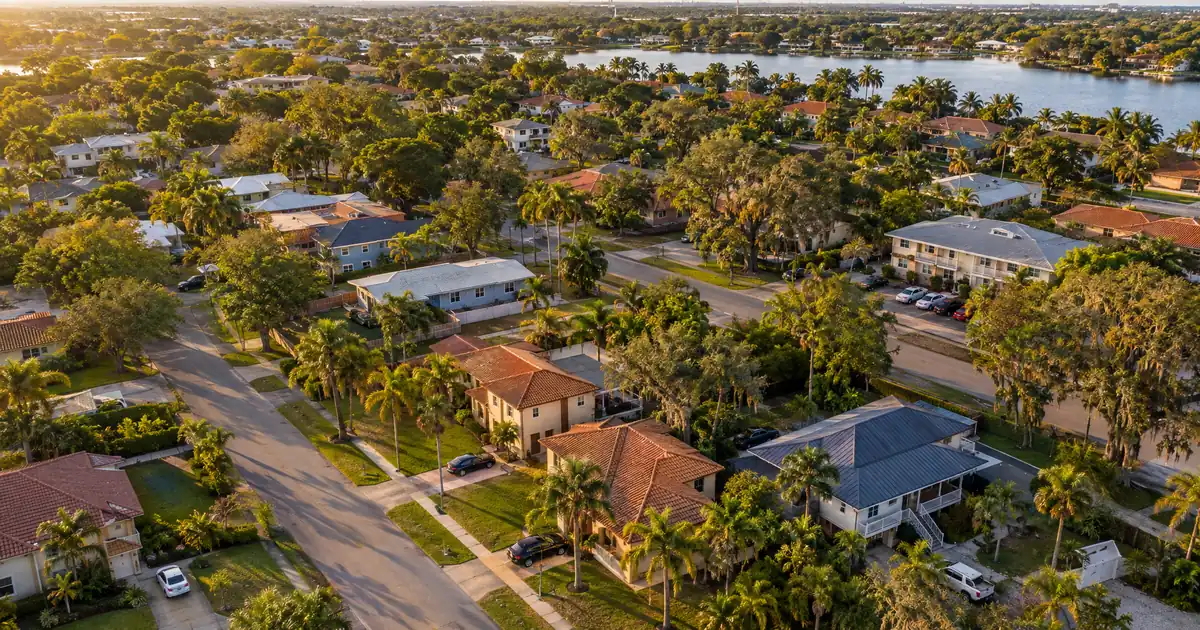
A cash-out refinance in Miami Lakes starts from a 75 percent loan-to-value ceiling applied to a town where Redfin puts the median sale price at $690K, down 1.3 percent year over year. Rents here sit well below that price level. At full leverage, many single-family files land under the 1.00 coverage benchmark once taxes and insurance go into the denominator. The equity is real, but the rent-to-debt ratio is what decides how much of it can be pulled out.
At a Glance: A Miami Lakes cash-out refinance is underwritten primarily on the property’s rental income measured against its full monthly obligation, and with a $690K median price the rent side is usually the constraint, not the equity side.
DSCR Cash-Out Calculator
Run the cash-out numbers in Miami Lakes, FL
Rate source: Freddie Mac 30-yr average via FRED® — Federal Reserve Bank of St. Louis · effective Sep 24, 2026
Prefilled with starting assumptions — enter your property’s value, balance, taxes, and insurance for a more accurate picture.
Program parameters update from Lendmire’s centralized guideline source. Taxes and insurance are editable estimates.
As of Sep 24, 2026 · General Freddie Mac market benchmark, not a Lendmire loan offer. Property value, balance, taxes, and insurance are editable estimates. Maximum loan-to-value varies by lender, program, property type, and seasoning. Not a Loan Estimate, approval, or commitment to lend. Program availability and eligibility are subject to lender guidelines, credit approval, property review, and underwriting.
- Modeled single-family coverage at the 75 percent ceiling runs roughly 0.85 to 1.05 including taxes and insurance.
- Townhomes carry the best coverage in town because of their lower price points.
- Homes now sell after 79 days on average, up from 55 a year earlier.
- A proposed 541-unit Graham apartment project is a supply risk to watch.
Lendmire, NMLS# 2371349, a DSCR-focused mortgage broker, arranges these files through wholesale investor channels. Lenders, not the brokerage, review and approve them. The sections below cover how the coverage math behaves in Miami Lakes, which property types hold up, and where the market could erode a cash-out plan.
Where the 75 Percent Cap Meets a $690K Median
Miami Lakes cash-outs are rent-constrained, not equity-constrained. Standard DSCR programs cap cash-out leverage at 75 percent of value and typically ask for about six months of ownership, measured from title recording, plus reserves around six months of PITIA. The binding limit here is usually the coverage ratio, not the seasoning clock or the LTV cap.
Run the numbers on a modeled 3/2 single-family home valued near $650,000 (inside the agent-quoted entry band of $575,000 to $750,000 from Rangely Adames’ local guide, which is an agent estimate, not official data). Assume a rent of $3,800, toward the middle of that guide’s $3,500 to $4,800 range for 3/2 homes. Divide that rent by full PITIA at 75 percent LTV and the ratio lands in the low 0.90s, including taxes and insurance. Below 1.00. Not workable on a standard 1.00 baseline.
The paths from there are structural. A lender may review a lower-leverage cash-out, since dropping to about 60 percent LTV on the same modeled property pushes coverage to roughly 1.05. A lender may also look at an interest-only structure or a sub-1.00 program, usually with compensating factors, less cash-out or added reserves. Outcomes depend on lender guidelines, credit profile, property review and appraisal rent, so none of these is an assumption of approval. For the mechanics of the ratio itself, see the guide “What Is a DSCR Loan”.
DSCR files in markets like this one typically look the same. The equity is comfortable and the seasoning is easy, but the rent-to-debt ratio decides the loan size. The stronger files pair a conservative appraisal rent schedule with a leverage choice made after the coverage number is known, not before. Borrowers who start from “how much cash can I pull” tend to get a smaller answer than borrowers who start from “what coverage does this rent support.”
Which Rent Number Belongs in the Numerator?
Town-wide rent averages understate single-family rent, so the house-specific bands are the right input. The published averages are also inconsistent, which matters because a few hundred dollars of rent moves coverage by several hundredths.
Redfin’s town-wide average rent was $2,394 at the last update, and Point2Homes shows $2,357. Both are dominated by apartments and condos. RentHop breaks it out by bedroom count: $2,650 for a 2-bedroom (down nearly 14 percent year over year), $3,200 for a 3-bedroom (down about 4 percent) and $5,124 for a 4-bedroom (up about 8 percent). The pattern is soft mid-size rents and firmer large-home rents.
Put a 3-bedroom at $3,200 into the model above and coverage falls into the high 0.70s at 75 percent LTV. Put it at $4,800, the top of the agent band, and it clears 1.00. That spread is why the appraisal’s rent schedule matters more than any portal average. Underwrite to the conservative end.
Townhomes First, Single-Family Second
Townhomes carry the best rent-to-debt ratios in Miami Lakes because price falls faster than rent. The agent guide puts townhomes in communities like Lake Sarah and Bridgewater at $425,000 to $625,000, against rents of $2,800 to $3,800.
Consider a townhome valued near $450,000 with a modeled rent of $3,300. At 75 percent LTV, coverage works out near 1.10 including taxes and insurance. Drop the rent to $2,800 and it slips just under 1.00. A wide band, but the center of it clears, which is more than single-family can claim.
Entry-level single-family in the original Graham-built sections east of the Palmetto is the next tier. Those older 3/2 homes sit among lakes and tree-shaded streets, and Main Street, the town center, anchors a small pocket of rental condos and apartments. Royal Oaks, a gated community, shows a Redfin median rent of $2,400, and The Moors shows $2,500. Those are thin data points and neither neighborhood has sourced sale-price data. Treat them as rent markers, not full profiles.
Condos near Main Street are the third candidate, but there is no sourced condo pricing here, so the coverage math can’t be checked.
Skip the Lakefront Tier.
Loch Lomond, Lake Patricia and the premium Royal Oaks lake and estate sections run $800,000 to $1.2 million for mid-range 4-bedrooms and $1.3 million to $2.5 million or more for gated and lakefront homes. Rents on those homes do not scale with price. Even the $5,124 RentHop figure for a 4-bedroom falls far short of what a $1.3 million loan basis demands at 75 percent LTV. Coverage sits well under 0.70 on anything in that range.
An owner there may still want equity access, but a DSCR structure is the wrong tool. Other programs fit better, and the guide “Where DSCR and Conventional Diverge” is worth reading before choosing.
Appreciation Won’t Rescue the Appraisal
Miami Lakes is a flat market, and a cash-out thesis should rest on today’s rent coverage, not on projected gains. Redfin shows the median price down 1.3 percent and days on market at 79 versus 55 a year earlier. RentCafe shows average rent slipping from $2,361 to $2,345, about 0.68 percent. Prices are soft, rents are soft, and inventory sits longer.
One data point needs care. Redfin’s price per square foot is up 22.1 percent at $426, which contradicts the falling median. That is most likely a mix-shift effect, with smaller homes selling at higher per-foot prices. Don’t build a cash-out plan on it.
Longer marketing times also tell appraisers to lean on conservative comps. An owner who assumes the appraisal will confirm last year’s value is carrying risk that the LTV math doesn’t show. Data USA reports population growth of only about 0.36 percent over a year (30,621 to 30,731), with median household income of $97,255. It is a stable, built-out town, not a growth story. A rising tide isn’t coming to lift the value.
The Graham Pipeline: A Supply Overhang in Waiting
Miami Lakes has an unusual structure. The Graham Companie is the largest landowner, and its residential arm reports owning and managing 2,276 apartment units across nine communities (a company claim). That makes small-investor rental inventory scarce and means one landlord sets much of the local rent benchmark.
The risk is what comes next. The Graham Companies has proposed a 541-unit apartment project on 22.2 acres, reported as still in planning and zoning review. An earlier, smaller 220-unit version on 9.5 acres stalled when the Town Council deferred its site plan vote. The larger project is only a proposal. If it gets built, it becomes the largest new rental supply in town in years and competes directly with townhome and condo rentals for the same tenants.
For a cash-out borrower, the timing point is simple. Coverage that clears today at 1.10 could face pressure from concessions if new supply arrives. Sizing the new loan with a cushion, rather than at the exact maximum, is a reasonable hedge. (It also happens to leave more room for the reserves lenders typically ask for.)
What the Proceeds Do Next
Cash-out capital is only useful if the next purchase is underwritten better than the collateral it came from. Proceeds pulled from a Miami Lakes property and redeployed into a higher-coverage market improve the portfolio’s overall rent-to-debt ratio. Redeployed into another $650,000 single-family home at the same leverage, they just duplicate the thin coverage.
Lendmire’s broader refinance pathway for investor properties covers rate-and-term and cash-out structures alike, and the refi options page lays out how cash-out files are framed. Loan amounts typically run up to $3,000,000 on standard programs, credit tiers start at a 620 floor, and LLC-titled properties are reviewed subject to lender program eligibility. Investors can see Lendmire’s Florida DSCR loan programs for state-level detail, or request a scenario review at 828-256-2183. Program details change, and investors should confirm current local rental rules, taxes and insurance with qualified local professionals.
DSCR vs. conventional financing
Two common ways to finance an investment property in Miami Lakes, FL. They qualify you differently — here’s how investors weigh them.
Why investors choose it
- Qualifies on the property’s rental income — no personal tax returns, W-2s, or pay stubs needed to document income.
- No personal debt-to-income ceiling to clear, so existing mortgages and obligations don’t cap your borrowing the same way.
- Can be closed in an LLC, keeping the property inside a business entity.
- Built for scaling — not held to the limit on number of financed properties that conventional financing applies.
- Underwriting centers on the deal: generally qualifies when the rent covers the payment, a 1.00x coverage ratio being a common baseline (confirmed in underwriting).
- Designed specifically for investment property, including long-term and, where the program allows, short-term rentals.
Where it’s strong
- Often the lowest ongoing financing cost for a buyer who fully qualifies on personal income — a fit for a first property or a cost-first purchase.
Trade-offs for investors
- Requires full personal income documentation and must fit within a debt-to-income limit — salary, existing debts, and other mortgages all count.
- Typically held in your personal name rather than a business entity.
- Caps how many financed properties you can carry, which can become a ceiling as a portfolio grows.
- Evaluates you as a borrower as much as the property, which usually means more paperwork.
How investors usually choose: a first or single property often optimizes for the lowest financing cost; portfolio builders often optimize for leverage, vesting in an LLC, and scaling past conventional caps. The right answer depends on your goals, the property, and current guidelines — both paths run through select lenders in Lendmire’s wholesale network, with eligibility and terms confirmed in underwriting.
Frequently Asked Questions
Can a Miami Lakes single-family rental clear 1.00 on a 75 percent cash-out?
Sometimes, but not typically. Modeled coverage on entry-level 3/2 homes runs roughly 0.85 to 1.05 including taxes and insurance, depending on where the appraisal rent lands within the $3,500 to $4,800 agent band. Lower leverage or a sub-1.00 program, both subject to lender review, are the usual adjustments.
Why do townhomes work better than houses for a cash-out here?
Price drops faster than rent. Townhomes in communities like Lake Sarah and Bridgewater run $425,000 to $625,000 with rents of $2,800 to $3,800, which puts modeled coverage near 1.10 at the center of those ranges. The band is wide, so the appraiser’s rent schedule still decides the outcome.
Does the 541-unit Graham proposal affect my refinance today?
Not directly. The project is still in planning and zoning review, and a lender underwrites current rents and the appraisal’s rent schedule. The risk is forward-looking: new supply could pressure townhome and condo rents if it’s built, so leaving a coverage cushion makes sense.
Should I use Redfin’s average rent as my DSCR input?
No. Redfin’s $2,394 town-wide figure blends apartments and condos, so it understates house rents. Use house-specific bands and expect the appraisal to land between the town-wide average and the top of the agent range.
Miami Lakes rewards the investor who sizes a cash-out to the rent, not the equity. The one statistic worth carrying into any refinance decision is the gap between the 541 apartment units proposed for the town and the 1,810 rentals Point2Homes currently tracks.
For current guidelines and terms, see Lendmire’s DSCR loan programs page.
About Lendmire
Lendmire, NMLS# 2371349, is a mortgage brokerage focused on DSCR investor loans, arranging financing in 41 markets, including Washington, D.C., through wholesale and investor-lending channels. The lender reviews the property’s rental income rather than W-2 documentation, subject to lender guidelines, which suits entity-owned and multi-property investors. Lendmire is a 2026 Scotsman Guide Top Mortgage Workplace and was recognized by Scotsman Guide in 2025.
Get Started
Ready to find the right loan for you?
In about 30 seconds you can review financing options available for your investment property. No commitment required.
Informational only. Not a Loan Estimate, approval, or commitment to lend. Program availability and eligibility are subject to lender guidelines, credit approval, property review, and underwriting.
References
1. Redfin: Miami Lakes Housing Market
2. Rangely Adames: Miami Lakes Real Estate Guide
3. Redfin: Miami Lakes Rental Market
4. Point2Homes: Miami Lakes Average Rent
5. RentHop: Average Rent in Miami Lakes
6. Main Street Miami Lakes: The Graham Companies
7. RentCafe: Miami Lakes Rent Trends
9. The Kren Group: Graham Companies 541-Unit Proposal
10. The Real Deal: Graham Companies Rental Proposal
11. a 2026 Scotsman Guide Top Mortgage Workplace
12. recognized by Scotsman Guide in 2025
This article is part of Lendmire’s investment property cash-out refinance program — full qualification details, guidelines, and scenarios live on the program page.
Related reading: Cash Out Refinance Investment Property in Miami Lakes, Florida: The 2026 DSCR Financing Guide to Main Street · Cash Out Refinance Investment Property in Cutler Bay, Florida: Equity Math Ahead of Southplace · Cash Out Refinance Investment Property in Tamiami, Florida: The 2026 DSCR Guide to Tamiami Trail
Guides: Investment Property Cash-Out Refinance in Miami, FL · Investment Property Cash-Out Refinance in Florida
Brandon Miller
Founder & CEO, Mortgage Loan Originator, Lendmire LLC
- Mortgage Loan Originator · NMLS# 1129696 · Verify on NMLS Consumer Access
- North Carolina Real Estate Broker · License# 343312 · Verify on NCREC
- North Carolina Insurance Producer · License# 19053198 · Property, Casualty, Life, Health · Verify on NAIC SBS
- Lendmire LLC · Firm NMLS# 2371349 · Verify firm licensure
Legal disclosures. Lendmire (NMLS# 2371349) is a state-licensed mortgage brokerage that arranges financing through wholesale lender relationships. Lendmire is not a direct lender, depository institution, or registered financial advisor. The discussion above is general informational content about real estate financing — it is not financial, legal, or tax advice, and readers should consult licensed professionals for guidance on their individual circumstances. Loan inquiries are subject to lender underwriting; this article does not represent a commitment to lend. Loan terms, rates, and qualification standards vary by borrower, property, and state, and are subject to change at any time. Equal Housing Opportunity. NMLS Consumer Access: nmlsconsumeraccess.org.