
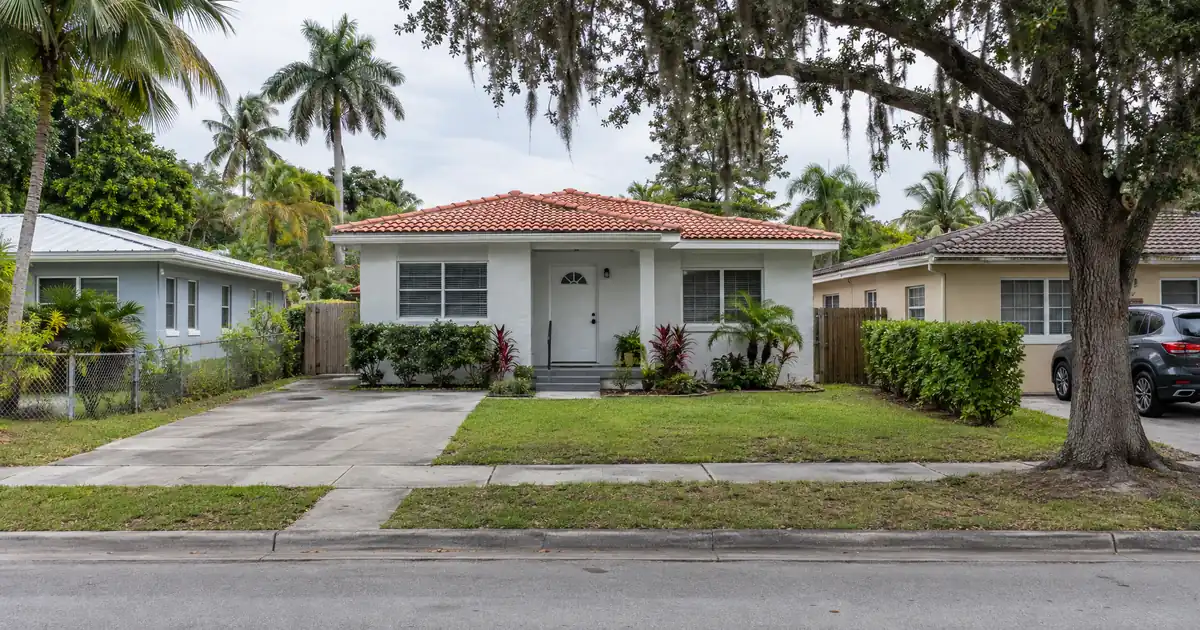
Most investors stall on a cash-out refinance for one of three reasons: the property hasn’t been owned long enough, the appraisal doesn’t support the value they expect, or the rent doesn’t cover the new debt once taxes and insurance are counted. North Miami tests all three at once. Values run from inland workforce stock to multimillion-dollar waterfront homes, and published rent figures disagree with each other by a wide margin. This research walks through how a DSCR cash-out refinance works on North Miami, Florida rentals you already own, and where the coverage math holds up.
DSCR Cash-Out Calculator
Run the cash-out numbers in North Miami, FL
Rate source: Freddie Mac 30-yr average via FRED® — Federal Reserve Bank of St. Louis · effective Sep 24, 2026
Prefilled with starting assumptions — enter your property’s value, balance, taxes, and insurance for a more accurate picture.
Program parameters update from Lendmire’s centralized guideline source. Taxes and insurance are editable estimates.
As of Sep 24, 2026 · General Freddie Mac market benchmark, not a Lendmire loan offer. Property value, balance, taxes, and insurance are editable estimates. Maximum loan-to-value varies by lender, program, property type, and seasoning. Not a Loan Estimate, approval, or commitment to lend. Program availability and eligibility are subject to lender guidelines, credit approval, property review, and underwriting.
The Quick Read:
A DSCR cash-out refinance in North Miami, Florida is underwritten primarily on the property’s rental income measured against its full monthly obligation, so the rent figure you document matters more than the value you hope for. Listing-based rent sources here disagree by roughly 45%, per RentCafe and Apartments.com.
- Inland stock (Arch Creek, Westside–Sunkist Grove, Allen Park) fits the coverage test better than waterfront.
- Keystone Point and Keystone Island prices, in the millions, sit far above achievable rents.
- Cash-out typically caps at 75% LTV after about six months of ownership.
- Duplexes with two 2-bedroom units stack income better than a single house at similar prices.
- New apartment deliveries in the neighboring submarket may cap rent growth.
North Miami Market Snapshot
A quick read on the North Miami investor landscape — figures come from the cited sources below. Confirm current property-level numbers before underwriting.
| Metric | Detail |
|---|---|
| Home prices | $365,000 median value (Data USA, North Miami) |
| Typical rents | $1,702 (Niche, North Miami) |
| Cap rates | ~5.0% cap (Serhant Florida Commercial) |
| University enrollment | 7,000+ students (Wikipedia, Biscayne Bay Campus) |
| Population | 62,202 population (NeighborhoodScout, North Miami) |
| Vacancy | 6.6% (MIAMI REALTORS, rental report) |
How the Cash-Out Math Works, Step by Step
The equity you can pull is set by the lowest of three ceilings: 75% of appraised value, the rent-based coverage test, and reserves. Value alone never decides it.
Start with seasoning. Most programs in the wholesale network want roughly six months of ownership measured from title recording. Next comes the LTV ceiling. Cash-out sits at 75%, and that cap is firm even though purchase loans can go higher. Then comes coverage. The standard benchmark is a 1.00x rent-to-debt ratio, meaning rent used for lender review divided by the full monthly obligation (principal, interest, taxes, insurance, and any HOA dues). The guide “What Is a DSCR Loan” is worth a read if the mechanics are new. Some lenders will review sub-1.00 files with stronger compensating factors, lower leverage, or more cash in reserve, but that is the exception, and eligibility depends on credit, reserves, and property review.
Pricing and available terms vary by lender, borrower profile, property type, and full underwriting review. Reserves typically run about six months of the monthly obligation. Loan sizes go up to $3,000,000 on standard programs. Equity available is never a guaranteed figure. It falls out of the interaction of those ceilings.
Here’s the catch in North Miami: the coverage test is where files get pinched, and rent documentation drives it.
Where the Coverage Test Passes
Inland North Miami carries the strongest cash-out candidates. Arch Creek, Westside–Sunkist Grove, and Allen Park combine lower price points with year-round renter demand, while waterfront pockets fail the rent test outright.
Renters occupy about 57% of households, and Data USA puts the citywide median property value at $365,000 with a 43.5% homeownership rate. Large apartment complexes make up 54.34% of housing units. This is a renter’s city.
Arch Creek. Zillow’s average values run about $449,299 for Arch Creek Estates and $263,764 for Arch Creek East (directional listing-based figures, not sold medians). A local investor guide describes the Arch Creek Park-to-FIU corridor as garden-style complexes, private duplexes, and condo rentals, with 2-bedroom rents of $2,150–$2,750. That is a marketing source, so treat it as directional. Still, two 2-bedroom units under one roof is the structure that lifts coverage above a single house at a similar value.
Allen Park, Washington Park, and Breezeswept Heights. Redfin lists Allen Park near $619,000, while Zillow’s average values run $453,008 for Allen Park, $395,008 for Washington Park, and $484,603 for Breezeswept Heights. The gap between sources is itself a warning: your appraisal, not a listing page, will set the value.
Westside–Sunkist Grove. Redfin shows about $480,000. Older, cheaper inland stock draws workforce tenants, and it fits the cash-out profile of a long-held house with meaningful equity.
Biscayne Gardens and Biscayne Highlands. Redfin lists Biscayne Gardens at $624,000, and Zillow’s average sits near $529,280. Apartments.com counts Biscayne Highlands among the neighborhoods with the most rental listings, which suggests deep tenant demand.
Skip the Waterfront
Keystone Point lists near $3,100,000 on Redfin, and Keystone Island near $3,875,000. No plausible rent covers debt at those values. These homes may appraise strongly, but a rent-based test measures cash flow, and there isn’t any. Investors holding waterfront property who want liquidity should look at other structures, and a sub-1.00 program, interest-only structuring, or a lower-leverage file are the paths a lender would review. None is assured.
Which Rent Number Do You Use?
Use the figure your leases support, and be suspicious of headline averages. RentCafe reports a $2,425 average, up 7.84% year over year, with 3-bedrooms at $3,928, but that data covers only buildings with 50 or more units, which skews toward newer stock. Apartments.com, on a page dated December 2024, shows about $2,898 or more for a 3-bedroom and rents down 1%. RentHop’s median across current listings is $2,700, roughly flat. Exact terms depend on the lender’s guidelines, property type, leverage, and a full review of the borrower’s file.
Treat that spread as the underwriting problem. Rentometer’s house medians of $3,600–$3,700 for 3-bedrooms come from listing data, which tends to run high.
Run the numbers on a modeled example. Say you own a 3-bedroom house near Arch Creek Estates, valued around $450,000 on a directional Zillow average, and you refinance at the 75% ceiling. On the lower rent source of about $2,898, coverage lands around 1.0 including taxes and insurance. On the higher $3,600 figure, it improves toward 1.2. Those are modeled assumptions, not quotes. Same house, two rent sources, two very different files. Against a $3,600 rent claim, an appraiser’s rent schedule and your signed leases decide which side you land on.
Gross yield tells the same story. On this article’s own arithmetic (not a sourced yield), 3-bedroom rents against inland values imply gross annual rent of roughly 7–9% of value. That is workable, not generous.
Appreciation or Cash Flow: Pick One Per Property
North Miami’s inland stock is a cash-flow play, and its waterfront is an appreciation play. Using them interchangeably is the classic mistake.
Metro rent growth is near flat. MIAMI REALTORS reports 0.7% year-over-year asking rent growth and a 6.6% Miami metro vacancy rate, citing Apartment List data. Marcus & Millichap projects Miami’s inventory growth at 1.6%, the slowest in a decade. Scarcity is supporting values more than rent growth is. So appraisals should rest on today’s rents rather than projected increases. (Anyone modeling a refinance on next year’s rent is modeling a hope.)
That matters for sizing. On interior workforce stock, the rent-based test caps proceeds well before value does. You may have far more equity than the 75% LTV and coverage math will release. Every figure here varies by lender and program — guidelines, property type, leverage, and credit profile all apply.
Who Rents Here, and Why It Holds
Two universities, a hospital corridor next door, and a hospitality workforce anchor tenant demand. FIU’s Biscayne Bay Campus is a 200-acre waterfront campus inside city limits, and Johnson & Wales University North Miami is the other four-year school named in the city’s financial report. According to the City of North Miami, the community profile also cites the Museum of Contemporary Art and Oleta River State Park among its attractions.
Employment anchors point the same way. Data USA counts 4,143 residents working in health care and social assistance and 4,035 in accommodation and food services. Jackson North Medical Center, a 382-bed hospital in adjacent North Miami Beach, is part of Jackson Health System and went through a $100 million modernization. Health care and hospitality jobs are steady sources of rental demand, though neither guarantees occupancy on a given unit.
New supply sits on the bayfront too. The SoLē Mia redevelopment, on the former Interama tract next to Oleta River State Park, added two rental towers, per a FIU-hosted planning document. Brand-new units compete at a different tier than a 1970s duplex. That comparison matters for your rent schedule.
What Deal Desks Tend to See on Files Like This
In markets structurally similar to this one, where rent sources conflict and new supply sits nearby, the common friction point is a rent claim that outruns the documentation. The cleaner files tend to arrive with signed leases, proof of deposits, and an appraisal rent schedule that agrees with the borrower’s number. Lendmire’s deal desk tends to see the other pattern more often: an investor quotes a listing-based rent, the appraiser’s schedule comes in lower, and the leverage has to be resized after the fact. Bringing both in line before submission tends to spare that reset.
Does the Pipeline Threaten Coverage?
Yes, in the nearby submarket, though older workforce stock is more insulated. Per Miami Finance Review, citing Cushman & Wakefield’s census of 100+ unit properties, 1,807 apartments were under construction in the North Miami Beach submarket. That was the second-largest pipeline in Miami-Dade after Downtown, at 4,235. Miami-Dade occupancy was 94.6% with annual rent change of −0.2%, per the same report’s MMG data.
DSCR vs. conventional financing
Two common ways to finance an investment property in North Miami, FL. They qualify you differently — here’s how investors weigh them.
Why investors choose it
- Qualifies on the property’s rental income — no personal tax returns, W-2s, or pay stubs needed to document income.
- No personal debt-to-income ceiling to clear, so existing mortgages and obligations don’t cap your borrowing the same way.
- Can be closed in an LLC, keeping the property inside a business entity.
- Built for scaling — not held to the limit on number of financed properties that conventional financing applies.
- Underwriting centers on the deal: generally qualifies when the rent covers the payment, a 1.00x coverage ratio being a common baseline (confirmed in underwriting).
- Designed specifically for investment property, including long-term and, where the program allows, short-term rentals.
Where it’s strong
- Often the lowest ongoing financing cost for a buyer who fully qualifies on personal income — a fit for a first property or a cost-first purchase.
Trade-offs for investors
- Requires full personal income documentation and must fit within a debt-to-income limit — salary, existing debts, and other mortgages all count.
- Typically held in your personal name rather than a business entity.
- Caps how many financed properties you can carry, which can become a ceiling as a portfolio grows.
- Evaluates you as a borrower as much as the property, which usually means more paperwork.
How investors usually choose: a first or single property often optimizes for the lowest financing cost; portfolio builders often optimize for leverage, vesting in an LLC, and scaling past conventional caps. The right answer depends on your goals, the property, and current guidelines — both paths run through select lenders in Lendmire’s wholesale network, with eligibility and terms confirmed in underwriting.
Signals on workforce housing conflict. MIAMI REALTORS says occupancy is declining in Class B/C rentals, while Marcus & Millichap says Class C vacancy held near 3%. The Marcus & Millichap outlook adds that renters priced out of higher-end units are likely to stay put, which tightens the workforce tier. Honestly, this one is a toss-up. Underwrite on in-place rent with a vacancy cushion, and don’t assume concessions from new towers stay away from your street.
Putting the Proceeds to Work
Two sensible uses of proceeds: pay down higher-cost debt on other holdings, or fund the down payment on the next property. Either way, the refinance changes your debt on the current asset, so the new coverage number has to hold on its own. Investors weighing structures can compare the refinance pathway for investor properties with the cash-out refinance walkthrough, and Lendmire’s DSCR-versus-conventional breakdown explains why rent-based underwriting suits owners with several financed properties. Statewide context is on the hub page for DSCR loans in Florida. To test a specific property, request a scenario quote or call 828-256-2183. Qualification remains subject to lender overlays, credit approval, and property review, and investors should confirm current local rental rules, taxes, and insurance with qualified local professionals.
Frequently Asked Questions
How long do I need to own a North Miami rental before a cash-out refinance?
Plan on about six months from title recording, which is the seasoning most programs in the network apply. Ownership before that point generally limits you to a rate-and-term structure, and purchase price rather than appraised value may drive the loan. Confirm current seasoning with your lender.
Can I pull cash from a Keystone Point or Keystone Island home?
Equity there is large on paper, but rent will not cover debt at values in the millions, so the coverage test becomes the barrier. A sub-1.00 program or a lower-leverage structure could be reviewed, with no assurance. Inland workforce houses and duplexes are the more natural fit.
Which North Miami rent figure should I use for coverage?
Use your signed leases and the appraiser’s rent schedule rather than a listing average. Published city figures range widely, from the $2,425 RentCafe average to lower older-stock benchmarks, so the lower, lease-backed number is the safer basis for sizing.
Does the new construction in nearby North Miami Beach hurt refinance appraisals?
It can pressure rent growth and concessions, which is what appraisers weigh. Older, lower-priced stock competes on a different tier than new towers, so the effect varies. Expect the appraisal to rest on current rents.
What is the maximum LTV for a cash-out on a North Miami investment property?
75% of appraised value is the ceiling, and it is firm for cash-out. Actual proceeds also depend on the coverage test, reserves of about six months, and credit tier, so the available figure is often lower.
For current guidelines and terms, see Lendmire’s DSCR loan programs page.
The One Blind Spot
The biggest risk for a DSCR-financed North Miami investor is the rent number itself. Published figures diverge by about 45%, appraisers weigh in-place leases rather than listing averages, and thousands of new apartments in the neighboring submarket could soften the very rents an appraisal will lean on. An investor who sizes a cash-out on the optimistic figure can discover the gap only after the appraisal.
About Lendmire
Lendmire (NMLS# 2371349) is a mortgage brokerage focused on DSCR investor financing, helping arrange programs through wholesale and investor-lending channels in 41 markets, including Washington, D.C. DSCR loans are evaluated by the lender on property cash flow rather than personal income, subject to lender guidelines, supporting LLC closings and accommodating investors with four or more financed properties. Lendmire was named a Scotsman Guide Top Mortgage Workplace in both 2025 and 2026.
Get Started
Ready to find the right loan for you?
In about 30 seconds you can review financing options available for your investment property. No commitment required.
Informational only. Not a Loan Estimate, approval, or commitment to lend. Program availability and eligibility are subject to lender guidelines, credit approval, property review, and underwriting.
References
1. RentCafe
3. Data USA
6. Wikipedia, Biscayne Bay Campus
7. NeighborhoodScout, North Miami
11. 2025
12. 2026
This article is part of Lendmire’s investment property cash-out refinance program — full qualification details, guidelines, and scenarios live on the program page.
Related reading: Cash Out Refinance Investment Property Aventura Florida · Cash Out Refinance Investment Property in North Miami Beach, Florida: The 2026 DSCR Financing Guide to Uleta · Cash Out Refinance Investment Property in Jupiter FL
Guides: Investment Property Cash-Out Refinance in North Miami, FL · Investment Property Cash-Out Refinance in Florida
Brandon Miller
Founder & CEO, Mortgage Loan Originator, Lendmire LLC
- Mortgage Loan Originator · NMLS# 1129696 · Verify on NMLS Consumer Access
- North Carolina Real Estate Broker · License# 343312 · Verify on NCREC
- North Carolina Insurance Producer · License# 19053198 · Property, Casualty, Life, Health · Verify on NAIC SBS
- Lendmire LLC · Firm NMLS# 2371349 · Verify firm licensure
Important disclosures. Lendmire (NMLS# 2371349) is a licensed mortgage brokerage. Lendmire is not a direct lender, depository institution, or financial advisor. All loan inquiries are subject to lender underwriting; this article does not constitute a commitment to lend. Rates, terms, and program guidelines are subject to change without notice and vary by borrower profile, property type, and state. Information in this article is general in nature and is not financial, legal, or tax advice. Equal Housing Opportunity. NMLS Consumer Access: nmlsconsumeraccess.org.