
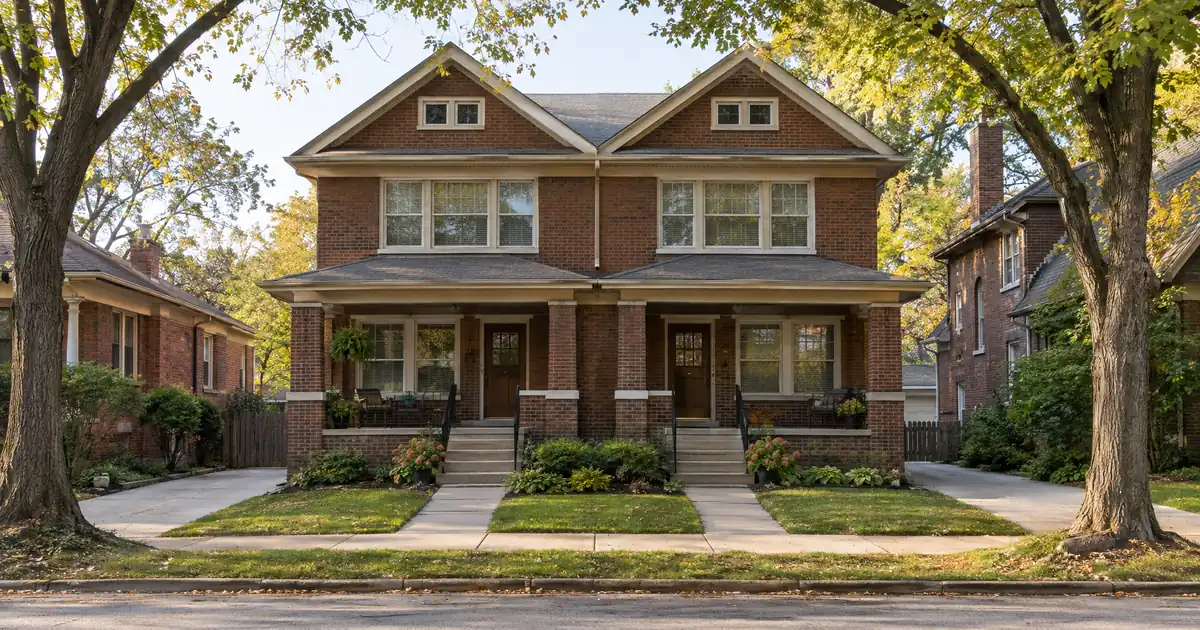
Picture an investor holding a two-flat in the Ridgeland-Oak Park Historic District, bought several years back. Both units are leased, the tenants pay on time, and the building is worth meaningfully more than the balance against it. That equity is doing nothing. Meanwhile, the next deal is sitting on a listing site with someone else’s offer on it.
That’s the Oak Park cash-out refinance in one picture. The investor already owns the asset. The question is how much capital can come out without breaking the coverage ratio, and whether the building’s income supports a bigger loan at all.
DSCR Cash-Out Calculator
Run the cash-out numbers in Oak Park, IL
Rate source: Freddie Mac 30-yr average via FRED® — Federal Reserve Bank of St. Louis · effective Sep 24, 2026
Prefilled with starting assumptions — enter your property’s value, balance, taxes, and insurance for a more accurate picture.
Program parameters update from Lendmire’s centralized guideline source. Taxes and insurance are editable estimates.
As of Sep 24, 2026 · General Freddie Mac market benchmark, not a Lendmire loan offer. Property value, balance, taxes, and insurance are editable estimates. Maximum loan-to-value varies by lender, program, property type, and seasoning. Not a Loan Estimate, approval, or commitment to lend. Program availability and eligibility are subject to lender guidelines, credit approval, property review, and underwriting.
The Short Version: A cash-out refinance on an Oak Park, Illinois rental is underwritten primarily on the property’s rental income measured against its full monthly obligation, with the file moving from appraisal and lease review through lender eligibility check and title, and proceeds sized by the lower of what coverage and the 75 percent LTV ceiling allow.
- Apartment-type buildings are 46.13 percent of Oak Park housing units, per NeighborhoodScout.
- One-bedroom rents run $1,219 in the Arts District versus $1,697 Downtown, per Rent.com.
- Ten-year appreciation annualized at 3.49 percent, so equity builds steadily rather than fast.
- Cash-out caps at 75 percent LTV after roughly six months of ownership.
Lendmire (NMLS# 2371349) is a DSCR-focused mortgage broker. It places DSCR investor financing for Oak Park, Illinois through non-QM wholesale channels that cover 41 markets, including Washington, D.C. The brokerage’s Illinois hub covers the state-level picture, so this piece stays on the village and on pulling equity out.
Oak Park Market Snapshot
A quick read on the Oak Park investor landscape — figures come from the cited sources below. Confirm current property-level numbers before underwriting.
| Metric | Detail |
|---|---|
| Home prices | $500K median sale (Redfin) |
| Typical rents | $1,951 median (Apartment List Rent Report) |
| Recent appreciation | 40.91% 10-yr appreciation (3.49% annualized) (NeighborhoodScout) |
| Cap rates | 4–5% sfh cap (Sync Properties Oak Park Rental) |
| Population | 53,292 population (Census Reporter) |
| Vacancy | 6.61% (Sync Properties Oak Park Rental) |
Why Oak Park Is a Refi Market, Not a Yield Market
Oak Park rewards patience, not day-one yield. NeighborhoodScout shows house values up 40.91 percent over ten years, an annualized 3.49 percent, which trails most comparable markets nationally. That is steady, low-volatility growth. It’s the kind that builds refinance capacity slowly and doesn’t evaporate.
Inner-ring Chicago suburbs also trade at tight cap rates. Sync Properties puts multifamily at roughly 4.5 to 5.5 percent and single-family at 4 to 5 percent, with single-family showing the stronger price appreciation. Read that as a map. Single-family here is an equity play. Transit-adjacent 2-4 units are the better bet when coverage matters on day one.
The tenant base is why the equity holds. Per Data USA, resident employment is led by professional and technical services (4,584 people), educational services (4,471), and health care (3,926). Rush Oak Park Hospital and West Suburban Medical Center sit in or beside the village. Concordia University Chicago enrolls more than 5,000 students just across the border in River Forest. No single employer drives it, which is a feature.
The caution: Data USA also shows local employment slipping about 0.7 percent in the latest year, and population fell 4.26 percent in the three years after the last census, per Census Bureau estimates. Neither is alarming. But a village with a flat-to-soft headcount won’t bail out an overleveraged file, so don’t stretch.
Where the Equity Is Hiding (and Where It Isn’t)
Equity concentrates in the older multi-unit stock, and the coverage math improves the more rent rolls get stacked against one loan. The submarkets differ sharply, and the cash-out outcome follows the submarket.
Ridgeland and the Arts District are where the math is easiest. Ridgeland one-bedrooms average $1,399 and the Arts District $1,219, against $1,697 Downtown. The lower rents come with lower acquisition basis, so rent-to-value can hold up better than the village-wide average implies. Underwrite these blocks against their own comps, not the blended village median. A borrower who benchmarks a Ridgeland two-flat against the village median of $1,951 (per Apartment List) will undersell the file.
Downtown along Lake Street commands the highest rents, and the tenant is typically a professional commuting toward the Loop on transit. The trade-off is basis. High entry prices mean a lot of that rent is spoken for before the loan even starts. Great for appraisals, mixed for coverage.
The Frank Lloyd Wright Historic District is a prestige play. Median listing prices ran near $788,000 in a recent snapshot, and one-bedrooms average $1,645. Equity can be large, but coverage on a stretched basis is thin, and historic buildings demand specialized contractors. Skip it if the goal is maximum cash-out per dollar of rent. It suits investors who want the asset class and can carry low coverage with a lower-leverage structure.
South Oak Park toward the Austin boundary is hospital-adjacent workforce housing. Redfin’s rental breakdown shows Austin-adjacent pockets at $1,225 to $1,275 against roughly $2,072 in Ridgeland and $2,547 on the West Side. That’s close to a 2x swing inside one village. The lower rents can still work against a low basis. But appraisal comps are the pressure point, so expect to pull comps at the block level before committing to a refinance.
Run the Numbers on a Two-Flat
Say a two-flat appraises at a modeled $450,000, with a modeled combined rent of $3,900. These are illustrative inputs, not sourced market figures. At 75 percent LTV, the full obligation including taxes and insurance leaves coverage in low-1.2 territory. That clears the standard 1.00x benchmark with some room, and it supports cash-out, though exact eligibility depends on lender guidelines, credit, and property review.
Now swap in a single-family at the roughly $500,000 median sale price, per Redfin. Even at generous single-family rents, coverage including taxes and insurance often lands at or below 1.00. Not ideal. This is the tension in Oak Park’s numbers: the single-family home appreciates better but covers worse.
When coverage falls short, options exist, and a lender would review each case individually. An interest-only structure can improve the ratio on paper. Sub-1.00 programs exist with select lenders but usually mean lower leverage, stronger credit, and more reserves. Dropping the LTV below 75 percent shrinks the loan against the same rent. None of these is a promise. Each reshapes the file, and the investor’s return model has to survive the compromise.
The mechanics: the DSCR ratio is monthly rent divided by the full monthly obligation (principal, interest, taxes, insurance, and any HOA dues). Lendmire’s DSCR guide walks through it, and the guide “The Refi Options” covers the equity side. Lendmire’s refi programs cover the broader program menu.
Appraisals: Where the Cash-Out Number Gets Real
Appraisal value, not an online estimate, sizes the loan. This is where Oak Park files get surprised. Zillow puts the average home value at $489,829, up 10.7 percent year over year. Redfin’s closed-sale data, which the median above comes from, tells a different story with more volatility. Index values and comp-based appraisals can diverge by double digits in a lower-volume market.
An investor running a refinance off a Zestimate may get a rude shock when the appraiser pulls recent closed sales. Size the plan off conservative comps. If the appraisal comes in light, the 75 percent cap applies to the lower number, and proceeds shrink with it.
Seasoning matters too. Cash-out generally requires about six months of ownership measured from title recording. An investor who bought recently and renovated can’t pull the lever right away. Lenders also typically look for around six months of reserves on PITIA (more above $1.5 million in loan size), and credit tiers generally start at a 620 floor. Treat these as guidelines subject to lender overlays, not guarantees. Entity-titled properties can be financed subject to lender program eligibility.
What the Deal Desk Sees in Markets Like This
In older, tight-cap inner-ring markets, the common friction point isn’t credit, it’s documentation and valuation. The cleanest files from a documentation standpoint have complete leases, entity docs, title, and property details ready for lender review before the appraisal gets ordered. Files with month-to-month tenants or missing lease records tend to stall when the lender asks for rent support. Mixed-use or oddly configured historic buildings are the other usual snag. Tell the lender up front about any unit that doesn’t fit a clean 2-flat or 3-flat profile.
Where Does the Cash Go?
The point of a cash-out is the next acquisition. Proceeds from an Oak Park two-flat typically fund a down payment on another small multifamily, or a renovation that lifts rents on the building you keep. Oak Park’s stock is deep enough to shop. With roughly 10 percent of units in duplexes and small converted buildings, 2-4 unit targets aren’t scarce here, so a buyer with fresh capital has real inventory to choose from.
Two ways this goes wrong. Pulling the maximum and buying a deal that only works on appreciation. Or keeping the original building at razor-thin coverage while stacking a second leveraged purchase on top (the kind of mistake that looks fine until a unit sits vacant). Statewide, Illinois rental vacancy was 5.7 percent last year, and local sources describe Oak Park vacancy as better than most Chicago suburbs. Underwrite to a realistic vacancy anyway.
Budget for taxes and insurance, and verify current Cook County and village rental rules with qualified local professionals before you transact. To start a file, reach out at 828-256-2183 or request a quote. The side-by-side comparison explains why the property-income approach often fits self-employed and entity-held portfolios better than a conventional refinance.
Frequently Asked Questions
How do you qualify for a DSCR cash-out refinance in Oak Park?
Qualification centers on the property’s rent versus its full monthly obligation, with a 1.00x benchmark common on most standard programs. Beyond coverage, lenders typically look at credit (620 floor, with better tiers at 660, 680, and 700), reserves of about six months, and roughly six months of seasoning. Final eligibility depends on lender guidelines and property review.
DSCR vs. conventional financing
There are two common ways to finance an investment property in Oak Park, IL, and they qualify you differently — here’s how investors weigh them.
Why investors choose it
- Qualifies on the property’s rental income — no personal tax returns, W-2s, or pay stubs needed to document income.
- No personal debt-to-income ceiling to clear, so existing mortgages and obligations don’t cap your borrowing the same way.
- Can be closed in an LLC, keeping the property inside a business entity.
- Built for scaling — not held to the limit on number of financed properties that conventional financing applies.
- Underwriting centers on the deal: generally qualifies when the rent covers the payment, a 1.00x coverage ratio being a common baseline (confirmed in underwriting).
- Designed specifically for investment property, including long-term and, where the program allows, short-term rentals.
Where it’s strong
- Often the lowest ongoing financing cost for a buyer who fully qualifies on personal income — a fit for a first property or a cost-first purchase.
Trade-offs for investors
- Requires full personal income documentation and must fit within a debt-to-income limit — salary, existing debts, and other mortgages all count.
- Typically held in your personal name rather than a business entity.
- Caps how many financed properties you can carry, which can become a ceiling as a portfolio grows.
- Evaluates you as a borrower as much as the property, which usually means more paperwork.
How investors usually choose: a first or single property often optimizes for the lowest financing cost; portfolio builders often optimize for leverage, vesting in an LLC, and scaling past conventional caps. The right answer depends on your goals, the property, and current guidelines — both paths run through select lenders in Lendmire’s wholesale network, with eligibility and terms confirmed in underwriting.
What are the requirements for an investment property loan in Oak Park, Illinois?
Expect an appraisal, lease documentation, proof of reserves, entity documents if the property sits in an LLC, and title work. Cash-out is capped at 75 percent LTV, with loan amounts up to $3,000,000 on standard programs. Smaller balances route through select lenders in the network. These specifics are subject to lender guidelines and a full review of property, leverage, and credit.
Does Oak Park’s older housing stock create any problems for a refinance?
It can, because a large share of homes were built before 1939, so appraisers will scrutinize condition and comparable sales closely. Deferred maintenance can trim value or complicate the file. Well-kept two-flats and three-flats with documented updates tend to review more cleanly.
Which Oak Park property type works best for cash-out coverage?
Two-flats and three-flats near Ridgeland or transit generally cover better than single-family, because stacked rents carry a single loan. Single-family tends to show stronger appreciation but tighter coverage including taxes and insurance. Match the property type to whether you’re optimizing for coverage now or equity later.
How does rental income affect DSCR refinance eligibility in Oak Park?
Lendmire arranges DSCR investor loans and rental income is the center of the file. Rent is measured against the full monthly obligation, so higher documented rents (or a lower loan balance) improve the coverage ratio. Final terms depend on lender and program guidelines.
For current guidelines and terms, see Lendmire’s DSCR loan programs page.
What to Watch Next Quarter
Three local signals will tell an Oak Park owner whether to pull equity now or wait:
- If Redfin closed sales keep lagging Zillow’s index, expect appraisals to land light and size proceeds conservatively. Apartment List shows year-over-year rent growth at 2.2 percent, behind the state average. A further slowdown would pressure coverage on thin files. Hospital and university hiring also matters, since Rush Oak Park, West Suburban, and the River Forest campuses anchor tenant demand. Any retrenchment there matters more than headline village employment.
About Lendmire
Lendmire is a non-QM mortgage brokerage (NMLS# 2371349) arranging DSCR investor loans in 41 markets, including Washington, D.C. DSCR eligibility is generally reviewed around property-level rental income rather than personal income, subject to lender and program guidelines, which suits self-employed investors and LLC-owned portfolios. Lendmire has been recognized by Scotsman Guide, including as a 2025 Scotsman Guide Top Workplace and as a top-ranked workplace in 2026. Follow Lendmire press releases and announcements for company news.
Get Started
Ready to find the right loan for you?
In about 30 seconds you can review financing options available for your investment property. No commitment required.
Informational only. Not a Loan Estimate, approval, or commitment to lend. Program availability and eligibility are subject to lender guidelines, credit approval, property review, and underwriting.
References
2. Rent.com
3. Redfin
7. Data USA
9. West Suburban Medical Center
10. Concordia University Chicago
12. Zillow
13. a 2025 Scotsman Guide Top Workplace
14. Scotsman Guide — Top Workplaces 2026
This article is part of Lendmire’s investment property cash-out refinance program — full qualification details, guidelines, and scenarios live on the program page.
Related reading: Luxury Rental DSCR Loans In New Jersey · Jersey Shore Vacation Rental Loans: DSCR Financing In Ocean City, Cape May And Long Beach Island · DSCR Cash-out Refinance In New Jersey: Pulling Equity From A Rental
Guides: Investment Property Cash-Out Refinance in Oak Park, IL · Investment Property Cash-Out Refinance in Illinois
Brandon Miller
Founder & CEO, Mortgage Loan Originator, Lendmire LLC
- Mortgage Loan Originator · NMLS# 1129696 · Verify on NMLS Consumer Access
- North Carolina Real Estate Broker · License# 343312 · Verify on NCREC
- North Carolina Insurance Producer · License# 19053198 · Property, Casualty, Life, Health · Verify on NAIC SBS
- Lendmire LLC · Firm NMLS# 2371349 · Verify firm licensure
Disclosure information. Lendmire is a state-licensed mortgage brokerage under NMLS# 2371349. Lendmire is not a depository institution, direct lender, or financial advisor — all loans referenced are placed through wholesale lender partners and are subject to each lender's underwriting standards. This article is provided for general informational purposes and is not a commitment to lend, nor does it constitute financial, legal, or tax advice. Loan programs, terms, rates, and qualification standards change without notice and depend on borrower profile, property type, and the state in which the subject property is located. Equal Housing Opportunity provider. NMLS Consumer Access: nmlsconsumeraccess.org.