
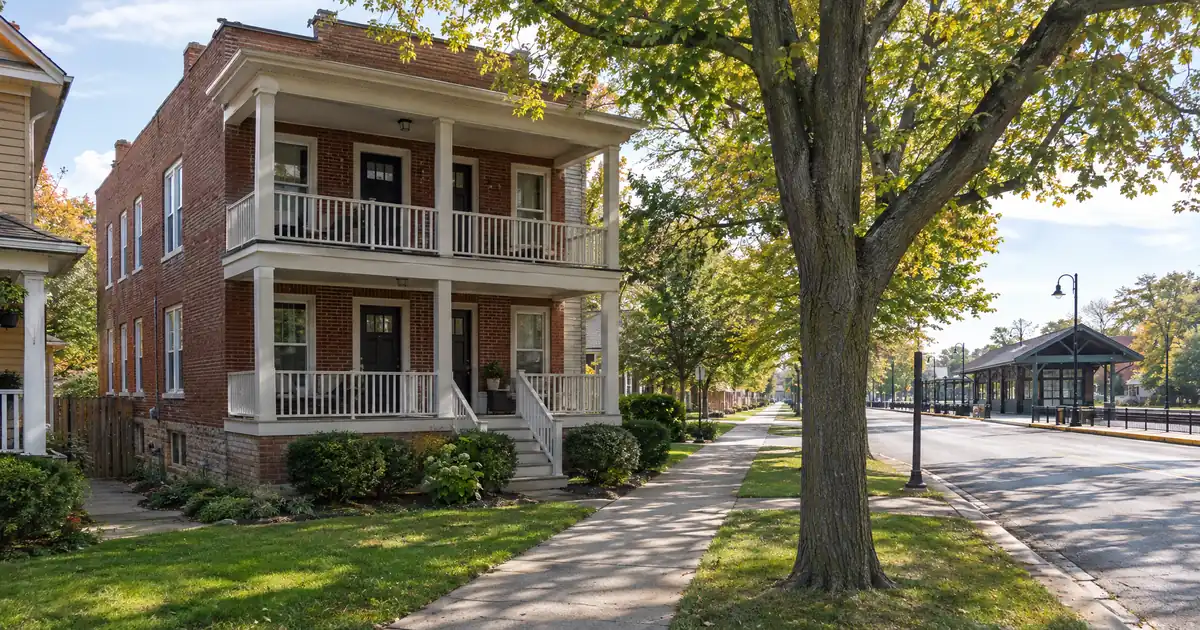
The older grid east of downtown Palatine, a short walk from the Wood Street station, is where the cash-out math gets interesting. Palatine’s stop on the Union Pacific Northwest Line sits 26.8 miles from Ogilvie Transportation Center and ranks fourth of 236 stations by ridership. Some of the housing stock around it consists of legal two-flats, which are rare in a village dominated by detached houses, townhomes, and condos. Two rent streams on one basis is the single most useful structural feature an investor can own here when pulling equity out. Palatine, Illinois is one of the 41 markets — 40 states plus Washington, D.C. — where Lendmire (NMLS# 2371349), a DSCR-focused mortgage broker, places DSCR loans for investment-property borrowers.
The Short Version: A DSCR cash out refinance in Palatine, Illinois is underwritten primarily on the property’s rental income measured against its full monthly obligation, so the deal works from seasoning check to appraisal to coverage test, with the loan-to-value ceiling and reserves setting how much equity actually comes out.
DSCR Cash-Out Calculator
Run the cash-out numbers in Palatine, IL
Rate source: Freddie Mac 30-yr average via FRED® — Federal Reserve Bank of St. Louis · effective Sep 24, 2026
Prefilled with starting assumptions — enter your property’s value, balance, taxes, and insurance for a more accurate picture.
Program parameters update from Lendmire’s centralized guideline source. Taxes and insurance are editable estimates.
As of Sep 24, 2026 · General Freddie Mac market benchmark, not a Lendmire loan offer. Property value, balance, taxes, and insurance are editable estimates. Maximum loan-to-value varies by lender, program, property type, and seasoning. Not a Loan Estimate, approval, or commitment to lend. Program availability and eligibility are subject to lender guidelines, credit approval, property review, and underwriting.
- Citywide median rent is $1,850 per Zillow Rental Manager, against a home-value average near $385K.
- Single-family coverage tends to land well under 1.00x at the 75 percent ceiling.
- Legal two-flats can clear the baseline because rent stacks while the price basis doesn’t.
- Zip 60074 leads on cash flow, while 60067 leads on equity growth.
- Bears stadium upside is unresolved. Don’t build a pro forma on it.
Palatine Market Snapshot
A quick read on the Palatine investor landscape — figures come from the cited sources below. Confirm current property-level numbers before underwriting.
| Metric | Detail |
|---|---|
| Home prices | $395K median sale price (Redfin Housing Market) |
| Typical rents | $1,850 median (Zillow Rental Manager Market) |
| Recent appreciation | +5.2% yoy (Zillow Home Values: Palatine, IL) |
| Cap rates | 6.2% cap rate (Cook County Assessor) |
| University enrollment | 13,477 students (Wikipedia: Harper College) |
| Employment | 48,000 jobs (Athletic Business) |
Why Palatine Cash-Outs Are a Two-Flat Story
Palatine’s rent-to-value ratio is thin, so the cash-out deals that work here are usually multi-unit, not single-family. Zillow puts the average home value at $385,886, up 5.2 percent over the past year. Median rent is $1,850, which works out to roughly 0.48 percent of value per month. That is well below the ratio that produces comfortable coverage.
The inventory backs this up. Redfin’s Palatine market data shows a for-sale mix of condos, townhouses, and single-family homes, with multifamily barely present. A recent snapshot listed 93 condos, 56 townhouses, and a single multifamily unit. So the investor who already owns a legal two-flat, three-flat, or small attached portfolio is sitting on something scarce.
Census-derived figures on City-Data’s Palatine profile show the shape of the gap. The mean price for 3-to-4-unit structures is $218,275, against $447,387 for detached houses. Those averages come from different samples, so treat them as directional, not as a comp set. The direction still matters: the price basis falls sharply while rent scales with unit count.
The debt coverage ratio is monthly rent divided by the full monthly obligation (principal, interest, taxes, insurance, and any HOA dues). When the denominator is a $450K-ish single-family shell and the numerator is one $1,850 rent, the ratio struggles. Add a second unit to the same denominator and the picture changes.
Run the Numbers: Single-Family Versus Two-Flat
The comparison below uses modeled assumptions, not newly sourced market data. It draws on the citywide median rent discussed earlier, the average home value discussed earlier for the single-family case, and a hypothetical two-flat purchase price chosen for illustration. Every figure is rent divided by full PITIA, meaning taxes and insurance at Illinois-typical loads are included, not just principal and interest. The bands are rounded down.
| Modeled scenario | Coverage at 75% LTV | Coverage at 65% LTV |
|---|---|---|
| SFR at average value, one $1,850 rent | About 0.65x | About 0.75x |
| Two-flat, two units at $1,850 each | About 1.15x | About 1.25x |
| Same two-flat, two units at $1,400 each | About 0.85x | About 0.95x |
The single-family row is the uncomfortable one. Even at a conservative 65 percent leverage, coverage stays under 1.00x. Most standard programs are built around a 1.00x benchmark because rent covers the payment at that level. Some lenders will review lower-coverage files, but that usually means stronger compensating factors, lower leverage, different pricing, or more cash in the deal.
If you own a single-family rental at 0.65x, the available paths include a sub-1.00 program, an interest-only structure, or a smaller cash-out request that lowers the debt. A lender would review each of them. Whether any of them fits depends on lender guidelines, credit approval, and property review. It is not something to assume.
The third row is the useful stress test. Cut each unit’s rent by a few hundred dollars and the two-flat that looked comfortable slips below the baseline. Palatine’s median rent has been flat to slightly down year over year, so an investor pulling equity today shouldn’t lean on rent growth to fix a thin ratio. Underwrite to today’s leases. (Or to a conservative appraiser’s market rent, which is what the lender will do anyway.)
Sizing the cash-out request below the ceiling is often the smarter move. The 75 percent cap is a maximum for the loan, not a target for the deal. A borrower who requests 65 or 70 percent may get through a file that the full ceiling would sink on coverage.
60074 Versus 60067: Cash Flow or Equity?
Zip 60074 is the cash-flow submarket, and 60067 is the equity submarket. That split should shape how much you ask for at the refinance table.
| Factor | 60074 (northwest) | 60067 (central/south) |
|---|---|---|
| Median sale price | $394,808 | $501,865 |
| Cash-flow read | Better rent-to-value | Compressed |
| Refi lean | Coverage-led sizing | Equity-led sizing |
Both medians come from RealtyTrac’s zip-level pages, for 60074 and 60067. Redfin’s zip read is lower for 60067, at $463K, but it carries a striking 30.3 percent year-over-year jump. The methodologies differ, so use the range, not a single point.
Rents are relatively uniform across the village while prices are not. A roughly $107K median-price gap between the two zips means the same $1,850 rent covers a lot more debt in 60074. Workforce single-family and townhome product in the northwest pockets, along with smaller attached product like the townhome pocket around Sutton Park, sits closer to a workable ratio.
Winston Park is the established single-family subdivision that tends to come up when investors talk about family-oriented rentals. It is a fine holding, but at a 60067-style basis it behaves like an appreciation asset, not a coverage asset.
This one’s a genuine toss-up for an investor holding in 60067. The equity is real, and appreciation there has run hotter than the village overall. But a 30 percent one-year print in a single zip is the kind of number that reverses. Pulling maximum equity against a peak appraisal, and then holding a loan whose coverage never cleared 1.00x, is a different risk than pulling a modest slice from a conservatively valued two-flat. Investors who believe in the appreciation story could reasonably argue for taking more. The cleaner structure is to take less.
What Equity Is the Refinance Actually Releasing?
The appreciation math is simple, and it is smaller than most owners expect. A cash-out loan at the 75 percent ceiling releases the difference between 75 percent of the new value and the balance you owe today. Percentages make this easy to see.
Say you bought at 80 percent leverage and the property has since appraised 15 percent higher. Seventy-five percent of the new value is about 86 percent of your original price, against an existing balance of 80. That is roughly six points of the original price before costs, which is a thin cushion.
Now run the version where you put down more. An investor who bought at 65 percent leverage and sees 20 percent appreciation has a new 75 percent ceiling around 90 percent of the original price, or about 25 points of released equity. Real money.
The buyer who put down the most benefits most from a rising market, and the buyer who used maximum leverage is the one for whom a cash-out barely moves the needle. Palatine’s recent 5.2 percent annual appreciation is healthy but not the kind of run that turns a fully leveraged purchase into a cash machine within a year or two.
Three program guardrails shape the ceiling on most files, all subject to lender guidelines:
- Seasoning: about six months of ownership, measured from title recording.
- Reserves: about six months of PITIA, moving to about nine months above $1,500,000.
- Credit: tiers at 620, 660, 680, and 700, with 620 as the floor.
The standard-program loan amount runs up to $3,000,000, with smaller balances routed through select lenders in the network. Palatine balances sit well inside that band. If you want the mechanics, the equity recycle pathway walks through them, and investor refinance options covers the rate-and-term alternative.
Here is a practitioner note. On files from suburban markets structurally like this one, the common friction point isn’t the LTV cap. It is the appraiser’s market-rent figure coming in below the borrower’s actual leases. The cleaner files from a documentation standpoint tend to have current leases, a fresh rent comp set, and a borrower who has already decided how much cash they need, not how much the ceiling permits. Deciding the number first tends to produce a better-sized request than reverse-engineering from the maximum.
The Tenant Base Behind the Rents
Palatine’s rental demand rests on healthcare, education, commuting, and light industry. Those are steady employers, not boom-and-bust ones. A 489-bed hospital on the village’s doorstep is the biggest single support.
Northwest Community Hospital is a 489-bed acute-care facility in adjacent Arlington Heights with more than 1,000 physicians on staff, serving about 200,000 outpatients and 20,000 inpatients annually. It is part of Endeavor Health and runs a Palatine outpatient presence. Nurses, technicians, and shift workers are the classic 1-2 bedroom workforce tenant, and their rental demand doesn’t swing with retail cycles.
Harper College adds a smaller but real layer. Its 200-acre campus in Palatine enrolls roughly 13,477 students per Wikipedia’s institutional summary, though other sources report a range from about 12,000 to 14,000 depending on methodology. Staff and student demand favors smaller units near the Algonquin Road corridor.
Weber-Stephen Products is headquartered here, and a UPS distribution hub sits at Rand and Hicks roads, where a commercial TIF district has drawn redevelopment interest. No verified headcounts exist for either, so treat them as demand anchors, not sized ones.
For vacancy assumptions, the best government-sourced benchmark is the Cook County Assessor’s income-approach data for Palatine Township. It uses a 5 percent vacancy rate and a 6.2 percent cap rate for large multifamily buildings, with rents of roughly $860 to $1,000 per unit. That is large-building stock, not two-flats, so it is a sanity check on conservative underwriting, not a comp. Small-building landlords in Palatine typically see faster lease-up on condos and small townhomes than on single-family homes, which is a reasonable input for vacancy loss.
What’s the Catch on Bears Stadium Speculation?
The catch is that the stadium thesis is unresolved and possibly reversing, so it belongs in the risk column, not the pro forma. The Chicago Bears bought the 326-acre former Arlington Park racetrack site for $197.2 million, right on Palatine’s border. Palatine’s mayor told reporters the outcome would reshape the village. Economic-impact projections were huge: more than 48,000 jobs and $9.4 billion in regional impact.
Then the story turned. Recent reporting from WBEZ and The Real Deal frames the decision as still open between Arlington Heights and Hammond, Indiana, with the organization reportedly signaling a pivot across the state line. If the project lands in Indiana, any stadium-driven pricing premium in Arlington Heights-adjacent Palatine pockets is reversible.
The practical advice is straightforward. An investor sizing a cash-out today should treat the stadium as free optionality, not as underwriting support. If it happens, existing holdings benefit without any extra leverage taken on the bet. If it doesn’t, the loan still needs to work on today’s rents. Investors who are counting on stadium-driven rent growth to bridge a sub-1.00 coverage ratio are reaching, and that signals a need to rethink the property or the submarket, not the loan type.
Skip the Inverness-Adjacent Estates
Higher-value single-family stock in the west and Inverness-adjacent parts of Palatine is not typical cash-out territory. Price-to-rent is stretched, so coverage suffers, and the leverage a lender will allow on the coverage math is usually well below the LTV ceiling. Conventional financing deserves a look there, especially for a high-W-2 borrower holding a single rental personally. It may cost less and won’t depend on the property’s rent at all. Palatine’s household incomes run above national levels, so plenty of local owners fit that profile.
DSCR vs. conventional financing
Two common ways to finance an investment property in Palatine, IL. They qualify you differently — here’s how investors weigh them.
Why investors choose it
- Qualifies on the property’s rental income — no personal tax returns, W-2s, or pay stubs needed to document income.
- No personal debt-to-income ceiling to clear, so existing mortgages and obligations don’t cap your borrowing the same way.
- Can be closed in an LLC, keeping the property inside a business entity.
- Built for scaling — not held to the limit on number of financed properties that conventional financing applies.
- Underwriting centers on the deal: generally qualifies when the rent covers the payment, a 1.00x coverage ratio being a common baseline (confirmed in underwriting).
- Designed specifically for investment property, including long-term and, where the program allows, short-term rentals.
Where it’s strong
- Often the lowest ongoing financing cost for a buyer who fully qualifies on personal income — a fit for a first property or a cost-first purchase.
Trade-offs for investors
- Requires full personal income documentation and must fit within a debt-to-income limit — salary, existing debts, and other mortgages all count.
- Typically held in your personal name rather than a business entity.
- Caps how many financed properties you can carry, which can become a ceiling as a portfolio grows.
- Evaluates you as a borrower as much as the property, which usually means more paperwork.
How investors usually choose: a first or single property often optimizes for the lowest financing cost; portfolio builders often optimize for leverage, vesting in an LLC, and scaling past conventional caps. The right answer depends on your goals, the property, and current guidelines — both paths run through select lenders in Lendmire’s wholesale network, with eligibility and terms confirmed in underwriting.
The flip point is portfolio scale and structure. Once a borrower holds several financed properties, or holds title in an LLC (subject to lender program eligibility), the conventional lane narrows quickly. That’s where the comparison of DSCR against conventional financing becomes a live question, and where the guide “What Is a DSCR Loan” is worth a read before committing.
For a fuller view of program options in the state, see DSCR loan options for Illinois investors. To price a specific Palatine file, investors can request a quote or call 828-256-2183. Details, eligibility, and any local requirements should be confirmed before you underwrite, including current taxes, insurance, and local rules, which vary by taxing district and property and are worth checking with qualified local professionals.
Frequently Asked Questions
Can a single-family rental in Palatine support a DSCR cash-out?
Usually only at reduced leverage or under a sub-1.00 structure. At the citywide median rent and average value, modeled coverage including taxes and insurance lands well under 1.00x even at 65 percent LTV. Lenders may review interest-only or sub-1.00 programs on stronger credit, subject to lender guidelines, but a two-flat or a lower-basis workforce property is the more natural fit.
Which Palatine zip code is better for pulling equity?
It depends on the goal. Zip 60067 has the larger equity cushion, with a median near $502K on RealtyTrac and a sharp recent price jump on Redfin, but coverage is tighter. Zip 60074 has a lower median near $395K and a better rent-to-value relationship, so coverage-led sizing works better there.
How long must I own a Palatine property before a cash-out refinance?
Programs generally look for about six months of ownership, measured from title recording, and the appraised value at the time of the refinance drives the equity available. Reserves of about six months of PITIA are typical on most files. Program terms vary by lender, so confirm the specifics for your loan.
Should I count on the Bears stadium to lift Palatine rents?
No. The project is unresolved, and recent reporting points toward a possible move to Indiana. Underwrite to current leases and treat any stadium upside as a bonus. A refinance that only works if the stadium is built is not a refinance worth taking.
What can I do with the proceeds from a Palatine cash-out?
Most investors recycle them into the next acquisition, a reserve build, or renovation of existing units. Recycling into another Palatine two-flat, where coverage clears at reasonable leverage, is straightforward. Deploying into markets where the math doesn’t pencil is a separate decision worth stress-testing first.
What the Next Six to Eighteen Months Probably Look Like
The likeliest scenario is a steady, unspectacular market with a wide gap between equity and cash flow. Prices have kept ticking up while rents sit flat, and that compression tends to persist until something changes the supply picture. Investors who pull equity conservatively from legal two-flats near the Metra line, and who size requests to coverage instead of the ceiling, look best positioned. Owners in 60067 with big paper gains should keep in mind that a single-zip surge is a snapshot, not a trend. The Bears decision is the wild card, and if the stadium goes to Indiana, Palatine’s best cash-out candidates will still be the same scarce two-flats the village had before the headlines started.
For current guidelines and terms, see Lendmire’s DSCR loan programs page.
About Lendmire
Lendmire, NMLS# 2371349, is a mortgage brokerage focused on investor financing, arranging DSCR loans in 40 states plus Washington, D.C. — 41 markets total. Qualification is based on the property’s income rather than personal income documentation, subject to lender guidelines, making it a fit for LLC-held rentals and scaling portfolios. Lendmire has been recognized by Scotsman Guide as a 2026 Top Workplace and recognized by Scotsman Guide in 2025.
Get Started
Ready to find the right loan for you?
In about 30 seconds you can review financing options available for your investment property. No commitment required.
Informational only. Not a Loan Estimate, approval, or commitment to lend. Program availability and eligibility are subject to lender guidelines, credit approval, property review, and underwriting.
References
2. Zillow Rental Manager: Palatine, IL
3. Redfin’s Palatine market data
4. Zillow Home Values: Palatine, IL
5. Cook County Assessor: Palatine Township Commercial Valuations
6. Wikipedia’s institutional summary
8. City-Data’s Palatine profile
9. 60074
10. 60067
11. Redfin Zip 60067 Housing Market
12. Northwest Community Hospital
13. Harper College
15. WBEZ
16. The Real Deal
17. U.S. Census Bureau QuickFacts: Palatine village, Illinois
19. recognized by Scotsman Guide in 2025
This article is part of Lendmire’s investment property cash-out refinance program — full qualification details, guidelines, and scenarios live on the program page.
Related reading: Cash Out Refinance Investment Property in Palatine, Illinois: Two-Flat Equity, Redeployed · Cash Out Refinance Investment Property Without W-2 in Moline · Cash Out Refinance Investment Property via DSCR in Hoffman Estates
Guides: Investment Property Cash-Out Refinance in Palatine, IL · Investment Property Cash-Out Refinance in Illinois
Brandon Miller
Founder & CEO, Mortgage Loan Originator, Lendmire LLC
- Mortgage Loan Originator · NMLS# 1129696 · Verify on NMLS Consumer Access
- North Carolina Real Estate Broker · License# 343312 · Verify on NCREC
- North Carolina Insurance Producer · License# 19053198 · Property, Casualty, Life, Health · Verify on NAIC SBS
- Lendmire LLC · Firm NMLS# 2371349 · Verify firm licensure
Important disclosures. Lendmire (NMLS# 2371349) is a licensed mortgage brokerage. Lendmire is not a direct lender, depository institution, or financial advisor. All loan inquiries are subject to lender underwriting; this article does not constitute a commitment to lend. Rates, terms, and program guidelines are subject to change without notice and vary by borrower profile, property type, and state. Information in this article is general in nature and is not financial, legal, or tax advice. Equal Housing Opportunity. NMLS Consumer Access: nmlsconsumeraccess.org.