
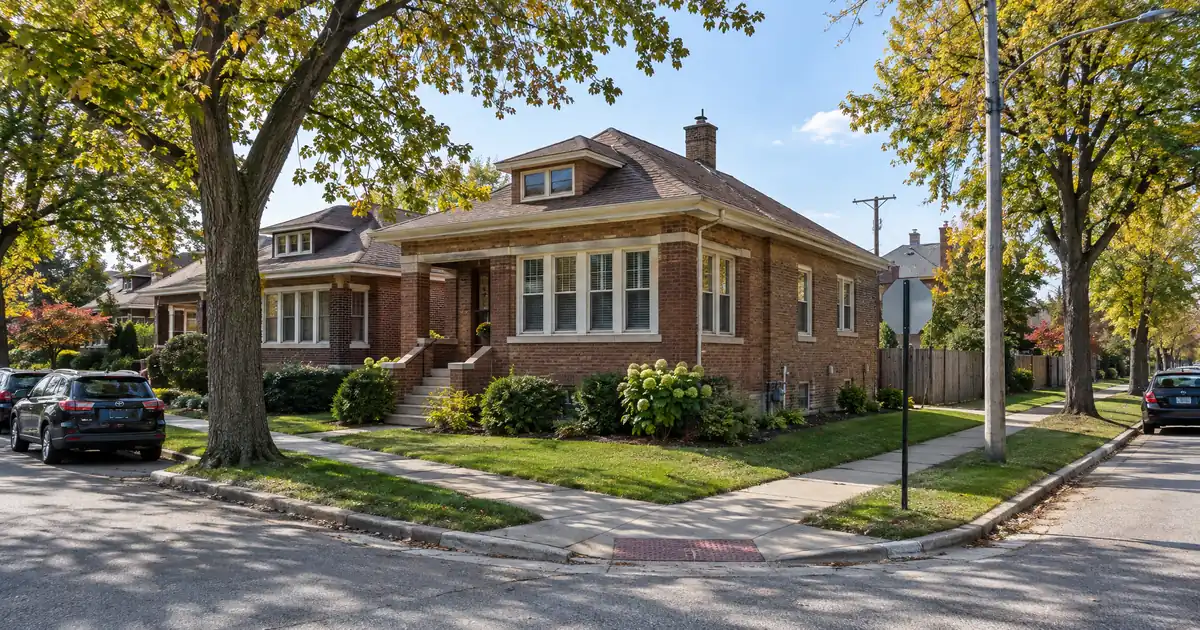
A duplex bought in Southeast Skokie three years ago for around $380,000 has probably outrun its purchase price. Southeast Skokie — the pocket that sits, as one local realtor put it, “on the cusp of Evanston and Lincolnwood” — now runs a median sale price near $424,950, up 8% over the prior period, with homes moving in about 17 days against a national average of 44. Run the math on a cash-out refinance at that new value, keep the rent roll where it’s been (two units at legacy rents, tenant-paid utilities on separate meters), and the coverage ratio still clears 1.00 comfortably even after pulling equity. That’s the shape of the opportunity in Skokie right now: appreciation has moved faster than most owners have refinanced, and there’s capital sitting in these properties that could be funding the next acquisition instead of just sitting on paper.
At a Glance: A Skokie, Illinois cash-out refinance is underwritten primarily on the property’s current rent measured against its full monthly obligation, with Illinois cash-out capped near 70% loan-to-value under current lender overlays rather than the standard 75% ceiling.
DSCR Cash-Out Calculator
Run the cash-out numbers in Skokie, IL
Rate source: Freddie Mac 30-yr average via FRED® — Federal Reserve Bank of St. Louis · effective Sep 17, 2026
Prefilled with starting assumptions — enter your property’s value, balance, taxes, and insurance for a more accurate picture.
Program parameters update from Lendmire’s centralized guideline source. Taxes and insurance are editable estimates.
As of Sep 17, 2026 · General Freddie Mac market benchmark, not a Lendmire loan offer. Property value, balance, taxes, and insurance are editable estimates. Maximum loan-to-value varies by lender, program, property type, and seasoning. Not a Loan Estimate, approval, or commitment to lend. Program availability and eligibility are subject to lender guidelines, credit approval, property review, and underwriting.
- Southeast Skokie multi-family values sit at a $424,950 median, up 8% year-over-year (Homes.com)
- Villagewide multi-family listings run $499,900 to $6,200,000 against a $425,000 single-family median (Homes.com)
- Seasoning before cash-out typically runs about 6 months of ownership from title recording
- Two-bedroom rents average $2,037 villagewide, per Apartments.com
- Rand McNally’s global headquarters and the Illinois Science + Technology Park anchor a non-retail employment base
Skokie Market Snapshot
A quick read on the Skokie investor landscape — figures come from the cited sources below. Confirm current property-level numbers before underwriting.
| Metric | Detail |
|---|---|
| Home prices | $450K median (Redfin) |
| Typical rents | $1,810 avg (Apartments.com) |
| University enrollment | 7,433 students (spring 2022, Oakton College) |
| Employment | 1,500+ jobs since inception (ISTP official staff page) |
Why Cash-Out Math Works Differently in Skokie Than the Rest of Chicagoland
Skokie’s for-sale market shows genuine spread across data sources, and that spread matters more here than in most suburbs because it changes what an appraiser is likely to land on. Redfin pegs the median sale price at $450,000 with homes fielding five offers on average and selling in about 42 days — a tight market. Zillow’s citywide typical value sits lower, at $374,501, up 12.1% over the past year. Zillow’s Central Skokie submarket data shows $454,479, up 8.1%. City-Data’s ACS-based estimate lands at $420,600.
None of those numbers is wrong — they’re measuring different things. Redfin’s figure reflects closed sales; Zillow’s ZHVI smooths for the broader stock including homes that haven’t transacted recently. For an investor sizing up cash-out proceeds, the practical takeaway is this: don’t anchor to a single citywide number. The appraisal on a refinance is going to reflect the specific block, not the village average, and in Skokie that specific block could easily land $50,000-$80,000 off a citywide figure in either direction depending on submarket.
What’s consistent across every source is the direction — Skokie values are climbing, and climbing faster than a typical Chicago suburb of this size and age. That appreciation is exactly what feeds a cash-out refinance. Illinois cash-out currently caps near 70% loan-to-value as a lender geographic overlay (tighter than the standard 75% ceiling elsewhere), and seasoning generally runs about six months from title recording before that equity is accessible. On a property that’s appreciated 8-12% in a year, that seasoning window often isn’t a constraint — it’s just the calendar catching up to the comps.
Southeast Skokie: The Refinance Candidate, Not the Buy-and-Hold Play
Southeast Skokie is the strongest cash-out story in the village right now, and it’s worth being direct about why: it’s appreciation-led, not cash-flow-led. Days on market of 17 against a national average of 44 tells you buyers are competing for this stock, and an 8% year-over-year gain on a $424,950 median means an owner who refinanced eighteen months ago is sitting on real, bankable equity today.
Where this gets nuanced is on the rent side. Southeast Skokie’s day-one rent coverage on a fresh purchase at today’s prices is tighter than the appreciation story suggests — new acquisitions here are buying appreciation, not yield. That’s fine for a refinance play on a property already owned at a lower basis, but it’s a different conversation than a purchase-money DSCR file. An investor holding here for two or three years, watching values climb 8% annually, is in a good position to pull equity and redeploy it elsewhere in the village where the rent-to-price math is more favorable on day one.
Southwest Skokie and the Multi-Unit Spread
Here’s where the property-type story gets interesting. In Southwest Skokie, the single-family median sits around $379,000, while multi-family properties range from $569,000 to $1,750,000 — a gap wide enough that it changes the whole DSCR conversation. A single-family purchase at the submarket median doesn’t clear coverage as easily as a four-to-six unit building, where tenant-paid utilities on separate meters keep the landlord’s expense load down and the aggregated rent roll simply produces more monthly income against one loan payment.
One active listing in this submarket described a six-unit building with four large three-bedroom units and two one-bedroom garden units, mixing long-term and newer tenants — that’s the profile that tends to work best for a Skokie DSCR refinance. Villagewide, the same pattern holds: 13 multi-family listings ranged from $499,900 to $6,200,000 against a $425,000 single-family median, and one four-unit listing specifically called out tenant-paid utilities on separate meters as a selling point. That’s not incidental. Separately metered utilities are the detail that most directly narrows the gap to a 1.00-plus coverage ratio in this market, because the landlord’s net operating income isn’t eaten alive by utility pass-through the way it would be on a single-family long-term rental where the owner covers everything.
Working DSCR brokers see a recurring pattern in suburbs like Skokie with a bifurcated housing stock: the single-family workforce rentals in older subdivisions carry thin coverage at today’s prices, while small multifamily with separately metered utilities and a mixed-tenancy rent roll clears the ratio with real cushion — the underwriting story usually comes down to expense load, not gross rent.
North Skokie, Old Orchard, and the Rent-Comp Trap
North Skokie’s condo stock runs $200,000 to $300,000, with single-family homes ranging from $325,000 split-levels up toward a million dollars for custom builds. That spread on its own creates a favorable acquisition-to-rent story if the basis is toward the lower end of that condo range and the exit rent comp is drawn correctly.
And that’s the trap worth flagging directly: don’t benchmark rent against Optima Old Orchard Woods. That luxury development near Old Orchard mall commands one-bedrooms from $2,450, two-bedrooms from $3,065, and three-bedrooms from $7,620 — roughly double the villagewide average. An investor pricing a refi-and-hold strategy on older workforce stock near this corridor who anchors to Optima’s rents is going to overstate achievable rent and undershoot on the coverage calculation when the actual lease signs for less. Use the older-stock comps, not the new luxury tower, for anything near Old Orchard. Optima is a ceiling, not a floor, and Westfield Old Orchard’s more than 100 specialty stores including Nordstrom and Macy’s are what’s driving that ceiling upward — not evidence of what a two-flat two blocks away can actually command.
The Oakton Street Corridor: Real Demand, Real Competition
The Oakton–Skokie CTA station opened in 2012 and has genuinely reshaped this stretch. Weekday boardings run 800-900 — modest in absolute terms, but growing, and the Village has leaned into transit-oriented development around it. A 40-unit apartment building broke ground and opened in 2018, and a 56-unit mixed-use building was approved in 2023 nearby.
This is a case where the demand thesis and the supply thesis are both true at the same time, and an investor needs to hold both in mind. The transit access is real and it supports rental demand along the corridor. But new-build product with amenities older stock can’t match is landing in the same footprint, and 800-900 daily boardings isn’t yet a scale that guarantees rent growth will outpace what’s being delivered. An older two-flat or small multifamily near Oakton Street can still work for a DSCR refinance, but the investor should model rent against what comparable pre-2012 stock is actually leasing for, not assume the new TOD apartments are pulling rents up villagewide.
The Illinois Science + Technology Park adds a different kind of demand anchor to this general area — a life-sciences and biotech employment cluster that’s brought over 1,500 jobs to the local area since inception, with NorthShore University HealthSystem as the largest tenant alongside Astellas Pharma and a Fresenius unit. That’s a salaried, non-seasonal tenant base distinct from the retail workforce tied to Westfield Old Orchard, and it supports steady workforce rental demand near this corridor independent of the transit-development supply question.
Anchors Behind the Rent Roll
Skokie’s economy doesn’t lean on a single employer the way some suburbs do. The Village of Skokie’s economic development page describes a combination of industrial, retail, and business-service activity “unique in the suburban Chicago area,” with more than 250 industrial firms calling the village home. Named anchors include NorthShore University HealthSystem, Westfield Old Orchard, Oakton College, and Cook County government, with nearby Northwestern University widening the talent pool. Rand McNally’s global headquarters sits in Skokie too — an unusual anchor for a suburb this size, tying part of the local economy to logistics and mapping rather than purely retail or healthcare.
On the tenant demand side, Data USA shows the largest employment sectors among Skokie residents are Health Care and Social Assistance at 6,950 workers, Retail Trade at 3,610, and Educational Services at 3,453. That’s a diversified, largely non-cyclical renter base. Skokie Hospital, formerly Rush North Shore Medical Center, joined what’s now Endeavor Health in 2009 and sits within a nine-hospital regional system following the 2022 merger with Edward-Elmhurst Health — that’s steady healthcare employment feeding rental demand in the Gross Point Road corridor near the hospital. Oakton College‘s Ray Hartstein Campus, enrolling a share of the combined 7,433 students across its Des Plaines and Skokie locations, adds a smaller but consistent renter pool near downtown.
Running the Refinance Numbers
Say an investor owns a four-unit property in the Gross Point Road corridor, purchased about two years ago and now appraised well above the original purchase price after values in the area have climbed. Illinois cash-out currently caps near 70% LTV rather than the standard 75% ceiling, and seasoning of roughly six months from title recording generally needs to be satisfied before the deal works. Assuming rents across the four units combine to a monthly figure that, run against full PITIA — principal, interest, taxes, and insurance at Illinois-typical levels — produces a coverage ratio comfortably above the 1.00 minimum, this is a file that clears underwriting with room to spare, and the equity extracted becomes capital for a down payment on the next acquisition.
That’s a modeled scenario, not a market fact — actual proceeds depend on the specific rent roll, reserves (typically about six months of PITIA, closer to nine above $1,500,000 in loan amount), and credit tier, which on Lendmire’s network runs across tiers from 620 up through 700 depending on the file. Investors working through the cash-out qualification details will see how seasoning, reserves, and the LTV ceiling interact more specifically. For a full breakdown of what DSCR qualification actually looks like, or how DSCR compares with conventional financing on investor loans, those resources cover the general mechanics that apply regardless of city.
Manufactured homes, log homes, and barndominiums fall outside these DSCR programs entirely — not a Skokie-specific issue given the village’s housing stock, but worth noting since it occasionally trips up investors moving between markets.
Where the Refinance Makes the Most Sense
The properties that make the strongest cash-out cases in Skokie share two traits: they were bought before the recent appreciation run, and they carry rent rolls that were underwritten conservatively relative to where the market has moved. A duplex or small multifamily in Southeast Skokie bought at a lower basis two or three years ago, or a four-unit near Gross Point Road with separately metered utilities, both fit that description well. Lendmire’s Illinois DSCR platform works these scenarios routinely, and investors can call 828-256-2183 or start your quote to see how a specific property’s numbers pencil under current guidelines.
DSCR vs. conventional financing
Two common ways to finance an investment property in Skokie, IL. They qualify you differently — here’s how investors weigh them.
Why investors choose it
- Qualifies on the property’s rental income — no personal tax returns, W-2s, or pay stubs needed to document income.
- No personal debt-to-income ceiling to clear, so existing mortgages and obligations don’t cap your borrowing the same way.
- Can be closed in an LLC, keeping the property inside a business entity.
- Built for scaling — not held to the limit on number of financed properties that conventional financing applies.
- Underwriting centers on the deal: generally qualifies when the rent covers the payment, a 1.00x coverage ratio being a common baseline (confirmed in underwriting).
- Designed specifically for investment property, including long-term and, where the program allows, short-term rentals.
Where it’s strong
- Often the lowest ongoing financing cost for a buyer who fully qualifies on personal income — a fit for a first property or a cost-first purchase.
Trade-offs for investors
- Requires full personal income documentation and must fit within a debt-to-income limit — salary, existing debts, and other mortgages all count.
- Typically held in your personal name rather than a business entity.
- Caps how many financed properties you can carry, which can become a ceiling as a portfolio grows.
- Evaluates you as a borrower as much as the property, which usually means more paperwork.
How investors usually choose: a first or single property often optimizes for the lowest financing cost; portfolio builders often optimize for leverage, vesting in an LLC, and scaling past conventional caps. The right answer depends on your goals, the property, and current guidelines — both paths run through select lenders in Lendmire’s wholesale network, with eligibility and terms confirmed in underwriting.
Frequently Asked Questions
Why does Skokie show such different median home values across sources?
Different platforms measure different things. Redfin’s $450,000 figure reflects actual closed sales over a recent three-month window, while Zillow’s $374,501 ZHVI smooths values across the entire housing stock, including homes that haven’t sold recently. An appraisal on a specific Skokie property will track the block and comparable sales, not any single citywide average.
Does Illinois cap cash-out refinance loan-to-value lower than other states?
Yes, at least for Skokie deals moving through this network’s current overlays. Illinois cash-out is capped near 70% loan-to-value rather than the standard 75% ceiling used elsewhere, which is a detail investors modeling proceeds off a national LTV assumption often miss.
Is a single-family rental in North Skokie or a small multifamily near Gross Point Road the better refinance candidate?
It depends on the rent roll, but multi-unit generally has an edge here. The spread between Southwest Skokie’s roughly $379,000 single-family median and $569,000-plus multi-family entry price shows the coverage math clears more easily when several doors are stacked under one loan, particularly where utilities are separately metered and tenant-paid.
Should rents near Old Orchard be benchmarked against Optima Old Orchard Woods?
No. Optima’s rents — one-bedrooms from $2,450 up to three-bedrooms from $7,620 — sit roughly double the villagewide average and reflect new luxury construction, not comparable older stock. Underwriting a refinance on nearby workforce housing should use older-stock rent comps, not the luxury tower’s pricing.
How does the Oakton Street CTA station affect refinance value on nearby rentals?
It supports demand directionally, but investors shouldn’t assume it guarantees rent growth. Weekday boardings run 800-900, and new apartment supply (a 40-unit building in 2018, a 56-unit building approved in 2023) has landed along the same corridor, meaning older rental stock nearby needs to compete on rent rather than ride transit access alone.
For current guidelines and terms, see Lendmire’s DSCR loan programs page.
About Lendmire
Lendmire (NMLS# 2371349), a non-QM mortgage broker serving investors in 41 markets including Washington, D.C., helps structure DSCR scenarios commonly evaluated around a property’s rental income rather than personal income paperwork, subject to lender guidelines. Lendmire was recognized by Scotsman Guide as a 2026 Top Workplace and recognized by Scotsman Guide in 2025 as well, and it places loans through wholesale investor lenders rather than lending directly.
Get Started
Ready to find the right loan for you?
In about 30 seconds you can review financing options available for your investment property. No commitment required.
Informational only. Not a Loan Estimate, approval, or commitment to lend. Program availability and eligibility are subject to lender guidelines, credit approval, property review, and underwriting.
References
1. Homes.com – Southeast Skokie Multifamily
2. Homes.com – Skokie Multifamily (villagewide)
3. Apartments.com – Skokie Rent Market Trends
4. Redfin
7. Village of Skokie – Business & Economic Vitality
9. Endeavor Health / Wikipedia
11. recognized by Scotsman Guide in 2025
This article is part of Lendmire’s investment property cash-out refinance program — full qualification details, guidelines, and scenarios live on the program page.
Related reading: Cash Out Refinance Investment Property Skokie Illinois · DSCR Cash Out Refinance Evanston Illinois · Cash Out Refinance Investment Property in Evanston IL
Guides: Investment Property Cash-Out Refinance in Skokie, IL · Investment Property Cash-Out Refinance in Illinois
Brandon Miller
Founder & CEO, Mortgage Loan Originator, Lendmire LLC
- Mortgage Loan Originator · NMLS# 1129696 · Verify on NMLS Consumer Access
- North Carolina Real Estate Broker · License# 343312 · Verify on NCREC
- North Carolina Insurance Producer · License# 19053198 · Property, Casualty, Life, Health · Verify on NAIC SBS
- Lendmire LLC · Firm NMLS# 2371349 · Verify firm licensure
Legal disclosures. Lendmire (NMLS# 2371349) is a state-licensed mortgage brokerage that arranges financing through wholesale lender relationships. Lendmire is not a direct lender, depository institution, or registered financial advisor. The discussion above is general informational content about real estate financing — it is not financial, legal, or tax advice, and readers should consult licensed professionals for guidance on their individual circumstances. Loan inquiries are subject to lender underwriting; this article does not represent a commitment to lend. Loan terms, rates, and qualification standards vary by borrower, property, and state, and are subject to change at any time. Equal Housing Opportunity. NMLS Consumer Access: nmlsconsumeraccess.org.