
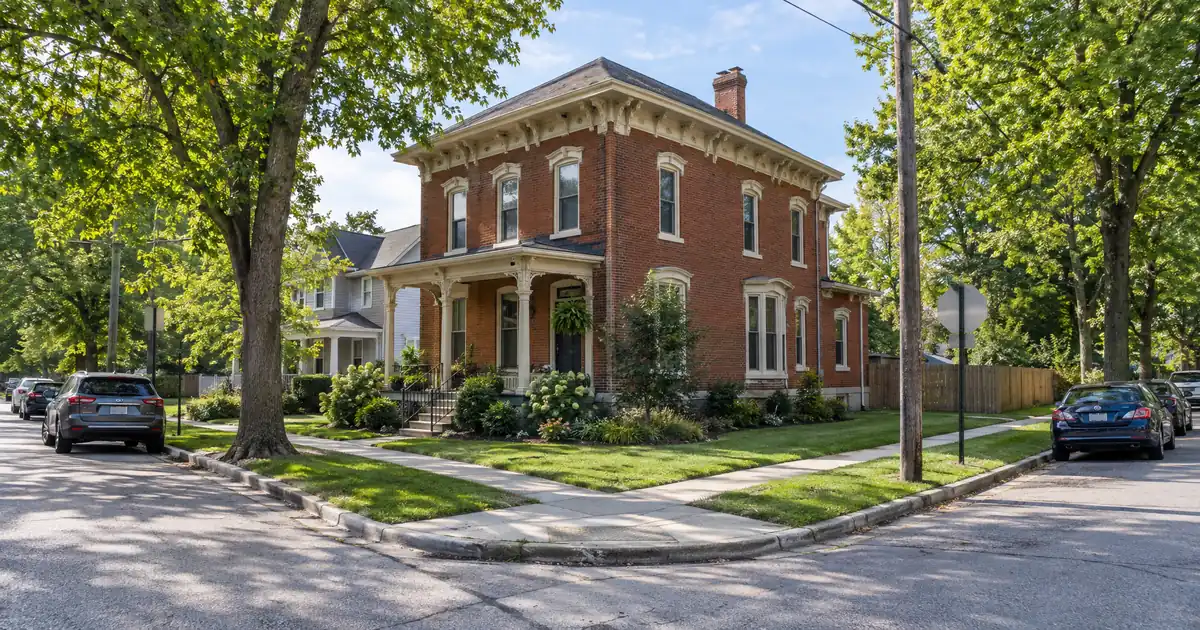
If you own a Plainfield rental worth around $300K, the equity question is easy. The harder one is whether the rent can carry a bigger balance once taxes and insurance are in the denominator. Most cash-out conversations skip that second step. In this town it decides almost everything.
Plainfield, Indiana investors can have DSCR scenarios reviewed through lender programs that Lendmire (NMLS# 2371349), a DSCR-focused mortgage broker, helps place across 41 markets, including Washington, D.C. The brokerage arranges the file. Lenders review eligibility and make the credit decisions.
DSCR Cash-Out Calculator
Run the cash-out numbers in Plainfield, IN
Rate source: Freddie Mac 30-yr average via FRED® — Federal Reserve Bank of St. Louis · effective Sep 24, 2026
Prefilled with starting assumptions — enter your property’s value, balance, taxes, and insurance for a more accurate picture.
Program parameters update from Lendmire’s centralized guideline source. Taxes and insurance are editable estimates.
As of Sep 24, 2026 · General Freddie Mac market benchmark, not a Lendmire loan offer. Property value, balance, taxes, and insurance are editable estimates. Maximum loan-to-value varies by lender, program, property type, and seasoning. Not a Loan Estimate, approval, or commitment to lend. Program availability and eligibility are subject to lender guidelines, credit approval, property review, and underwriting.
The Short Version: A cash-out refinance on a Plainfield rental is underwritten primarily on the property’s rental income measured against its full monthly obligation. It suits investors holding duplexes or small multifamily, where stacked rents have room to cover a larger balance than a single detached house does.
- Detached homes are 64.93% of housing units, per NeighborhoodScout, so small multifamily is scarce.
- Redfin puts the median sale price at $300K, up 3.5% year over year.
- Census-derived median gross rent is $1,646.
- Cash-out caps at 75% LTV, with about 6 months of seasoning from title recording. Terms vary by lender guidelines, property type, leverage, credit profile, and full file review.
The Rent-to-Value Problem Nobody Mentions
Single-family rent in Plainfield covers a cash-out loan thinly, and duplex rent covers it comfortably. That gap shapes every decision below. Census-derived data in City-Data shows a median gross rent of $1,646. Redfin’s median sale price is $300K. Divide one by the other and you get roughly 0.55% a month, which is thin for a detached house. (Other sources disagree on rent. RentCafe shows $1,561 and Point2Homes shows $1,564, but both skew toward newer apartment inventory. This article uses the $1,646 Census-based figure as its anchor.)
Zillow’s house-rent data is more generous. It shows an average of $1,870, with a range from $850 to $3,191, per Zillow Rental Manager. That spread matters. An appraiser’s choice of rent comps can move the coverage number a lot on a single-family file.
Here is how the modeled math falls out. These are illustrative assumptions, not sourced market data. Coverage is rent divided by full PITIA, meaning principal, interest, taxes, insurance and any HOA dues, using typical Indiana tax and insurance loads.
| Scenario | Modeled value | Modeled rent | Modeled coverage |
|---|---|---|---|
| Detached house, 75% LTV | $300K | $1,646-$1,870 | about 0.90-1.00x |
| Detached house, 60% LTV | $300K | $1,646-$1,870 | about 1.1x |
| Duplex, 75% LTV | about $220K | $2,640 combined | above 1.7x |
The duplex row uses two modeled 2-bedroom units at Zillow’s $1,320 each, and a value near the $219,821 mean 2-unit price in the City-Data table. The math is illustrative. Actual duplex comps will differ, and the figures include taxes and insurance.
What the Single-Family Numbers Mean
Picture an investor with a detached house appraising near $300K and a lease at market rent. At the 75% LTV ceiling, coverage lands around or slightly below the 1.00x benchmark once taxes and insurance are counted. The standard 1.00x floor is common because rent covers the obligation at that level. Some lenders review lower scenarios, but those usually bring stronger compensating factors, lower leverage or more reserves.
If the number lands below 1.00x, there are paths a lender might review. One is a sub-1.00 program. Another is an interest-only structure. A third is simply a smaller cash-out, which lowers the balance and lifts the ratio. Each is subject to lender guidelines, credit approval and property review.
There’s also the plain option of pulling less. The equity is there either way, and pulling 60% instead of 75% often turns a borderline file into a clean one. The trade-off is less capital for the next purchase. Whether that’s acceptable depends on what the proceeds are for. Funding a duplex down payment is a different decision than funding a cosmetic renovation on a house that already struggles to cash flow.
Duplexes: Where the Stacking Works
Duplex and triplex product is the best fit for a cash-out here, because price rises far less than rent when you add a second unit. City-Data lists mean 2-unit prices of $219,821 against $336,497 for detached houses. That means a duplex sits well below a detached home on price while potentially doubling gross rent. It is a Census-derived mean, not a rent-to-value study, so treat it as a direction rather than a promise.
Stock is the catch. Small multifamily is a thin slice of a housing supply that is nearly two-thirds detached houses. That scarcity supports values, but it limits comparables, and thin comps can make appraisals harder to predict. Fourplexes are rarer still.
One wrinkle on stacked-unit underwriting: in multi-unit DSCR files, lenders often count a leased unit at the lower of the lease or market rent, and may haircut vacant units. So a duplex with one unit empty generally looks worse on paper than its stabilized math suggests. An investor who refinances right after a tenant turns over can leave coverage on the table.
(Yes, the duplex row above looks almost too good. That’s why real rent comps matter more than any table.)
The Demand Side: Logistics, Airport and Health Care
Plainfield’s renter base comes from shift work, not campuses. No college is based in town. According to Data USA, the top resident sectors are Transportation & Warehousing at 2,540 workers, Retail Trade at 2,119, and Health Care & Social Assistance at 2,027. The average commute is 22.8 minutes. City-Data reports a population of 37,796, up 105.5% since 2000, and estimated median household income of $78,721.
Then there’s the warehouse district. Wikipedia’s Plainfield entry describes a 1,033-acre east-side district employing around 5,000 people, roughly half of central Indiana’s warehouse jobs. That is a Wikipedia figure and should be checked against its underlying citation. Even discounted, the direction holds. The Plainfield Chamber names Amazon, FedEx and Walmart among the logistics and distribution operators, and the developer of Plainfield Logistics Park describes the nearby airport as home to the world’s second-largest FedEx hub. Health care adds a second layer, with Hendricks Regional Health and IU Health West both listed locally by the chamber. The state’s correctional facility on the west side is a stable government employer as well.
The practical read is long-term tenant demand tied to logistics and aviation payrolls. Lease-length and employment data, not neighborhood reputation, are what a lender will care about.
Submarkets: Airport Corridor, Hobbs Station and the Rest
The airport side of town is the only place with a sourced rent premium. Redfin’s rental page shows an Airport District median rent of $1,695 (an earlier update), against a citywide average of $1,549, per Redfin. No matching sale-price band exists in the research, so treat that as a rent band only. A higher rent with an unknown price is not proof of better coverage.
The corridor also carries a resale caution. Homes next to industrial parks, truck routes or flight paths tend to face a narrower buyer pool. That doesn’t hurt a cash-out appraisal directly, but it matters if the plan involves selling later.
Hobbs Station and East US-40. This mixed-use project is a rent benchmark more than a target. REBusinessOnline reports a $300M plan for 240 single-family homes, 650 multifamily units and 120 senior residences. WRTV reports it will create 1,500 permanent jobs. Older small multifamily has to price against that floor, which caps what a dated duplex can ask.
Downtown, Perry Crossing and west side. Downtown is the historic core, and The Shops at Perry Crossing, a 600,000-square-foot open-air retail center, anchors retail and service jobs. No reliable price or rent data exists for any of these areas, so the honest position is that they’re names on a map until local comps say otherwise.
Why Appreciation Won’t Do the Heavy Lifting
Equity from price growth alone is modest here. Redfin reports the median up 3.5% year over year, but price per square foot is down 0.97%, which suggests part of the headline gain is a change in what sold. Only 31 homes sold in the latest month shown, versus 40 a year earlier. Days on market improved to 55 from 69. (Data USA’s median property value of $280,600, up 6.33% over one year, uses a different methodology and sits below Redfin’s sale-price figure.)
Thin monthly sales mean shallow comps. On a cash-out, that can leave the appraised value close to purchase basis plus documented improvements. An investor counting on a big appraisal jump may be disappointed, and one who bought below market or added value through renovation is better positioned.
Rents look flat too. RentCafe shows a 1.82% rise over the past year, while Zumper shows rents down 1% year over year. A refinance thesis here should rest on in-place leases, not projected growth. Exact terms depend on the lender’s guidelines, property type, leverage, and a full review of the borrower’s file.
There is some support on the demand side. A Census-derived summary from AffordableHousingOnline puts rental vacancy at 3% in Plainfield and 5% in Hendricks County. That is aggregator data and should be checked against Census figures. It does suggest well-priced units lease, while overpriced ones sit. About 38% of households rent, with 4,823 renter-occupied homes against 7,986 owner-occupied.
What the Deal Desk Sees in Markets Like This
In logistics-driven suburbs with a mostly detached housing stock, the cleaner files tend to be the ones where the borrower has a fully executed lease and a rent figure close to what the appraiser’s rent schedule will show. The common friction point is a gap between what the owner charges and what the appraisal supports, which shows up as a coverage number lower than the borrower expected. Smaller balances, which are common at Plainfield price points, typically route through select lenders in the network rather than the standard programs, so it helps to know that before choosing a cash-out target.
Program Basics for a Plainfield Cash-Out
Typical guidance for this structure, subject to lender guidelines and varying by borrower, property and loan scenario:
- Leverage: the cash-out ceiling is 75% LTV. The 80% figure that applies to purchases does not carry over.
- Seasoning: about 6 months of ownership, measured from title recording.
- Coverage: a 1.00x benchmark is common, based on rent used for lender review against full PITIA.
- Credit: tiers generally run 620, 660, 680 and 700, with 620 as the floor.
- Reserves: about 6 months of PITIA, more on larger balances.
- Loan size: up to $3,000,000 on standard programs.
Equity available depends on rent used for lender review, PITIA, reserves and that 75% ceiling. It is not a guaranteed cash figure. Properties held in an LLC are common in portfolios, subject to lender program eligibility. Manufactured homes, log homes and barndominiums fall outside these programs.
For the broader mechanics, see cash-out refinance details and Lendmire’s refi programs. Investors new to the structure can start with Lendmire’s primer on DSCR loans, and DSCR versus conventional covers when a W-2 borrower with one or two rentals might be better served by a conventional loan. The statewide picture is on the page for DSCR loans in Indiana.
Where Should the Proceeds Go?
The best use of proceeds is buying more small multifamily, not spreading across the same thin single-family math. Consider an investor who refinances a detached rental at a cautious LTV and uses the cash as the down payment on a duplex. The duplex is priced well below a detached comparable, and its combined rents carry more cushion. The refinance improves the portfolio’s coverage rather than just the investor’s cash balance.
The alternative is riskier. Pull maximum equity from a borderline single-family rental, then add a second single-family at similar ratios, and the portfolio runs thin across every property at once. That may work if vacancy stays near 3% and rents hold, but flat rents and modest appreciation leave little room for error. This one is a genuine judgment call. Investors with large reserves can absorb it. Those without should probably favor the smaller pull.
DSCR vs. conventional financing
Two common ways to finance an investment property in Plainfield, IN. They qualify you differently — here’s how investors weigh them.
Why investors choose it
- Qualifies on the property’s rental income — no personal tax returns, W-2s, or pay stubs needed to document income.
- No personal debt-to-income ceiling to clear, so existing mortgages and obligations don’t cap your borrowing the same way.
- Can be closed in an LLC, keeping the property inside a business entity.
- Built for scaling — not held to the limit on number of financed properties that conventional financing applies.
- Underwriting centers on the deal: generally qualifies when the rent covers the payment, a 1.00x coverage ratio being a common baseline (confirmed in underwriting).
- Designed specifically for investment property, including long-term and, where the program allows, short-term rentals.
Where it’s strong
- Often the lowest ongoing financing cost for a buyer who fully qualifies on personal income — a fit for a first property or a cost-first purchase.
Trade-offs for investors
- Requires full personal income documentation and must fit within a debt-to-income limit — salary, existing debts, and other mortgages all count.
- Typically held in your personal name rather than a business entity.
- Caps how many financed properties you can carry, which can become a ceiling as a portfolio grows.
- Evaluates you as a borrower as much as the property, which usually means more paperwork.
How investors usually choose: a first or single property often optimizes for the lowest financing cost; portfolio builders often optimize for leverage, vesting in an LLC, and scaling past conventional caps. The right answer depends on your goals, the property, and current guidelines — both paths run through select lenders in Lendmire’s wholesale network, with eligibility and terms confirmed in underwriting.
Reach 828-256-2183 if you want a specific scenario reviewed against lender programs.
Frequently Asked Questions
How much equity can I pull from a Plainfield rental?
The ceiling is 75% LTV on a cash-out, but the practical number is often lower. Coverage has to clear the lender’s benchmark using rent used for lender review against full PITIA, and reserves have to be in place. On a detached house near $300K, the coverage limit may bind before the LTV limit does.
Does a Plainfield duplex really cash-out better than a house?
Usually yes, on a rent-to-value basis. The mean 2-unit price of $219,821 sits well below the $336,497 for detached houses, while two units can produce far more gross rent. The caveat is that the rents used here are apartment averages, so real duplex comps should confirm the picture.
Will the Hobbs Station apartments hurt my rents?
They set a ceiling rather than a collapse. Because the project also adds 1,500 permanent jobs over time, demand is likely to stay supported, but the benchmark favors well-maintained units over tired ones.
Is 6 months of seasoning enough if I just bought in Plainfield?
Seasoning is about 6 months from title recording on these programs. The harder issue is the appraisal. With only 31 sales in the latest month Redfin reports, comps are shallow, and a recent purchase may appraise close to basis unless improvements are documented.
Should I use a DSCR loan or conventional financing for a cash-out?
It depends on how many properties are financed and how the borrower’s income is documented. A high-W-2 investor with one rental may find conventional financing cheaper and simpler. An LLC operator, a self-employed borrower or anyone near conventional property-count limits is more likely to find the rental-income basis workable.
The Diligence Step Worth Doing Regardless
Before choosing any loan structure, pull actual duplex rent comps and recent sale comps for the airport corridor and the east side, then check them against Hobbs Station’s $1,299 starting rent. Verify current local rental rules, taxes and insurance with qualified local professionals. The spread between Zillow’s $850 to $3,191 house-rent range is the widest uncertainty in Plainfield, and comps built from real leases are the only thing that narrows it.
For current guidelines and terms, see Lendmire’s DSCR loan programs page.
About Lendmire
A DSCR-focused mortgage broker, Lendmire (NMLS# 2371349) places investor financing across 41 markets, meaning 40 states plus Washington, D.C. Lenders generally review eligibility on property cash flow rather than traditional personal-income documentation, subject to lender guidelines. Scotsman Guide named Lendmire a 2026 Scotsman Guide Top Workplace and a top-ranked workplace in 2025 as a Top Mortgage Workplace. See the 2026 Top Workplace recognition announcement and Lendmire press releases and announcements.
Get Started
Ready to find the right loan for you?
In about 30 seconds you can review financing options available for your investment property. No commitment required.
Informational only. Not a Loan Estimate, approval, or commitment to lend. Program availability and eligibility are subject to lender guidelines, credit approval, property review, and underwriting.
References
1. NeighborhoodScout, Plainfield real estate
2. Redfin, Plainfield housing market
3. City-Data, Plainfield, Indiana
4. RentCafe
5. Point2Homes
8. Wikipedia’s Plainfield entry
9. Plainfield Chamber of Commerce, relocation resources
11. Redfin, Plainfield rental market
12. REBusinessOnline
13. WRTV, Hobbs Station development
14. Zumper
16. a 2026 Scotsman Guide Top Workplace
17. Scotsman Guide — Top Workplaces 2025
18. 2026 Top Workplace recognition announcement
This article is part of Lendmire’s investment property cash-out refinance program — full qualification details, guidelines, and scenarios live on the program page.
Related reading: Luxury Rental DSCR Loans In New Jersey · Jersey Shore Vacation Rental Loans: DSCR Financing In Ocean City, Cape May And Long Beach Island · DSCR Cash-out Refinance In New Jersey: Pulling Equity From A Rental
Guides: Investment Property Cash-Out Refinance in Indiana
Brandon Miller
Founder & CEO, Mortgage Loan Originator, Lendmire LLC
- Mortgage Loan Originator · NMLS# 1129696 · Verify on NMLS Consumer Access
- North Carolina Real Estate Broker · License# 343312 · Verify on NCREC
- North Carolina Insurance Producer · License# 19053198 · Property, Casualty, Life, Health · Verify on NAIC SBS
- Lendmire LLC · Firm NMLS# 2371349 · Verify firm licensure
Disclosures. The information presented in this article is general market commentary, not financial, legal, or tax advice. Lendmire is a mortgage brokerage (NMLS# 2371349) — not a direct lender or depository institution — and loan placement is subject to lender underwriting. Nothing in this content represents a commitment to lend. Loan terms, pricing, and program availability vary based on borrower qualifications, property characteristics, and state of subject property, and are subject to change at any time. Lendmire complies with Equal Housing Opportunity requirements. Consumer access: nmlsconsumeraccess.org.