
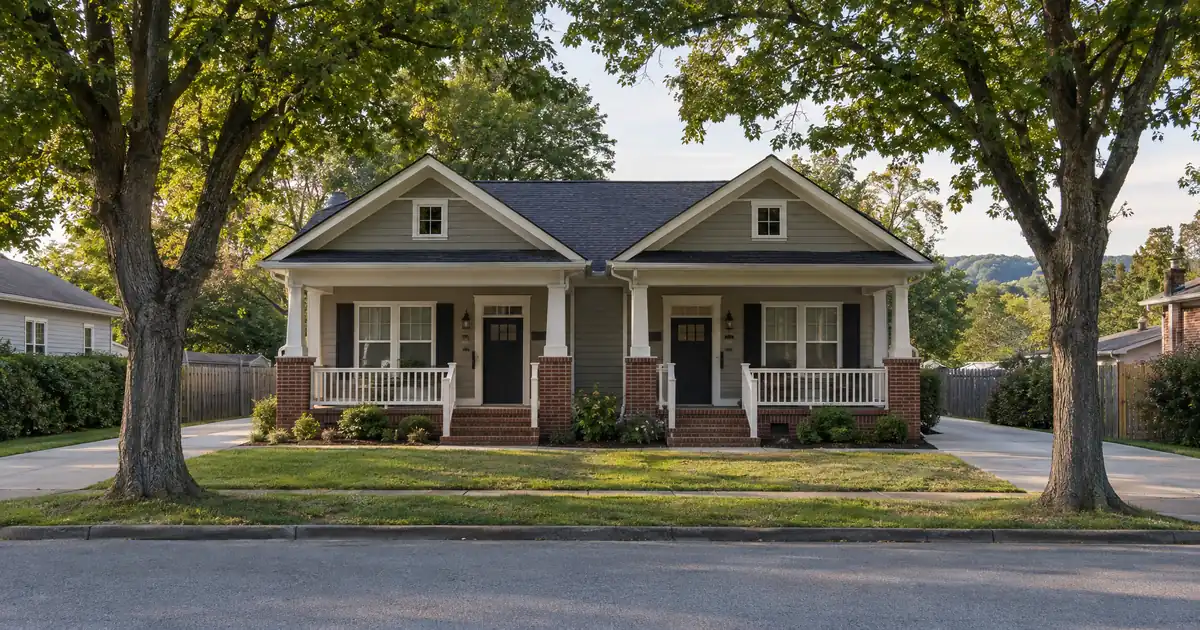
Can a city of 37,111 people produce enough rent to support a DSCR cash out refinance in Richmond, Kentucky? It depends on the property type. A duplex near Eastern Kentucky University can clear 1.0 on rent alone, with room to spare. A median-priced house usually can’t. The rest of this article explains why, and what it means for an investor who already owns and wants capital for the next deal.
DSCR Cash-Out Calculator
Run the cash-out numbers in Richmond, KY
Rate source: Freddie Mac 30-yr average via FRED® — Federal Reserve Bank of St. Louis · effective Sep 24, 2026
Prefilled with starting assumptions — enter your property’s value, balance, taxes, and insurance for a more accurate picture.
Program parameters update from Lendmire’s centralized guideline source. Taxes and insurance are editable estimates.
As of Sep 24, 2026 · General Freddie Mac market benchmark, not a Lendmire loan offer. Property value, balance, taxes, and insurance are editable estimates. Maximum loan-to-value varies by lender, program, property type, and seasoning. Not a Loan Estimate, approval, or commitment to lend. Program availability and eligibility are subject to lender guidelines, credit approval, property review, and underwriting.
Key Takeaways:
A DSCR cash out refinance in Richmond, Kentucky is underwritten primarily on the property’s rental income measured against its full monthly obligation. The file then moves through seasoning review, appraisal, reserves documentation and title, with the proceeds capped by a 75 percent loan-to-value ceiling.
- Richmond is 60 percent renter households, which favors duplex and small-multifamily holdings.
- EKU enrollment reached 15,969 students, the largest tenant base in town.
- Value sources conflict. Appraisal risk is the main friction point.
- Seasoning runs about 6 months from title recording.
- Median-priced houses model well below 1.0. Duplexes model above it.
Lendmire (NMLS# 2371349) works with investors buying or refinancing in Richmond, Kentucky, helping place DSCR financing across 41 markets, including Washington, D.C. This piece covers the refinance side only. The reader already owns the asset. The question is how much equity comes out and whether the rent supports it.
Richmond Market Snapshot
A quick read on the Richmond investor landscape — figures come from the cited sources below. Confirm current property-level numbers before underwriting.
| Metric | Detail |
|---|---|
| Home prices | 31 sales (Redfin housing market) |
| Recent appreciation | +1.8% (Zillow home values) |
| University enrollment | 15,673 students (fall 2024) (Wikipedia, EKU) |
| Employment | 245 jobs (WKYT (Feb 2025)) |
What the Rent Actually Supports
Rent in Richmond is modest, and the sources disagree on how modest. RentCafe puts average rent at $992, up 5.71 percent year over year, with one-bedrooms at $841, two-bedrooms at $1,065 and three-bedrooms at $1,150. Those are apartment averages. Apartments.com reports a lower $883 from an earlier reading. Pick the conservative figure for a lender file.
Two-bedroom units dominate. Point2Homes reports that 45 percent of 3,967 rentals are two-bedrooms, and it counts 8,844 renter-occupied units against 5,510 owner-occupied. A renter-majority housing stock is the base case for small multifamily.
The sale side is messier. Redfin shows a median sale price of $297K, up 17.9 percent year over year, but only 31 homes sold that month. Zillow lands at $297,439 with growth of just 1.8 percent. Data USA shows an owner-reported median value of $214,900. Same city, three stories.
Treat appreciation as uncertain. Redfin also shows days on market at 76, up from 47 a year earlier. That is not a hot market. It is not a cold one either.
The Modeled Math: Duplex vs. House
Run the numbers on two modeled scenarios. These are assumptions, not market data. Both use 75 percent LTV and full PITIA, meaning principal, interest, taxes and insurance, modeled at Kentucky average tax and insurance loads.
| Scenario | Value / Rent input | Modeled coverage |
|---|---|---|
| Duplex, two 2BR units | $235,000 / $1,600 gross | about 1.1x |
| Same duplex at RentCafe 2BR average | $235,000 / about $2,130 gross | about 1.5x |
| 3BR house at Redfin median | $297,000 / $1,150 | about 0.6x |
The $235,000 figure and the roughly $800-per-side rent come from a seller’s multifamily listing in 40475, where one owner was offering three duplexes together. One asking price, not a market statistic. On those inputs the gross yield is about 8.2 percent, and the coverage ratio clears 1.0 including taxes and insurance.
The house is the problem. Using the three-bedroom apartment average as a rent proxy against the median sale price gives a ratio near 0.6x. Houses may rent above apartment averages, but the gap would have to be large.
If a file lands below 1.00, the paths are narrow. A lender may review a sub-1.00 program, an interest-only structure or a lower loan amount. Each comes with different pricing and stronger compensating factors, and all of it is subject to lender guidelines, credit approval and property review. A 1.00 baseline is common because rent covers the payment at that level. Some programs look lower, at a cost.
For the broader mechanics, Lendmire’s primer on DSCR loans covers the formula, and a comparison of DSCR and conventional loans covers why entity-owned investors use this route.
Where the Tenants Come From
EKU is the demand engine. The university reported total enrollment of 15,969, making it Kentucky’s third-largest public university. The prior-year total was 15,673 per Wikipedia, so enrollment grew about 300 students. A growth trend matters more to a lender than a flat level. The university has also announced an in-state freshman scholarship and a tuition cut of more than 40 percent for out-of-state students. That is an announcement, not a rental forecast. Call it a tailwind.
Students are not the whole story, and lenders prefer it that way. Baptist Health Richmond is a 105-bed hospital drawing patients from six counties. A county data aggregator, KYData, lists 488 employees there. Data USA shows health care and social assistance as the top resident employment sector at 2,818 workers, with educational services at 2,731 and retail trade at 2,384. Employment grew 4.95 percent in the most recent year reported.
A rent roll that mixes campus-adjacent leases with hospital and retail workers reads better in review than a student-only roll. Lenders and appraisers may view a pure student roll more skeptically.
The Depot Is a Transition, Not a Cliff
Blue Grass Army Depot sits on about 14,000 acres and has been the county’s quiet federal employer for decades. The CDC says the chemical stockpile is fully destroyed and the pilot plant is being decommissioned. WKYT reported 245 layoffs at the weapons-destruction plant, with full closure on the calendar. Rep. Andy Barr’s office said the demilitarization mission employed nearly 1,450 workers and contributed more than $1 billion in local payroll over its life.
That is a real workforce winding down. KYData cites a $903 million appropriation for an energetics mission that could replace some of it. The honest read is two-sided. An underwriter will ask about the tenant base, and a stress test should assume some depot-linked tenants turn over. Don’t underwrite as if the workforce is permanent. Don’t assume it disappears either.
Submarkets: Qualitative Only
No reliable source gives neighborhood-level rent or price for Richmond. So the submarkets below are described by function, with no invented numbers.
Eastern Bypass and the US-25 and US-421 corridor. Retail, I-75 access and a steady supply of duplexes. Listing text describes duplexes just off the bypass near the main retail strip. One listing calls multifamily inventory limited. Fewer comps cuts both ways: scarcity supports rent, but a thin set of comparable sales can slow an appraisal.
Around EKU, the hospital and Richmond Centre. Duplexes here are marketed on proximity to campus, Baptist Health and the interstate. This is the strongest tenant-demand pocket. It is also where new purpose-built apartment communities compete for the same renters, so older stock competes on price. Underwrite rents conservatively.
Duncannon Lane area. Keys to Kentucky Realty lists a fully occupied duplex here with three-bedroom units and garages. Larger units mean higher rent per door, but they also mean a different tenant pool than the campus pockets.
Berea Road and Tower Drive. Properties between Richmond and Berea, minutes from I-75. Berea is a neighboring market with EV-related manufacturers, and KYData lists Hitachi Astemo at about 1,500 employees. Commuting is part of the demand story.
Select Richmond also names Madison Tool & Die, National Metal Processing and Precision Tube as local employers, without headcounts.
What Derails These Files
Appraisal comes first. With 31 sales in a month and three conflicting value figures, a Richmond appraisal can land below what the owner expects. Since the 75 percent cap applies to appraised value, a low appraisal cuts proceeds directly. The usual response is an appraisal reconsideration request with recent sales, condition adjustments and a lease schedule attached.
Working DSCR brokers see a recurring pattern in college-and-anchor towns like this one: the rent schedule in the appraisal and the actual leases don’t match. Student leases cluster around the academic calendar, one unit sits vacant between terms, and the coverage number gets calculated on whichever document the underwriter reads first. Files stay clean when the lease evidence, rent roll and appraisal rent schedule tell the same story before submission.
Seasoning comes second. A purchase must be about 6 months old, measured from title recording, and the settlement statement is the proof. Files that assume seasoning away get returned. Related: if the owner renovated after purchase, expect the lender to look at what was paid and what was spent. Clearing title and settlement reconciliation need to be tidy.
Third is reserves. Plan on about 6 months of PITIA in documented reserves, and more above $1,500,000 in loan size. Reserves documentation means statements, not a promise. If a cash-out is meant to fund the next purchase, remember that proceeds typically can’t be counted twice.
Fourth, entity paperwork. If the property sits in an LLC, operating agreement, EIN letter and certificate of good standing should match across title, insurance and the loan application, subject to lender program eligibility.
(Credit is the least dramatic item. Credit tiers on the network’s programs run 620, 660, 680 and 700 with a 620 floor, and pricing tends to improve higher up.) Program details move, so confirm current terms before building a plan around them.
How the Proceeds Get Used
The mechanics are simple. Take the appraised value, apply the 75 percent ceiling, subtract the existing balance and closing costs, and the remainder is the maximum equity available. It is a ceiling, not a promise: the rent coverage, reserves and appraisal all have to hold. Loan sizes run up to $3,000,000 on standard programs, though a Richmond duplex will sit nowhere near that. Smaller balances route through select lenders in the network.
Think it through before pulling the maximum. Say an investor owns a seasoned duplex near campus and pulls equity to buy a second small multifamily. Coverage on the first property drops as the loan grows. If the first duplex only modeled near 1.1x at 75 percent, a cash-out on a weaker property is a harder file. The better sequence is to refinance the property with the most rent cushion and use proceeds on a property that does not need the cash-out to work.
DSCR vs. conventional financing
There are two common ways to finance an investment property in Richmond, KY, and they qualify you differently — here’s how investors weigh them.
Why investors choose it
- Qualifies on the property’s rental income — no personal tax returns, W-2s, or pay stubs needed to document income.
- No personal debt-to-income ceiling to clear, so existing mortgages and obligations don’t cap your borrowing the same way.
- Can be closed in an LLC, keeping the property inside a business entity.
- Built for scaling — not held to the limit on number of financed properties that conventional financing applies.
- Underwriting centers on the deal: generally qualifies when the rent covers the payment, a 1.00x coverage ratio being a common baseline (confirmed in underwriting).
- Designed specifically for investment property, including long-term and, where the program allows, short-term rentals.
Where it’s strong
- Often the lowest ongoing financing cost for a buyer who fully qualifies on personal income — a fit for a first property or a cost-first purchase.
Trade-offs for investors
- Requires full personal income documentation and must fit within a debt-to-income limit — salary, existing debts, and other mortgages all count.
- Typically held in your personal name rather than a business entity.
- Caps how many financed properties you can carry, which can become a ceiling as a portfolio grows.
- Evaluates you as a borrower as much as the property, which usually means more paperwork.
How investors usually choose: a first or single property often optimizes for the lowest financing cost; portfolio builders often optimize for leverage, vesting in an LLC, and scaling past conventional caps. The right answer depends on your goals, the property, and current guidelines — both paths run through select lenders in Lendmire’s wholesale network, with eligibility and terms confirmed in underwriting.
The tradeoff between leaving equity in place and extracting it is genuinely close in a market where appreciation figures range from under 2 percent to nearly 18 percent depending on the source. Underwriting should assume the lower figure. The refinance should pay for itself without any appreciation.
For the general process, see Lendmire’s DSCR cash-out refinance and the page on refinancing options. Kentucky-specific program context lives on the Kentucky DSCR financing page. Investors who want to see how a specific Richmond file might structure can compare DSCR options or call 828-256-2183.
Frequently Asked Questions
How do you qualify for a DSCR cash out refinance in Richmond, Kentucky?
Qualification centers on the property’s rent against its full PITIA, with a 1.00 minimum DSCR as the standard benchmark. Beyond that, lenders look at about 6 months of seasoning, credit in the 620 to 700 tier range, documented reserves of about 6 months PITIA and a loan-to-value at or below 75 percent. Eligibility is subject to lender guidelines, credit approval and property review.
What are the requirements for an investment property loan in Richmond, Kentucky?
Expect an appraisal with a rent schedule, current leases, proof of insurance, title work and entity documents if the property is in an LLC. Manufactured homes, log homes and barndominiums fall outside these DSCR programs. Richmond duplexes, small multifamily and three-bedroom houses are the common fits, subject to program terms.
Does EKU enrollment actually help a lender approve a cash-out refinance?
It helps the rent-durability argument, not the approval itself. EKU grew from 15,673 to 15,969 students in a year, which supports rent comps near campus. The lender still reviews the property’s qualifying rent against its obligations, and a student-only rent roll may get a closer look than a mixed one.
How does the Blue Grass Army Depot affect a Richmond DSCR file?
Directly, it doesn’t. The lender reviews the property’s rental income, not the employer. Indirectly, an underwriter may ask about tenant concentration if leases tie to depot workers, since the demilitarization workforce is winding down. A conservative rent assumption is the practical answer.
Can Lendmire help arrange DSCR financing for investment properties in Richmond?
Yes. A key program feature is that the property’s rental income is the primary qualifying basis, subject to lender guidelines.
Where the Gap Is
The asymmetry in Richmond sits in small multifamily near EKU and the Eastern Bypass. Listing prices for duplexes run well below the Redfin median of $297K, while rent per door tracks the same apartment averages that house rents are measured against. A $235,000 duplex yields roughly 8.2 percent gross on seller-quoted rents that sit under the two-bedroom average. Houses are priced for the Lexington commuter. Duplexes are still priced for the landlord, and with only 13 multifamily listings in the city on the day of the search, inventory is thin enough that existing owners hold something scarce.
About Lendmire
Lendmire, NMLS# 2371349, is a mortgage brokerage specializing in DSCR investor loans. It helps arrange financing across 41 markets, including Washington, D.C., through wholesale and investor-lending channels. The model centers on property-level rental income reviewed by the lender rather than W-2 documentation, subject to lender guidelines, which suits entity-owned and multi-property investors. Lendmire has been recognized by Scotsman Guide as a 2026 Top Workplace and as a 2025 Scotsman Guide Top Workplace.
Get Started
Ready to find the right loan for you?
In about 30 seconds you can review financing options available for your investment property. No commitment required.
Informational only. Not a Loan Estimate, approval, or commitment to lend. Program availability and eligibility are subject to lender guidelines, credit approval, property review, and underwriting.
References
1. Census Reporter — Richmond KY
2. RentCafe, Richmond rent trends
3. Eastern Kentucky University news
4. Redfin, Richmond housing market
5. Zillow
6. Wikipedia — Eastern Kentucky University
9. Point2Homes
11. Homes.com — Richmond KY Multi Family Homes for Sale
13. KYData
14. wkyt.com — All Kinds Bombs Bullets Officials Discuss Future Blue Grass Army Depot
15. CDC, Blue Grass closure status
18. Select Richmond
19. recognized by Scotsman Guide as a 2026 Top Workplace
20. a 2025 Scotsman Guide Top Workplace
This article is part of Lendmire’s investment property cash-out refinance program — full qualification details, guidelines, and scenarios live on the program page.
Related reading: Luxury Rental DSCR Loans In New Jersey · Jersey Shore Vacation Rental Loans: DSCR Financing In Ocean City, Cape May And Long Beach Island · DSCR Cash-out Refinance In New Jersey: Pulling Equity From A Rental
Guides: Investment Property Cash-Out Refinance in Kentucky
Brandon Miller
Founder & CEO, Mortgage Loan Originator, Lendmire LLC
- Mortgage Loan Originator · NMLS# 1129696 · Verify on NMLS Consumer Access
- North Carolina Real Estate Broker · License# 343312 · Verify on NCREC
- North Carolina Insurance Producer · License# 19053198 · Property, Casualty, Life, Health · Verify on NAIC SBS
- Lendmire LLC · Firm NMLS# 2371349 · Verify firm licensure
Legal disclosures. Lendmire (NMLS# 2371349) is a state-licensed mortgage brokerage that arranges financing through wholesale lender relationships. Lendmire is not a direct lender, depository institution, or registered financial advisor. The discussion above is general informational content about real estate financing — it is not financial, legal, or tax advice, and readers should consult licensed professionals for guidance on their individual circumstances. Loan inquiries are subject to lender underwriting; this article does not represent a commitment to lend. Loan terms, rates, and qualification standards vary by borrower, property, and state, and are subject to change at any time. Equal Housing Opportunity. NMLS Consumer Access: nmlsconsumeraccess.org.