
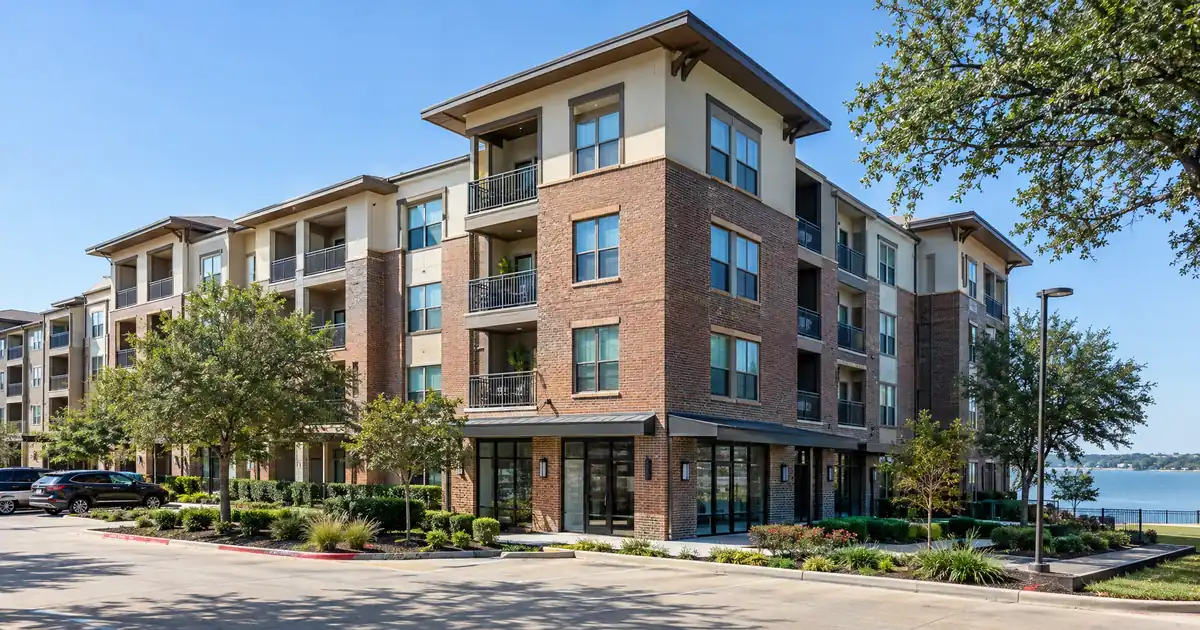
The cash-out files that stall in Rowlett tend to stall in the same three places. The appraisal comes in below the number the owner had in mind, the seasoning clock is measured from the wrong date, or the rent doesn’t cover a full payment that includes Texas taxes and insurance. A DSCR cash out refinance in Rowlett, Texas, can work, but only when the equity math is built on today’s comps rather than yesterday’s purchase price.
DSCR Cash-Out Calculator
Run the cash-out numbers in Rowlett, TX
Rate source: Freddie Mac 30-yr average via FRED® — Federal Reserve Bank of St. Louis · effective Oct 1, 2026
Prefilled with starting assumptions — enter your property’s value, balance, taxes, and insurance for a more accurate picture.
Program parameters update from Lendmire’s centralized guideline source. Taxes and insurance are editable estimates.
As of Oct 1, 2026 · General Freddie Mac market benchmark, not a Lendmire loan offer. Property value, balance, taxes, and insurance are editable estimates. Maximum loan-to-value varies by lender, program, property type, and seasoning. Not a Loan Estimate, approval, or commitment to lend. Program availability and eligibility are subject to lender guidelines, credit approval, property review, and underwriting.
Key Takeaways:
A DSCR cash-out refinance in Rowlett, Texas is underwritten primarily on the property’s rental income measured against its full monthly obligation, so the file turns on three things: a lease or market rent that supports coverage, an appraisal that holds up on today’s comps, and enough equity left under the 75 percent LTV ceiling after seasoning is met.
- Redfin puts the median sale price at $382K, down 3.6 percent year over year.
- Homes sit 63 days on market versus 47 a year earlier, so appraisers see more concessions.
- Highland Meadows and Waterview carry the highest rents and the thinnest coverage.
- Mid-priced three- and four-bedroom single-family homes fit the rental base best.
Why Rowlett Is an Equity Story, Not an Appreciation Story
Rowlett’s appreciation case has weakened, which makes cash-out here an exercise in conservative underwriting. Redfin shows a median sale price of $382K for the three months ending in May, down 3.6 percent, with price per square foot at $172, down 7.0 percent (Redfin). Zillow shows a similar direction, with an average home value of $370,262, down 3.0 percent (Zillow).
Supply is building too. A local brokerage summary of NTREIS data reports 5.6 months of supply, active listings up 12.4 percent, and sellers still getting 96.3 percent of original list price (The Dunnican Team). Prop-Metrics, citing Realtor.com data, says 52 percent of listings carried a price cut (Prop-Metrics).
So a refinance can’t bank on paper gains. An owner who bought near the top and expects the appraisal to reflect it will probably be disappointed. The cleaner approach is to size the cash-out off the lower of the appraised value and a realistic comp set, then work backward to proceeds.
The deepest comp pool sits between $300K and $399K, which accounted for 43.8 percent of May closings (The Dunnican Team). Properties inside that band are easiest to support. Above it, valuation risk rises.
What the Lender Actually Reviews
The program mechanics are plain. Under the parameters Lendmire works with, cash-out is capped at 75 percent LTV, with ownership seasoned about six months from title recording. Minimum coverage is typically 1.00 on rent used for lender review versus the full payment, and reserves generally run about six months of PITIA. Credit tiers start at a 620 floor, and loan size can reach $3,000,000 on standard programs. All of this is subject to lender guidelines, credit approval, and property review. Equity available is not a guaranteed figure; it depends on the appraisal, the rent, and the reserves.
Seasoning is the most common paperwork snag. The clock runs from the recorded title date, not the contract date or the closing-table date. A recorded deed that lands a few weeks late can push an otherwise clean file back.
Two other items cause friction. The first is lease documentation versus market rent. A signed lease that sits below market can drag the coverage number, so the file needs a clear rent basis. The second is the insurance and tax line, which flows straight into PITIA and often moves between the original purchase and the refinance. Investors should verify current local rules, taxes, and insurance with qualified local professionals. For the underlying ratio mechanics, see the guide “What Is a DSCR Loan”.
Running the Numbers (Modeled, Not Quoted)
The coverage math here is thin, and anyone telling an owner otherwise is skipping the taxes line.
Say you own a Highland Meadows rental that appraises near the neighborhood’s $417,000 single-family median (Homes.com) and rents near Redfin’s $2,595 neighborhood median (Redfin). Those are modeled inputs, not a specific listing. That implies a rent-to-value ratio of roughly 0.62 percent monthly.
Run a cash-out at the full 75 percent LTV on a 30-year amortization, with property tax near 1.68 percent and insurance near 0.50 percent of price annually (Texas averages). Coverage lands in the low 0.9s, including taxes and insurance. Drop leverage to roughly 65 percent and the number moves to right around 1.00.
The citywide picture is similar. Rentcast’s three-bedroom rent of $2,360 against a roughly $382K median price implies about 0.62 percent as well (Prop-Metrics). Same conclusion: full leverage doesn’t clear at a standard 1.00 benchmark.
That’s the catch. When a scenario falls below 1.00 on full-payment coverage, the paths a lender may review include lower leverage, an interest-only structure, or a sub-1.00 program that typically asks for stronger compensating factors, more reserves, or different pricing. Whether any of those apply depends on the lender, the credit profile, and the property.
Honestly, the cleaner play for most owners is to take less cash. Pulling 60 to 65 percent of value and keeping the file clean beats pushing to the cap and negotiating exceptions.
DSCR files in markets like this one typically look the same. Equity exists on paper, rent is solid but not generous relative to price, and the deciding variable is the appraisal. The files that move smoothly come in with a market-rent opinion already in hand, a seasoning date confirmed against the recorded deed, and a reserve account documented before anyone asks. The files that bog down usually have a rent figure the borrower assumed rather than documented.
Submarkets: Where the Equity Pencils
| Submarket | Rent signal | Coverage read |
|---|---|---|
| Waterview | $2,892 median | Highest rent, highest basis |
| Highland Meadows | $2,595 median | Thin at full leverage |
| Princeton | $2,450 median | Better rent-to-value |
| Northlake / Valley Creek | $1,997 / $1,975 | Lower basis, workforce fit |
Rents above are Redfin neighborhood medians and mix unit types, so treat them as directional.
Waterview sits on the east side and carries the city’s highest median rent (Redfin). Premium rent comes with a premium basis, which keeps coverage tight on a cash-out. No reliable sale-price source turned up for this submarket, so the rent-to-value ratio is unconfirmed. Appraisal support is the thing to watch here.
Highland Meadows and Springfield are established single-family areas, with median prices of $417,000 and $400,000 respectively (Homes.com). They are stable, but the math above shows why they favor moderate leverage.
Princeton, Northlake, and Valley Creek are the mid-priced north and central pockets, with Redfin medians of $2,450, $1,997, and $1,975. No sale-price source was found for them, so the ratio can’t be computed precisely. The lower rents suggest lower bases, and these are likely the closest fit for workforce single-family cash-out files. That’s a read, not a measured fact.
Bayside, Sapphire Bay, and Dalrock form the lakefront corridor on the western shore. Dalrock’s median rent is $2,130 (Redfin). The competing supply here is apartments. Redfin listings show concessions ranging from six to ten weeks free at newer communities (Redfin), which caps rent growth for smaller units. Sapphire Bay is described as a $1B-plus mixed-use project on Lake Ray Hubbard, but delivery has been uneven (Business View Magazine). Underwrite current rents, not promised amenities.
Downtown and the DART Blue Line terminus draw car-light commuters to Dallas. No price or rent figure turned up specific to Downtown. Treat it as a demand story, not a measured one.
Property Type: Single-Family Is the Product
Single-family detached homes make up 84.29 percent of Rowlett’s housing units (NeighborhoodScout), and about 24 percent of households rent (RentCafe). Point2Homes shows three-bedrooms as the largest share of rentals at 35 percent (Point2Homes), which matches Rentcast’s three- and four-bedroom rents of $2,360 and $2,840.
Multi-unit is a different story. No sourced inventory or rent data for duplexes, triplexes, or fourplexes turned up, so stacking units is not a proven Rowlett strategy. Anyone pursuing a duplex or ADU angle should verify it with local brokers first.
Rent direction matters too. Prop-Metrics shows average rent down 8.9 percent year over year, and RentHop and Redfin point the same way. Flat-to-softening rent plus flat-to-softening price means the proceeds should be sized on a haircut, not on a hoped-for rebound.
Demand Anchors: Real but Modest
Rowlett is largely a bedroom community. The 2024 Business Census count shows 1,032 establishments employing about 12,010 people (ZIP-Codes.com). Residents work mostly in manufacturing (4,096), health care and social assistance (3,993), and retail trade (3,913) (Data USA), with a 31.2-minute average commute. Average household income is $115,189.
Baylor Scott & White Medical Center – Lake Pointe is a 148-bed acute care hospital with more than 500 physicians on staff, and the city targets healthcare and light industrial growth (City of Rowlett). The only employer table found is an older city list, so it’s directional at best, but it shows a mix of schools, healthcare, retail, and city government. That is stable, not explosive.
This is not a student-rental market. There is no four-year campus, and workforce partners like Dallas College are not a rental demand engine.
DSCR vs. conventional financing
There are two common ways to finance an investment property in Rowlett, TX, and they qualify you differently — here’s how investors weigh them.
Why investors choose it
- Qualifies on the property’s rental income — no personal tax returns, W-2s, or pay stubs needed to document income.
- No personal debt-to-income ceiling to clear, so existing mortgages and obligations don’t cap your borrowing the same way.
- Can be closed in an LLC, keeping the property inside a business entity.
- Built for scaling — not held to the limit on number of financed properties that conventional financing applies.
- Underwriting centers on the deal: generally qualifies when the rent covers the payment, a 1.00x coverage ratio being a common baseline (confirmed in underwriting).
- Designed specifically for investment property, including long-term and, where the program allows, short-term rentals.
Where it’s strong
- Often the lowest ongoing financing cost for a buyer who fully qualifies on personal income — a fit for a first property or a cost-first purchase.
Trade-offs for investors
- Requires full personal income documentation and must fit within a debt-to-income limit — salary, existing debts, and other mortgages all count.
- Typically held in your personal name rather than a business entity.
- Caps how many financed properties you can carry, which can become a ceiling as a portfolio grows.
- Evaluates you as a borrower as much as the property, which usually means more paperwork.
How investors usually choose: a first or single property often optimizes for the lowest financing cost; portfolio builders often optimize for leverage, vesting in an LLC, and scaling past conventional caps. The right answer depends on your goals, the property, and current guidelines — both paths run through select lenders in Lendmire’s wholesale network, with eligibility and terms confirmed in underwriting.
Where Does the Cash Go?
A cash-out on a Rowlett rental is only worth doing if the proceeds earn more than they cost. With softening comps, buying the next property at a discount to its prior list is more realistic than betting on appreciation. Proceeds can also reduce a higher-cost balance elsewhere in the portfolio. For LLC-titled holdings, financing is available subject to lender program eligibility. For the broader refinance picture, see the refinance side and Lendmire’s DSCR cash-out refinance. For a side-by-side with bank financing, the guide “Where DSCR and Conventional Diverge” lays it out.
Frequently Asked Questions
How do you qualify for a DSCR loan in Rowlett, Texas?
Qualification centers on the property’s rent relative to its full monthly obligation, with 1.00 a common benchmark. Lenders also review credit (a 620 floor with higher tiers), reserves of about six months PITIA, and the appraisal. For a refinance, ownership seasoning of about six months applies. Final eligibility is subject to lender guidelines and property review.
What are the requirements for an investment property loan in Rowlett, Texas?
Expect a single-family or small residential rental, a market-rent opinion or lease, an appraisal, proof of reserves, and entity documents if the property sits in an LLC. Manufactured homes, log homes, and barndominiums fall outside these DSCR programs. Because Rowlett’s stock is 84 percent single-family, most files are standard SFR deals.
Will Rowlett’s softer prices hurt a cash-out refinance?
Yes, if the owner expects prior appreciation to show up. With the median down 3.6 percent year over year and homes taking 63 days to sell, appraisals can come in conservative. Underwriting off current comps, and keeping the property inside the $300K to $399K band where comps run deepest, tends to produce more reliable proceeds.
Which Rowlett areas leave the most room for coverage?
Likely the mid-priced Princeton, Northlake, and Valley Creek pockets, where median rents of $2,450, $1,997, and $1,975 sit against lower assumed bases. Waterview and Highland Meadows carry higher rents but also higher prices, which compresses coverage at full leverage. Sale-price data for the mid-priced areas is thin, so treat this as a directional read.
Where the Mispricing Sits
The asymmetric opportunity is in the mid-priced single-family pockets (Princeton, Northlake, and Valley Creek, plus the lower-rent Garland-edge areas that Redfin groups with Rowlett). Three- and four-bedroom homes match the largest share of local rentals, and their lower bases leave room to pull equity without fighting the coverage ratio. Waterview and Highland Meadows get the attention, but the cleaner risk-adjusted equity sits where rent-to-value runs strongest, and for Texas investors the broader range of DSCR loan options applies there as well. In a lakeside suburb where the premium neighborhoods are priced for a rebound the comps aren’t showing, the workforce streets are the ones still priced for their rent.
For current guidelines and terms, see Lendmire’s DSCR loan programs page.
About Lendmire
Lendmire, NMLS# 2371349, is a DSCR and non-QM mortgage brokerage with investor loan programs in 41 markets, including Washington, D.C. DSCR eligibility is commonly reviewed by the lender on property-level rent rather than personal income documentation, subject to lender guidelines, and the brokerage helps arrange financing for LLC-owned portfolios beyond conventional financed-property limits. Recognized by Scotsman Guide as a 2025 Scotsman Guide Top Workplace and a 2026 Scotsman Guide Top Workplace.
For broader investor-financing rules and property-type coverage across the state, see Texas DSCR loans.
Get Started
Ready to find the right loan for you?
In about 30 seconds you can review financing options available for your investment property. No commitment required.
Informational only. Not a Loan Estimate, approval, or commitment to lend. Program availability and eligibility are subject to lender guidelines, credit approval, property review, and underwriting.
References
1. Redfin — Rowlett Housing Market
2. Zillow
4. Prop-Metrics
5. Homes.com
6. Redfin
7. Redfin
10. RentCafe
11. Point2Homes
12. ZIP-Codes.com
13. Data USA
14. Baylor Scott & White Medical Center – Lake Pointe
15. City of Rowlett
16. a 2025 Scotsman Guide Top Workplace
17. a 2026 Scotsman Guide Top Workplace
This article is part of Lendmire’s investment property cash-out refinance program — full qualification details, guidelines, and scenarios live on the program page.
Related reading: Cash Out Refinance Investment Property Rowlett Texas · Cash Out Refinance Investment Property in Marshall, Texas: A 2026 DSCR Guide to Downtown Marshall · Cash Out Refinance Investment Property in Benbrook, Texas: The 2026 DSCR Guide to Benbrook Lake
Guides: Investment Property Cash-Out Refinance in Rowlett, TX · Investment Property Cash-Out Refinance in Texas
Brandon Miller
Founder & CEO, Mortgage Loan Originator, Lendmire LLC
- Mortgage Loan Originator · NMLS# 1129696 · Verify on NMLS Consumer Access
- North Carolina Real Estate Broker · License# 343312 · Verify on NCREC
- North Carolina Insurance Producer · License# 19053198 · Property, Casualty, Life, Health · Verify on NAIC SBS
- Lendmire LLC · Firm NMLS# 2371349 · Verify firm licensure
Disclosure information. Lendmire is a state-licensed mortgage brokerage under NMLS# 2371349. Lendmire is not a depository institution, direct lender, or financial advisor — all loans referenced are placed through wholesale lender partners and are subject to each lender's underwriting standards. This article is provided for general informational purposes and is not a commitment to lend, nor does it constitute financial, legal, or tax advice. Loan programs, terms, rates, and qualification standards change without notice and depend on borrower profile, property type, and the state in which the subject property is located. Equal Housing Opportunity provider. NMLS Consumer Access: nmlsconsumeraccess.org.